Author: Neville

  • Could High Speed Rail Between Sydney and Canberra become a reality

    The announcement by prime minister Kevin Rudd and minister for transport Anthony Albanese on high-speed rail suggests both men at least want to maintain the momentum of the debate on the project. Firstly, Mr Albanese released and praised an advisory report suggesting the viability of such a project…

    9j2fmf7q-1377505165
    High speed rail is back on the agenda, at least for the election. AAP

    The announcement by prime minister Kevin Rudd and minister for transport Anthony Albanese on high-speed rail suggests both men at least want to maintain the momentum of the debate on the project.

    Firstly, Mr Albanese released and praised an advisory report suggesting the viability of such a project.

    Mr Rudd then committed to set up a high-speed rail authority as well as $52 million worth of spending on a business case and market testing of station locations and cost estimates (and possibly some land acquisitions) for the proposed Brisbane-Sydney-Canberra-Melbourne line.

    In my last piece for The Conversation in May, I concluded that “high-speed rail in Australia would be very exciting indeed to have, but unless the government is prepared to make a strategic rather than a cost benefit decision on this project I don’t see any high-speed rail coming to Australia in the near future”.

    Since then the fundamentals have not changed, other than Australia being very close to an election. The timing of the both announcements is not typical of the approach usually given to such strategic long-term decisions, particularly since the potential incoming government has not declared its support for such a project.

    In terms of the fundamentals, let’s start with the positives. It would certainly make a lot of sense to break the proposed Brisbane-Melbourne link (worth $114 billion) into smaller pieces and Canberra to Sydney appears to be the most feasible first option.

    Rail versus flight

    According to the advisory report, this first leg could be up and running within 17 years and would cost some $23 billion. The report also suggests fares (single) on such a high speed rail service of around $42 to $69 in order to be competitive to air services.

    While airlines (particularly low cost carriers such as Jetstar and Tigerair) will most probably be able to offer such a trip for less money, a key benefit of the high speed train option would be convenience. The high speed trains would connect city centre with city centre, with less hassle (security, luggage) compared to airports. Passengers would be able to work on the trains, which is particularly important to high-yielding business travellers.

    The 300 kilometre distance would be ideal as the international experience shows that for trips of up to 400km, the total trip time (door-to-door) of high-speed rail is similar to that of aviation, assuming that both ends of the route are in the city centres of the cities in question.

    Again from international experience we know that integrating high speed rail with airports drives demand and it is likely that there is large potential for travellers originating from Canberra’s CBD who would take a high-speed train to Sydney airport to connect with a long haul international flight.

    The management of Canberra airport argues the same, just with opposite traffic flows (Sydney CBD to Canberra airport), which shows the importance of the terminal location in terms of CBD and airport connectivity and the need to conduct further research (at the Institute of Transport and Logistics Studies (ITLS) we are currently looking into such topics for the European context).

    Again, breaking the project into smaller pieces helps to understand the details and complexities involved and is further useful to build momentum and public support. Whether the route will ever go beyond Sydney-Canberra is another matter.

    Cautious analysis

    This brings us to the points that require cautious analysis. The advisory report claims the project can be delivered for much less than what was indicated in the Phase 2 HSR Report released in April. Yet it still talks about exactly the same amount – $23 billion – for the Canberra-Sydney leg.

    While I agree that this figure might be reduced a little by international tendering of the rail construction project, evidence from past projects shows that in almost all high-speed rail cases, the initial cost estimates had to be revised once the actual construction had started. Large cost increases could result primarily as a result of the problem of accessing Sydney’s CBD, apparently involving a 67km tunnel (and about 144km of tunnelling required for the entire 1748km route).

    A really, really fast train

    Such tunnelling is not only complex but also expensive. On top of those costs it will then also be interesting to see if the passenger forecasts will indeed materialise. Again, to make the high speed train competitive to aviation, it will have to be a very fast train.

    The predicted speed of 350 km/h would be nice to achieve (in order to make the trip in 64 minutes) and may be possible in the future. Today however, most high speed trains have a top speed of 320 km/h and to achieve short travel times they hardly stop along the route.

    For example, the Frecciarossa high speed trains in Italy connects the cities in the north (Turin – Milan – Bologna) with the south (Rome – Naples – Salerno) with a mostly non-stop service – and reaching hardly more than 300 km/h. (I tested these train services in July this year.)

    The comfort in those trains is comparable to air services, with pricing depending on the cabin class. While some of the trains stop in smaller cities, the system works because of the “super frequency” of over 72 daily connections on that corridor.

    As those frequencies are not likely in the Sydney CBD to Canberra CBD (with potential airport stops) context, the route would be an ideal candidate for a large number of non-stop services. It is questionable whether there would be sufficient demand to justify more than one stop, (The current proposal aims for one stop at Southern Highlands.) along the route for most trains, assuming the aim is to relieve the aviation system. If the aim is to connect regional centres (as in the extended proposal where there would be a lot of stops between Sydney and Melbourne and even more between Sydney and Brisbane), then the proposed number of stops along the route might be feasible but is unlikely to contribute much to relieving the aviation system.

    Finding the balance between the two objectives by choosing how many non-stop trains to operate will be a key challenge (currently proposed are five non-stop and five regional trains per hour during peak hours).

    Other legs doubtful

    Despite the many open questions, today’s largely political events (the two announcements) may indeed lead to some more substantive investments on the Sydney-Canberra route, but it is to some degree doubtful whether such a rail link (should it ever materialise) will ever go beyond those two cities.

    Again, by focusing on the Sydney-Canberra leg (shown by ITLS research as far back as 1996 and detailed in the 1997 SPEEDRAIL report for the Sydney-Canberra Corridor), the project becomes more manageable and should the economics of that route not work, one would still be able to stop its extensions to Melbourne and Brisbane.

    Should the first leg become viable, there would then be a much stronger case for the minimum of $91 billion required to complete the Brisbane-Melbourne corridor.

    It is in any case, with the future of a second Sydney airport uncertain, a worthwhile idea to preserve the necessary corridors. Whether this will help make the project economically viable is an entirely different question.

    Articles also by This Author

  • Climate change looms as challenge for all parties

    Climate change looms as challenge for all parties

    Updated 8 hours 29 minutes ago

    Three years ago then-prime minister Julia Gillard promised there would not be a carbon tax under a government she led.

    After the 2010 federal election resulted in a hung Parliament, Ms Gillard signed an agreement with the Greens to introduce a price on carbon from 2015, with a transitional period of a fixed carbon tax.

    Backtracking on her campaign promise fatally undermined Ms Gillard’s leadership and the standing of her government.

    Trust is the currency of politics and once spent can never be recovered.

    From the day Julia Gillard signed the agreement to introduce a carbon price, her truth dollar was spent and the word “liar” became a daily refrain.

    Anger over the carbon tax/price was white hot before its introduction but has subsided since. The failure of the dire predictions made on the tax’s impacts to come true eventually made it less central to political debate.

    Yet the tax was still live enough as an issue to see Kevin Rudd alter the scheme as one of his first actions on returning to the prime ministership.

    By proposing to bring forward the market price mechanism to 2014, the Rudd government has tried to address the cost of living issues associated with the carbon tax. It has also tried to return the issue to again being about climate change, rather than tax and the economy.

    The change of wording from tax to price has not removed the political divisions created by the issue, as revealed by the results of questions on the issue in Vote Compass.

    Vote Compass put the proposition to respondents that “the federal government should put a price on carbon” and asked them to agree or disagree.

    Of the more than 800,000 respondents so far, about 400,000 answered this question as well as providing the demographic data that allows the sample to be weighted against the 2011 Australian Census.

    Overall the survey revealed the electorate leaning toward supporting a carbon price, as shown below.

    Had the originally intended question about repealing the carbon tax been retained, there may have been more polarised views. Yet even the milder question on a carbon price created clear divisions in the response on party lines, as shown in the graph below.

    Overall Coalition intended voters oppose the price mechanism 57 per cent to 24 per cent.

    Labor voters support a price on carbon, with 71 per cent agreeing with the proposition and 12 per cent disagreeing, while Green intended voters agreed 77 per cent to only 9 per cent opposed.

    The slight overall support for a carbon price was created by Coalition supporters being a little more likely to agree with a carbon price than Labor and Green supporters were likely to be in disagreement.

    A second related question asked in Vote Compass, “How much should the federal government do to tackle climate change?”, produced a very different response as shown in the graph below.

    Why this question receives a different response becomes clear when you examine answers by intended party vote, as shown in the graph below.

    Labor and Green supporters are strongly of the view that the federal government should do more about climate change. Green supporters opted for more action 88 per cent to only 5 per cent opting for less. Among Labor supporters the difference was 75 per cent to 8 per cent.

    Coalition intended voters were more evenly split, 30 per cent opting for less action, 26 per cent for about the same and 42 per cent opting for more action.

    In the very first Vote Compass report we highlighted the enormous difference between Green and Coalition voters on whether they thought climate change was the most important issue. Twenty five per cent of Greens voters nominated climate change but only 2 per cent of Coalition voters made the same choice.

    What the question on tackling climate change shows is that while Coalition voters don’t rate it the most important issue, they rate it an issue the government should do something about.

    Coalition voters are strong in opposition to a carbon price/tax, but then state they want something done about climate change.

    In the early days of the ‘Juliar’ campaign against the carbon tax, there was a two-pronged feel to the attack on the government.

    One was an attack on the truthfulness of the prime minister, which in the end was the most devastating part of the anti-carbon tax campaign.

    The second prong of the attack was from those who argued there is no global warming and climate change policy is unnecessary.

    The answer to the Vote Compass question on climate change reveals why the Coalition has stuck to having a policy on the issue and has not moved to a climate change sceptic position.

    While public concern over climate change has subsided since the drought years towards the end of the Howard government, clearly there remains a sentiment that something should be done about climate change.

    As the difference between answers on the two questions reveals, the public wants something done about climate change, but they don’t all like the solution the Gillard/Rudd  government came up with.

    Squaring the circle between ‘doing something’ about climate change policy and specific action may be just as complicated for any incoming Abbott government.

    Topics: federal-elections, climate-change, federal-government, australia

    First posted 11 hours 19 minutes ago

  • Is high speed rail value for economy

    Firstly corridors need to be found. transitting these through an already overtaxed metrop and central coast system and then up the north coast, subject to severe flooding and coastal erosion will be some of problems to be solved. Tinnelling is a very expensive process. We certainly need to ask if this concept is worth all the expense involved. Should we open a new airport and utilise air-buses to provide fast intercapital travel ?  There will be intense debate on this issue.


    There is no doubt that the creation of a 1748-kilometre high-speed rail network connecting Brisbane, Sydney, Canberra, and Melbourne is an exciting endeavour. But given the large capital costs – $114 billion – and impact on surrounding communities, as well as its potential positive impact on the economy…

    S7sm5yhh-1365663852
    The European experience with high speed rail suggests there are trade-offs with aviation depending on the routes.

    There is no doubt that the creation of a 1748-kilometre high-speed rail network connecting Brisbane, Sydney, Canberra, and Melbourne is an exciting endeavour. But given the large capital costs – $114 billion – and impact on surrounding communities, as well as its potential positive impact on the economy, a national debate is urgently required.

    The report on high-speed rail, launched by Transport Minister Anthony Albanese yesterday, hints at possible flow-on effects for the economy, suggesting that there will be an estimated $2.30 of benefits for each $1 spent.

    The proposition of getting from the city centres of Sydney to Melbourne in less than three hours is likely to be an interesting one to business and leisure travellers. Given that the Sydney – Melbourne route is currently the fifth busiest route in the world with Sydney-Brisbane not far behind, there is certainly a lot of demand for travelling fast along the large centres of Australia’s east coast. But the process of implementing a high-speed rail network in Australia is no easy feat.

    I am originally from Germany, where high-speed train connections between large cities are the norm. This is true for most West European cities, as is for China, Taiwan, Japan and Russia. But even German taxpayers — who are traditionally fascinated by high-tech engineering — often question the high cost involved with high speed rail and see conventional trains as better value for money. Given the distances involved (the proposed route is 1748 kilometres long), conventional trains are clearly not an option for Australia. Aviation might offer better value for money.

    The proposed high speed rail route is interesting and, despite its complexities, I am sure it will be implemented eventually. That day might be quite some time in the future, so rail enthusiasts may have to curb their enthusiasm. The required tunnelling of some 144 kilometres around Sydney, as well as the rest of the fairly long route, will be subject to a lengthy consultation process with affected local communities.

    Given the logistical challenges involved, the construction phase will be similarly lengthy. In fact, the first leg of the route (connecting Sydney and Canberra) is not to be expected to be in operation before 2035 — and that is if a government decision on this project would be made in the immediate future.

    But Australian airlines should not be too afraid of losing some of their most important domestic routes. In the long run, the proposed high speed rail connection might be of some benefit to aviation. Given the amount of air travel between these cities with Sydney at the centre, high speed trains could actually help Sydney airport with their predicted capacity problem.

    In Germany, the latest piece of high speed rail infrastructure built there was finished in 2002 at a cost of some 6 billion Euros. As a result of that high speed rail link, Lufthansa no longer flies the 150-kilometre route from Frankfurt to Cologne, but instead code-shares with the train operator and reserves an entire car on thirteen 300km/h high-speed trains a day. The experience in Europe has shown that airlines can use high speed rail to feed their hubs.

    There are several assumptions in the report that need to be addressed. They assume that the train will run at 350km/h. The fastest trains in Europe run currently 320km/h and that is the maximum speed, rather than the average speed.

    In order to be compatible with aviation, I believe that there need to be direct non stop connections between the city centres of Sydney, Melbourne, Brisbane and Canberra. That means the very fast trains would not stop anywhere else, which surely will create some opposition amongst communities that currently hope to benefit from a potential train connection in return for having a high speed rail in their backyard.

    Finally, the report claims that the train operators would charge similar fares to the airlines that are currently operating the routes in question. By doing so, it is argued that the train operator would not require any subsidies. First of all, it is questionable whether the assumed 84 million train passengers will materialise.

    When I mentioned SYD/MEL and SYD/BNE as some of the busiest airline routes in the world, then that translates into some 7 million passengers on the SYD/MEL route and not even 4 million passenger on the SYD/BNE route; in total, 11 million passengers on both routes in 2011. Even with the predicted strong growth in aviation, I have difficulties seeing where those 84 million train users will come from.

    The evidence from Europe (particularly from Germany, where the high speed rail infrastructure is in many cases not even dedicated to high speed rail operation) points to the need for indirect subsidies of high speed rail operations.

    And all that does not even consider the required $114 billion upfront infrastructure cost, which is likely to go up during the construction phase due to the huge amount of tunnelling required.

    The Institute of Transport and Logistics Studies at the University of Sydney Business School will host “HSR in Australia forum – Is it value for money?“ on 22 May 2013.

  • BY GEORGE: The Arctic Ocean Ice Melt Accelerating

    make WWAY your homepage  Become a fan on facebook  Follow us on twitter  Receive RSS Newsfeeds  MEMBERS: Register | Login

    make WWAY your homepage  Become a fan on facebook  Follow us on twitter  Receive RSS Newsfeeds  MEMBERS: Register | Login

    BY GEORGE: The Arctic Ocean Ice Melt Accelerating

    Submitted by George Elliott on Sat, 08/24/2013 – 6:17am.

    Even more evidence is in, and it’s solid science, from numerous agencies, and from all political persuasions.  The Arctic Ocean expansive ice shield is shrinking, and shrinking extremely fast.  The summer ice melt is progressing more rapidly, the winters are shorter, and the time between freezing periods and melting again as shrunk to record short periods. And since this is frozen freshwater (not like the ice burgs that float in the oceans or like ice cubes in a glass of soda, for example), melting of such raises sea levels and changes the salinity of the oceans, both of which have major impacts on climate, the oceans circulatory system, lifestyles, and marine life.

    It is now abundantly clear the sea ice is shrinking more quickly almost every year, and it’s been going on for quite a while now.  Global warming (regardless of why the globe is warming…the FACT is, the globe is warming), as well as human pollutants not necessarily directly related to the warming planet, as the culprits.  This is a clear sign of how rapidly the Earth is warming over the past 20-30 years, and how quickly the potential impact is increasing.  We already know it’s has changed life in the region drastically.  The native Inuit, whom have inhabited the region for thousands of years, report for the first time the lack of ice, the crumbling of their homes into the water, and the extreme danger of falling through thin ice (which has already cost lives).  Additionally, vast deep sea oil and gas reserves are being unlocked, and methane is now more easily popping out of the sea (methane gas bubbles).  Methane is over 20 times more impactful on global warming than carbon dioxide on a pound to pound ratio.

    Over the past three decades, the summer Arctic sea ice extent has declined roughly 40 percent, and the ice has lost significant volume according to data from the Polar Science Center.  If this continues on pace, this region could very well be ice free by around 2030.  The profound worldwide impact from climate and weather to energy and food resources, let alone sea levels, cannot be imagined.

    A new study in this month’s Environmental Research Letters concludes that between 70 and 95 percent of the Arctic melt since 1979 has been caused by human activity. Man-made global warming has rapidly heated up the Arctic — the region has been warming about twice as fast as the global average.  What’s more, soot and other pollutants from smokestacks in Europe and Asia have traveled up to the Arctic. When those dark particles settle onto the snow and ice, they absorb sunlight and start warming.

    Greenland’s ice sheet is 1.9 miles thick and contains enough ice to raise global sea levels by about 25 feet.  As a result, a recent study by the U.S. Jet Propulsion Laboratory predicted that sea levels are on pace to rise at least a foot by 2050, and possibly three feet by century’s end.

    Regarding weather patterns, the first thing that appears to be happening as a result of the shrinking ice shield is the west-to-east jet stream appears to be slowing down, which allows weather patterns to persist in certain areas for longer than usual. This could help account for the onslaught of snowstorms in the United States and Europe in 2009 and 2010, as well as prolonged heat waves like the one that hit Moscow in 2010. Arctic amplification can also increase the “waviness” of the jet stream surrounding the polar region. That could allow more frequent blasts of cold Arctic air to escape down into North America or Europe, leading to frigid winters.

    No one knows for sure, but the weather extremes observed over the past few years could very well be linked to long-term climate change, which is highly likely linked to changes in the arctic region.  It is not new science that we know the intricate balance of global circulations over arctic regions and the rest of the planet.  One thing that has occurred in this country, beyond a doubt, is the western states have been in a long-term change to drier and drier weather.  The drought in some areas of the west has been ongoing for over ten years.  Some scientists believe that the trend will continue, leaving the west in a perpetual pattern of dryness for decades, mirroring climate regimes of the past in that area.

    By: George Elliott

    BY GEORGE: The Arctic Ocean Ice Melt Accelerating

    Submitted by George Elliott on Sat, 08/24/2013 – 6:17am.

    Even more evidence is in, and it’s solid science, from numerous agencies, and from all political persuasions.  The Arctic Ocean expansive ice shield is shrinking, and shrinking extremely fast.  The summer ice melt is progressing more rapidly, the winters are shorter, and the time between freezing periods and melting again as shrunk to record short periods. And since this is frozen freshwater (not like the ice burgs that float in the oceans or like ice cubes in a glass of soda, for example), melting of such raises sea levels and changes the salinity of the oceans, both of which have major impacts on climate, the oceans circulatory system, lifestyles, and marine life.

    It is now abundantly clear the sea ice is shrinking more quickly almost every year, and it’s been going on for quite a while now.  Global warming (regardless of why the globe is warming…the FACT is, the globe is warming), as well as human pollutants not necessarily directly related to the warming planet, as the culprits.  This is a clear sign of how rapidly the Earth is warming over the past 20-30 years, and how quickly the potential impact is increasing.  We already know it’s has changed life in the region drastically.  The native Inuit, whom have inhabited the region for thousands of years, report for the first time the lack of ice, the crumbling of their homes into the water, and the extreme danger of falling through thin ice (which has already cost lives).  Additionally, vast deep sea oil and gas reserves are being unlocked, and methane is now more easily popping out of the sea (methane gas bubbles).  Methane is over 20 times more impactful on global warming than carbon dioxide on a pound to pound ratio.

    Over the past three decades, the summer Arctic sea ice extent has declined roughly 40 percent, and the ice has lost significant volume according to data from the Polar Science Center.  If this continues on pace, this region could very well be ice free by around 2030.  The profound worldwide impact from climate and weather to energy and food resources, let alone sea levels, cannot be imagined.

    A new study in this month’s Environmental Research Letters concludes that between 70 and 95 percent of the Arctic melt since 1979 has been caused by human activity. Man-made global warming has rapidly heated up the Arctic — the region has been warming about twice as fast as the global average.  What’s more, soot and other pollutants from smokestacks in Europe and Asia have traveled up to the Arctic. When those dark particles settle onto the snow and ice, they absorb sunlight and start warming.

    Greenland’s ice sheet is 1.9 miles thick and contains enough ice to raise global sea levels by about 25 feet.  As a result, a recent study by the U.S. Jet Propulsion Laboratory predicted that sea levels are on pace to rise at least a foot by 2050, and possibly three feet by century’s end.

    Regarding weather patterns, the first thing that appears to be happening as a result of the shrinking ice shield is the west-to-east jet stream appears to be slowing down, which allows weather patterns to persist in certain areas for longer than usual. This could help account for the onslaught of snowstorms in the United States and Europe in 2009 and 2010, as well as prolonged heat waves like the one that hit Moscow in 2010. Arctic amplification can also increase the “waviness” of the jet stream surrounding the polar region. That could allow more frequent blasts of cold Arctic air to escape down into North America or Europe, leading to frigid winters.

    No one knows for sure, but the weather extremes observed over the past few years could very well be linked to long-term climate change, which is highly likely linked to changes in the arctic region.  It is not new science that we know the intricate balance of global circulations over arctic regions and the rest of the planet.  One thing that has occurred in this country, beyond a doubt, is the western states have been in a long-term change to drier and drier weather.  The drought in some areas of the west has been ongoing for over ten years.  Some scientists believe that the trend will continue, leaving the west in a perpetual pattern of dryness for decades, mirroring climate regimes of the past in that area.

    By: George Elliott

  • Open letter to Community Organisations, Businesses and the Public


    Our Projects

    Open letter to Community Organisations, Businesses and the Public


    Commitment to protect our children and future generations from dangerous climate change


    We write seeking your support for the Statement of Commitment on Climate Change.

    Leading public health organisations and prestigious peer reviewed journals have recognised that “Climate change is the biggest global health threat of the 21st century.”

    We also know that current Australian and international carbon reduction commitments are nowhere near enough to protect our children, grandchildren and future generations from dangerous climate change.

    Unfortunately, decades of relative inaction on mitigation means that, despite the steep reductions in greenhouse gas emissions required to avoid dangerous climate change, the level of global emissions continues to increase. The threat to our children and future generations grows larger with every passing year.

    Therefore, we all need to do everything we possibly can to protect our children and future generations. Indeed, if we are to have any chance of preventing dangerous climate change then we can no longer accept the excuse “climate change is not my responsibility” from anyone.

    We all have a responsibility to speak up in defence of the children of today and tomorrow.

    Join us in making a commitment to protect them from dangerous climate change.

    Please go here to register your intention to support the Statement of Commitment on Climate Change. A list of supporting individuals, businesses and organisations will be posted with the Statement of Commitment on the Australian Research Alliance for Children & Youth website and the Climate and Health Alliance website. We also encourage you to include the statement or similar on your own website etc.

    We understand that making this commitment is just one step. However, fulfilling it can be challenging. There are a number of not-for-profit organisations who can assist you to complete a carbon inventory, make plans to reduce your footprint and offset any remaining greenhouse gas emissions. Reducing carbon emissions has many co-benefits: not only is it good for the environment and future generations, it’s also good for the health and welfare of current generations, and it will be beneficial for corporate and national economies.

    We owe it to our children and future generations to act now.

    Please read and sign the statement of commitment here.


    Yours sincerely,


    Signed by the following leading researchers, health professionals and organisations:


    Fiona Armstrong, Convenor, Climate and Health Alliance

    Associate Professor Erica Bell, Deputy Director, University Department of Rural Health, University of Tasmania

    Dr Susie Burke, Chair of the Australian Psychological Society Climate Change and Environmental Threats Reference Group

    Professor Simon Chapman, Sydney School of Public Health, University of Sydney

    Professor Donna Cross, Child Health Promotion Research Centre, Edith Cowan University

    Professor Peter C Doherty, Nobel Laureate, Department of Microbiology and Immunology, University of Melbourne Medical School

    Assistant Professor Mark Edwards, Business School, University of Western Australia

    Dr Lance Emerson, Chief Executive Officer, Australian Research Alliance for Children & Youth

    Dr Janet Fletcher, FAPS, Senior Honorary Research Fellow, School of Psychology, University of Western Australia

    Bret Hart, Public Health Physician/Future Health Advocate, foundation member of the Alliance for Future Health, Lead Fellow, Australasian Faculty of Public Health Medicine, Health in All Policies Working Party

    Karen Kiang, Paediatrician and International Child Health Fellow, Centre for International Child Health, The Royal Children’s Hospital and University of Melbourne Dept of Paediatrics and the Murdoch Childrens Research Institute

    Winthrop Professor Carmen Lawrence, Director, Centre for the Study of Social Change, School of Psychology, University of Western Australia

    Winthrop Professor Stephan Lewandowsky, School of Psychology, University of Western Australia

    Francis Lynch, Chief Executive, Ruah Community Services

    Professor Emeritus Tony McMichael, National Centre for Epidemiology and Population Health, The Australian National University

    Dr Noel Nannup, Founder Cultural Corridors Inc.

    Anna Rose, author Madlands: A Journey to Change the Mind of a Climate Sceptic and co-founder, Australian Youth Climate Coalition

    Associate Professor Peter Sainsbury, School of Public Health, University of Sydney

    Dr Rosalie Schultz, Director of Clinical Services, Anyinginyi Health Aboriginal Corporation

    Associate Professor Linda Selvey, Deputy Head of School, School of Public Health, Curtin University

    Michael Sheldrick, Global Policy and Advocacy Manager, Global Poverty Project

    Professor Fiona Stanley, AC, Patron Telethon Institute for Child Health Research, Distinguished Professorial Fellow, University of Western Australia, Vice-Chancellor’s Fellow, University of Melbourne.

    Associate Professor Lyndall Strazdins, National Centre for Epidemiology and Population Health, The Australian National University

    Jaime Yallup, Chair, Alliance for Future Health


  • Sudan’s worst floods for 25 years leave 500,000 facing destruction and disease • 48 people die as property and infrastructure is wrecked

    Sudan’s worst floods for 25 years leave 500,000 facing destruction and disease

    • 48 people die as property and infrastructure is wrecked
    • Clashes in South Sudan raise fears over healthcare access

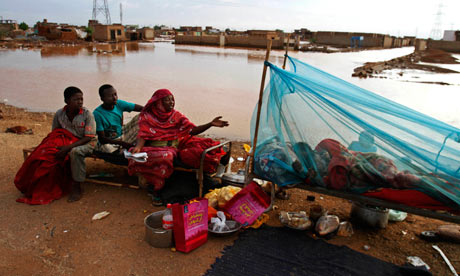
    MDG : Floods in Sudan : A Sudanese homeless family rest on the side of a highway in Khartoum

    Sudan’s floods have left many families homeless, particularly in the region around Khartoum, the capital. Photograph: Abd Raouf/AP

    Forty-eight people have been killed and more than 500,000 affected by the worst floods in Sudan in quarter of a century.

    The region around the capital, Khartoum, was particularly badly hit, with at least 15,000 homes destroyed and thousands of others damaged. Across Sudan, at least 25,000 homes are no longer habitable. A UN official described the situation as a disaster.

    The flooding, caused by continuous rains, has damaged public buildings, including schools, clinics, offices, shops, markets and water and sanitation facilities. Roads have been inundated, disrupting transport.

    One of the major health worries is the collapse of more than 53,000 latrines; the World Health Organisation (WHO) has warned of an increase in malaria cases in the past two weeks.

    WHO and Unicef, the UN agency for children, are supporting Sudanese authorities and national NGOs to run 50 emergency health clinics. The centres will be open for two months in eight states – Khartoum, White Nile, El Gezira, River Nile, Northern, Blue Nile, North Darfur and South Darfur.

    In South Sudan, recent fighting has forced 148,000 people in Pibor country – almost the entire population – to flee to the bush. Médecins Sans Frontières (MSF), the medical NGO, says about 90,000 people are missing. The 28,000 people who have been accounted for are in and around Gumuruk village, where MSF is running a clinic.

    The organisation has provided up to 100 consultations a day to people with diseases contracted after spending weeks or months hiding in the bush during the rainy season.

    MSF has expressed concern about the absence of men coming for treatment, apparently because they are frightened of seeking help where there is a military presence.

    In May, clashes between the South Sudan Army and the David Yau Yau militia intensified in Pibor county, prompting a mass exodus. In July, further violence between the Lou Nuer ethnic group and the Murle, the majority group in the area, triggered a wave of panic. Last month’s attacks left 328 people dead, according to a Murle leader.

    A woman who received treatment from MSF said her husband was too frightened to visit the clinic. “My husband does not dare enter the village as he is afraid he will be killed. If we run to the town the soldiers might kill us, and if we run to the bush the enemy tribe might kill us,” she said.

    MSF is also worried about the impact of the fighting on food supplies. “People come to the village and sit all day waiting for food,” said Carolina Lopez, its emergency co-ordinator in Pibor county. “Most lost their cattle in the recent fighting, and this year’s planting season was plagued with violence, so they are extremely vulnerable. Too many of them turn and walk back through the rain to their temporary shelters in the evening, their bags empty.”

    The UN military mission in South Sudan said this week it had increased its patrols in Pibor county to allow civilians to return to their towns and access food distribution points. Jonglei state has been plagued by ethnic violence between the Lou Nuer and the Murle, who have a history of animosity over grazing land, water sources and cattle raids that have often involved the abduction of women and children.