Author: Neville

  • The Peak Oil Crisis: A Review of Richard Heinberg’s ‘Snake Oil’

    The Peak Oil Crisis: A Review of Richard Heinberg’s ‘Snake Oil’

    August 21, 2013 5:53 PM1 Comment

    Richard Heinberg has been following and writing about peak oil for a long time. In the last decade, he has published 10 books on peak oil and related resource depletion topics as well as given some 500 lectures warning about the hard times ahead. The subtitle of his recent book, “How Fracking’s False Promise of Plenty Imperils Our Future” captures “Snake Oil’s” theme in a lucid phrase. This is an angry book, for it is intended as a rejoinder to the avalanche of half truths and optimistic estimates concerning the future of our energy resources which have filled our media in the last few years.

    As the evidence accumulates that man is destroying the atmosphere by ever-increasing carbon emissions and bankrupting his economic systems by continued reliance on increasingly expensive oil, realistic appraisals of our true energy situation are being lost.

    In recent years numerous institutions which should know better, major universities and widely respected publications have joined the chorus talking about “energy independence for America” and a century of oil and gas just waiting to be tapped.

    “Snake Oil” starts with a review of the fundamentals that most “peakists” have come to understand and accept. Peak oil is about the rate of supply, not estimated size of underground resources. There is a lot of oil and gas still in the ground, but only a small percentage will ever be extracted at prices people can afford to pay. Production from existing oil fields is declining by 4-5 percent annually and demand is increasing by about a million b/d each year. To keep the lid on costs, the world will have to come up with 5 million b/d of new oil production each year for the foreseeable future.

    It takes energy to produce energy so that when you spend more than you get back, it is time to quit extracting. As the Middle East gets hotter, both physically and politically, oil exporters are consuming an increasing share of their own production to keep their people cool and off the streets. These and other underlying realities are largely ignored by those enamored with recent, admittedly impressive, gains in US oil production and optimistic talk of billions and sometimes trillions of barrels of oil waiting to be produced.

    Heinberg acknowledges that the fracking boom has produced some spectacular numbers with US oil production increasing by 766,000 barrels a day (b/d) in 2012 and is likely to do about the same this year if current trends continue. The problem, of course, comes from projecting this spectacular growth into the more distant future. There are simply too many factors especially rapid decline rates and lower initial production rates as the best drilling locations are used up.

    The heart of “Snake Oil” is directed at countering the optimistic projections for production of oil and gas by hydraulic fracturing (fracking). Fracked oil and gas production is simply another, albeit expensive, resource that will climb to a peak and then deplete away just like all the others.

    Using the work done by two independent geologists, Arthur Berman of Texas and David Hughes of Canada, who have extensively analyzed the production of fracked oil wells across the US, Heinberg and his associates conclude that “shale gas and oil wells have proven to deplete quickly, the best fields have already been tapped, and no major new field discoveries are expected; thus with average per-well productivity declining and ever-more wells (and fields) required simply to maintain production, an “exploration treadmill” limits the long-term potential of shale resources”.

    With per-well production decline rates of between 81 and 90 percent in the first 24 months, wells must be constantly replaced by new ones just to keep production flat. The higher production gets, the more new replacement wells have to be drilled. Before the end of the decade, this bubble will collapse on its own accord and fracked oil and gas production will begin dropping. As usual there are disputes as to just when this downturn will begin, but the best available analysis suggest that four or five years from now will be the time period when fracked oil peaks in the US and a few years later for gas.

    The analysis shows that decades of abundant fracked oil and gas production is simply not in the cards that we see today.

    An interesting chapter in the book deals with just who has benefitted from the shale boom. Although thousands of jobs have been created and some landowners have profited handsomely from lending their property for drilling, local governments have yet to fully comprehend the damage that boom towns have done to their communities and that heavy trucks have done to their roads. Service companies that sell equipment performing the actual fracking have done well, the drillers, include large ones such as ExxonMobil, who assume the ultimate risk have been losing money on natural gas and only some are making money on oil due to the high prices.

    Heinberg concludes that the real winners, however, are the investment banks that have earned huge fees for raising the money that has fueled the boom.

    The book is clearly a contribution to the literature of peak oil for it updates recent developments and does an effective job in separating reality from the hype of the financial media.

    Heinberg leave us with two somewhat contradictory thoughts:

    • Hydrocarbons are so abundant that, if we burn a substantial portion of them, we risk a climate catastrophe beyond imagining.

    • There aren’t enough economically accessible, high-quality hydrocarbons to maintain world economic growth for much longer.


  • The Battle Over Global Warming Is All in Your Head

    The Battle Over Global Warming Is All in Your Head

    Despite the fact that more people now acknowledge that climate change represents a significant threat to human well-being, this has yet to translate into any meaningful action. Psychologists may have an answer as to why this is

    165161414165161414
    ANDREY SMIRNOV/AFP/Getty ImagesClimate campaigns, like this one from Greenpeace in Moscow, have failed to galvanize public support for strong climate action

    Today the scientific community is in almost total agreement that the earth’s climate is changing as a result of human activity, and that this represents a huge threat to the planet and to us. According to a Pew survey conducted in March, however, public opinion lags behind the scientific conclusion, with only 69% of those surveyed accepting the view that the earth is warming — and only 1 in 4 Americans see global warming as a major threat. Still, 69% is a solid majority, which begs the question, Why aren’t we doing anything about it?

    This political inertia in the face of unprecedented threat is the most fundamental challenge to tackling climate change. Climate scientists and campaigners have long debated how to better communicate the message to nonexperts so that climate science can be translated into action. According to Christopher Rapley, professor of climate science at University College London, the usual tactic of climate experts to provide the public with information isn’t enough because “it does not address key underlying causes.” We are all bombarded with the evidence of climate change on an almost a daily basis, from new studies and data to direct experiences of freakish weather events like last year’s epic drought in the U.S. The information is almost unavoidable.

    If it’s not a data deficit that’s preventing people from doing more on global warming, what is it? Blame our brains. Renee Lertzman, an applied researcher who focuses on the psychological dimensions of sustainability, explains that the kind of systemic threat that climate change poses to humans is “unique both psychologically and socially.” We face a minefield of mental barriers and issues that prevent us from confronting the threat.


    (MORE: As Temperatures Rise, Empires Fall: Heat and Human Behavior)

    For some, the answer lies in cognitive science. Daniel Gilbert, a professor of psychology at Harvard, has written about why our inability to deal with climate change is due in part to the way our mind is wired. Gilbert describes four key reasons ranging from the fact that global warming doesn’t take a human form — making it difficult for us to think of it as an enemy — to our brains’ failure to accurately perceive gradual change as opposed to rapid shifts. Climate change has occurred slowly enough for our minds to normalize it, which is precisely what makes it a deadly threat, as Gilbert writes, “because it fails to trip the brain’s alarm, leaving us soundly asleep in a burning bed.”

    Robert Gifford, a professor of psychology and environmental studies at the University of Victoria in Canada, also picks up on the point about our brains’ difficulty in grasping climate change as a threat. Gifford refers to this and other psychological barriers to mitigating climate change as “dragons of inaction.” Since authoring a paper on the subject in 2011 in which he outlined seven main barriers, or dragons, he has found many more. “We’re up to around 30,” he notes. “Now it’s time to think about how we can slay these dragons.” Gifford lists factors such as limited cognition or ignorance of the problem, ideologies or worldviews that may prevent action, social comparisons with other people and perceived inequity (the “Why should we change if X corporation or Y country won’t?”) and the perceived risks of changing our behavior.

    Gifford is reluctant to pick out one barrier as being more powerful or limiting than another. “If I had to name one, I would nominate the lack of perceived behavioral control; ‘I’m only one person, what can I do?’ is certainly a big one.” For many, the first challenge will be in recognizing which dragons they have to deal with before they can overcome them. “If you don’t know what your problem is, you don’t know what the solution is,” says Gifford.

    Yet this approach can only work if people are prepared to acknowledge that they have a problem. But for those of us who understand that climate change is a problem yet make little effort to cut the number of overseas trips we make or the amount of meat we consume, neither apathy nor denial really explains the dissonance between our actions and beliefs. Lertzman has come to the conclusion that this is not because of apathy — a lack of feeling — but because of the simple fact that we care an overwhelming amount about both the planet and our way of life, and we find that conflict too painful to bear. Our apparent apathy is just a defense mechanism in the face of this psychic pain.

    (MORE: The Evil Brain: What Lurks Inside a Killer’s Mind)

    “We’re reluctant to come to terms with the fact that what we love and enjoy and what gives us a sense of who we are is also now bound up with the most unimaginable devastation,” says Lertzman. “When we don’t process the pain of that, that’s when we get stuck and can’t move forward.” Lertzman refers to this inability to mourn as “environmental melancholia,” and points to South Africa’s postapartheid Truth and Reconciliation Commission as an example of how to effectively deal with this collective pain. “I’m not saying there should be one for climate or carbon, but there’s a lot to be said for providing a means for people to talk together about climate change, to make it socially acceptable to talk about it.”

    Rosemary Randall, a trained psychotherapist, has organized something close to this. She runs the U.K.-based Carbon Conversations, a program that brings people together to talk in a group setting about ways of halving their personal carbon footprint. Writing in Aeon, an online magazine, Randall suggests that climate change is such a disturbing subject, that “like death, it can raise fears and anxieties that people feel have no place in polite conversation.” Randall acknowledges that while psychology and psychoanalysis aren’t the sole solutions to tackling climate change, “they do offer an important way of thinking about the problem.”

    Lertzman says the mainstream climate-change community has been slow to register the value of psychology and social analysis in addressing global warming. “I think there’s a spark of some interest, but also a wariness of what this means, what it might look like,” she notes. Gifford says otherwise, however, explaining that he has never collaborated with other disciplines as much as he does now. “I may be a little biased because I’m invested in working in it, but in my view, climate change, and not mental health, is the biggest psychological problem we face today because it affects 100% of the global population.”

    Despite the pain, shame, difficulty and minefield of other psychological barriers that we face in fully addressing climate change, both Lertzman and Gifford are still upbeat about our ability to face up to the challenge. “It’s patronizing to say that climate change is too big or abstract an issue for people to deal with,” says Lertzman. “There can’t be something about the human mind that stops us grappling with these issues given that so many people already are — maybe that’s what we should be focusing on instead.”

    MORE: The Psychology of Environmentalism: How the Mind Can Save the Planet

    Read more: http://science.time.com/2013/08/19/in-denial-about-the-climate-the-psychological-battle-over-global-warming/#ixzz2chPF6a1z

  • Population Plus Climate: Why Coastal Cities Will Face Increased Risks From Floods

    Content

    Science & Space

    Population Plus Climate: Why Coastal Cities Will Face Increased Risks From Floods

    A new study names the global cities most at risk at coastal flooding—both today, and in a warmer future.

    155028577
    Aby Baker/Getty ImagesFlooding seen at the entrance to FDR Drive in New York City after Hurricane Sandy, on Oct. 30, 2012

    Living in New York, it’s easy to forget that the ocean is right on our doorsteps. This isn’t Miami with its beaches or Venice with its canals or New Orleans with its history of storms and floods. New York has always been a supremely self-involved city—this famous magazine cover pretty much sums it up—and though Manhattan is an island, it’s one that has its eyes turned inward, not out toward the water that rings it.

    Hurricane Sandy ended that illusion last year. The storm surge flooded tunnels, subway lines and apartment buildings; swamped power lines and transformers caused a blackout over much of Manhattan that lasted for days. Altogether Sandy cost the city of New York some $19 billion in public and private losses, nearly all of it due to the water. Sandy wasn’t even that powerful a storm, its winds barely ranking as a category 1 when it made landfall along the East Coast last October. What it had was something any New Yorker who’s hunted for apartments could appreciate—location, location, location—hitting the biggest city in America and flooding it with all that forgotten coastal water.

    For coastal cities like New York, Hurricane Sandy was a coming attraction for what is likely to be a very wet and destructive future. According to leaked drafts of the forthcoming new report from the Intergovernmental Panel on Climate Change (IPCC), scientists believe that sea level could rise by more than three feet by the end of the century is carbon emissions keep growing at a runaway pace. And a new study published in the journal Nature Climate Change laid out the enormous flood losses that major coastal cities could face in the future. Average global flood losses could rise from approximately $6 billion per year in 2005 to $60 to $63 billion per year by 2050, thanks to population and economic growth along the coasts and the multiplying effect of climate change-driven sea level rise. As Robert Nicholls, a professor of coastal engineering at the University of Southampton in Britain and a co-author of the study, put it in a statement: “There is a pressing need to start planning how to manage flood risk now.”

    The Nature Climate Change study looked at both present and projected future flood losses in the 136 largest coastal cities in the world, looking at their financial risks both in absolute terms—taking into account protections like sea walls and dikes—and as a percentage of the city’s GDP. The cities ranked as most at risk today range from Guangzhou in southern China to Mumbai in India to, yes, New York City. What those cities tend to have in common is high wealth and population levels and relatively little flooding protection. (By contrast, Dutch cities like Amsterdam or Rotterdam—which are extremely flood-prone geographically—aren’t found on the list because the Netherlands government has invested heavily in coastal protection.) Three American cities—Miami, New York and New Orleans—are responsible for 31% of the total losses across the 136 cities surveyed in 2005. When it comes to losses as a percentage of total city GDP—which gives the very richest cities like New York an advantage—Guangzhou, New Orleans and Guayaquil in Ecuador are most at risk.

    The situation changes a bit in 2050. The study assumed that climate change will lead sea levels to rise 0.65 to 1.3 ft. by 2050, with some cities facing additional sea level rise because of local subsidence—literally, the earth sinking. Developing cities like Guangzhou, Mumbai and Shenzhen face the biggest risks, though Miami and New York rank highest among cities in developed nations. If no improvements are made in flood defenses, the study estimates that the world could be facing as much as $1 trillion or more per year in losses. Now, that number is the worst of the worst case, assuming that cities do absolutely nothing to protect themselves from sea level rise, suffer major floods and then pay to immediately rebuild everything they lost. But even assuming improvements in coastal defenses, potential losses will increase significantly, thanks to the risk of bigger floods and more immediately, a huge increase in the number of people and the value of property along the coasts.

    That second bit is important. It’s vital for governments to gain a better understanding of flooding risks from global warming—and sea level rises of the sort apparently projected by the IPCC will endanger major world cities. But the most immediate threat is the sheer increase in people—and their property—put in harm’s way in coastal cities. In the U.S. 87 million people now live along the coast, up from 47 million people in 1960, and globally six of the world’s 10 largest cities are on the coast. Of the $60 to $63 billion in flood risk the Nature Climate Change study estimates the world’s cities will face by 2050, $52 billion is due to economic and population growth—the rest is due to sea level rise and land use change.

    That doesn’t mean that climate change-amplified floods and storms don’t present a danger to coastal cities—or that we don’t need to worry about reducing carbon emissions. But the numbers don’t lie—the single biggest increase in the risk from flooding comes from putting people and property in places where floods have always been likely to happen. As Sandy showed, coastal cities are at risk from major flooding right now if a storm should hit at the wrong place at the wrong time. It’s location, location, location—which is why it’s so important to spend money now to improve coastal

  • Grassroots Campaign Focuses on Tackling Sea Level Rise Awareness

    Published: 21 August 2013

    Including Study on Perceptions and Opinions

    Point Pleasant Beach, NJ- Today, environmental advocates gathered at Jenkinson’s Boardwalk in Point Pleasant Beach to wrap up this year’s C.O.A.S.T. (Clean Ocean Action Shore Tips) Campaign, highlighting the launch of a sea-level rise survey, tip-card for citizens, and a new national initiative called US Strong.

    C.O.A.S.T. is an annual summer outreach campaign that raises awareness among beachgoers and coastal citizens about current ocean pollution and industrialization issues.  The C.O.A.S.T. campaign organizes volunteers to set up and staff information and action tables at beach locations in Monmouth and Ocean Counties on weekend in July and August. This summer, additional tables were set up at festivals as several beaches could not accommodate the campaign due to complications from Superstorm Sandy. Despite the setbacks from the storm, the volunteers were able to reach hundreds of citizens at dozens of locations. Volunteers also sold campaign merchandise to raise funds for Clean Ocean Action’s efforts to stop ocean pollution.

    It has been nearly ten months since Superstorm Sandy devastated the Jersey Shore. What Sandy destroyed in 36 hours will take years to restore. This summer’s C.O.A.S.T. campaign focused on educating the public about the imminent threat of sea level rise in an effort to prevent the same kind of destruction from occurring again. At each table a new card from Clean Ocean Action’s “10 Tips” series were given out that outlines what steps the public can take to protect themselves from such devastation in the future.

    “Until recently, many New Jerseyans were unaware of what climate change meant to them; it was a vague term that had no face,” said Cindy Zipf, executive director of Clean Ocean Action. “Superstorm Sandy gave us a harsh devastating glimpse of the threats and realities of sea level rise, but we now have a window of opportunity to help inform citizens about what is at stake and how they can prepare and respond to keep them safe from future storms,” Zipf added.

    Yesterday, Governor Christie and Housing and Urban Development Secretary Shaun Donovan called for creating more resilient communities through long term planning. This year’s C.O.A.S.T. campaign got to the grassroots of that endeavor. The campaign provided coastal citizens with the tools to become more aware of the pressing issues related to sea level rise.

    “Clean Ocean Action’s work to educate the public about the threat and reality of sea level rise is vital,” said Lauren Townsend, New Jersey Director of US Strong. “Between sea level rise and extreme weather events like Superstorm Sandy, we need real protections and disaster relief to protect our communities. Establishing a federal extreme weather relief and protection fund will help vulnerable communities respond to sea level rise and extreme weather events that are becoming common place across the nation.  Acting now will save money and, more importantly, save lives.”

    The C.O.A.S.T. campaign also launched Clean Ocean Action’s new citizen’s survey on sea level rise. The survey will gauge public perception on what should be done to prevent sea level-related devastation, and whose responsibility it is.

    “The Jersey Shore bounced back from the storm with the kind of resilience and determination that you would expect from New Jerseyans” said Macailagh McCue, Clean Ocean Action’s C.O.A.S.T. Intern, “however there is a great deal of rebuilding and planning that still needs to be done. The citizen’s survey will help Clean Ocean Action to determine what the best actions are moving forward, and who should be responsible for protecting our homes and communities from this kind of catastrophe in the future”.

    To participate in the survey, and voice your opinion on this important issue, visit www.cleanoceanaction.org or call Clean Ocean Action at (732) 872-0111 for more information.

    Comments (2)

    • bill wolfe 13 hours ago
      Where was COA and COAST when it mattered?

      Where have they been as Gov. Christie has ignored climate change and sea level rise dismantled existing protections, such as: 1) DEP deregulation of infrastructure reconstruction; 2) DEP exemption of redevelopment from coastal permit requirements; 3) DEP emergency Orders that roll back existing coastal protections; 4) attack on FEMA flood maps; 5) DEP failure to update flood maps for inlands rivers; and most importantly 6) Gov. Christie’s appointment of a non-transparent, non-democratic unaccountable “Rebuild Czar” who oversaw NJ’s Rebuild plans for securing federal Sandy recovery funds?

      COAST and COA are ineffective diversions – while the policy, regulatory, and financial horses gallup out of the barn and repeat the mistakes of the past.

      0
    • bill wolfe 13 hours ago
      If the public is interested in shaping real solutions, here are the policy tools you need to look at critically and use:

      www.wolfenotes.com/2013/08/gov-christies…orm-hazard-planning/

      0
  • 5 Terrifying Statements in the Leaked Climate Report

    5 Terrifying Statements in the Leaked Climate Report

    Is the Intergovernmental Panel on Climate Change getting blunt about how bad global warming is going to be?

    —By

    | Tue Aug. 20, 2013 7:02 AM PDT
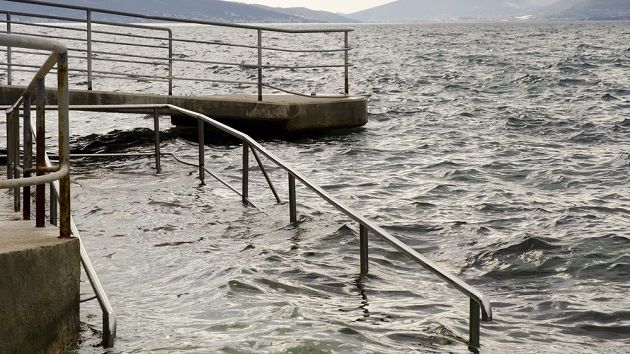
    Image of a submerged pier.In the long run, global sea level rise could easily exceed 5 meters. Brendan Howard/Shutterstock

    Climate Desk has obtained a leaked copy of the draft Intergovernmental Panel on Climate Change’s 2013 Summary for Policymakers report, which other media outlets are also reporting on. The document is dated June 7, 2013. We recognize, as we’ve previously reported, that this document is not final, and is in fact certain to change.

    Most media outlets are focusing on the document’s conclusion that it is now “extremely likely”—or, 95 percent certain—that humans are behind much of the global warming seen over the last six decades. But there is much more of note about the document—for instance, the way it doesn’t hold back. It says, very bluntly, just how bad global warming is going to be. It gives a sense of irreversibility, of scale…and, of direness.

    In particular, here are five “holy crap” statements from the new draft report:

    We’re on course to change the planet in a way “unprecedented in hundreds to thousands of years.” This is a general statement in the draft report about the consequences of continued greenhouse gas emissions “at or above current rates.” Unprecedented changes will sweep across planetary systems, ranging from sea level to the acidification of the ocean.

    Ocean acidification is “virtually certain” to increase. Under all report scenarios, the acidification of the world’s oceans will increase—the draft report calls this outcome “virtually certain.” As we have previously reported, more acidity “threatens the survival of entire ecosystems from phytoplankton to coral reefs, and from Antarctic systems reliant on sea urchins to many human food webs dependent on everything from oysters to salmon.”

    Long-term, sea level rise could be 5 to 10 meters. Journalists are already citing the draft report’s prediction that by the year 2100, we could see as much as three feet of sea level rise. But there is also a more long-range sea level scenario alluded to in the draft report, and it’s far more dramatic and alarming.

    Taking a look at the planet’s distant past, the document ascribes “very high confidence” to the idea that sea levels were “at least 5 [meters] higher” during the last interglacial period, some 129,000 to 116,000 years ago. It also adds that sea level during this period probably did not exceed 10 meters higher than present levels. Finally, the draft report says, with “medium confidence,” that temperatures at that time weren’t more than 2 degrees Celsius warmer than “pre-industrial” levels.

    Add it all up, and what that means is that if we exceed 2 degrees of warming beyond pre-industrial levels, then we could be looking at radically higher oceans, and submerged coastal cities, in the long run. And just how close are we to exceeding 2 degrees Celsius? Several scenarios used for the draft report project “high confidence” that we’ll get there by the end of the century. At that point, seas would continue to rise well beyond the year 2100, and by much more than three feet.

    This also implies a substantial melting of the Greenland ice sheet. The draft report adds that during the last interglacial period, the melting of Greenland “very likely” contributed between 1.4 and 4.3 meters of global sea level rise, with additional contributions coming from the melting of Antarctica. If Greenland were to melt entirely, it is estimated that sea level would rise by about seven meters.

    Thus, a substantial Greenland melting could also be set in motion by the end of this century, which would eventually result in dramatic sea level increases. To be sure, most of this wouldn’t occur during the current century—it would play out on a much longer time scale. But over 1,000 years or more, the draft report says, Greenland could melt almost entirely, and much of the change might be “irreversible.” (Granted, the report expresses low confidence about the precise temperature threshold required to bring about a full melting of Greenland.)

    Much of the carbon we’ve emitted will stay in the atmosphere for a millennium…even after we’ve stopped emitting it. The draft report says that 20 percent of the carbon dioxide currently in the atmosphere will stay there for an almost unimaginably long time—more than 1,000 years. Even if we were to completely cease all greenhouse gas emissions, the draft report adds, warming would continue for “many centuries.” “A large fraction of climate change,” the document intones, “is thus irreversible on a human time scale.” The only way out would be if our emission levels were “strongly negative for a

  • VIDEO: Are we kidding? Yes and no GET-UP

    Why this ad?
    Award Winning Mobile Planamaysim.com.au/Promo_Code_50UNL – No Lock-In Contracts Or Plans. BYO Mobile & Number. 50% Off-Ends Soon

    VIDEO: Are we kidding? Yes and no

    Inbox
    x
    GetUp!
    6:01 PM (26 minutes ago)

    to me
    NEVILLE,

    An hour ago, Immigration Minister Tony Burke went on TV to release the Government’s new “online video” spruiking their Papua New Guinea detention “solution”. We thought the Minister’s video was, well, shameless – and the production value sucks!

    We thought we’d help the Government out by making them a better video. After all, if you want to show off a renovation, there’s no better way than TV’s Grand Designs.

    Check it out and share far and wide:

    Bad Designs Video

    www.getup.org.au/manus-facts

    – the GetUp team

    PS. Tony Abbott recently announced refugee policies that go far lower than the Government’s plans – lower even than John Howard’s government ever dared. Stay tuned for more actions in our ongoing campaign to hold the parties accountable for their asylum seeker policies. If you haven’t already, let us know what you’d like to see the GetUp movement do next on this campaign by clicking here: http://www.getup.org.au/quick-survey


    GetUp is an independent, not-for-profit community campaigning group. We use new technology to empower Australians to have their say on important national issues. We receive no political party or government funding, and every campaign we run is entirely supported by voluntary donations. If you’d like to contribute to help fund GetUp’s work, please donate now! If you have trouble with any links in this email, please go directly to www.getup.org.au. To unsubscribe from GetUp, please click here. Authorised by Sam