Author: Neville

  • What is the future of Australian productivity and investment after the mining boom? AAP/Christian Sprogoe

    Where will jobs and growth come from after the mining boom? This is the fundamental question facing the next Australian government, whose success will depend to a great extent on how it addresses this question. The resources investment of recent years may well bring additional production and exports…

    N8fp3pm8-1377145111
    What is the future of Australian productivity and investment after the mining boom? AAP/Christian Sprogoe

    Where will jobs and growth come from after the mining boom? This is the fundamental question facing the next Australian government, whose success will depend to a great extent on how it addresses this question.

    The resources investment of recent years may well bring additional production and exports, but it’s becoming clear that the boost to our national income growth from the high commodity prices from Australia’s latest mining boom is coming to an end, revealing a serious and potentially damaging fall in productivity.

    What do we need to do to create long-term growth and jobs?

    How we got here

    Let’s begin at the beginning. We have to ask ourselves, did Australia make the best use of the windfall from the boom that was never supposed to end? The economic gains were unprecedented in their size and impact, and even though temporary, could have prepared us well for a post-boom economy. Prior to the 2007 election, then opposition finance spokesperson Lindsay Tanner complained that the Howard government had been:

    …rained with revenue by the minerals boom and it’s wasting far too much of it and it’s not building it for the future.

    The incoming Labor government had an opportunity to capitalise on the re-emerging mining boom, driven by demand from China and the region. However, apart from the government’s deft handling of the global financial crisis, which was no small achievement, it is difficult to make the case that Labor did so much better than its predecessor in constructing an economic legacy for a world of knowledge-driven products and services.

    As well as being constantly distracted by leadership issues, the government made little headway against the prevailing economic orthodoxy: the misunderstanding of short term business cycle activity as longer term structural change, and the false belief that resources- driven growth had become such a permanent feature of the Australian economy that manufacturing and other sources of growth could safely be abandoned.

    Fiona Katauskas
    Click to enlarge

    Clearly, the global economy is going through major structural change, but this is less about commodity price fluctuations than innovations in technology and business models and the changing patterns of international trade and development.

    The problem and continuing challenge is that Australia is not taking as much advantage of these changes as we could. Both business leaders and policy makers have allowed the contribution to growth from trade to mask a steady deterioration in our productivity over the past decade, which will be fully laid bare as the mining boom fades in coming years.

    This is nothing new. Australia has seen such booms before, which have ended badly, and their lessons have been widely canvassed. We have also had the benefit of observing the impact of North Sea gas discoveries in the 1970s on Dutch manufacturing, as booming gas revenues drove up the value of the currency, making it much harder for Dutch industries to compete on the international market. It took many years with a laser-like focus on industry and innovation policies to overcome the so-called “Dutch disease” and reconstruct and reposition manufacturing.

    Similarly, North Sea oil and gas enabled the UK government of the 1980s to keep itself in office by fuelling a consumption boom with tax cuts. Only gradually was there a realisation that, in the words of J. K. Galbraith, the price of private affluence was public squalor, as schools and hospitals bore the brunt of neglect and key areas of manufacturing were lost, never to return. Ironically, the experience was repeated with the finance sector in the 1990s and 2000s, once more ending badly, with a new government committing to “re-balancing” the economy.

    All Australia had to do was learn from the past – and observe the current approach of Norway, which actually learnt something from the experience of other resource rich economies. Norway has taken a public stake in its mammoth oil and gas assets, imposed a 76% resource rent tax, and established a sovereign wealth fund to partially quarantine the exchange rate and provide an income stream for investment in research and innovation.

    Beyond the boom, Norway will have given itself the best possible chance to build a competitive knowledge-based economy. Already it is a world leader in productivity performance – we have a lot of catching up to do.

    Productivity slowdown

    Without a shared understanding of the problem, it’s not easy to come up with a solution to Australia’s productivity slowdown, which has only partly been reversed over the past year and not anywhere near the required scale of improvement.

    While economists and policy-makers agree that productivity drives growth, competitiveness and living standards, there is much less agreement on where productivity comes from, and how to measure it – and thus on the policies which contribute to sustainable productivity improvement. The need for productivity improvement has been sharpened by two separate but related problems that have recently received considerable public attention.

    The first problem is the impending fall in Australia’s terms of trade from the heights reached during the commodity boom. The unprecedented rise in our terms of trade as a result of increased commodity prices delivered a massive boost to the growth in our national income in the early 2000s – around 15% over a five year period – and has not inaccurately been described as the “gift from China”. Combined with an effective stimulus, the boom helped to shield Australia from the worst of the global financial crisis and make our economy the envy of the world.

    However, it also masked the second problem, which is the deterioration of Australia’s productivity performance since the 1990s. While this problem could be safely ignored, and was ignored in the past, as rising terms of trade took up the slack, it is now increasingly exposed as the commodity cycle runs its course. There were warning signs but many policy-makers and commentators mistakenly saw a cyclical event as structural change (see below).

    Australia’s Productivity and Income, 1990-2012. ABS
    Click to enlarge

    Recently I prepared a detailed report with my colleagues Phil Toner and Renu Agarwal for the McKell Institute Understanding Productivity (2012), which explores Australia’s productivity slowdown and the policy measures that are being proposed to address it.

    We found that just as the slowdown was previously ignored, it is now misinterpreted and exaggerated to justify measures that may have little or no relevance to our future productivity performance, and which may themselves have contributed to the slowdown.

    The report notes that the most common measure of productivity performance is labour productivity, which measures the value of goods made or services provided either by hours worked, or by employed person.

    Growth in this kind of productivity slowed in the early years of this century. This was less a result of the waning of the 1990s microeconomic reform agenda than a consequence of the increase in total employment and, at least since the global financial crisis, the decline in output growth.


    This is an edited extract of a chapter from Pushing our luck: ideas for Australian progress from the Centre for Policy Development.


  • A harbinger of conservative battles to come

    A harbinger of conservative battles to come

    Updated Fri 23 Aug 2013, 2:41pm AEST

    If his paid parental leave scheme is any guide, Tony Abbott is a ‘big government’ interventionist who is on course for an ongoing battle with his conservative base, writes David Hetherington.

    In the era of small target campaigning, it’s rare for Opposition Leaders to have a big signature policy.

    For one thing, they’re all too conscious of the fate of Fightback and Medicare Gold. For another, it’s just easier to campaign on bad government policy than to risk scrutiny of detailed, positive policies developed without the resources available to incumbents.

    Yet in 2013, in an Opposition campaign in which every other imaginable risk has been neutralised, Tony Abbott has insisted on retaining a signature policy which risks more critical scrutiny than all his other positions combined.

    That’s why the Opposition’s paid parental leave (PPL) scheme is fascinating to election tragics: not principally for its policy detail, but because it adds to an emerging picture about the contradictions of Tony Abbott’s leadership and in his brand of conservatism.

    Much has been made of the fiscal impacts of the scheme, but its policy objectives and philosophical foundations are equally revealing.

    Of course, the most debated contradiction sits squarely within the wider narrative of this campaign: the battle over costings. How much will it cost and who pays for it? If, as Abbott claimed last week, we are facing a “budget emergency”, can we afford a new $5.5b scheme, particularly when we have a workable, but less generous, PPL scheme in place already?

    The answer leads immediately to the second contradiction – a 1.5 per cent levy on big business to pay for the scheme while concurrently cutting corporate tax rates.

    Confused? We’re only just starting. Abbott conceded this week the levy would only pay for half the scheme, with the balance promised to come from the cessation of the PPL schemes run by Labor and the states. The credibility of this can only be tested with the release of the Coalition’s full costings the day before the election.

    There has been a brief kerfuffle about the burden of the scheme falling on shareholders in lost franking tax credits but, in Abbott’s defence, a business levy was always going to be paid for by the shareholders of those businesses. There is longstanding precedent for treating a levy in this way.

    More interesting paradoxes emerge from the stated objectives of the policy. Mr Abbott has claimed it will boost the fertility rate, workforce participation and productivity. Yet while it is true that financial support makes it easier for working women to have more babies, it is not clear how participation or productivity will be improved by the policy.

    The key participation challenge is to get women back in the workforce after child-raising – rather than before children – which the policy does nothing to address. If anything, its generosity might defer women’s return to work by giving them more savings to stay at home with the baby.

    And the productivity benefits claimed in the Coalition’s policy document are directly contingent on higher participation. The experts’ consensus is that PPL will not lift productivity without matching improvements in childcare accessibility and affordability.

    In effect, the Coalition’s PPL should be seen less as a participation policy than a much-needed social insurance scheme. Social insurance provides financial support for citizens at important life junctures, and there is no doubt the care of young babies falls in this category.

    This is the strongest argument for the increased generosity of the Coalition’s scheme – that we should be supporting mothers as best we can during a challenging and financially draining period.

    By contrast, there is no strong argument for making PPL highly regressive, so that it pays high-income women far more than low-income ones as Abbott’s scheme does. It is almost unprecedented for a social insurance scheme to distribute public money in a way that increases inequality by benefiting the wealthy at the cost of the poor. Imagine if Medicare or the pension did this.

    Finally, the PPL scheme tells us much about Tony Abbott’s personal political philosophy. In his 2009 book Battlelines, as in his campaign stance on marriage equality, Abbott makes clear that he is a social conservative who believes in government’s right to intervene to sustain traditional institutions. The PPL scheme shows he is willing to use the public purse in these efforts, in this case to support motherhood.

    In a real sense, that makes him a ‘big government’ interventionist. And it sets him at odds with many in the conservative movement who believe fervently in ‘small government’ – the right-wing think tanks, the fiscal conservatives, the IR hardliners. These groups despair of the fiscal and policy contradictions inherent in Abbott’s PPL scheme.

    Should Abbott win on September 7, as seems likely, these frustrations will be harbingers of the battles ahead between Abbott and his conservative base – on industrial relations, on the GST, and on ‘big government’ schemes like Gonski and the NDIS.

    The paradoxes of this prime ministerial aspirant could make for a rollercoaster three years ahead.

    David Hetherington is executive director of Per Capita, a progressive think tank. View his full profile here.

  • Tony Windsor concerned over slow progress of CSG scrutiny

    Tony Windsor concerned over slow progress of CSG scrutiny

    By Nonee Walsh, ABCUpdated August 24, 2013, 11:09 am

    Former independent MP Tony Windsor, who pushed for federal powers to scrutinise the impact of gas and coal projects on water supply says he is dismayed at its slow implementation.

    The powers to require assessment of cumulative water impacts of coal seam gas and coal projects under the Environment Protection and Biodiversity Act, known as the water trigger, was passed in June.

    So far it has been applied to only 4 out of 50 applications before the Federal Government.

    Mr Windsor, the former Member for , supported the Gillard Labor government, provided Federal environment law was extended to scrutinise water protection in coal mines and gas well projects.

    “I am a little bit concerned we don’t seem to be proceeding very quickly,” he said.

    “I would hope there is very good reason for that in terms of getting the process right, rather than some of the officials hoping that there will be a change of government or some change of policy after the election.”

    When the water trigger amendment was passed, Mr Windsor also moved an amendment to ensure the power could not be devolved back to the states.

    do not think restrictions of coal seam gas miners should be eased.

    Voters in rural and regional seats were more supportive of restrictions on CSG than urban dwellers.

    Concern about appropriate investigation of proposals

    Carmel Flint from Lock the Gate Alliance, which campaigns against inappropriate mining projects, says the Government needs to ensure that some of New South Wales and Queensland’s most controversial mine and gas applications are captured by the water trigger.

    The water trigger has been applied to the Kevin’s Corner open cut and underground coal mine in the Galilee basin in western Queensland, 160 kilometres west of Emerald, but not to three other projects in the same basin.

    “Because there has not been full and adequate assessments conducted, we don’t know what the full impacts will be and unless the Federal Government requires those assessments, these mines will be approved without full knowledge of the water impacts,” she said.

    Ms Flint says community concern about the Wallarah 2 mine in the New South Wales central coast water catchment and plans for CSHG wells in the western Sydney suburbs of Camden and Campbelltown must be addressed.

    “It is incredibly important that the Federal Government lets the community know know before the election whether it will require further water studies in these incredibly sensitive locations,” she said.

    The environment group is concerned because there is a 60-day statutory deadline for the trigger to be applied which falls just before election day.

    In a statement to the ABC, the Environment Department dismissed the concern.

    “According to the provisions of the Amendment Act, decisions on the application of the water trigger to transitional projects can continue to be made past the 60-business-day time frame,” the department said.

    However, Mr Windsor is not entirely convinced by the department’s assurances.

    “Tony Abbott and Kevin Rudd have been talking about Green tape as they call it, and the capacity to tighten up some of the environmental regulations, that to me is code that the water trigger is under scrutiny,” he said.

    “They would be far better off to have a very close look at a lot of the polls that are out there, particularly in relation to coal seam gas where the population has massive concerns about the relationship between some of these extractive activities and groundwater resources.”

    Sponsored Links

    Banks Fight For Your Loan

    TomorrowFinance.com.au/HomeLoans

    Use Our Simple Home Loan Form. Banks Call You With Their Best Rate

  • Is climate change humanity’s greatest-ever risk management failure?

    Is climate change humanity’s greatest-ever risk management failure?

    Humans are very good at managing risks, except when it comes to the greatest risk we’ve faced – climate change

    Roulette wheel

    Our gamble may lead to an unstable future climate. Photograph: Don Mcphee

    Humans are generally very risk-averse. We buy insurance to protect our investments in homes and cars. For those of us who don’t have universal health care, most purchase health insurance. We don’t like taking the chance – however remote – that we could be left unprepared in the event that something bad happens to our homes, cars, or health.

    Climate change seems to be a major exception to this rule. Managing the risks posed by climate change is not a high priority for the public as a whole, despite the fact that a climate catastrophe this century is a very real possibility, and that such an event would have adverse impacts on all of us.

    For example, in my job as an environmental risk assessor, if a contaminated site poses a cancer risk to humans of more than 1-in-10,000 to 1-in-1 million, that added risk is deemed unacceptably high and must be reduced. This despite the fact that an American man has a nearly 1-in-2 chance of developing and 1-in-4 chance of dying from cancer (1-in-3 and 1-in-5 for an American woman, respectively).

    To that 42 percent chance of an average American developing cancer in his or her lifetime, we’re unwilling to add another 0.001 percent. The reason is simple – we really, really don’t want cancer, and thus consider even a small added risk unacceptable.

    Yet we don’t share that aversion to the risks posed by human-caused climate change. These risks include more than half of global species potentially being at risk of extinction, extreme weather like heat waves becoming more commonplace, global food supplies put at risk by this more frequent extreme weather, glaciers and their associated water resources for millions of people disappearing, rising sea levels inundating coastlines, and so forth.

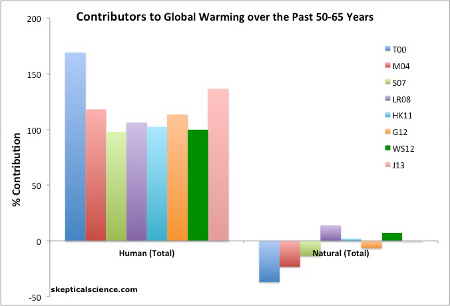
    This isn’t some slim one-in-a-million risk; we’re looking at seriously damaging climate consequences in the most likely, business-as-usual scenario. The forthcoming fifth IPCC report is likely to state with 95 percent confidence that humans are the main drivers of climate change over the past 60 years, and the scientific basis behind this confidence is quite sound. It’s the result of virtually every study that has investigated the causes of global warming.

    The percentage contribution to global warming over the past 50-65 years is shown in two categories, human causes (left) and natural causes (right), from various peer-reviewed studies (colors). The percentage contribution to global warming over the past 50-65 years is shown in two categories, human causes (left) and natural causes (right), from various peer-reviewed studies (colors).

    Yet in a recent interview with NPR, climate scientist Judith Curry, who has a reputation for exaggerating climate science uncertainties, claimed that based on those uncertainties,

    “I can’t say myself that [doing nothing] isn’t the best solution.”

    This argument, made frequently by climate contrarians, displays a lack of understanding about risk management. I’m uncertain if I’ll ever be in a car accident, or if my house will catch fire, or if I’ll become seriously ill or injured within the next few years. That uncertainty won’t stop me from buying auto, home, and health insurance. It’s just a matter of prudent risk management, making sure we’re prepared if something bad happens to something we value. That principle should certainly apply to the global climate.

    Uncertainty simply isn’t our friend when it comes to risk. If uncertainty is large, it means that a bad event might not happen, but it also means that we can’t rule out the possibility of a catastrophic event happening. Inaction is only justifiable if we’re certain that the bad outcome won’t happen.

    Curry is essentially arguing that she’s not convinced we should take action to avoid what she believes is a very possible climate catastrophe. That’s a failure of risk management. I wonder if she would also advise her children not to buy home or auto or health insurance. Maybe they’ll be a wasted expense, or maybe they’ll prevent financial ruin in the event of a catastrophe.

    Climate change presents an enormous global risk, not in an improbable one-in-a-million case, but rather in the most likely scenario. From a risk management perspective, our choice could not be clearer. We should be taking serious steps to reduce our impact on the climate via fossil fuel consumption and associated greenhouse gas emissions. But we’re not. This is in large part due to a lack of public comprehension of the magnitude of the risk we face; a perception problem that social scientists are trying to determine how to overcome.

    At the moment, climate change looks like humanity’s greatest-ever risk management failure. Hopefully we’ll remedy that failure before we commit ourselves to catastrophic climate consequences that we’re unprepared to face.

  • Australian cities urged to plan for growth of overseas arrivals

    Australian cities urged to plan for growth of overseas arrivals

    1

    by Ray Clancy on August 22, 2013

    in Australia Immigration

    Australian cities urged to plan for growth of overseas arrivals

    Australian cities urged to plan for growth of overseas arrivals

    Overseas migration accounts for half of the population growth rate in Australia with population expansion in major cities outstripping the national average. It means that cities need good planning in terms of managing this growth and helping to ensure that services can cope with the number of newcomers from abroad, according to the Planning Institute of Australia (PIA).

    In a new report it highlights the importance of good planning in managing growth and determining settlement patterns across the country. The population and settlement data is outlined in the latest report State of Australian Cities 2013, the fourth in a series of documents designed to present a comprehensive picture of how Australian cities are evolving.

    PIA chief executive officer, Kirsty Kelly said that the publications contain invaluable information for planning and policy decisions. ‘These reports are a pulse check on the trends and growth patterns in our major cities and they attract overwhelming interest from both the planning fraternity and the general public,’ she explained. ‘The migration data in this report is invaluable and can inform the best possible planning decisions for our cities,’ she added.

    Quote from AustraliaForum.com : “Just wondering after my wife’s visa is granted will she have to send her passport to Washington? As she is currently in the process of changing her name on documents. Just wondering if the passport can wait so we have it if needed to be sent.”


    The latest edition includes data from the second tranche of the Australian Bureau of Statistics 2011 Census of Population and Housing which has an emphasis on migration, industry structure and human capital. The report shows that in the 2011/2012 year the larger capitals grew almost 50% faster than the rest of the country. However, Sydney’s growth rate was below the national average which was due to overseas migrants taking the place of a significant numbers of residents who left the city.

    Kelly said the Federal government is to be congratulated on the way it has monitored the progress of Australian Cities since the benchmark report was first released in March 2010. ‘Good planning decisions need the latest data and the State of Australian Cities reports are essential tools in the development of planning policy,’ she added. She also pointed out that support for these initiatives is essential from all sides. ‘The focus on transport planning and the value of integrated land use are key factors in achieving healthy communities and decent productivity in our cities,’ she said.

    PIA has worked with the National Heart Foundation, the Department of Health and Ageing and the Australian Local Government Association to create the Healthy Places and Spaces programme.


    There are no comments posted yet. Be the first one!

    Post a new comment

  • Scientists find Arctic Ocean more vulnerable to acidification than Antarctic (audio)

    Scientists find Arctic Ocean more vulnerable to acidification than Antarctic (audio)

    Posted: 22 Aug 2013 01:29 AM PDT

    A new and unique year-long study of the pH level of the worlds polar oceans shows a marked difference between Arctic and Antarctic conditions.

    The study showed that the Arctic ocean, for a variety of reasons, was far more vulnerable to climate change and acidification from the added C02 in the atmosphere as a result of burning of fossil fuels.

    Helmuth Thomas is a professor at Dalhousie University’s Department of Oceanography in Halifax on Canada’s east coast. He is also hold the Canada Research Chair for Marine bio-geochemistry.


    Listen

    The study  (published in Science Reports) was carried out by Dr Thomas and oceanography doctoral graduate Elizabeth Shadwick.

    Dr Thomas noted that C02 and other greenhouse gases generated by events like volcanoes and forest fires are natural events having occurred over millenia, and nature has adapted quite well to them, but that human activity has added a great amount of C02 to the atmosphere and in a relatively short period.

    Scientists have long noted that as we pump more C02 into the air, more is absorbed by the oceans, which turns them slightly acidic as the C02 in combination with the water becomes a mild form of carbonic acid.

    As the water becomes more acidic, it becomes more difficult for marine life such as shell-fish to form their shells, and also weakens the shells  as the acidic condition reduces the concentration of calcium carbonate, a key building block of seashells and other marine skeletons.

    This new study shows the Arctic is more acidic than the Antarctic and that it will become even more so and at a much faster rate than the Antarctic Ocean.

    Their study noted differing conditions between the polar regions, with those conditions creating a greater propensity for the Arctic to become acidic more quickly.

    The time scale to prevent massive biogeochemical changes to occur in polar regions is extremely short; only a very few decades in the Arctic. – Helmuth Thomas, Professor of Oceanography, Dalhousie University

    One such difference was the higher freshwater content of the Arctic and the much greater variation in temperatures there. Between winter and summer conditions, water temperature could vary by up to 10 degrees, whereas in the Antarctic water temperature throughout the season remained almost constant throughout the year.

    Carbon dioxide absorbing phytoplankton also increase in the warmer summer and die off in the colder months in the Arctic even as the warmer summer water absorbs more carbon,

    Because of the mixing of different oceans around the Antarctic, there were also more nutrients in the water than in the Arctic which may help to mitigate acidification there.

    However, because of the fragile nature and “narrow windows” that enable life to exist in the polar oceans, even minute changes may have enormous affects.

    What was also unique was the full-cycle year-long duration of the study. The research vessel Amundsen, remained frozen in the ice during the winter as the studies continued.

    Up until this project, the Arctic and Southern Oceans remained under-studied at the annual scale compared to other oceans, with the majority of observations restricted to the less difficult and slightly less costly ice-free summer and autumn seasons.

    Dr Thomas noted that the changes in the Arctic will occur rapidly, and “the time scale to prevent massive biogeochemical changes to occur in polar regions is extremely short; only a very few decades”

    Because acidification will affect marine life such as tiny pteropods which are an important food source for fish, along with shell fish, both of which are important for marine animals higher up the food chain, including humans.

    The expected changes in the polar oceans, especially the Arctic are likely to result in changes resulting in severe consequences for the polar ecosystem, and the region’s inhabitants.

    Science reports: Vulnerability of Polar Oceans to Anthropogenic Acidification: Comparison of Arctic and Antarctic Seasonal Cycles

    Dr Helmuth Thomas-Dalhousie University page

    Marc Montgomery, Radio Canada International, 21 August 2013. Article and audio.