Author: Neville

  • AUSTRALIAN OCEAN CURRENTS

    Ocean Currents in Australia

    Spending a day by the sea you may notice some ocean currents at work, such as localised rips or larger-scale tidal movements. Currents in the ocean can be quite complicated and may be driven by wind, temperature differences, water densities or tides.

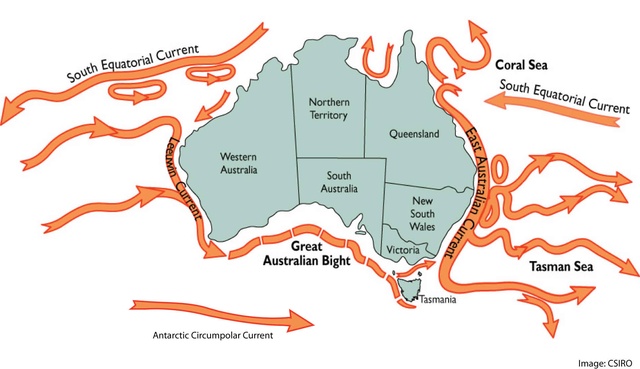
    The main currents around Australia, pictured left, include the East Australian Current (EAC), Leeuwin and Antarctic circumpolar currents (Image: CSIRO).

    What affects the movement of water in the ocean? If you think of a current flowing in a river, the direction of the current is effectively downhill with gravity causing the water to flow along a path of least resistance into a lake or the ocean. Does the sea work like a river?

    Spending a day by the sea you may notice some ocean currents at work, such as localised rips or larger-scale tidal movements. Currents in the ocean can be quite complicated and may be driven by wind, temperature differences, water densities or tides.

    There are four major currents in Australian waters: the East Australian Current (EAC), the Leeuwin, the Antarctic Circumpolar Current and the Indonesian Throughflow.

    East Australian Current:

    The EAC moves southward from near Fraser Island in Queensland to the eastern shores of Tasmania. Remember the movie Finding Nemo? The EAC is the current that helped Marlin find his way to Sydney. The EAC is usually stronger in summer, when it reaches further south, often bringing with it northern tropical species such as tuna.

    Leeuwin and Zeehan Current:

    Beginning about mid-way down the Western Australian coast, the Leeuwin Current flows south-east across the Great Australian Bight and reaches the west coast of Tasmania as the Zeehan Current. This current is strongest in winter when it has been recorded travelling south, rounding the southern coast and travelling north again as far as Freycinet Peninsula (eastern Tasmania).

    Antarctic Circumpolar Current:

    A third current system, the Global Conveyor Belt, originates in the southern ocean as the Antarctic Circumpolar Current. This is an ocean current created by density and temperature variations in the water, (thermohaline circulation). Thermohaline describes currents that are the result of differences in temperature (thermo) and salinity (haline). As the Antarctic water begins to freeze, very cold and salty water is left behind. The density of this water becomes quite high and it sinks below the surface (euphotic zone), deep into the ocean, and moves toward the equator. Eventually this water will warm, and as it does, it rises to the surface bringing with it nutrients from the deep.

    The Indonesian Throughflow:

    This current brings warm water from the Pacific to the Indian Ocean via Indonesia. This is unique because it is the only area in which warm water from the equator flows from one ocean to another. It is an important source of heat transport to the Indian Ocean.

    Links and further Information:

    CSIRO currents showing the latest maps http://www.cmar.csiro.au/remotesensing/oceancurrents/

    CSIRO animation of the currents circumnavigating Australia http://www.cmar.csiro.au/currents/animations.htm

    Integrated Marine Observing System: http://oceancurrent.imos.org.au/

    CSIRO website Australasian ocean currents fact sheet: http://www.csiro.au/resources/AustralasianOceanCurrents.html

    http://www.csiro.au/en/Outcomes/Climate/Understanding/AustralasianOceanCurrents.aspx

    Seas at the Millennium: An Environmental Evaluation, The Tasmanian Region CH 95, Ed C.Sheppard

    Hobday, A. J., E. S. Poloczanska, and R. J. Matear (eds) (2008). Implications of Climate Change for Australian Fisheries and Aquaculture: a preliminary assessment. Report to the Department of Climate Change, Canberra, Australia. August 2008.

  • SF Bay Area building demolition fuels quake study

    SF Bay Area building demolition fuels quake study

    • Like
    • Dislike
    Associated Press

    MIHIR ZAVERI 3 hours ago Nature
    Workers walk away from Warren Hall on the California State University, East Bay Hayward Campus Thursday, Aug. 15, 2013, in Hayward, Calif. The 13-story Warren Hall, which opened in 1971, was determined by the California State University Seismic Review Board to be the most vulnerable building in the CSU system, and will be demolished on Saturday, Aug. 17, 2013. (AP Photo/Ben Margot)

    .View gallery

    • .
    • .

    HAYWARD, Calif. (AP) — Every time the ground trembles in the San Francisco Bay Area, people ask themselves: Could this be the big one?

    For years now, the region has been bracing for a major earthquake that many worry could level vulnerable schools, hospitals and apartment buildings and unleash near-apocalyptic chaos. The U.S. Geological Survey estimates there is a 63 percent chance of a major earthquake in the region within the next three decades.

    On Saturday, scientists hope to get one-up on the looming temblor, courtesy of the demolition of a university building.

    Workers plan to implode the 13-story Warren Hall, a fixture of the East Bay hillside and of Cal State East Bay, which was built about 2000 feet from what researchers call one of the most dangerous fault lines in the country: the Hayward fault.

    The building is expected to crumple into 12,500 tons of concrete and steel, which will slam against the ground sending out shockwaves similar to a magnitude-2.0 earthquake. Scientists have placed more than 600 seismographs in concentric circles within a mile of the building to pick up the vibrations.

    View gallery.”

    United States Geological Survey Physical Science technician …

    United States Geological Survey Physical Science technician Coyn Criley installs seismographs Thursd …

    USGS scientists hope the unique experiment will help map out where the ground might shake the most when the big one hits.

    “We’re just getting an idea of the distribution of the shaking,” said Rufus Catchings, the lead USGS scientist on the project.

    Many vividly remember the magnitude-6.9 Loma Prieta earthquake in 1989 that killed 63 people, injured almost 3,800, caused up to $10 billion damage, including a collapsed freeway that killed dozens of drivers. That quake was centered near Santa Cruz, about 50 miles south of here.

    But in the East Bay, the Hayward fault — which runs through East Bay cities and under the University of California, Berkeley’s football stadium — is the most likely to act up and cause a major earthquake in the next few decades, experts say.

    The last major temblor on the Hayward fault was in 1868, Catchings said. He said the fault triggers a major earthquake every 140 years on average.

    View gallery.”

    United States Geological Survey research geophysicist …

    United States Geological Survey research geophysicist Rufus Catchings gestures as he holds a seismog …

    And it’s not just the fault line residents have to worry about. Additional fault lines —called traces — split off from the main fault, and the location of many is unknown. The vibrations set off by Warren Hall’s implosion will help scientists figure out where they are.

    “In the event of a large earthquake, oftentimes it’s not just one break in the ground, it’s spread out over some distance,” Catchings said. “You’d kind of like to know where all these things are if you really want to understand the hazard.”

    Mark Salinas, Hayward’s mayor pro tem, said knowing where the ground shakes will help the city decide where to put new housing and other buildings. “This data, when it’s available, will inform us on future development,” he said.

    The idea to use the building’s demolition came from Luther Strayer, a geology professor at the university who called the USGS to see if they would be interested.

    “Anybody in my position who is trained like I am would have recognized the opportunity,” Strayer said. “That’s really the cool part; it was sort of a simple obvious thing to do.


  • Aragonite saturation state dynamics in a coastal upwelling zone

    Aragonite saturation state dynamics in a coastal upwelling zone

    Published 16 August 2013 Science Leave a Comment
    Tags: , ,

    Coastal upwelling zones may be at enhanced risk from ocean acidification as upwelling brings low aragonite saturation state (ΩAr) waters to the surface that are further suppressed by anthropogenic CO2. ΩAr was calculated with pH, pCO2, and salinity-derived alkalinity time series data from autonomous pH and pCO2 instruments moored on the Oregon shelf and shelf break during different seasons from 2007 to 2011. Surface ΩAr values ranged between 0.66 ± 0.04 and 3.9 ± 0.04 compared to an estimated pre-industrial range of 1.0 ± 0.1 to 4.7 ± 0.1. Upwelling of high-CO2 water and subsequent removal of CO2 by phytoplankton imparts a dynamic range to ΩAr from ~1.0 to ~4.0 between spring and autumn. Freshwater input also suppresses saturation states during the spring. Winter ΩAr is less variable than during other seasons and is controlled primarily by mixing of the water column.


    Harris K. E., DeGrandpre M. D. & Hales B., 2013. Aragonite saturation state dynamics in a coastal upwelling zone. Geophysical Research Letters 40: 2720–2725. Article (subscription required).

    Rate this:

    i
    Rate This

    Quantcast

    Share this post!

  • pH evolution in sea ice grown at an outdoor experimental facility

    pH evolution in sea ice grown at an outdoor experimental facility

    Published 16 August 2013 Science Leave a Comment
    Tags:

    The pH of sea ice and brine was experimentally determined during initial ice growth and melt at the Sea-ice Environmental Research Facility (SERF), an outdoor experimental sea ice facility in Winnipeg, Canada. pH measurements were performed potentiometrically and spectroscopically at near-freezing temperatures. Vertical pH profiles from bulk ice cores revealed a consistent C-shaped pattern during columnar ice growth, with highest pH values (> 9) in both exterior (top and bottom) ice sections and in frost flowers, and lowest pH (~ 7) in interior ice sections. Brine pH typically remained below that of the source seawater pH (~8.4). The distinct differences between these ice features and the underlying seawater source demonstrates the effect of the natural freezing process and associated changes in the CO2-carbonate system on the pH of the sea ice environment. Interpreting this effect provides new insight into the conditions leading to CO2 exchange across the ocean-sea ice-atmosphere interface. A conceptual model of pH evolution in seawater, sea ice and brine, and frost flowers is proposed to explain the observed pH characteristics of seawater components during sea ice growth and melt.


    Hare A. A., Wang F., Barber D., Geilfus N.-X., Galley R. J. & Rysgaard S., 2013. pH evolution in sea ice grown at an outdoor experimental facility. Marine Chemistry 154: 46–54. Article (subscription required).

    Rate this:

  • Climate Change And Tsunamis: Ice Melt May Cause Underwater Avalanches, Research Shows

    Climate Change And Tsunamis: Ice Melt May Cause Underwater Avalanches, Research Shows

    Posted: 08/16/2013 4:36 pm EDT  |  Updated: 08/16/2013 7:15 pm EDT

    45
    16
    3
    9
    Get Green Newsletters:

    From Charles Q. Choi, OurAmazingPlanet Contributor:

    If melting ice caps trigger rapid sea level rise, the strain that the edges of continents could experience might set off underwater landslides, new research suggests.

    Submarine landslides happen on every continental margin, the underwater parts of continental plates bordering oceanic plates. These underwater avalanches, which can happen when underwater slopes get hit by earthquakes or otherwise have too much weight loaded onto them, can generate dangerous tsunamis.

    A staggering half of all the Earth moved by submarine landslides over the past 125,000 years apparently happened between 8,000 and 15,000 years ago. “This time period coincides with the period of most rapid sea level rise following the end of the last ice age,” said study co-author Daniel Brothers, a geophysicist at the U.S. Geological Survey’s Coastal and Marine Science Center in Woods Hole, Mass. [10 Tsunamis That Changed History]

    landslide

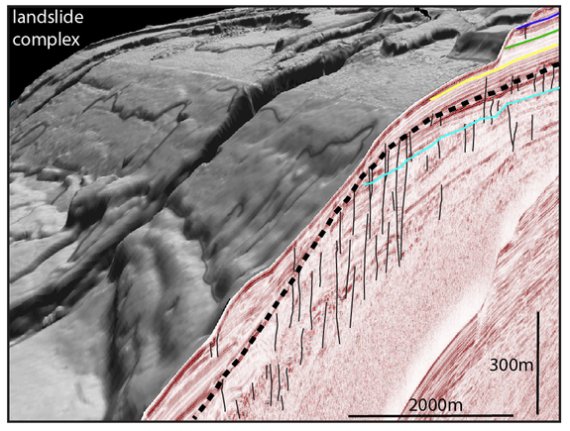
    Example of a submarine landslide complex along the southern New England continental margin, about 100 miles (161 kilometers) south of Cape Cod, Mass. The 3D perspective includes the seafloor seismic imaging. Credit: Daniel Brothers

    Since these prehistoric disasters coincided with changes in climate, previous research suggested natural global warming might have been their cause, but what exactly the link might be was unclear. To learn more, Brothers and his colleagues generated 3D computer models of the effects of 395 feet (120 meters) of sea level rise on the continental margins off North Carolina and Brazil’s Amazon coast.

    The rapid sea level rise that happened between 8,000 and 15,000 years ago was due to melting ice caps, which were originally hundreds to thousands of feet high. These glaciers placed weight on the planet’s rocky surface, building stress on faults in the Earth for millennia. The later thinning and retreat of these glaciers raised sea levels by about 395 feet, increasing the amount of pressure these critically stressed faults experienced across their entire length by an amount similar to that of the average human bite. This would be enough pressure to set off the faults, triggering underwater landslides, the models showed.

    The scientists added that such underwater landslides could have helped release vast quantities of methane, a greenhouse gas, from the seabed. This could have, in turn, driven profound changes in the oceans and the atmosphere, such as the warming of the climate.

    Brothers and his colleagues Karen Luttrell and Jason Chaytor detailed their findings online July 22 in the journal Geology.

    Follow us @livescience, Facebook & Google+. Original article on LiveScience.com.

    Copyright 2013 LiveScience, a TechMediaNetwork company. All rights reserved. This material may not be published, broadcast, rewritten or redistributed.

    Also on HuffPost:

    Loading Slideshow...
    • #10 Madagascar, Indian Ocean

    • #9 Eritrea, Red Sea

    • #8 Pakistan, Arabian Sea

    • #7 Faroe Islands, North Atlantic Ocean

    • #6 Aruba, Southern Caribbean

    • #5 Kiribati, Central Tropical Pacific Ocean

    • #4 Comoros, Indian Ocean

    • #3 Turks And Caicos Islands, Caribbean

    • #2 New Caledonia, Southwest Pacific Ocean

    • #1 Cook Islands, South Pacific Ocean

    • Worst Ocean Acidification in 300 Million Years

      New research suggests that increased carbon emissions have caused the worst ocean acidification in 300 million years.

    Most Vulnerable Nations to Seafood Security Threats from Ocean Acidification
    1 of 12
     Hide Thumbnails
    • Next
     Share
     Tweet
    1 of 12

    Play All

    #10 Madagascar, Indian Ocean
    Like
    Dislike
    45 Points

    49 likes, 4 dislikes
    Advertisement
    ×

    • Contribute to this Story:
    • Send us a tip
    • Send us a photo or video
    • Suggest a correction
  • Scientists continue research into natural gas production from hydrates

    Providing coverage of Alaska and northern Canada’s oil and gas industry


    Where from here?

    Scientists continue research into natural gas production from hydrates

    Alan Bailey

    Petroleum News

    Research into possible future natural gas production from massive worldwide deposits of methane hydrate has reached the stage of planning long-term production tests, with the possibility of some of these tests being conducted on the Alaska North Slope, and with Japan hoping to produce gas from its offshore hydrate resources sometime after 2023, Brian Anderson, a fellow in the Department of Energy National Energy Technology Laboratory and Ray Boswell, Department of Energy technology manager for natural gas technology, told a workshop held on July 31 during the International Association for Energy Economics’ North American conference.


    Ice-like solid

    Methane hydrate, an ice-like solid with methane, the primary component of natural gas, trapped in a lattice of water molecules, is known to exist in huge quantities in many parts of the world. And for a number of years scientists, intrigued by the possibility of turning at least some of this natural resource into a prolific source of gas for fuel, have been researching the nature of various methane hydrate deposits and the practicalities of extracting gas from the material.The material is stable under a certain range of temperatures and pressures, and moving the temperature or pressure out of this range causes the hydrate to decompose into water and gas. And the relatively low temperatures and high pressures required for stability tend to cause hydrate formation in deep ocean seafloors and around the base of the permafrost under land in regions such as the Alaska North Slope where the ground is frozen to substantial depths.


    Vast potential resource

    Boswell said that methane hydrate is thought to exist on most of the world’s continental shelf areas, as well as on land in permafrost regions. There is still a huge range of uncertainty in estimates of worldwide gas volumes locked in methane hydrate deposits but, to give a sense of the possible scale of the resource, the mid-point of that range may be around 350,000 trillion cubic feet, he said.“Gas hydrate is one-third of all potential mobile organic carbon on the planet,” Boswell said.

    The hydrates typically exist as solids in the pores of subsurface rocks and are also found on the seabed as seeps and mounds. But, given the relatively high concentrations of hydrate that can exist in geologically stable sand deposits and the relative ease with which fluids might flow through these sands to a wellbore, research into the commercial development of methane hydrate has focused on areas where the hydrates are deeply buried in sand, Anderson explained.

    The sand deposits likely hold tens of thousands of trillion cubic feet of gas, out of the total of hundreds of thousands of trillion cubic feet that may exist in all types of deposit, he said.


    Detailed assessments

    People have conducted detailed methane hydrate assessments for areas where the hydrate deposits appear especially promising as development targets. One of these areas is the North Slope of Alaska, where the U.S. Geological Survey has estimated a total resource of 85 trillion cubic feet of technically recoverable gas in hydrates around the base of the permafrost. In the Gulf of Mexico, another promising area, the Bureau of Ocean Energy Management has estimated the possibility of 21,000 trillion cubic feet of gas in hydrates in methane hydrate deposits of all kinds, with perhaps 6,700 trillion cubic feet of this in sand-based deposits, Boswell said. The Bureau has not yet assessed how much of this Gulf of Mexico resource might be technically recoverable, he said.A similar assessment by the Japanese for the Nankai Trough, a region offshore southeast Japan that perhaps represents 10 percent of Japan’s prospective areas for methane hydrate, found the possibility of 40 trillion cubic feet of gas in place in hydrates, with perhaps 20 trillion cubic feet of that total resource existing in sand-based deposits.


    Production techniques

    Production of gas from any of these resources would require the deliberate destabilizing of the hydrates, to cause the hydrates to break down into water and methane, releasing the methane into a production gas well. And, although it might be possible to achieve this destabilization by injecting some suitable chemical into the hydrate or by heating the hydrate using steam or hot water, the most practical approach seems to involve reducing the pressure in the hydrate-bearing sand reservoir, Anderson said.Essentially, a well would be drilled into the hydrate reservoir and the reservoir pressure reduced by pumping free water from the reservoir up the well. The pressure reduction would cause the hydrates to start to disassociate, generating methane and additional water. By continuing to pump water out of the well, the reservoir pressure would be maintained at too low a level for hydrate stability, thus causing more hydrate to disassociate, more water to form and methane to pass up the well.

    One variant of the process might be operable when a solid hydrate layer lies over free gaseous methane in a subsurface reservoir — the necessary pressure reduction would be achieved by pumping free gas up a well from the reservoir, with the subsequent hydrate disassociation releasing gas to continuously replenish the gas reservoir.

    The snag with these apparently simple processes is that the disassociation reaction absorbs heat, thus cooling the reservoir and perhaps inhibiting further disassociation. Thus, for continuous gas production during depressurization heat would need to flow in from the reservoir surroundings.


    Test wells

    In 2002 a test in a methane hydrate well in northwestern Canada called the Mallik well attempted methane production through the application of hot water to the hydrate reservoir but found this technique to be ineffective, Anderson said. However, another different test demonstrated that the hydrates could be disassociated through depressurization without the artificial application of heat, a result representing a major breakthrough in methane hydrate research, he said.In 2007 BP, the Department of Energy and the U.S. Geological Survey drilled the Mount Elbert methane hydrate stratigraphic test well at Milne Point on the Alaska North Slope. Tests in this well demonstrated the possibility of de-pressuring the hydrates and thus releasing methane by extracting free water from the hydrate reservoir, Anderson said.

    And in 2008 a new test in the Mallik well succeeded in producing about 13,000 cubic meters of gas over a six-day period using depressurization, he said.


    Carbon dioxide injection

    In 2012 ConocoPhillips, the Department of Energy and a Japanese company conducted a test in the Ignik Sikumi methane hydrate well in the Prudhoe Bay unit on the North Slope to try a combination of depressurization and carbon dioxide injection as a means of methane production from hydrates. The carbon dioxide would displace some of the methane in the hydrate, thus releasing methane in a reaction that generates rather than absorbs heat.The test, involving the injection of nitrogen as well as carbon dioxide, resulted in the production of about one billion cubic feet of a mixture of methane, carbon dioxide and nitrogen, with less carbon dioxide produced than injected, Anderson said.

    In 2013 the Japanese drilled a methane hydrate production test well in the Nankai Trough and used a depressurization technique to produce about 706,000 cubic feet per day of gas over a six-day period, Anderson said.

    But, despite the success of these various tests, people do not yet know what would happen if production were to be attempted over extended time periods and, hence, whether commercial scale production over perhaps several years would be possible. Much more field testing needs to be done to demonstrate the long-term viability of methane hydrate as an energy source, Boswell said.

    Meantime researchers have been using the detailed information obtained from the various well tests done to date to use computer models to simulate possible long-term production scenarios, Anderson said. And results so far for North Slope on-land scenarios indicate that production will be highly sensitive to the condition of the methane hydrate reservoir but that gas production rates in the order of one million to tens of millions of cubic feet per day, with cumulative production of tens of billions of cubic feet per well, may be achievable. The modeling of production from known deposits in the Gulf of Mexico indicates possible offshore production rates of 50 million to 60 million cubic feet per day, Anderson said. But offshore drilling is much more expensive than onshore drilling, he pointed out.

    Simulations have also tested the potential to use horizontal wells to increase gas production rates from methane hydrate resources and to evaluate the strain that production places on the reservoir rock, Anderson said.


    Long-term tests

    The next step in hydrate research is to identify optimum sites with appropriate geology for field production tests over relatively long timeframes, Anderson said. Boswell also commented on the need for much additional exploration, confirming, delineating and characterizing methane hydrate resources.With the North Slope being an ideal location for methane hydrate testing, the Department of Energy is interested in further research in the region. The department has signed a memorandum of understanding with the State of Alaska for methane hydrate research in the state. The state has also set aside some North Slope land tracts for possible methane hydrate production testing. The Department of Energy would also like to confirm the existence of methane hydrate resources on the U.S. Atlantic coast and to continue a methane hydrate exploration drilling program that the department started in the Gulf of Mexico, Boswell said.


    International interest

    With international interest in methane hydrate development, as several countries seek some level of energy independence, plans for methane hydrate production testing are moving ahead in different parts of the world. Japan, having conducted its initial test drilling in the Nankai Trough, is preparing to conduct a longer-term offshore production test in 2015. Japan aims to complete the technical development of methane hydrate production by 2018, with a view to starting commercial production from its offshore resources at some time after 2023, Boswell said. South Korea wants to do a field test of its offshore resources within the next couple of years or so. China and India are conducting research into developing their methane hydrate resources, and several other countries around the world are also conducting methane hydrate research