Great lecture by Dr. Jeremy Jackson on damage to our oceans.
@ARTHURSLEA @Mark_Butler_MP Yep, I know. Watch this Jeremy Jackson lecture.Best I’ve watched for eco & climate detail http://youtu.be/2zMN3dTvrwY
Great lecture by Dr. Jeremy Jackson on damage to our oceans.
@ARTHURSLEA @Mark_Butler_MP Yep, I know. Watch this Jeremy Jackson lecture.Best I’ve watched for eco & climate detail http://youtu.be/2zMN3dTvrwY
Nature Climate Change | Editorial
As the journal’s first impact factor is released, it is time to reflect on journal metrics and how Nature Climate Change has been making its mark.
“The impact factor is one of the most recognized metrics and is a measure of a journal’s influence.”
How time flies. The first issue of Nature Climate Change appeared in April 2011, and the journal — a monthly publication — is now well into its third volume. By the time this issue goes to press, we should have received our first impact factor from Thomson Reuters1. The impact factor is one of the most recognized metrics and is a measure of a journal’s influence. It is calculated on two years’ worth of citation data. The impact factor released in 2013 is for 2012; it is calculated on citation counts in 2012 of papers published in 2010–2011, divided by the number of ‘citable items’ published in that period. Citable items — typically considered to be research papers and review articles — may not include all of the journal content that has been cited, Commentary and Policy Watch pieces would be excluded, for example.
The importance of impact factors is much debated, with a feeling that too heavy an emphasis is placed on this single number. A small number of very highly cited papers can strongly influence the final number, and the citation is not rated on being positive or negative, so a highly criticized paper may inflate the value.
Further criticisms of the impact factor include the timeframe — it only looks at the first two years of citations for any given paper, so the longer-term impact of work is not measured; and coverage — citations in books, conferences, reports, policy documents, working papers and the media — is not taken into account. Different dynamics, including publishing timelines and formats, across research disciplines result in different citation rates, meaning that comparison across fields is not possible. The social sciences are not well represented by impact factors; a study has shown that they often have artificially low numbers and are better ranked by other metrics2. Thomson Reuters recognises this and there is a Social Science Citation Index, covering over 4,000 journals and 50 disciplines in the social sciences, for better comparison in these fields3.
Another tool for measuring journal performance is the h5-index used by Google Scholar, which provides greater coverage of citations including books, conference and working papers4, 5. One advantage of the h5-index is that it is based on five years’ worth of data, rather than just two, which should make it more reliable; on the other hand a new journal would have to wait this period of time before receiving its first h5-index ranking.
All metrics have shortcomings, are still used as they provide a value for something that is difficult to define. Regardless, Nature Climate Change papers have attracted attention across the scientific and broader community in ways that might not be captured by a single number.
Nature Climate Change publishes across the climate change disciplines and it is pleasing that papers from all fields are being recognized in the scientific community. Our most cited paper is about coral reefs and ocean acidification6, with another marine ecology paper — ‘Coral and mollusc resistance to ocean acidification adversely affected by warming’7 — also being well cited. A top social science paper is ‘The role of social and decision sciences in communicating uncertain climate risks’8. The physical sciences are also represented, for example ‘Global radiative forcing from contrail cirrus’9 and a paper on the historical interdecadal modulation of El Niño Southern Oscillation10. Citation counts vary between the ISI Web of Science and Google Scholar due to the different coverage. As is to be expected, papers from our first year, 2011 to early 2012, dominate as they have had longer to accumulate citations.
The Nature Climate Change papers that have received the most press coverage are not necessarily those that are the most cited. Papers that have been reported in the media come from many sections of the journal and are varied in subject area. Examples include a paper on the impacts of wind farms on land surface temperature11, a Perspective on shrinking body size as an ecological response to climate change12 and a paper on a hotspot of sea-level rise13. Other top stories picked up by the media include a very highly cited Correspondence on the rapid growth in carbon dioxide emissions after the global financial crisis of 2008–200914, and more recently a paper on intensification of turbulence affecting air travel over the Atlantic, which received worldwide interest15. Many more Nature Climate Change papers have featured in the press, as well as in digital and social media.
The impact of published research on policy and working papers is harder to gauge, however feedback from authors and reviewers indicates that papers from the journal are being referenced outside academia. We expect several papers from the journal to feature in the upcoming Intergovernmental Panel on Climate Change Assessment Report Five, with ‘The Physical Science Basis’ expected in September of this year, followed by ‘Impacts, Adaptation and Vulnerability’ and ‘Mitigation of Climate Change’ early next year and the Synthesis Report in October 2014. Another report, the US National Climate Assessment — currently in draft form but closed for comments16 — references several Nature Climate Change papers.
Nature Climate Change is establishing itself as a resource of climate change information for scientists and the broader community. Although measuring the success of a publication is a complex process, the impact factor represents a key indicator of influence. The release of our first impact factor is therefore an exciting milestone for the journal.
We are seeing conflicting scientific reports. Which one is correct?

Share
 |
 The dramatic loss of Arctic sea ice this summer is just one of the signs global warming has not stopped, scientists say. The dramatic loss of Arctic sea ice this summer is just one of the signs global warming has not stopped, scientists say.Credit: Jeremy Potter NOAA/OAR/OER |
A scientific controversy erupted this week over claims that methane trapped beneath the Arctic Ocean could suddenly escape, releasing huge quantities of methane, a greenhouse gas, in coming decades, with a huge cost to the global economy.
The issue being debated is this: Could the Arctic seafloor really fart out 50 billion tons of methane in the next few decades? In a commentary published in the journal Nature on Wednesday (July 24), researchers predicted that the rapid shrinking of Arctic sea ice would warm the Arctic Ocean, thawing permafrost beneath the East Siberian Sea and releasing methane gas trapped in the sediments. The big methane belch would come with a $60 trillion price tag, due to intensified global warming from the added methane in the atmosphere, the authors said.
But climate scientists and experts on methane hydrates, the compound that contains the methane, quickly shot down the methane-release scenario.
“The paper says that their scenario is ‘likely.’ I strongly disagree,” said Gavin Schmidt, a climate scientist at the NASA Goddard Institute for Space Studies in New York.
An unlikely scenario
One line of evidence Schmidt cites comes from ice core records, which include two warm Arctic periods that occurred 8,000 and 125,000 years ago, he said. There is strong evidence that summer sea ice was reduced during these periods, and so the methane-release mechanism (reduced sea ice causes sea floor warming and hydrate melting) could have happened then, too. But there’s no methane pulse in ice cores from either warm period, Schmidt said. “It might be a small thing that we can’t detect, but if it was large enough to have a big climate impact, we would see it,” Schmidt told LiveScience.
David Archer, a climate scientist at the University of Chicago, said no one has yet proposed a mechanism to quickly release large quantities of methane gas from seafloor sediments into the atmosphere. “It has to be released within a few years to have much impact on climate, but the mechanisms for release operate on time scales of centuries and longer,” Archer said in an email interview.
Methane has a lifetime of about 10 years in the atmosphere before it starts breaking down into other compounds. [What are Greenhouse Gases?]
Defending new model
Today (July 26), Peter Wadhams, a co-author of the Nature commentary, defended the work against critics in an essay posted online.

 When brought to the surface, methane gas will escape from the hydrate and can be burnt off as seen in this picture.
“The mechanism which is causing the observed mass of rising methane plumes in the East Siberian Sea is itself unprecedented, and the scientists who dismissed the idea of extensive methane release in earlier research were simply not aware of the new mechanism that is causing it,” wrote Wadhams, an oceanographer at the University of Cambridge in the United Kingdom.
“But once the ice disappears, as it has done, the temperature of the water can rise significantly, and the heat content reaching the seabed can melt the frozen sediments at a rate that was never before possible,” Wadhams added. “David Archer’s 2010 comment that ‘so far no one has seen or proposed a mechanism to make that (a catastrophic methane release) happen’ was not informed by the … mechanism described above. Carolyn Ruppel’s review of 2011 equally does not reflect awareness of this new mechanism,” Wadhams wrote.
But Ruppel, a methane hydrate expert at the U.S. Geological Survey who authored a review of research on gas hydrates in 2011, also called the sudden-thawing scenario unrealistic.
“I would say it’s nearly impossible,” Ruppel, chief of the USGS Gas Hydrates Project in Woods Holes, Mass., told LiveScience.
Methane: microbial or hydrate?
Much of the Arctic’s methane sits in permafrost buried under hundreds of meters of seafloor sediments, Ruppel said. The deposits formed on exposed ground during the last Ice Age, when sea levels were lower. The rising seas have been warming the deposits for millennia. Any added warming will have to work down through the thick sediment cap.

 On this cross-section running from onshore to deep-water ocean basin, gas hydrates occur in and beneath permafrost that is located onshore and on continental shelves flooded over the past 15,000 years due to sea level rise. For the deep-water system, the gas hydrate zone vanishes on upper continental slopes before thickening seaward in the shallow sediments with increasing water depth.
Much of the modeling predictions in the Nature commentary were based on recent discoveries of rising methane plumes in the East Siberian Sea. However, those plumes may be from methane hydrates or from microbes.
“Methane release in the Arctic from both marine and terrestrial sources is expected to increase with warming climate, as documented in numerous papers,” Ruppel said. “Much of the methane may actually be produced in the shallow sediments by microbial processes and be completely unrelated to methane hydrates.”
However, there has yet to be a detectable change in Arctic methane emissions in the atmosphere over the past two decades, Ed Dlugokencky, a research scientist with the National Oceanic and Atmospheric Administration’s Earth System Research Laboratory, said in an email interview.
Email Becky Oskin or follow her @beckyoskin. Follow us @livescience, Facebook & Google+. Original article on LiveScience.com.


Becky was a science reporter at The Pasadena Star-News. She has freelanced for New Scientist and the American Institute of Physics and interned at Discovery News. She earned a master’s degree in geology from Caltech, a bachelor’s degree from Washington State University, and a graduate certificate in science writing from the University of California, Santa Cruz. To find out what her latest project is, you can follow Becky on Google+.


SUBSCRIBE
 Copyright © 2013 All Rights Reserved.

Can we all stop worrying about global warming? According to a recent rash of stories in the media, the “climate sensitivity” – the extent to which temperatures respond to more carbon dioxide in the atmosphere – is lower than expected, and thus that the world won’t get as hot as predicted. One story, in The Economist, based on leaked information from a draft of the next assessment by the Intergovernmental Panel on Climate Change, claims the IPCC will revise its sensitivity estimate downwards when they release their official report this September.
The sceptics have mounted a concerted campaign to persuade journalists and politicians that climate scientists now think that climate sensitivity is lower, says Bob Ward of the Grantham Research Institute on Climate Change and the Environment, London. But is there any truth to the claims?
Climate sensitivity refers to how much the world will warm if carbon dioxide levels double. But this apparently simple concept is slippier than a Turkish wrestler. As the planet warms in response to rising CO2 levels, a whole series of feedbacks kick in over the following decades, centuries or millennia. Depending on which feedbacks are included and what the timescale is, there are many competing ways of defining sensitivity. To add to the confusion, there are also dozens of ways of calculating it.
One way is to look at how much warming there has been in response to rising CO2 levels over the past century. But this approach has all kinds of problems. For starters, we have been pumping out all kinds of pollutants, some of which may be masking the effect of CO2.
What’s more, in the last decade, CO2 levels have continued to rise but with little surface warming. Such lulls are expected and the latest is probably a blip, due to the oceans soaking up more heat than usual. Unsurprisingly, this means that any sensitivity estimate that includes the past decade will produce a lower value than any calculated without taking the last decade into account, says Reto Knutti of the Institute for Atmospheric and Climate Science in Zurich, Switzerland. He co-authored one such study published earlier this year, which concluded that “equilibrium sensitivity” – usually taken to mean the warming expected after several decades of doubled CO2 – is between 1° C and 5° C, most likely 2° C.
Another way to calculate sensitivity is to look at how global temperatures changed thousands or millions of years ago in response to changing CO2 levels. Such studies point to a higher value for equilibrium sensitivity, closer to 3° C, says Knutti, who reviewed the evidence last year. But there are all kinds of problems with this approach too, such as the uncertainties about what the world was like in the past.
A third way to calculate sensitivity is to use climate models, which point to even higher values for equilibrium sensitivity, between 2.2 and 4.7° C, says Knutti: “Above 3 °C at least.” But there’s a lot missing from the models. For one thing, most only include fast feedbacks such as the effect of water vapour. They don’t include slower feedbacks such as increasing vegetation, or the risk of a sudden methane “belch” as the Arctic warms.
The bottom line is that there is no new consensus that climate sensitivity is lower than previously thought, says Knutti. The observed trend points to lower values because of the recent slowdown, but other evidence continues to support higher values.
The last IPCC report stated that equilibrium climate sensitivity was between 2 and 4.5 °C, mostly likely 3 °C. The Economist claims the IPCC’s next report will give a figure between 1.5 and 4.5 °C, with no most likely value. The IPCC won’t confirm or deny it, but it’s not a huge change if it is true.
“What matters for avoiding dangerous climate change is the upper end, and that hasn’t changed,” says Knutti. Ward makes the same point. “We can’t afford to gamble on sensitivity definitely being low,” he says.
But will it all be a huge waste if sensitivity does turn out to be low? Far from it. If we don’t cut emissions, Knutti points out, all low sensitivity means is that it will take a decade or two longer for the planet to warm as much as it would if sensitivity was high.
|
Inbox
|
x | |||

|
1:22 PM (6 hours ago)
 |
|
||
|
||||
Your details have not been shared with Solar Citizens or Xavier Mayes.
Dear GetUp member,
About two years ago my partner and I moved from the city and bought our first house in Faulconbridge. Within a month the hot water system gave out! But rather than only looking at it as a hit to our bank balance, it was the push we needed to invest in solar hot water. It was great to know the sun was heating our water each day for free instead of paying for dirty coal power. And, I love my hot water so much that we decided to put in solar panels, as well.
I am one of 5,777 people in the Blue Mountains-Hawkesbury area who have made the switch to solar. We are taking power generation back into our own hands. And an energy revolution is underway. But there is so much more that needs to be done for us to get to a clean, renewable energy future.
Through Solar Citizens, I’m working together with members of our community to reach out to solar voters, and demonstrate to candidates that the people of Macquarie want more solar. We are going to make sure Louise Markus, Susan Templeman and the rest of the candidates who want to represent us are clear that solar is important to the voters of Macquarie. Will you join us?
Come along to one of our upcoming information nights, and we’ll let you know how you can help ensure that solar stays strong in Australia. The information nights will be fun and inspiring, and, we’ll share the plan to make sure solar power is front and centre this election.
Info night details:
When: Tuesday 30 July, 6.30 – 8pm
Where: Mid Mountains Neighbourhood Centre, Lawson
RSVP and map: www.solarcitizens.org.au/macquarie_info_night_lawson
When: Wednesday 31 July, 6.30 – 8pm
Where: Richmond Club, Richmond
RSVP and map: www.solarcitizens.org.au/macquarie_info_night_richmond
Everyone is welcome.
This election is crucially important for Australia’s renewable energy future. In our marginal electorate of Macquarie there are five candidates who are asking for our vote, and all of them have different views on what kind of energy path we go down – whether we see the continued roll out of wind and solar, or stick to more coal and gas.
This seat’s election race will be one of the most interesting in New South Wales. The media is watching it closely. It will only take only a little over 1000 votes for the seat to change hands. And there are over 11,000 solar voters. That gives those of us who support a solar-powered future a huge opportunity.
Solar Citizens is a new community organisation, but in a few months, we’ve managed great things. Thousands of Solar Citizens came together in Queensland to stop the Newman Government from penalising solar owners, and we’re now fighting in other states to ensure a sunny future.
We know that people power has the ability to influence policy – and that’s why we need your voice in Macquarie.
We look forward to seeing you sometime next week!
Yours for a sunny future,
Xavier Mayes, Solar Citizens
PS from GetUp – Interested in going solar? Already 155 GetUp members have installed panels on their roof as part of our solar campaign with Sungevity. Click here to be part of it http://au.sungevity.org/getup
GetUp is an independent, not-for-profit community campaigning group. We use new technology to empower Australians to have their say on important national issues. We receive no political party or government funding, and every campaign we run is entirely supported by voluntary donations. If you’d like to contribute to help fund GetUp’s work, please donate now! If you have trouble with any links in this email, please go directly to www.getup.org.au. To unsubscribe from GetUp, please click here. Authorised by Sam Mclean, Level 2, 104 Commonwealth Street, Surry Hills NSW 2010. 
|
Reply |
Forward |
This is the story of two Australian men, both 27, drunk and in trouble with the law. Their respective treatment neatly encapsulates a tale of two Australias

This is the story of two Australian men, both 27, drunk and in trouble with the law.
On 7 April, Liam Danial Sweeney attended a friend’s birthday drinks at Crown Casino in Melbourne. According to the prosecution, Sweeney had been ignored when he attempted to shake another guest’s hand, and stewed on this “insult” for a couple of hours. At midnight, under the influence of alcohol, he reportedly engaged in an “unprovoked and gratuitous” assault of the man, Richard Huiswaard. Sweeney smashed a wine glass into Huiswaard’s face, and then punched him twice in the head. The defence argued that Huiswaard had made comments about Sweeney’s mother, implying he was gearing up to a fight.
Huiswaard was bleeding, but Sweeney did not stop to render assistance, nor to speak to police. Again according to prosecutors, he instead “fled the scene like a coward“. Huiswaard was left needing stitches in his head and three weeks off work.
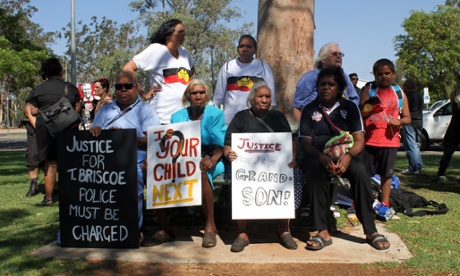
Compare Sweeney with the second 27-year-old Australian man – Mr Briscoe of Alice Springs. Briscoe was also drinking with friends but, unlike Liam Danial Sweeney, had not entered an “unprovoked and gratuitous assault”, glassed someone, or permanently scarred their face when he encountered police on 5 January 2012. He had committed no crime whatsoever when the police chased him, wrestled him to the ground and took him into “protective custody” that evening. It was, in fact, Briscoe who complained of a bleeding headwound when he was locked in a cell.
What follows is a neat encapsulation of the two very different realities faced by the different segments of Australia’s population.
Briscoe’s pleas for treatment for his headwound were ignored by the police. Officers were listening to iPods while other prisoners heard the audible “choking and gasping” that Briscoe was making while he was confined behind bars. The police did not make cell checks as required, despite Briscoe’s bleeding face and severely inebriated state; they surfed the internet instead. Two hours later, when an ambulance was finally called, Briscoe – the 27-year-old man innocent of any crime – was dead.
Sweeney, the 27-year-old who had committed a crime, did not die in police custody once apprehended for his assault. His crime made it to trial, and he pleaded guilty to “intentionally causing injury”, which can carry a sentence of up to 10 years in prison.
But Sweeney will not serve a day. He received an 18-month suspended sentence and a $5,000 fine. The serving magistrate, Jack Vandersteen, explained in sentencing that he did not believe Sweeney “would last very long” in jail. “Not many people are in jail who went to Haileybury,” continued Vandersteen, naming the prestigious private school that educated the kind of young man who glassed and scarred another as the result of a perceived slight.
Vandersteen’s concern was that it may be “extremely devastating” for Sweeney’s parents, one of whom is a barrister himself, to see Sweeney in court. There were concerns, too, about the impact of sentencing Sweeney due to the young man being a lawyer himself. Should he be jailed, he would not be able to practice law, after all.
The death of Briscoe was the subject of a court inquest into police responsibility for his death. Although it was identified that police had committed “errors and failures” that evening, the officers brought before the inquest were “formally disciplined” and not charged.
Briscoe’s family were certainly “extremely devastated” after the finding, and shouted abuse at the police officers as they left court. “He was a young man, didn’t even have a wife and kids, and policemen walk free,” one family member said.
No one needed me to mention that Briscoe was Aboriginal, did they?

 Email
Email