Author: Neville

  • Baby oysters in ‘death race’ with acidifying oceans

    Baby oysters in ‘death race’ with acidifying oceans

    Published 27 July 2013 Media coverage , Web sites and blogs Leave a Comment

    Knocking back a few oysters (along with beers) at Pearl Dive or Hank’s Oyster Bar is a fine way to end a muggy summer day here in Washington D.C. As I passed by the crowd stuffed into Hank’s last night, I remembered that I’d neglected to share a news item from last month that pertains to our beloved bivalve.

    The dispatch is from the Oregon coast, where some of the most delectable oysters grow — or are supposed to. Scientists at Oregon State University have pinpointed a reason for the mysterious die-offs of young oysters in the Pacific Northwest, a phenomenon that threatens the survival of one of America’s prime seafood delicacies.


    Pacific oyster larvae, two days old or younger, are among the shellfish most at risk as the oceans become more acidic, according to a study released in a June issue of Geophysical Research Letters. The release of carbon into the atmosphere, caused by humans’ burning of fossil fuels, is in turn adding carbon to the ocean, changing its chemistry and endangering entire marine food webs.

    During the first two days of life, an oyster’s prime directive is to build a shell of calcium carbonate to protect itself against predators. To do this, it relies entirely on energy from its own egg, as it has not yet developed the ability to feed.

    “They must build their first shell quickly on a limited amount of energy – and along with the shell comes the organ to capture external food more effectively,” said George Waldbusser, a marine ecologist at OSU who was lead author on the study. “It becomes a death race of sorts. Can the oyster build its shell quickly enough to allow its feeding mechanisms to develop before it runs out of energy from the egg?”

    The delicate task is complicated on the U.S. West Coast, where the $73 million oyster industry (pdf) is especially vulnerable to the effects of ocean acidification. There, upwellings from the deep ocean — oversaturated with carbon that makes the water especially acidic — regularly rise to mingle with surface water.

    Many of America’s favorite seafoods, including mussels, crabs, scallops, abalone and lobster, are at risk for perishing in coming decades as their shells fail to develop properly in more acidic ocean water. The scourge also affects tiny plankton that are the base of the food web that produces prized Alaskan salmon.

    On the Oregon coast, adult oysters are not as much under threat, prior studies have found. They have mechanisms that allow them to prosper in spite of large amounts of carbon in the water. Some oyster farms in Oregon have begun adding antacid to the water to create a more favorable environment for the youngest bivalves.

    Another stronghold of oyster production, the Atlantic coast from Maine down to Virginia, has so far seen less acidification. But diseases are on the rise as the ocean gets warmer — another consequence of a warming planet.

    One prized Oregon variety, the Olympia oyster, has recently staged a comeback after being eaten to near extinction. This tiny species, according to The Oregonian, has “an earthy flavor with hints of the wild mushrooms growing in coastal forests and finally, a coppery finish.” Hopefully our grandchildren will be able to enjoy such flavors in the abundance that we do.

    David Ferris, Forbes, 26 July 2013. Article.

    Rate this:

    Rate This

    Share this post!

    0 Responses to “Baby oysters in ‘death race’ with acidifying oceans”

    1. Leave a Comment

    Leave a Reply

    Subscribe to the RSS feed

    Subscribe to Ocean acidification by

  • Oil falling as demand slows, dollar gives support

    Oil falling as demand slows, dollar gives support

    Can the dollar save oil?

    By

    July 26, 2013 • Reprints

    Oil prices (NYMEX:CLU13) started to give in to expectations of slowing demand and a reduction of geo-political risk, but it was the dollar to the rescue. Oh sure some traders are worried about Tropical Storm Dorian and its track that could put it right into the mouth of the Gulf of Mexico next week, but it will be Hurricane Ben Bernanke and his band of merry men and women that may be the major factor. OPEC is showing signs that they will cut production in unison with slowing seasonal demand and Iraq has slowed shipments.

    Oil demand may be questionable short term but long term demand for all energy will be strong. A report by the Energy Information Administration that world energy consumption to increase 56% by 2040 led by Asia. Now in the past this type of report would have brought out the peak oil folks telling us the end was near. Yet with the innovations of new technology now the world can welcome these demand expectations and all of the economic growth and improvement in the quality of life for the people involved. With the U.S. on a path to producing more oil and gas, the technologies that have unleashed an energy revolution will spread throughout the world to rise up and meet the demands of the earth in the future.

    In fact Australia is saying that it might be the next major shale revolution! Energy Bangla writes the U.S. government’s Energy Information Administration noted in its country’s analysis for Australia, “Australia, rich in hydrocarbons and uranium, was the world’s second largest coal exporter in 2011 and the third largest liquefied natural gas (LNG) exporter in 2012. Australia is rich in commodities, including fossil fuel and uranium reserves, and is one of the few countries belonging to the Organization for Economic Cooperation and Development (OECD) that is a significant net hydrocarbon exporter, exporting over 70 percent of its total energy production according to government sources. Australia was the world’s second largest coal exporter based on weight in 2011 and the third largest exporter of liquefied natural gas (LNG) in 2012.” Six months ago Brisbane company Linc Energy Ltd.Energy released two reports, based on drilling and seismic exploration, estimating the amount of shale oil in the as yet untapped 30,000 square mile Arckaringa Basin surrounding Coober Pedy ranging from 3.5 billion to a mind boggling 233 billion barrels of oil.  If the upper end estimates are correct then it means that the Arckaringa Basin is six times larger than the Bakken, seventeen times the size of the Marcellus formation, and 80 times larger than the Eagle Ford U.S. shale deposits.  To put the potential of the Arckaringa Basin in context, Saudi Arabian reserves are estimated at 263 billion barrels.

    Natural gas?  Six basins in Australia stretching from coastal Queensland to Western Australia’s far northwest contain recoverable shale resources of as much as 437 trillion cubic feet of gas, all of which was previously inaccessible because it is contained in shale formations, which could be unlocked by “hydraulic fracturing.” But the U.S. Department of Energy predicts that Australia’s shale gas industry will develop at a “moderate pace” because the nation’s shale oil and gas resources do not as yet have the advanced production infrastructure that has underwritten the U.S. production boom.

    And what if estimates for the Arckaringa Basin pan out? We’ll leave the final word to the EIA, which notes, “Australia’s stable political environment, relatively transparent regulatory structure, substantial hydrocarbon reserves, and proximity to Asian markets make it an attractive place for foreign investment. The government published an Energy White Paper in 2012 that outlines its energy policy including balancing its priority of maintaining energy security with increasing exports to help supply Asia’s growing demand for fuel.”

    Tropical Storm Dorian is hanging in there as it moves across the Atlantic, according to the U.S. National Hurricane Center. The storm may weaken over cool waters but still could be a threat. Stay tuned!  Bring on the Fed!

    About the Author

    Phil FlynnPhil Flynn

    Phil Flynn is senior energy analyst at The PRICE Futures Group and a Fox Business Network contributor. He is one of the world’s leading market analysts, providing individual investors, professional traders, and institutions with up-to-the-minute investment and risk management insight into global petroleum, gasoline, and energy markets. His precise and timely forecasts have come to be in great demand by industry and media worldwide and his impressive career goes back almost three decades, gaining attention with his market calls and energetic personality as writer of The Energy Report. You can contact Phil by phone at (888) 264-5665 or by email at pflynn@pricegroup.com. Learn even more on our website at www.pricegroup.com.


    Futures and options trading involves substantial risk of loss and may not be suitable for everyone. The information presented by The PRICE Futures Group is from sources believed to be reliable and all information reported is subject to change without notice.


  • The five most important people for renewables

    The five most important people for renewables

    By Bill White

    wind transmission lines
    Shutterstock

    Five people will make a decision soon that will have an outsized impact on the future of renewable energy in America. I’m not talking about big shots like Obama, Koch, Boehner, Bloomberg, or Steyer. I’m talking about names many have never heard of:  Moeller, Norris, LaFleur, Clark, and Binz (if he is confirmed). These are the chief electricity officers of the United States of America — they are the commissioners of the Federal Energy Regulatory Commission (FERC).

    You’ve probably heard this before: “Scientists agree that in order to avoid the worst consequences of climate change, we must generate 80 percent of our energy from renewable sources by 2050.”  No single entity will play as crucial a role as FERC in ensuring that the infrastructure exists to handle new renewable energy generation.

    President Obama’s climate plan is a courageous step forward and deserves the widespread media coverage it has received. But only the acceleration of utility-scale renewable energy projects can take us where we need to go.

    Modernizing our nation’s power system is a daunting task, but there are good reasons to be optimistic. America has enough wind and solar to power the entire country more than a dozen times over. And with the cost of wind and solar going down every day, rapid development of large-scale generation projects appears inevitable.

    But if you place the map of regions with the best wind and solar energy on top of a map of our current transmission system, you won’t find too much overlap. Transmission is the key to unlocking America’s virtually unlimited renewable resources and delivering their energy to users.

    Unlike our interstate highway system, which is funded by taxpayers, high-voltage transmission lines are built with private capital. Investors will put money into transmission projects as long as they generate returns that are attractive relative to similar types of investments. This is where FERC steps in. They set the return on equity (ROE) for transmission projects across the nation.

    As you might imagine, the higher the ROE, the more incentive there is to build transmission. A company would never invest in our grid if the maximum ROE was 1 percent — meaning it would take 100 years to recoup the costs of a project. And if it was 100 percent, we would end up building much more transmission than we need and sticking consumers with the bill.

    Recent history also tells us that the cost of inadequate transmission is steep. Electric customers are still paying billions of dollars per year for congestion, poor reliability, and overpriced power from dirty, outdated, and inefficient power plants — all of which are the direct result of three decades of underinvestment in transmission. Renewable energy was locked out of a strained and inadequate grid. In the mid-2000s, FERC recognized the chronic neglect of transmission investments as a major burden on ratepayers and a barrier to modernizing our electric system, and stepped in to raise transmission ROEs.

    That decision helped spur a wave of new transmission investments that are reducing costs to consumers and expanding access to renewable energy. For example, the Midwest ISO has begun a new set of transmission lines called the MVP projects. The average consumer is seeing $23 in savings for every $11 spent these new lines.

    Why is transmission such a great deal for electric customers? It’s the smallest part of an electric bill — 11 percent on average — compared with 58 percent for generation and 31 percent for distribution. Transmission pays for itself quickly by relieving costly congestion, moving cheap and clean renewable power to customers, making the grid more reliable and secure, and putting old and inefficient power plants out of business. Simply put, transmission is essential infrastructure for competition, consumer choice, economic efficiency, and environmental protection.

    Despite the well-documented value that transmission investments deliver to ratepayers and the environment, FERC has been hearing complaints recently that ROEs for transmission projects are too high, and that ratepayers need relief. These complaints are misguided, and their timing could not be worse. Never in our history has so much depended on expanding and modernizing our electric transmission system.

    Our chief electricity officers may never get the ROE for transmission “just right”; the uncertainty of markets, interest rates, and the economy probably make that lofty goal impossible to achieve. But they can — and they must — ensure that ROEs remain at levels that ensure a steady and stable flow of private capital into urgently needed transmission investments. Failing to do so would stall renewable energy development and with it progress on reducing emissions, and would increase the cost of electricity for everyone.

    The president’s climate plan is moving forward. State renewable energy standards are helping expedite that progress. The falling costs of wind and solar are driving growth. But none of that will matter if the infrastructure to deliver renewable energy to customers is not built.

    Five FERC commissioners will make a little-noticed decision in the near future, one that will either keep us on the right track, or throw a major obstacle — one that we can ill-afford — on the road to achieving our nation’s renewable energy future and stabilizing our world’s climate.

    Bill White manages the National Clean Energy Transmission Initiative for the Energy Future Coalition. During the Clinton administration, he served as senior advisor to EPA Administrator Carol Browner.

  • Alaska’s latest climate worries: Massive wildfires and gushing glaciers

    Alaska’s latest climate worries: Massive wildfires and gushing glaciers

    By Claire Thompson

    The Mendenhall Glacier's sudden surges of icy water threaten people and property in nearby Juneau.
    Random Michelle
    The Mendenhall Glacier’s sudden surges of icy water threaten people and property in nearby Juneau.

    Some say the world will end in fire, some say in ice. Alaska, by the looks of it, is on track for a double apocalypse.

    The home of Sarah “global warming my gluteus maximus” Palin faces a daunting confluence of climate-related challenges, from rising seas to gushing glaciers to massive wildfires. Even Mayor Stubbs (who we’d expect to be cool about this kind of thing) won’t answer questions about the state’s fate.

    Raging blazes in Arizona and Colorado have dominated wildfire news in recent years, but the biggest fires of the past decade burned in Alaska, which is warming twice as fast as the lower 48 states. There, flames have swallowed more than a half-million acres at a time (that’s 781 square miles) of boreal forest, the landscape of spruce and fir trees dominant below the Arctic Circle. And a new study says that this fiery phase is here to stay. From the L.A. Times:

    A warming climate could promote so much wildfire in the boreal zone that the forests may convert to deciduous woodlands of aspen and birch, researchers said.

    “In the last few decades we have seen this extreme combination of high severity and high frequency” wildfire in the study area of interior Alaska’s Yukon Flats, said University of Illinois plant biology Prof. Feng Sheng Hu. …

    Accelerated wildfire could also unlock vast amounts of forest carbon, contributing to greenhouse gases. “The more important implication there is [that] you’re probably going to release a substantial fraction of the carbon that has been stored in the soil,” Hu said.

    In contrast, Alaska’s Mendenhall Glacier, outside Juneau, threatens to wreak chilly destruction, reports The New York Times:

    Starting in July 2011, and each year since, sudden torrents of water shooting out from beneath the glacier have become a new facet of Juneau’s brief, shimmering high summer season. In that first, and so far biggest, measured flood burst, an estimated 10 billion gallons gushed out in three days, threatening homes and property along the Mendenhall River that winds through part of the city. There have been at least two smaller bursts this year. …

    Water from snowmelt, rain and thawing ice are combining in new ways, researchers said — first pooling in an ice-covered depression near the glacier called Suicide Basin, then finding a way to flow downhill.

    What prompts a surge … is pressure. As water builds up in the basin and seeks an outlet, it can actually lift portions of the glacier ever so slightly, and in that lift, the water finds a release. Under the vast pressure of the ice bearing down upon it, the water explodes out into the depths of Mendenhall Lake and from there into the river.

    The phenomenon is not unique to Alaska. Scientists call it jokulhlaup, an Icelandic word meaning “glacier leap.” Though the name suggests an eccentric backcountry sporting event or maybe an elfin dance move, there’s nothing jolly about it. Mendenhall, unlike most glaciers, is far from isolated: 14 miles from downtown Juneau, it’s one of the most visited glaciers in the world, attracting 400,000 tourists a year. That means that its tendency to leap poses huge risks to people and property, and local officials are scrambling to keep a close eye on it. The city of Juneau kicked in part of the cost to install a pressure transducer, which gauges water buildup and transmits real-time results back to monitors via satellite. Meteorologists say the warmer, wetter weather the Juneau area could see in coming decades could increase runoff and spur more frequent surges.

    If only there were a way to make these glaciers leap on over to the burning boreal forest, where they could actually do some good. I’d suggest some kind of pipeline, but I think they’re all in use.

    Claire Thompson is an editorial assistant at Grist.

  • Ocean acidification papers among the most cited in Nature Climate Change

    Ocean acidification papers among the most cited in Nature Climate Change

    Published 26 July 2013 Science Leave a Comment

    Since the journal Nature Climate Change was launched 3 years ago, two ocean acidification papers are among the most cited ones: Fabricius et al. (2011)
    and Rodolfo-Metalpa et al. (2011).


    Excerpt from the editorial:

    “Nature Climate Change publishes across the climate change disciplines and it is pleasing that papers from all fields are being recognized in the scientific community. Our most cited paper is about coral reefs and ocean acidification6, with another marine ecology paper — ‘Coral and mollusc resistance to ocean acidification adversely affected by warming’7 — also being well cited. A top social science paper is ‘The role of social and decision sciences in communicating uncertain climate risks’8. The physical sciences are also represented, for example ‘Global radiative forcing from contrail cirrus’9 and a paper on the historical interdecadal modulation of El Niño Southern Oscillation10. Citation counts vary between the ISI Web of Science and Google Scholar due to the different coverage. As is to be expected, papers from our first year, 2011 to early 2012, dominate as they have had longer to accumulate citations.”


  • NOAA’s Fairweather Ship Will Set Sail On Ocean Acidification Cruise

    green

    Edition: U.S.


    NOAA’s Fairweather Ship Will Set Sail On Ocean Acidification Cruise

    Posted: 07/26/2013 11:30 am EDT

    28
    2
    3
    2
    Get Green Newsletters:

    By Douglas Main, LiveScience Staff Writer:

    The waters off the Pacific Northwest are becoming more acidic, making life more difficult for the animals that live there, especially oysters and the approximately 3,200 people employed in the shellfish industry.

    Researchers from the National Oceanographic and Atmospheric Administration (NOAA) will set sail Monday (July 29) on a month-long research cruise off the U.S. and Canadian West Coast to see how ocean acidification is affecting the chemistry of the ocean waters and the area’s sea life.

    Ocean acidification occurs when greenhouse-gas emissions cause carbon dioxide to accumulate in the atmosphere and become dissolved in sea water, changing the water’s chemistry and making it more difficult for coral, shellfish and other animals to form hard shells. Carbon dioxide creates carbonic acid when dispersed in water. This can dissolve carbonate, the prime component in corals and oysters’ shells.

    The world’s oceans are 30 percent more acidic than they were before the Industrial Revolution, scientists estimate.

    ocean acidification cruise

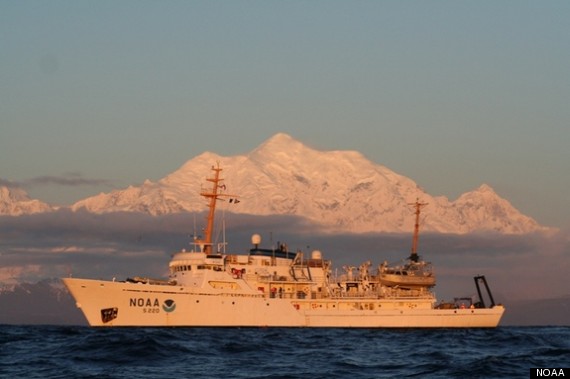
    NOAA Ship Fairweather in the Gulf of Alaska with namesake Mt. Fairweather. Credit: NOAA

    This cruise follows up on a similar effort in 2007 that supplied “jaw-dropping” data on how much ocean acidification was hurting oysters, said Brad Warren, director of the Global Ocean Health Partnership, at a news conference today (July 25). (The partnership is an alliance of governments, private groups and international organizations.)

    That expedition linked more acidic waters to huge declines in oyster hatcheries, where oysters are bred, Warren said. Oyster farms rely on a fresh stock of oysters each year to remain economically viable.

    When the data came in from that cruise, it was “a huge wake-up call,” Warren said. “This was almost a mind-bending realization for people in the shellfish industry,” he said.

    The new cruise will also look at how acidification is affecting tiny marine snails called pteropods, a huge source of food for many fish species, including salmon, said Nina Bednarsek, a biological oceanographer with NOAA’s Pacific Environmental Marine Laboratory.

    The research will take place aboard the NOAA ship Fairweather, which will depart from Seattle before heading north and then looping back south. It will end up in San Diego on Aug. 29. During this time, scientists will collect samples to analyze water chemistry, calibrate existing buoys that continuously measure the ocean’s acidity and survey populations of animals, scientists said.

    The researchers will also examine algae along the way. Ocean acidification is expected to worsen harmful algal blooms (like red tide), explosions of toxin-producing cells that can sicken and even kill people who eat oysters tainted with these chemicals, said Vera Trainer, a researcher at NOAA’s Northwest Fisheries Science Center.

    Email Douglas Main or follow him on Twitter or Google+. Follow us @livescience, Facebook or Google+. Article originally on LiveScience.com.

    Copyright 2013 LiveScience, a TechMediaNetwork company. All rights reserved. This material may not be published, broadcast, rewritten or redistributed.

    Also on HuffPost:

    • #10 Madagascar, Indian Ocean

    • #9 Eritrea, Red Sea

    • #8 Pakistan, Arabian Sea

    • #7 Faroe Islands, North Atlantic Ocean

    • #6 Aruba, Southern Caribbean

    • #5 Kiribati, Central Tropical Pacific Ocean

    • #4 Comoros, Indian Ocean

    • #3 Turks And Caicos Islands, Caribbean

    • #2 New Caledonia, Southwest Pacific Ocean

    • #1 Cook Islands, South Pacific Ocean

    • Worst Ocean Acidification in 300 Million Years

      New research suggests that increased carbon emissions have caused the worst