Author: Neville

  • No right to defend against sea for sea-side property owners

    No right to defend against sea for sea-side property owners

    RISING TIDE: Belongil Beach shows the scars from a super moon tides, the type of event from which waterside landowners want to protect themselves.
    RISING TIDE: Belongil Beach shows the scars from a super moon tides, the type of event from which waterside landowners want to protect themselves. Christian Morrow

    BEACHFRONT property owners have no right under common law to protect their properties against erosion or rising sea levels, according to research by a Southern Cross University academic.

    Recently published in the Australian Law Journal, the research was conducted by PhD candidate John Corkhill.

    His paper disputes research by Karen Coleman, published in 2010, that there was a fundamental right for private landholders and a government duty to protect properties against the sea.

    “I think it’s a weak claim that we have these common law rights if the best thing you can point to is a case from 1828 in England,” Mr Corkhill said.

    To come to his conclusion, he reviewed legal cases dating back to the 1800s from Australia and Britain.

    “The idea that we have got common law rights to defend against the sea just is nonsensical, given that we now have a framework in legislation that says if you want to build seawalls you need to get consent from council and the Crown.

    “You can’t have the right under common law when the legislation says you need permission.”

    “The fact that we have this legislation in place basically extinguishes those common law rights.”

    Coastal management should be done in the public interest, not the interests of private landholders, Mr Corkhill said.

    “The fishing industry, the tourism industry, the boating industry, the surfing industry and public use are all at risk if we go down this track of building seawalls along the coast.”

    In a submission to a review on coastal reforms, Mr Corkhill said evidence of predicted sea rises and an increase in severe storms should be taken into account in developing a revised coastal management plan.

    The risk to coastal properties would only increase over time and retreat was the best option.

    “It’s really past time in saying intensive development of the coast is a mistake; we need to be moving well back, in anticipation of what the scientists are saying is going to be centuries of sea level rise.”

  • Spain rail crash: why was train travelling so fast on bend?

    “This highlights the need for electronic sensors on HSR rail lines to detect the speed of HSR trains and either slow them down or bring them to a stop if necessary. The rail line did not appear to have been suitable for high speed rail. The role of the guard must also be determined, he should have realised the speed and warned the driver. We must take heed of this in any proposals to introduce HSR tyravel in Australia”


    Spain rail crash: why was train travellingso fast on bend?

    As death toll rises to 80, questions asked about how train was allowed to travel at up to twice the speed limit

    Link to video: Santiago train crash: Spanish PM visits site of derailmentAs Spain mourned the 80 dead in Europe’s worst rail crash this century, questions were being asked about how the train had been able to hit a tight curve at such a speed that it spun off into a concrete security wall.

    Analysis of video of the accident in the northern city of Santiago de Compostela suggested the train was going faster than 85mph on a bend where drivers are supposed to slow down after a straight stretch that allows them to reach up to 125mph.

    “We were going strongly when we got into the curve,” one driver was reported to have admitted shortly after surviving the accident on Wednesday, which killed more than a third of the passengers and left 168 injured.

    A spokeswoman for the Galicia supreme court said the driver, who was only slightly injured, was under investigation.

    The man, who has been named, is not believed to be under arrest but is expected to face questions from a judge with access to the train’s data recording black box.

    While trapped in the cab, the driver was reported to have given an account over the radio to officials at Santiago station. He was quoted saying, “I hope there are no dead because they would fall on my conscience” and having repeated over and over: “We’re human. We’re human.”

    Rail safety experts said such accidents are usually the result of more than one failure, and questions will inevitably be asked about how warning signals about the train’s speed were not picked up and acted on.

    On Thursday evening the death count looked set to creep up, with 36 of the 95 victims in hospital said to be in a critical condition.

    The Foreign Office confirmed that one Briton was among the injured.

    The Spanish prime minister, Mariano Rajoy, who is from the crash city, toured the scene alongside rescue workers and went to a nearby hospital to visit the injured and their families.

    “For a native of Santiago, like me, this is the saddest day,” said Rajoy, who declared Spain would observe a three-day period of mourning. He said judicial authorities and the Public Works Ministry had launched parallel investigations into what caused the crash.

    Link to video: Santiago de Compostela train crash: CCTV captures moment of derailmentEyewitness accounts backed by security camera footage of the disaster suggested the eight-carriage train was travelling at high speeds as it took the pronounced left-hand curve through a deep culvert.

    An estimate by Associated Press of the speed at the moment of impact using the time stamp of the video and the estimated distance between two pylons gives a range of 89mph to 119mph. Another estimate calculated on the basis of the typical distance between railroad ties gives a range of 96mph to 112mph.

    The speed limit on that section of track is 50mph, and locals said that trains often creep through, as the station is just a short way down the tracks.

    The leaked video footage, which railway authority Adif admitted must have come from one of its cameras, shows the front engine and train carriages buckling as they enter the turn.

    Professor Roger Kemp, of the Royal Academy of Engineering, said a derailment would be expected at high speeds on such a curve.

    “The big question is why the train was running at more than twice the speed limit. There must have been at least prominent visual warnings to reduce speed, if not audible warnings and an electronic speed supervision system,” he said.

    Francisco Otero, who lives near the crash site and is a relative of a woman who was a passenger, told the Guardian that she had said the train was going too fast.

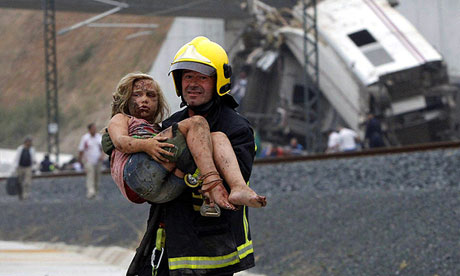
    A firefighter carries an injured girl from the wreckage of the Santiago de Compostela train crash A firefighter carries an injured girl from the wreckage of the train crash near Santiago de Compostela. Photograph: AFP/Getty Images”Until then I thought that it had been terrorist attack,” Otero said. “But it was one of the first things she said.”

    One of the survivors, Sergio Prego, told Cadena Ser radio station that the train “travelled very fast” just before it derailed and the cars flipped upside down, on their sides and into the air.

    “I’ve been very lucky because I’m one of the few able to walk out,” he said.

    Forensic scientists are still trying to identify the most mutilated corpses. Groups of families and friends gathered at the city’s Cersia hospital waiting for news of loved ones – though there was little chance they were alive as all survivors had been identified and their families informed.

    “It’s a major challenge to identify the people who have died,” Rajoy said. “Unfortunately, in many cases, this isn’t easy, but we are very conscious that the families cannot live in a state of uncertainty.”

    The Alvia 730 series train started from Madrid and was scheduled to end its journey at Ferrol, about 60 miles north of  Santiago.

    Alvias do not go as fast as Spain’s AVE bullet trains, but still reach 155mph on AVE tracks and travel at a maximum of 137mph on normal gauge rails.

    The accident came a day before a public holiday in Galicia: the feast of St James, after whom the region’s capital Santiago is named.

    “24 July will no longer be the eve of a day of celebration but rather one commemorating one of the saddest days in the history of Galicia,” said Alberto Núñez Feijóo, the region’s president.

    Residents of the semi-rural neighbourhood by the accident site struggled to help victims out of the toppled cars on Wednesday night. Some passengers were pulled out of broken windows as rescuers used rocks to try to free survivors from the wreckage.

    Daily Email

    close

    Sign up for the Guardian Today

    Our editors’ picks for the day’s top news and commentary delivered to your inbox each morning.

    Sign up for the daily email

    Daily Email

    close

    Get the Guardian’s daily US email

    Our editors’ picks for the day’s top news and commentary delivered to your inbox each morning. Enter your email address to subscribe.

    Sign up now
    Daily Email
  • Is it greener to travel by rail or car?

    Is it greener to travel by rail or car?

    Advances in research and technology challenge assumptions that trains are automatically greener than transport by road

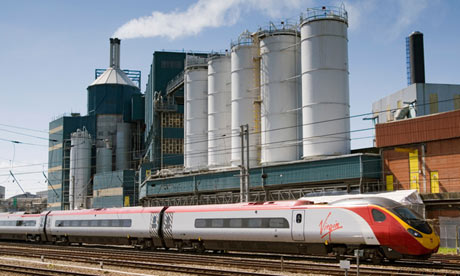
    A Virgin Pendolino train.

    A Pendolino electric train that generates 50 grams of CO2 per passenger. Photograph: John Davidson/Alamy

    Almost universally accepted by business, and rarely challenged, is the received wisdom that rail transportation is greener than travel by road. But does this assertion still hold true?

    This is no mere academic pursuit. Transportation is one of the fastest growing contributors to climate change, accounting for around a quarter of energy-related carbon dioxide emissions. Many experts foresee a five-fold increase in transport-related CO2 by 2030 in Asia alone.

    In India, annual vehicle production has rocketed by 110% over the past six years. Production lines churned out 20.4m vehicles in 2012, compared to just 9.7m in 2006. In China, the world’s second largest economy, the vehicle population is set to soar to about 300m by 2030, from 65m in 2010.

    In absolute terms, the picture is clear. Worldwide, road users account for about 71% of transport CO2 emissions, with railway companies making up less than 1.8%, next to 12.3% for aviation and 14.3% for shipping, according to the International Energy Agency and International Union of Railways.

    Finding out whether road or rail is the most eco-friendly mode of travel is more difficult when trying to make a comparison passenger-for-passenger, however. There are so many factors for businesses to consider: from fuel type and speed to occupancy rate and load.

    “If the train is going anyway, and you’re trying to decide which to use [road or rail], it obviously makes sense to take the train,” says Roger Kemp, former UK technical and safety director for Alstom Transport, manufacturer of TGV and Eurostar. “The additional energy consumption and emissions from you getting on are absolutely insignificant.”

    But if the train is powered by diesel, with refined crude oil as its primary fuel source, and you have the option of using a hybrid electricity powered vehicle instead, then the equation may change, suggests Kemp, who has studied how, over some distances, many trains perform badly in comparison to cars.

    “Diesel trains are frankly not that much different to cars. If you take a current car – say a small Citroën – which generates about 100 grams of CO2 per kilometre, that works out about 70 grams per passenger on average. It’s only when you get onto the electric trains, such as the Pendolino, which is down to 50 grams of CO2 per passenger, that cars just can’t compete.”

    Despite being a former rail worker, Kemp is clearly not your typical railway enthusiast. “I’m very suspicious of some people in the environmental movement who take this ‘trains good, cars bad’ attitude. It’s an Animal Farm mentality of ‘four legs good, two legs bad’.” After all, electric trains are hardly green if powered from the grid by coal-fired plants.

    Are car manufacturers streets ahead in green technology?

    Spurred on by ever stricter regulations, technological advances have dramatically reduced the footprint of road vehicles in the past 20 years. In 1998, most new cars in the UK emitted an average of 186 grams of carbon dioxide per passenger kilometre. By 2020, cars will be required by the European Union to emit almost half of this: no more than 95 grams.

    It is no longer inconceivable that motor vehicles could one day rival electric trains, notes Kemp. “Because trains last a lot longer, those that were built in the last five years are still going to be with us for the next 20 years. Even if you introduced a super efficient train tomorrow it would be a lot of time before most trains would be using that type of technology.”

    In India, one car manufacturer seeking to demonstrate the potential of new automobile technology is Mahindra Reva, based in Bangalore. In March this year it launched its new e20 electric car, a hatchback running on lithium-ion batteries.

    The vehicle has a top speed of 80 kilometres an hour and a range of 100 kilometres per recharge which, when coupled with a solar power source, promises zero emissions.

    With a price tag of around £9,800, the e20 remains unaffordable for most Indians. As far as Chetan Maini, Mahindra Reva’s chief executive, is concerned, however, the car nonetheless demonstrates how climate change pressures are encouraging the development of new innovations.

    “For us, the advancement of battery technology leading to better range, higher speeds and also light weighting of vehicles will be the key,” he says.

    Looking beyond the tailpipe

    Technology is not the only factor undermining the standard argument made for rail travel. Recent studies by US researchers from the Universities of California and Arizona have found that too little attention is given to the auxiliary emissions generated by both rail and road infrastructure and supply chains.

    Their argument goes that business needs to look beyond the tailpipe, so to speak, to the materials used in construction, lighting, salting and maintenance, as well as parking and even power for lighting and station escalators. Not factoring in these may give you the impression that rail is less carbon intensive than is in fact true.

    “These activities have been accounted for in the past, but under different economic circumstances and they haven’t been attributed to transit,” says Mikhail Chester, assistant professor at Arizona State University. “The maintenance of infrastructure over the long run has significant environment impacts. It could even double the footprint of the mode.”

    There are the other sustainability factors to consider: the greenfield sites bulldozed to make way for motorways and railway tracks and the respiratory and other ill health effects caused by pollution, not to mention social and economic impacts, such as traffic accidents.

    Might rail be at risk of losing its claim to be greener than road travel? Not yet, asserts Chester, although the distance between the two may have narrowed. “As engine technology becomes more energy efficient and fuel become less carbon intensive, I think rail will maintain the edge,” he says.

    “Cars are going to get greener in many different ways, through electrification and hybrid cars. But you also have advances in train technologies. We can’t forget that. Trains are not static, just like car innovation is not static.

    “Even when you include, in addition to the tailpipe, the CO2 emissions from infrastructure, fuel production and the supply chain, on average rail will still have a lower carbon footprint than road travel, when comparing life-cycle to life-cycle.”

    This content is brought to you by Guardian Professional. Become GSB member to get more stories like this direct to your inbox

  • Voters think Republican climate dissenters ‘crazy’, bipartisan poll finds

    Voters think Republican climate dissenters ‘crazy’, bipartisan poll finds

    Results show risks that deniers in Congress pose to GOP as majority of younger constituents back Obama’s carbon plans

    John Boehner, left, and Barack Obama

    John Boehner, left, has described Barack Obama’s climate plan as ‘crazy’ but voters in a bipartisan poll have dealt out the same assessment of climate change dissenters, who comprise the majority of Republicans in Congress according to other research. Photograph: Jason Reed/Reuters

    Republicans in Congress who reject the science behind climate change could soon be reduced to political fossils, with new polling on Wednesday suggesting three-quarters of young voters find such views “ignorant, out of touch or crazy”.

    The bipartisan poll conducted for the League of Conservation Voters found solid 80% support among under-35 voters for Barack Obama’s climate change plan – and majority support even among those who oppose the president.

    On the flip side the poll found three-quarters of voters, or 73%, would oppose members of Congress who stood in the way of Obama’s climate action plan.

    The findings could prove awkward for Republicans in Congress who have adopted climate contrarianism as a defining feature.

    Some 55% of Republicans in the House of Representatives and 65% of those in the Senate reject the science behind climate change or oppose action on climate change, according to an analysis by the Centre for American Progress.

    The house speaker, John Boehner, dismissed Obama’s plan to reduce carbon emissions as “absolutely crazy”. If the poll is right that would hurt Boehner even among members of his own party, with the poll finding 52% of young Republicans less inclined to support a candidate who opposed Obama on climate change.

    The implications were even more harsh for those Republicans who block Obama on climate action and dispute the entire body of science behind climate change. “For voters under 35, denying climate change signals a much broader failure of values and leadership,” the polling memo said. Many young voters would write such candidates off completely, with 37% describing climate change deniers as “ignorant”, 29% as “out of touch” and 7% simply as “crazy”.

    The climate cranks were unlikely to pick up many points with their base either; just under half of young Republicans said they would be less likely to vote for a climate change denier.

    The poll, a joint effort by the Democratic firm Benenson Strategy Group and the Republican firm GS Strategy Group, could provide further evidence to a small group of moderate Republicans – mainly retired from politics – who have been trying to nudge the party to engage with the issue of climate change.

    “As a Republican party strategist I believe that Republican candidates, Republican elected officials, need to find ways to demonstrate tolerance and understanding of what a young generation of voters need to see occurring,” said Greg Strimple of GS Strategy.

    A few former Republican members of Congress – and an anonymous congressional aide – have publicly warned the party will lose voters, especially among the young, if it is seen as anti-science.

    Obama, who has grown more high-profile about climate change in his second term, has played into those perceptions, calling out Republican climate cranks as “flat-earthers” in his climate speech last month.

    At the moment there is no sign elected Republicans are eager for a climate makeover. At a Senate environment and public works hearing this week on climate change Republican Senators freely aired their personal doubts on established climate science and attacked Obama for failing to show “tolerance” to their alternative views.

    In the house, meanwhile, Republicans were preparing bills to drastically reduce the powers and cut the budget by one-third of the Environmental Protection Agency – the main executor of Obama’s climate plan.

    Outside Washington, however, Strimple said a rethink was under way. “I think there is a broad soul-searching going on with Republicans,” he said.

    Daily Email

    close

    Sign up for the Guardian Today

    Our editors’ picks for the day’s top news and commentary delivered to your inbox each morning.

    Sign up for the daily email

    Daily Email

    close

    Get the Guardian’s daily US email

    Our editors’ picks for the day’s top news and commentary delivered to your inbox each morning. Enter your email address to subscribe.

    Sign up now
    Daily Email

    close

    Get the Guardian’s daily Australia email

    Our editors’ picks for the day’s top news and commentary delivered to your inbox every weekday.

  • The companies, prisons and cities making energy from human waste

    The companies, prisons and cities making energy from human waste

    The ‘ick’ factor is inescapable but human waste is a cost-efficient way to produce energy. The problem is there’s not enough of it

    Human waste tanks Bugasera prison

    Human waste tanks at Bugasera prison, Rwanda. Prisoners’ human waste is turned into energy to run the prison. Photograph: Nathalie Munyampenda

    At Bugesera prison in Rwanda, prisoners do what prisoners usually do: eat, sleep, work, co-exist in a highly confined space. But the Bugesera inmates, leaders of Rwanda’s genocide, are also unlikely sustainable business pioneers. Their human waste is turned into energy that runs the prison.

    “10 of our 13 correctional facilities now produce bio-gas from inmates’ human waste”, Rwanda’s deputy governor of prisons, Mary Gahonzayire explains. “Bugesera and another prison are run almost entirely on bio-gas. This is an opportunity that came up after the genocide, when the prisons got crowded. We thought, ‘why not use human waste for energy?’” The 10 prisons currently house 55,000 inmates. Now Rwanda’s government plans to expand human-waste energy to schools and hospitals.

    Welcome to the new world of sustainable energy, where developing countries are taking the lead – by turning their sanitation problems into an asset. In India, bio-gas kits from companies such as Biotech India allow families to collect their human and animal waste and transform it into energy and cooking gas.

    In China, a group called the Shaanxi Mothers has installed more than 1,300 bio-gas plants in Shaanxi Province. And in Accra, the US-Ghanaian company Waste Enterprisers has just inaugurated its first human-waste energy plant. “Human waste is an ideal source of energy”, explains Kartik Chandran, associate professor Department of Earth and Environmental Engineering at Columbia University. “It has the right constituents, and in the form we need them. And in many parts of the world it’s right there.” According to the United Nations, some 2.5 billion people around the world lack access to proper sanitation.

    Making energy from human waste is, of course, far from a new idea. “In cities like Boston they’ve been doing it for years”, notes Jason Kass, director of Toilets for People, a sanitation advocacy group. “But it’s expensive and the plants are difficult to maintain.”

    Grassroots projects, for their part, have been operating for several years. What’s changing now is efforts to move this clever combination of waste removal and sustainable energy beyond the Boston-or-grassroots level to a profitable business model. “We’d like to scale our project and make each unit cheaper”, explains managing director Dr A Saji Das of Biotech India. “Poor people can produce more than 50% of their energy needs from their waste. Here in India, more human-waste energy would also help solve the problem of deforestation.” 32,000 families and 47 municipalities currently use BioTech India’s bio-gas kit.

    Jack Sim, founder and CEO of World Toilet Day, recently declared an official United Nations day adds: “Turning human waste into energy is a good solution even if it doesn’t make money, because it prevents disease. Treating diseases costs a lot of money.”

    But researchers and companies know that human waste has to become more cost-effective. “Today the process is not optimised,” explains Chandran. “Bio-gas is very good, but there’s room to make it more efficient. And biodiesel, which is less common than bio-gas, currently sells at $7-8 per gallon. In order to be a competitive energy source, bio-gas needs a higher energy content, and we need to find a good way of converting bio-gas into liquid fuels.”

    Waste Enterprisers, which collects fecal sludge from Accra and turns the solid waste into fuel, plans to open three more plants in Africa in the next three years and then expand faster. The best financial solution, argues CEO Ashley Murray, is to sell to factories: “Households could use it, but to generate volume you have to sell to large buyers. Plus, there’s the ick factor. People don’t like to cook with poo.”

    With greater cost-efficiency, human-waste energy is poised to become a serious player. The main problem? The human body simply produces too little of it. Even if combined with animal waste, human waste doesn’t compare to the world’s oil resources. “I don’t think human-waste energy will ever be profitable”, says Kass. “Any efforts getting something useful out of human waste should be celebrated. But if Boston can’t make any money on it, how could developing countries?”

    But, says Chandran, for countries with high education levels and substandard sanitation infrastructure, loo power is a huge opportunity: “China, India, South Africa, Brazil, even less developed countries in Europe could turn their sanitation disadvantage to a commercial advantage. Densely populated cities, especially if they’re a bit agrarian and have animal waste as well, could even generate this energy for export.”

    These days, Rwanda’s prisons receive frequent visits from foreign government officials who want to replicate the energy generation at home. And for Mary Gahonzayire, the advantages of loo power are beyond doubt: “We save firewood, we save money, but most importantly, we save the environment!

    This content is brought to you by Guardian Professional. Become GSB member to get more stories like this direct to your inbox

  • Increase In Fish Prices Reflects Global Trend, Report Finds

    Increase In Fish Prices Reflects Global Trend, Report Finds

    LIMA, July 25 (BERNAMA-NNN-ANDINA) — Fishing in Peruvian waters and in the rest of the world has remained stable over the last decade and on the basis of a sustainable fisheries management, it is not expected to change.

    Meanwhile, the population growth and income level rise has led to an increased demand for fish products.

    As a result of this situation, the price of fish has risen at national and global level in recent years, although significantly less in Peru, according to a report issued by consultancy Macroconsult.

    “The average family income increased in the last five years by 21 percent and would be pressing food demand and prices with relatively stable supply,” explains Elmer Cuba, managing partner of the consulting firm.

    “However, in our country the increase in fish prices has been well below the global average,” he added at a breakfast meeting organized by the United Nations Food and Agriculture Organization (FAO) and the National Fisheries Society (SNP).

    Website FIS.com reported him saying that real fish prices have risen in recent years “due to the increase in household income and because the supply of fish is limited.” For this reason, “to meet an increased future demand and a stable marine supply, governments’ efforts to boost their aquaculture are important.” The economist explained that from 2003 to 2012 fish landings for human consumption (as frozen, cured, fresh and canned food — without considering the squid) did not fall and they have even presented a slightly positive trend.

    Anyway, he said that in the first four months of 2013 fish unloading for human consumption dropped by 18 percent over the same period of 2012.

    — BERNAMA-NNN-ANDINA