Author: Neville

  • Action needed on action plan

    Action needed on action plan

    July 12, 2013, 1:06 p.m.
    •   

    The claim about acceleration of sea level rise began in about 2008 as an extension of the catastrophic anthropogenic global warming claim that man-made emissions of carbon dioxide would heat the Earth to an unliveable state this century.

    This alarmism was perpetrated by the IPCC, and echoed by the ALP government and its Climate Commission.

    Yet, after hundreds of billions of dollars have been spent globally, no compelling empirical evidence exists to prove those claims.

    But, Eurobodalla Shire Council’s adopted Greenhouse Action Plan is a reflection of the IPCC’s alarmist claims.

    It states “Eurobodalla Shire Council is now pla-

    nning to accommodate projected sea level rise of 40cm by 2050 and 90cm by 2100 against the 1990 mean” (that is five times greater than its estimated sea level rise for the last century).

    The Greenhouse Action Plan relies on a notional global average sea level projection (not prediction) from IPCC flawed computer models only.

    The Greenhouse Action Plan has no relationship to local sea level rise.

    The rate of local sea level rise change varies widely around the world, rising in many places and falling in others: what counts is what happens locally.

    This requires taking into account the factors influencing the local uplift or subsidence of the substrate and the changes in sediment delivery, and what observations are available to demonstrate that there is a problem for the Eurobodalla Shire’s coast.

    The emerging studies confirm that these claims in the Greenhouse Action Plan are manifestly wrong.

    The State Government has begun to introduce changes to meet these realities.

    But, council seems paralysed: it will not repeal its Greenhouse Action Plan and its planners seem determined not to lose their control of things.

    Council should heed that information presented by Mr Lambert and Mr Bernard.

    Above all, council and its planners need to get ethical advice from scientific authorities that are not beholden to the IPCC or the Climate Commission.

    Neville Hughes

    Surf Beach

    Save today
    • 1.5kW Solar System

      (6 panels)

      Save up to $1,147.

      with solar incentives.

    • 3.0kW Solar System

      (12 panels)

      Save up to $2,294.

      with solar incentives.

    • 5.0kW Solar System

      (20 panels)

      Save up to $3,811.

      with solar incentives.

  • What Triggered Antarctic Glaciation – Insert Your Hypothesis Here

    What Triggered Antarctic Glaciation – Insert Your Hypothesis Here
    By News Staff | July 11th 2013 05:01 PM | Print | E-mail | Track Comments

    New geologic evidence that casts doubt on one of the conventional explanations for how Antarctica’s ice sheet began forming, says a team of researchers writing in Geology.

    The Antarctic Circumpolar Current (ACC), an ocean current flowing clockwise around the entire continent, insulates Antarctica from warmer ocean water to the north, helping maintain the ice sheet.

    For several decades, scientists have surmised that the onset of a complete ACC played a critical role in the initial glaciation of the continent about 34 million years ago.

    Now, rock samples from the central Scotia Sea near Antarctica reveal the remnants of a now-submerged volcanic arc that formed sometime before 28 million years ago and might have blocked the formation of the ACC until less than 12 million years ago. Hence, the onset of the ACC may not be related to the initial glaciation of Antarctica, but rather to the subsequent well-documented descent of the planet into a much colder “icehouse” glacial state.

    “If you had sailed into the Scotia Sea 25 million years ago, you would have seen a scattering of volcanoes rising above the water,” says co-author Ian Dalziel, research professor at The University of Texas at Austin’s Institute for Geophysics. “They would have looked similar to the modern volcanic arc to the east, the South Sandwich Islands.”

    Using multibeam sonar to map seafloor bathymetry, which is analogous to mapping the topography of the land surface, the team identified seafloor rises in the central Scotia Sea. They dredged the seafloor at various points on the rises and discovered volcanic rocks and sediments created from the weathering of volcanic rocks. These samples are distinct from normal ocean floor lavas and geochemically identical to the presently active South Sandwich Islands volcanic arc to the east of the Scotia Sea that today forms a barrier to the ACC, diverting it northward.

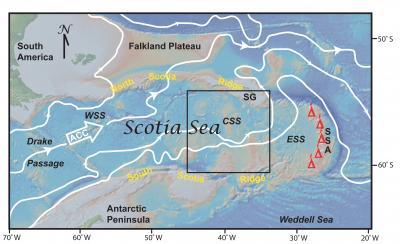
    This is a physiographic map of the present-day Scotia Sea, Drake Passage and adjacent land masses. The white arrows show the present path of the several branches of the deep Antarctic Circumpolar Current (ACC) centered on its core. The area of study in the central Scotia Sea (CSS) is shown by the black box to the south of South Georgia island (SG). The volcano symbols mark the active South Sandwich volcanic arc (SSA). (WSS = western Scotia Sea; ESS = eastern Scotia Sea). Credit: University of Texas at Austin

    Using argon isotopic dating, the researchers found that the samples range in age from about 28 million years to about 12 million years. The team interpreted these results as evidence that an ancient volcanic arc, referred to as the ancestral South Sandwich arc (ASSA), was active in the region during that time and probably much earlier. Because the samples were taken from the current seafloor surface and volcanic material accumulates from the bottom up, the researchers infer that much older volcanic rock lies beneath.

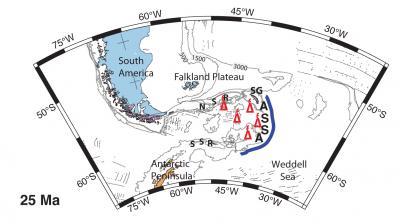
    A reconstruction of the Scotia Sea area 25 million years ago, showing volcanoes of the ancestral South Sandwich arc (ASSA). They are now submerged, but were active at that time and possibly emergent. They may have blocked the onset of the Antarctic Circumpolar Current. (NSR = North Scotia Ridge; SSR = South Scotia Ridge; SG = South Georgia island). Credit: University of Texas at Austin

    Combined with models of how the seafloor sinks vertically with the passage of time, the team posits that the ASSA originally rose above sea level and would have blocked deep ocean currents such as the ACC.

    Two other lines of evidence support the notion that the ACC didn’t begin until less than 12 million years ago. First, the northern Antarctic Peninsula and southern Patagonia didn’t become glaciated until less than approximately 12 million years ago. And second, certain species of microscopic creatures called dinoflagellates that thrive in cold polar water began appearing in sediments off southwestern Africa around 11.1 million years ago, suggesting colder water began reaching that part of the Atlantic Ocean.

  • Hiccups In Earth’s Rotation Can Shorten The Day, Or Make It Longer; Can Be Caused By Wind And Ocean Currents

    Hiccups In Earth’s Rotation Can Shorten The Day, Or Make It Longer; Can Be Caused By Wind And Ocean Currents

    By Rebekah Marcarelli r.marcarelli@hngn.com | Jul 11, 2013 04:10 PM EDT

    • icon
    • icon
    Earth

    There are a lot of factors that can contribute to small changes in the length of day. (Photo : University of Liverpool)

    Many factors can interfere with the Earth’s rotation, which could change the lenght of a day.

    New research has discovered the Earth’s core can change a say’s length by milliseconds.

    Three-hundred million years ago, a year lasted 450 days and a day 21 hours. As the years go by the Earth’s rotation slows down, increasing the length of day, a University of Liverpool press release reported.

    Share This Story

    • 0
      inShare

    The Earth’s rotation on its axis can be affected by other things. Winds blasting against mountain ranges can change adds a millisecond to the day, or take it away over the course of a year.

    Richard Holme, a Liverpool School of Environmental Sciences professor, looked at the fluctuations in day length from 1962 to 2012.

    The study told all time-altering factors into account to build a model of how time has changed over the past few decades.

    “Previously these changes were poorly characterised; the study shows they can be explained by just two key signals, a steady 5.9 year oscillation and episodic jumps which occur at the same time as abrupt changes in the Earth’s magnetic field, generated in the Earth’s core,” Holmes said.

    “This study changes fundamentally our understanding of short-period dynamics of the Earth’s fluid core.  It leads us to conclude that the Earth’s lower mantle, which sits above the Earth’s outer core, is a poor conductor of electricity giving us new insight into the chemistry and mineralogy of the Earth’s deep interior,” he said.

    In 2009 the Antarctic Circumpolar Current (a strong ocean current) slowed down drastically for two weeks, NewScientist reported.

    Researchers noticed as soon as the current slowed down the Earth’s rotation sped up, which shortened the day by 0.1 milliseconds. The days returned to normal as soon as the current did.

    This was the first time scientists had seen a change in current strong enough to affect the Earth’s rotation.

    Winds in the area that were moving in the same direction as the current slowed down too, but researchers said it was unusual to see such a strong effect on the ocean.

  • Geothermal Power Facility Induces Earthquakes, Study Finds

    Geothermal Power Facility Induces Earthquakes, Study Finds

    July 11, 2013 — An analysis of earthquakes in the area around the Salton Sea Geothermal Field in southern California has found a strong correlation between seismic activity and operations for production of geothermal power, which involve pumping water into and out of an underground reservoir.


    Share This:

    “We show that the earthquake rate in the Salton Sea tracks a combination of the volume of fluid removed from the ground for power generation and the volume of wastewater injected,” said Emily Brodsky, a geophysicist at the University of California, Santa Cruz, and lead author of the study, published online in Science on July 11.

    “The findings show that we might be able to predict the earthquakes generated by human activities. To do this, we need to take a large view of the system and consider both the water coming in and out of the ground,” said Brodsky, a professor of Earth and planetary sciences at UCSC.

    Brodsky and coauthor Lia Lajoie, who worked on the project as a UCSC graduate student, studied earthquake records for the region from 1981 through 2012. They compared earthquake activity with production data for the geothermal power plant, including records of fluid injection and extraction. The power plant is a “flash-steam facility” which pulls hot water out of the ground, flashes it to steam to run turbines, and recaptures as much water as possible for injection back into the ground. Due to evaporative losses, less water is pumped back in than is pulled out, so the net effect is fluid extraction.

    During the period of relatively low-level geothermal operations before 1986, the rate of earthquakes in the region was also low. Seismicity increased as the operations expanded. After 2001, both geothermal operations and seismicity climbed steadily.

    The researchers tracked the variation in net extraction over time and compared it to seismic activity. The relationship is complicated because earthquakes are naturally clustered due to local aftershocks, and it can be difficult to separate secondary triggering (aftershocks) from the direct influence of human activities. The researchers developed a statistical method to separate out the aftershocks, allowing them to measure the “background rate” of primary earthquakes over time.

    “We found a good correlation between seismicity and net extraction,” Brodsky said. “The correlation was even better when we used a combination of all the information we had on fluid injection and net extraction. The seismicity is clearly tracking the changes in fluid volume in the ground.”

    The vast majority of the induced earthquakes are small, and the same is true of earthquakes in general. The key question is what is the biggest earthquake that could occur in the area, Brodsky said. The largest earthquake in the region of the Salton Sea Geothermal Field during the 30-year study period was a magnitude 5.1 earthquake.

    The nearby San Andreas fault, however, is capable of unleashing extremely destructive earthquakes of at least magnitude 8, Brodsky said. The location of the geothermal field at the southern end of the San Andreas fault is cause for concern due to the possibility of inducing a damaging earthquake.

    “It’s hard to draw a direct line from the geothermal field to effects on the San Andreas fault, but it seems plausible that they could interact,” Brodsky said.

    At its southern end, the San Andreas fault runs into the Salton Sea, and it’s not clear what faults there might be beneath the water. A seismically active region known as the Brawley Seismic Zone extends from the southern end of the San Andreas fault to the northern end of the Imperial fault. The Salton Sea Geothermal Field, located on the southeastern edge of the Salton Sea, is one of four operating geothermal fields in the area.

    Share this story on Facebook, Twitter, and Google:
  • Distant Earthquakes Trigger Tremors at U.S. Waste-Injection Sites, Says Study

    Distant Earthquakes Trigger Tremors at U.S. Waste-Injection Sites, Says Study

    July 11, 2013 — Large earthquakes from distant parts of the globe are setting off tremors around waste-fluid injection wells in the central United States, says a new study. Furthermore, such triggering of minor quakes by distant events could be precursors to larger events at sites where pressure from waste injection has pushed faults close to failure, say researchers.


    Share This:

    The 2010 Chile earthquake set off tremors near waste-injection sites in central Oklahoma and southern Colorado, says a new study in Science.

    Among the sites covered: a set of injection wells near Prague, Okla., where the study says a huge earthquake in Chile on Feb. 27, 2010 triggered a mid-size quake less than a day later, followed by months of smaller tremors. This culminated in probably the largest quake yet associated with waste injection, a magnitude 5.7 event which shook Prague on Nov. 6, 2011. Earthquakes off Japan in 2011, and Sumatra in 2012, similarly set off mid-size tremors around injection wells in western Texas and southern Colorado, says the study. The paper appears this week in the leading journal Science, along with a series of other articles on how humans may be influencing earthquakes.

    “The fluids are driving the faults to their tipping point,” said lead author Nicholas van der Elst, a postdoctoral researcher at Columba University’s Lamont-Doherty Earth Observatory. “The remote triggering by big earthquakes is an indication the area is critically stressed.”

    Tremors triggered by distant large earthquakes have been identified before, especially in places like Yellowstone National Park and some volcanically active subduction zones offshore, where subsurface water superheated by magma can weakenfaults, making them highly vulnerable to seismic waves passing by from somewhere else. The study in Science adds a new twist by linking this natural phenomenon to faults that have been weakened by human activity.

    A surge in U.S. energy production in the last decade or so has sparked what appears to be a rise in small to mid-sized earthquakes in the United States. Large amounts of water are used both to crack open rocks to release natural gas through hydrofracking, and to coax oil and gas from underground wells using conventional techniques. After the gas and oil have been extracted, the brine and chemical-laced water must be disposed of, and is often pumped back underground elsewhere, sometimes causing earthquakes.

    “These passing seismic waves are like a stress test,” said study coauthor Heather Savage, a geophysicist at Lamont-Doherty. “If the number of small earthquakes increases, it could indicate that faults are becoming critically stressed and might soon host a larger earthquake.”

    The 2010 magnitude 8.8 Chile quake, which killed more than 500 people, sent surface waves rippling across the planet, triggering a magnitude 4.1 quake near Prague 16 hours later, the study says. The activity near Prague continued until the magnitude 5.7 quake on Nov. 6, 2011 that destroyed 14 homes and injured two people. A study earlier this year led by seismologist Katie Keranen, also a coauthor of the new study, now at Cornell University, found that the first rupture occurred less than 650 feet away from active injection wells. In April 2012, a magnitude 8.6 earthquake off Sumatra triggered another swarm of earthquakes in the same place.The pumping of fluid into the field continues to this day, along with a pattern of small quakes.

    The 2010 Chile quake also set off a swarm of earthquakes on the Colorado-New Mexico border, in Trinidad, near wells where wastewater used to extract methane from coal beds had been injected, the study says. The swarm was followed more than a year later, on Aug. 22 2011, by a magnitude 5.3 quake that damaged dozens of buildings. A steady series of earthquakes had already struck Trinidad in the past, including a magnitude 4.6 quake in 2001 that the U.S. Geological Survey (USGS) has investigated for links to wastewater injection.

    The new study found also that Japan’s devastating magnitude 9.0 earthquake on March 11, 2011 triggered a swarm of earthquakes in the west Texas town of Snyder, where injection of fluid to extract oil from the nearby Cogdell fields has been setting off earthquakes for years, according to a 1989 study in the Bulletin of the Seismological Society of America. About six months after the Japan quake, a magnitude 4.5 quake struck Snyder.

    The idea that seismic activity can be triggered by separate earthquakes taking place faraway was once controversial. One of the first cases to be documented was the magnitude 7.3 earthquake that shook California’s Mojave Desert in 1992, near the town of Landers, setting off a series of distant events in regions with active hot springs, geysers and volcanic vents. The largest was a magnitude 5.6 quake beneath Little Skull Mountain in southern Nevada, 150 miles away; the farthest, a series of tiny earthquakes north of Yellowstone caldera, according to a 1993 study in Science led by USGS geophysicist David Hill.

    In 2002, the magnitude 7.9 Denali earthquake in Alaska triggered a series of earthquakes at Yellowstone, nearly 2,000 miles away, throwing off the schedules of some of its most predictable geysers, according to a 2004 study in Geology led by Stephan Husen, a seismologist at the Swiss Federal Institute of Technology in Zürich. The Denali quake also triggered bursts of slow tremors in and around California’s San Andreas, San Jacinto and Calaveras faults, according to a 2008 study in Science led by USGS geophysicist Joan Gomberg.

    “We’ve known for at least 20 years that shaking from large, distant earthquakes can trigger seismicity in places with naturally high fluid pressure, like hydrothermal fields,” said study coauthor Geoffrey Abers, a seismologist at Lamont-Doherty. “We’re now seeing earthquakes in places where humans are raising pore pressure.”

    The new studymay be the first to find evidence of triggered earthquakes on faults critically stressed by waste injection. If it can be replicated and extended to other sites at risk of humanmade earthquakes it could “help us understand where the stresses are,” said William Ellsworth, an expert on human-induced earthquakes with the USGS who was not involved in the study.

    In the same issue of Science, Ellsworth reviews the recent upswing in earthquakes in the central United States. The region averaged 21 small to mid-sized earthquakes each year from the late 1960s through 2000. But in 2001, that number began to climb, reaching a high of 188 earthquakes in 2011, he writes. The risk of setting off earthquakes by injecting fluid underground has been known since at least the 1960s, when injection at the Rocky Mountain Arsenal near Denver was suspended after a magnitude 4.8 quake or greater struck nearby — the largest tied to wastewater disposal until the one near Prague, Okla. In a report last year, the National Academy of Sciences called for further research to “understand, limit and respond [to]” seismic events induced by human activity.

    Share this story on Facebook, Twitter, and Google:
  • Scientists Cast Doubt On Theory of What Triggered Antarctic Glaciation

    Scientists Cast Doubt On Theory of What Triggered Antarctic Glaciation

    July 11, 2013 — A team of U.S. and U.K. scientists has found geologic evidence that casts doubt on one of the conventional explanations for how Antarctica’s ice sheet began forming. Ian Dalziel, research professor at The University of Texas at Austin’s Institute for Geophysics and professor in the Jackson School of Geosciences, and his colleagues report the findings today in an online edition of the journal Geology.


    Share This:

    The Antarctic Circumpolar Current (ACC), an ocean current flowing clockwise around the entire continent, insulates Antarctica from warmer ocean water to the north, helping maintain the ice sheet. For several decades, scientists have surmised that the onset of a complete ACC played a critical role in the initial glaciation of the continent about 34 million years ago.

    Now, rock samples from the central Scotia Sea near Antarctica reveal the remnants of a now-submerged volcanic arc that formed sometime before 28 million years ago and might have blocked the formation of the ACC until less than 12 million years ago. Hence, the onset of the ACC may not be related to the initial glaciation of Antarctica, but rather to the subsequent well-documented descent of the planet into a much colder “icehouse” glacial state.

    “If you had sailed into the Scotia Sea 25 million years ago, you would have seen a scattering of volcanoes rising above the water,” says Dalziel. “They would have looked similar to the modern volcanic arc to the east, the South Sandwich Islands.”

    Using multibeam sonar to map seafloor bathymetry, which is analogous to mapping the topography of the land surface, the team identified seafloor rises in the central Scotia Sea. They dredged the seafloor at various points on the rises and discovered volcanic rocks and sediments created from the weathering of volcanic rocks. These samples are distinct from normal ocean floor lavas and geochemically identical to the presently active South Sandwich Islands volcanic arc to the east of the Scotia Sea that today forms a barrier to the ACC, diverting it northward.

    Using a technique known as argon isotopic dating, the researchers found that the samples range in age from about 28 million years to about 12 million years. The team interpreted these results as evidence that an ancient volcanic arc, referred to as the ancestral South Sandwich arc (ASSA), was active in the region during that time and probably much earlier. Because the samples were taken from the current seafloor surface and volcanic material accumulates from the bottom up, the researchers infer that much older volcanic rock lies beneath.

    Combined with models of how the seafloor sinks vertically with the passage of time, the team posits that the ASSA originally rose above sea level and would have blocked deep ocean currents such as the ACC.

    Two other lines of evidence support the notion that the ACC didn’t begin until less than 12 million years ago. First, the northern Antarctic Peninsula and southern Patagonia didn’t become glaciated until less than approximately 12 million years ago. And second, certain species of microscopic creatures called dinoflagellates that thrive in cold polar water began appearing in sediments off southwestern Africa around 11.1 million years ago, suggesting colder water began reaching that part of the Atlantic Ocean.

    Share this story on Facebook, Twitter, and Google: