Author: Neville

  • 12,000 people call for logging Bill to be deferred

    12,000 people call for logging Bill to be deferred

    Inbox
    x
    The Wilderness Society
    Last week, the regressive Sustainable Forests Timber Amendment Bill passed th…
    11:15 AM (29 minutes ago)

    Last week, the regressive Sustainable Forests Timber Amendment Bill passed th…
    The Wilderness Society <mail@change.org>
    11:18 AM (26 minutes ago)

    to me

    Last week, the regressive Sustainable Forests Timber Amendment Bill passed the Victorian Parliament.

    You were one of at least 12,000 people who thought this shouldn’t have happened.

    Thanks for signing our petition and sending a strong message to the Napthine government that it’s imprudent to give rogue logging agency VicForests more power than they’ve already got.

    The Wilderness Society raised your concerns with many MPs, arguing that it’s irresponsible to vest in VicForests more power to make decisions about where and when they log, without enough environmental and governmental oversight. And that it’s especially impetuous to do so, while VicForests is in the Supreme Court of Appeal over allegations that they’ve logged the habitat of the state animal emblem, the Fairy (Leadbeater’s) Possum!

    We met with Liberal MPs to explain why we’re concerned about the Bill. None of them tried to convince us that logging in native forests is good, nor that it needs to continue.

    So why did they support the Bill?

    We’re as disappointed as you are that no Liberal MPs stood up to the Nationals on this poor forest management policy.

    New laws allowing for long-term contracts won’t magic up a long-term wood resource.

    In fact, while the Bill was in Parliament, VicForests announced that due to a reduction in wood resource availability (‘cos they’ve overlogged for so many years, and due to the impacts of bushfires), they’re going to reduce their Ash logging by an (inadequate) 25%!

    Despite this, the SFTA Bill was still supported by every Liberal and National MP in the Parliament, bar one.

    On 7 May, when the Bill was before the Upper House, Labor MLC John Lenders said the Opposition believed the Bill is “flawed”. Labor also suggested that because the Auditor-General is currently investigating VicForests, the Bill should be properly considered by a Committee.

    We were heartened that President of the Upper House, Liberal MLC Bruce Atkinson agreed, and called upon the House to support the Bill being considered by a Committee due to his concerns about the “long-term sustainability of the resource”. Sadly, the vote was tied and the Bill proceeded to the Lower House.

    When it was debated there, the House was reminded of the plight of our endangered animal emblem when Opposition Environment Spokesperson Lisa Neville asked whether by passing the Bill, Parliament is “putting at risk the future of our native forests and creatures like the Leadbeater’s possum?”

    In our view, that’s exactly what the Bill does. We remarked that the Bill “would likely secure the extinction of the state’s animal emblem, the Fairy (Leadbeater’s) Possum, and require taxpayers to underwrite contracts to logging companies and paper manufacturers when the state cannot meet wood supply obligations.”

    In his contribution in Parliament, Greens MLC Greg Barber asked “would you invest in VicForests if it were a company listed on the Australian Stock Exchange and you saw that it had had a string of financial losses virtually since its inception and that its entire business was underpinned by, in effect, one customer with a stated position of getting out of the industry the company was in?”

    Here Mr Barber is referring to Australian Paper, manufacturers of Reflex copy paper, who have previously stated they intend be out of native forests by 2017. We believe our forests belong to all Australians, not only to logging and woodchipping companies.

    Write a letter to Australian Paper CEO Jim Henneberry (1) to let him know you’d like to see Australian Paper out of native forests far earlier than 2017, and our forests protected.

    The amazing Knitting Nannas of Toolangi were at Parliament to listen to the debate about the Bill, too.

    “We are aghast that the state government is attempting to ‘stitch-up’ a deal that will see our publicly owned native forests handed over to the industry for infinity logging,” said KNOT spokesperson, Karena Goldfinch.

    We know that Victorians are proud of their environment, and want to see forests protected. 12,000 people can’t be wrong.

    When it comes to the Sustainable Forests Timber Amendments Bill, the Napthine government hasn’t represented you. If your local MP is a member of the Napthine government, do let them know you’re disappointed they passed some very regressive logging laws, without even taking the trouble to defer them until the Auditor-General’s office has completed its investigation into VicForests and logging in Victoria.

    As the lawyers at the Environment Defenders Office say, “native forests are publicly owned, and Government should manage these forests on behalf of the public.”

    Thanks for being proud of your environment, and for standing up for our forests.

    Please keep in touch – because protecting Australia’s forests is crucial for the survival of endangered wildlife, for our way of life, and for the enjoyment and benefit of us all.

    For regular forest updates, sign up at wilderness.org.au. And follow us on Twitter @wilderness_VIC

    For the forests,

    Amelia Young
    Campaigns Manager, the Wilderness Society Victoria

    (1) Send your snail mail to Jim Henneberry, CEO, Australian Paper, Private Bag 87 Mt Waverley 3149 More info visit ethicalpaper.com.au

    This message was sent by The Wilderness Society using the Change.org system. You received this email because you signed a petition started by The Wilderness Society on Change.org: “Defer the Bill that would lock-in long-term native forest logging.” Change.org does not endorse contents of this message.

    View the petition  |  Reply to this message via Change.org

  • North Sea leaks ‘reality check’ for British oil industry, says Greenpeace

    North Sea leaks ‘reality check’ for British oil industry, says Greenpeace

    Environmentalists say industry’s arctic safety case undermined by figures showing 55 pollution incidents in last month

    north sea leaks oil industry

    Facilities operated by Shell, BP and BG were all offenders, according to the Department of Energy and Climate Change. Photograph: Royal Dutch Shell Ho/EPA

    Britain’s offshore rigs and platforms have leaked oil or other chemicals into the North Sea on 55 occasions over the past month alone, challenging claims by the industry that it has a strong safety and environmental record.

    Among the fields to have reported pollution discharges is Piper Alpha, the scene of the world’s worst offshore accident in terms of fatalities when it blew up, killing 167 workers, 25 years ago.

    Facilities operated by Shell, BP and BG were all offenders, according to the latest petroleum operations notices (PON1s) reported to the Department of Energy and Climate Change (DECC).

    Greenpeace said the alarming statistics should act as a reality check for an industry that was trying to persuade the world it should be allowed to drill in the pristine waters of the Arctic.

    “They’re trying to convince the world that they can operate safely in one of the world’s harshest environments, yet they can’t prevent this steady trickle of oil and other polluting chemicals leaking into the relatively safe waters of the North Sea,” said Greenpeace senior climate adviser Charlie Kronick. “This will do little to increase public trust in their ability to drill in the Arctic without damaging this incredibly beautiful and fragile corner of our planet.”

    But the industry itself says the leaks often contain tiny amounts of relatively harmless substances and the reporting system is an example of a good regulation.

    One of the worst offenders in the latest set of DECC figures is Shell, which on 3 June reported lubricant and other chemical discharges from its Brent Bravo and Brent Charlie platforms.

    A Shell spokesman said: “Asset integrity and process safety is Shell’s foremost priority at all times. No spill is acceptable and we work hard both offshore and onshore to minimise risks to maintain a safe working environment for our workforce and reduce any environmental impact on the North Sea.

    “Shell is actively participating in the Step Change in Industry safety initiative, which includes a focus on hydrocarbon spill reduction. The industry has achieved an almost 50% reduction in hydrocarbons leaks during 2012, based on a baseline set in 2009.”

    In 2006, Shell was fined £900,000 after pleading guilty to safety lapses on the Brent B platform following an accident in 2003, when the facility was hit by a gas leak in which two oil workers died.

    BP, which is still fighting criminal charges following the Deepwater Horizon accident of 2010 in the US Gulf, is reported to have had crude leaks off the Paul B Loyd Jnr rig, which was working on the Clair field on 6 June this year. There was also a release of “another” substance from the same drilling unit two days earlier. On 25 May there was discharge on the Marnock field.

    BG had a leak on the Everest North platform on 31 May while Talisman Energy discharged chemicals the day before on the Piper Bravo platform that was built in place of the Piper Alpha structure destroyed by fire in 1988.

    Petroleum operations notices are all reviewed and investigated by an offshore environmental inspector as they are reports of potential breaches of DECC-enforced regulations.

    Some of the discharges are allowable under North Sea rules but most on the latest PON1s monthly data whose status is marked “completed” rather than still “under review” ascribed the source to various mechanical failures.Those incidents that do show how much product was released indicate small amounts but any unintended action is unwelcome at a time when safety and the environment are major concerns of the public.

    Although the PONS1 data seen by the Guardian for the month from 6 May to 6 June show 55 different numbered notices, employers dispute the figures and downplay their significance.

    Mick Borwell, Oil & Gas UK’s environmental issues director, said: “The vast majority of the 103 spills this year [in PON1 reports] are very small operational chemical spills. They have no potential to cause a major accident, so do not compromise the increase in safety standards reported recently including a year on year reduction in combined fatal and major injury rates and in all types of dangerous occurrence and a 48% reduction in hydrocarbon releases over three years.”

    BP and Shell declined to comment. On Monday, BP will appear in court in New Orleans to argue that the huge compensation package agreed last year following the Deepwater Horizon disaster is being abused. Lawyers for BP will claim that large numbers of “fraudulent, excessive or improper claims” are being filed to the victims’ fund, to which BP set aside around $8bn.

  • New model could give 12 months warning on El Niño

    New model could give 12 months warning on El Niño

    Updated 1 hour 37 minutes ago

    Scientists hope a new method for forecasting El Niño weather events earlier will help Pacific farmers and fishermen adapt to droughts and floods.

    El Niño weather events lead to floods in the eastern Pacific and droughts in the west, severely affecting agriculture and fishing.

    El Niños typically happen every two to seven years, but current techniques measuring water temperature only allow scientists to forecast at most six months in advance.

    Professor Armin Bunde, from the University of Giessen in Germany, has told Pacific Beat their approach is different.

    “We do not consider the water temperature, but we consider the atmospheric temperature in all areas of the Pacific Ocean,” he said.

    “Then we study how the temperatures at different place in the Pacific are linked to each other…so by doing this we find that well before an El Niño event – in the year before – the data connections build up strongly.

    “This…we can use to forecast an El Niño event [and] when we do this we find that we succeed in forecasting seven out of ten El Niños, with less than one false alarm in 20 years.”

    Professor Bunde says the ability to predict El Nino’s further in advance allows those most at risk from unusual weather patterns to plan ahead.

    “During an El Niño in the west the water gets colder, there’s less evaporation and this may lead to droughts,” he said.

    “In the east where the water gets warmer, this may lead to heavy rainfall and floods.

    “Both results – droughts in the west and floods in the east – are bad for agriculture.”

    “By predicting El Niño events one year in advance, one can help the farmers to adapt better – to invest in drought or flood resistant crops.”

    Australian lecturer in climate change research, Dr Alex Sen Gupta, has told ABC Science the new model is “almost too good to be true”.

    “There’s no real physics behind it,” he said.

    “At the moment they’ve found a pattern, but they’re not really explaining where that pattern comes from.

    “I think give it another two or three El Niños and if it predicts those correctly more than a year in advance you’d start to think we’re on to something.”

    El Niño is Spanish for “the child”, named after the baby Jesus because it often appeared off Peru around Christmas.

    The pattern has been known to cause drought in some parts of Australia, Indonesia, and South America and heavy flooding in places like Peru and Ecuador.

    It’s also been linked to severe winters in Europe, unusual monsoons in East Asia and hurricanes in the Caribbean.

    Topics: weather, agricultural-crops, climate-change, germany, pacific, australia

    First posted 2 hours 15 minutes ago

  • Shock at Damage to Sydney Drinking Water Catchment Areas

    Shock at mining damage to Cordeaux Catchment
    by Stop Mining in Sydney Drinking Water Catchments (Notes) on Saturday, 6 July 2013 at 00:14

    Below a recent media statement from John Wrigley, a retired manager for Sydney Water, following an inspection of Cordeaux dam.


    Shock at Damage to Sydney Drinking Water Catchment Areas

    July 2013


    A recent inspection of the damage apparently caused by long-wall coal mining on the Cordeaux Catchment Area of Sydney and the Macarthur area’s water supply has shocked a former catchment manager.


    John Wrigley who worked for twenty four years managing the areas was horrified to see the devastation caused to the natural bushland areas above the coal mining. “I saw previously beautiful waterfalls and ponds now totally dry, unnatural red staining of creek lines with iron leachates, dying vegetation and widespread cracking of natural rock surfaces. I urge more people to show an interest in seeing this damage to the beautiful catchments. We can no longer trust government decision-making of either political party to protect our catchments for posterity. In a series of appalling decisions, most of the catchments of Woronora, Cataract, Cordeaux, Avon and Nepean Dams are now in line for similar damaging treatment by mining companies. And no politician seems to care!


    The irony is that these areas are closed to public visitation for good reason of prevention of pollution, but that the much more serious damage to the catchments’ integrity is being caused by the state government’s own decisions to allow this industrial-scale damage to occur.


    Don’t just take my word for it. I urge our local state members of parliament and the public to come out and see these areas for themselves. After over one hundred years of careful protection they are otherwise in a beautiful condition. But ‘Blind Freddy’ can see the appalling damage the underground mining is doing to them. The damage can be easily seen, I believe, to be directly above where the latest Dendrobium Mine long-wall activities are, of the BHP Billiton-Illawarra Coal Company.  All the damage was predicted by witnesses and in submissions in the decision making process and which are now seen to have been correct. We can no longer leave it to government ‘experts’ who are often seen to be associated with the mining industry lobby and powerbrokers.”


    John Wrigley OAM

    BSc Forestry, Dip Environmental Studies.


  • Climate Change Conjures Up ‘Alarming’ Scenarios In Southeast Asia – Analysis July 7, 2013

    Climate Change Conjures Up ‘Alarming’ Scenarios In Southeast Asia – Analysis

    July 7, 2013

    By

    By Parameswaran Ponnudurai

    Imagine these scenarios: The rice bowl of Vietnam cracking. Popular diving spots in the Philippines, Malaysia, and Indonesia lying idle with no tourists. Nearly half of Bangkok inundated with water.

    Well, they could become a reality in 20 to 30 years—no thanks to the adverse effects of climate change in Southeast Asia exacerbated by forest fires particularly in Indonesia which recently blanketed the region with deadly smoky haze.

    Scientists warn in a new World Bank report of major impacts on the region if the temperature rises by up to 2 degrees Celsius—warming which they say may be reached in two to three decades—fueled by the burning of fossil fuels and deforestation.

    The warming climate will push up the sea level in the region and cause an increase in heat extremes, a higher intensity of tropical cyclones, and ocean acidification stemming from excess carbon dioxide in the air, according to the latest edition of the bank’s “Turn Down the Heat” report.

    The scientific report predicts a drop in agricultural production and widespread food shortages, rapidly diminishing fish catch, increasing water- and vector-borne diseases, and diarrheal illnesses, impacting mostly the urban poor, who constitute large proportions of city populations in the region.

    The climate change effects will also dampen the region’s tourism industry, a top money-spinner, as coral reefs in pristine waters that lure divers and help fish breed are rapidly destroyed.

    ‘Alarming scenario’

    The World Bank issued its first “Turn Down the Heat” report last year, likening it to a wake-up call to climate change. It concluded that the world would warm by 4 degrees Celsius by the end of this century if no concerted action is taken.

    In the new report, scientists say that if the temperature rises by just 2 degrees Celsius, warming may be reached in 20 to 30 years.

    It gives a more detailed look at how the ongoing negative impacts of climate change could create devastating conditions especially for those vulnerable, predicting what the bank’s chief Jim Yong Kim calls an “alarming scenario for the days and years ahead.”

    “The displacement of impacted rural and coastal communities resulting from the loss of livelihood into urban areas could lead to ever higher numbers of people in informal settlements being exposed to multiple climate impacts, including heat waves, flooding, and disease,” the report said.

    “Basically, you’ll have a range of impacts on countries but the incidence on that will fall disproportionately on poor people, because fisheries and agriculture [are the key areas to be affected],” John Roome, the bank’s director for sustainable development in the East Asia Pacific Region, told RFA.

    He said that while there is greater awareness by governments to combat climate change, efforts needed to be accelerated by putting in place early warning, monitoring and evaluation systems, and allocating special budgets to mitigate the crisis.

    “The alarming part is that a 4-degree world [where the temperatures are 4 degrees warmer] is not going to be a very pleasant place to live in for all the reasons that are set out in the report but there are things that can be done if countries act soon to stem the temperature rise so that [the rise] doesn’t reach 4 degrees,” Roome said.

    Mekong Delta crop production drop

    The new report, based on analysis using advanced computer simulations to paint the clearest picture of vulnerabilities, says that as early as 2040, Southeast Asia’s major rice-growing region—the Mekong River Delta in Vietnam—will see crop production drop by about 12 percent due to an estimated sea-level rise of 30 cm (nearly 1 foot).

    The Mekong Delta, popularly known as the “rice bowl” of Vietnam and home to some 17 million people, makes up half of Vietnam’s total agricultural production and contributes significantly to the country’s rice exports.

    “Any shortfall in rice production in this area because of climate change would not only affect the economy and food security of Vietnam but would also have repercussions for the international rice market,” the report said.

    The Mekong Delta is also Vietnam’s most important fishing region. It is home to almost half of Vietnam’s marine fishing vessels and produces two thirds of Vietnam’s fish from aquaculture.

    But saltwater intrusion associated with sea-level rise is already affecting freshwater and brackish aquaculture farms.

    By 2050, the sea-level rise is expected to increase by over 30 percent of the total current area—1.3 million hectares— affected by saltwater intrusion in the delta, the report said.

    Sea levels rising

    It also warns that floods due to sea-level rise will engulf 43 percent of Thailand’s capital Bangkok around 2025, and about 70 percent in 2100.

    Bangkok together with Jakarta, Yangon, Manila, and Ho Chi Minh City are projected to be among cities in Southeast Asia to be most affected by sea-level rise and increased storm surges.

    Coral reefs, fish catches vulnerable

    The report said that rising ocean acidity caused by excessive carbon dioxide will lead to a significant loss of coral reefs and the benefits they provide as fish habitats, protection against storms, and revenue-generators in the form of tourism.

    Thailand, Indonesia, the Philippines, Myanmar, and Cambodia were cited as “among the most vulnerable tourism destinations.”

    Based on the projections, all coral reefs in the Southeast Asia region are very likely to experience severe thermal stress by the year 2050, as well as chemical stress due to ocean acidification.

    “Coral bleaching and reef degradation and losses are very likely to accelerate in the next 10–20 years; hence, revenue generated from diving and sport fishing also appears likely to be affected in the near term,” the report said.

    It also said that ocean fish catch in the southern Philippines is expected to be slashed by half due to warmer water temperatures and habitat destruction.

    Fish in the Java Sea in Indonesia and the Gulf of Thailand are also projected to be severely affected, with “very large reductions” in average maximum body size by 2050.

    Weather extremes and forest fires

    Scientists are also forecasting a significant increase in Southeast Asia in the intensity and maximum wind speed of tropical cyclones making landfall. Heat extremes are expected to surge in the region.

    More important, Southeast Asia is one of two regions—the other being the Amazon—which is projected to see, in the “near-term,” a strong increase in monthly heat extremes with the number of warm days projected to increase to 45–90 days per year under a 2-degree temperature rise scenario or to 300 days in a 4-degree scenario.

    The heat scare has also fueled concerns over a rise in brush, forest, and peat fires across Indonesia’s Sumatra Island and in nearby Borneo Island.

    Such fires recently caused a smoky haze in Indonesia, Malaysia, and Singapore and raised air pollution to hazardous levels.

    The burning “causes a short-term problem with the smoky haze but in the medium- and longer-term would exacerbate climate change and warming,” Roome said, calling for a concerted regional action to stem the crisis.

    “If countries could put in place actions that could better manage the forest resource and the peat land to preserve the green cover and to preserve peat land, you will get two benefits—in the short term you wouldn’t get the smoky haze and in the medium and longer term, it would reduce the impact on climate change,” he said.

    In all of East Asia, the biggest contribution to global warming come from China, particularly its energy sector, but the second biggest culprit is forest cutting in Indonesia, the biggest Southeast Asian nation.

    “So one of the most important ways of mitigating climate change in Southeast Asia is to mitigate the reduction of forest cover—stop the rate at which forests are being burned or being chopped and stop the conversion of peat land,” Roome said.

  • These dew ponds have been on the Downs possibly since medieval times

    These dew ponds have been on the Downs possibly since medieval times

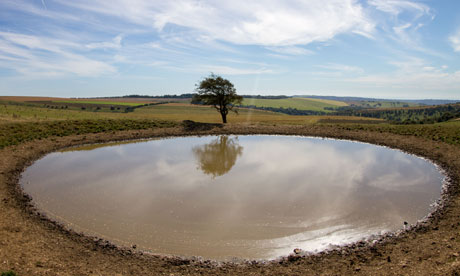
    North Stoke, near Arundel: The chalky soil allows rainwater to drain straight down into the ground, so farmers dug circular troughs to catch water for their flocks

    Country Diary: A tree is reflected in a dew pond on the South Downs

    A tree is reflected in a dew pond on the South Downs. Photograph: Paul Mansfield/Getty Images/Flickr RF

    The trees cast long shadows over the curving slopes of the South Downs as the sun rises. Dark clouds dissipate and drift off towards the sea. A chalk and grass track winds up and down into the distance. Beside the track is a large dish-shaped mound, edged by bushes. This dew pond – as with the others along the Downs – has been here as long as the sheep, possibly dating back to medieval times. The chalky soil allows rainwater to drain straight down into the ground, so farmers dug circular troughs to catch water for their flocks.

    The base of the pond was usually lined with straw and puddled clay, which was wetted and beaten down to create an impermeable surface. A layer of burnt lime was used to stop worms breaking up the clay. It was once thought that the main source of water was the dew but the ponds simply catch rain. Sheep still graze in the neighbouring field.

    Nearby, in one of the field margins, an open area attracts dozens of rabbits, which hop, chase, chew and wash. A grey partridge stands guard while its chicks bounce around it. A brown hare emerges from the tall grass and flowers, its black-tipped ears flicking over its back. Soft peewit cries announce the arrival of a group of five lapwings. They too linger on the chalk, picking up insects among the stones and small flowers. One of the lapwings is paler than the others, with scalloping on its lighter green back, and grey-green neck markings. Its short tuft is the final clue that this is a juvenile – a very rare sign that these birds still breed on the South Downs.

    Suddenly the rabbits dart for cover and the young lapwing scurries into the long grass while two adults swoop into the air, calling furiously. The low-flying shapes of two red kites cast broad shadows across the ground. The lapwings dive-bomb the raptors, which unhurriedly float away over the fields and down the slopes.