Author: Neville

  • LAKE MACQUARIE RESIDENTS CONSIDER CLASS ACTION OVER SEA LEVEL RISE

    LAKE MACQUARIE RESIDENTS CONSIDER CLASS ACTION OVER SEA LEVEL RISE


    July 4, 2013 at 5:16 pm

    A group of Lake Macquarie residents is considering a class action against council, as concerns grow about its sea level rise policy.

    The Marks Point locals claim the measures have caused property prices to plummet, and while council disputes that, it says, it is keen to talk.

    Lake Macquarie Council says its policy is further explained HERE

    previewImg
    Podcast Video [ 0.01 MB ] Hide Player | Play in Popup
    avatarStory: Diana Bushby ·
    Filed Under:
    Newcastle News

    One Response to “LAKE MACQUARIE RESIDENTS CONSIDER CLASS ACTION OVER SEA LEVEL RISE”

    1. john on July 5th, 2013 12:56 pm
      avatarcan we watch the video first???????????

    Tell us what you think


    Latest News

    You may also be interested in:

    Recent Comments

  • 12,000 people call for logging Bill to be deferred

    12,000 people call for logging Bill to be deferred

    Inbox
    x
    The Wilderness Society <mail@change.org>
    6:09 PM (25 minutes ago)

    to me

    Last week, the regressive Sustainable Forests Timber Amendment Bill passed the Victorian Parliament.

    You were one of at least 12,000 people who thought this shouldn’t have happened.

    Thanks for signing our petition and sending a strong message to the Napthine government that it’s imprudent to give rogue logging agency VicForests more power than they’ve already got.

    The Wilderness Society raised your concerns with many MPs, arguing that it’s irresponsible to vest in VicForests more power to make decisions about where and when they log, without enough environmental and governmental oversight. And that it’s especially impetuous to do so, while VicForests is in the Supreme Court of Appeal over allegations that they’ve logged the habitat of the state animal emblem, the Fairy (Leadbeater’s) Possum!

    We met with Liberal MPs to explain why we’re concerned about the Bill. None of them tried to convince us that logging in native forests is good, nor that it needs to continue.

    So why did they support the Bill?

    We’re as disappointed as you are that no Liberal MPs stood up to the Nationals on this poor forest management policy.

    New laws allowing for long-term contracts won’t magic up a long-term wood resource.

    In fact, while the Bill was in Parliament, VicForests announced that due to a reduction in wood resource availability (‘cos they’ve overlogged for so many years, and due to the impacts of bushfires), they’re going to reduce their Ash logging by an (inadequate) 25%!

    Despite this, the SFTA Bill was still supported by every Liberal and National MP in the Parliament, bar one.

    On 7 May, when the Bill was before the Upper House, Labor MLC John Lenders said the Opposition believed the Bill is “flawed”. Labor also suggested that because the Auditor-General is currently investigating VicForests, the Bill should be properly considered by a Committee.

    We were heartened that President of the Upper House, Liberal MLC Bruce Atkinson agreed, and called upon the House to support the Bill being considered by a Committee due to his concerns about the “long-term sustainability of the resource”. Sadly, the vote was tied and the Bill proceeded to the Lower House.

    When it was debated there, the House was reminded of the plight of our endangered animal emblem when Opposition Environment Spokesperson Lisa Neville asked whether by passing the Bill, Parliament is “putting at risk the future of our native forests and creatures like the Leadbeater’s possum?”

    In our view, that’s exactly what the Bill does. We remarked that the Bill “would likely secure the extinction of the state’s animal emblem, the Fairy (Leadbeater’s) Possum, and require taxpayers to underwrite contracts to logging companies and paper manufacturers when the state cannot meet wood supply obligations.”

    In his contribution in Parliament, Greens MLC Greg Barber asked “would you invest in VicForests if it were a company listed on the Australian Stock Exchange and you saw that it had had a string of financial losses virtually since its inception and that its entire business was underpinned by, in effect, one customer with a stated position of getting out of the industry the company was in?”

    Here Mr Barber is referring to Australian Paper, manufacturers of Reflex copy paper, who have previously stated they intend be out of native forests by 2017. We believe our forests belong to all Australians, not only to logging and woodchipping companies.

    Write a letter to Australian Paper CEO Jim Henneberry (1) to let him know you’d like to see Australian Paper out of native forests far earlier than 2017, and our forests protected.

    The amazing Knitting Nannas of Toolangi were at Parliament to listen to the debate about the Bill, too.

    “We are aghast that the state government is attempting to ‘stitch-up’ a deal that will see our publicly owned native forests handed over to the industry for infinity logging,” said KNOT spokesperson, Karena Goldfinch.

    We know that Victorians are proud of their environment, and want to see forests protected. 12,000 people can’t be wrong.

    When it comes to the Sustainable Forests Timber Amendments Bill, the Napthine government hasn’t represented you. If your local MP is a member of the Napthine government, do let them know you’re disappointed they passed some very regressive logging laws, without even taking the trouble to defer them until the Auditor-General’s office has completed its investigation into VicForests and logging in Victoria.

    As the lawyers at the Environment Defenders Office say, “native forests are publicly owned, and Government should manage these forests on behalf of the public.”

    Thanks for being proud of your environment, and for standing up for our forests.

    Please keep in touch – because protecting Australia’s forests is crucial for the survival of endangered wildlife, for our way of life, and for the enjoyment and benefit of us all.

    For regular forest updates, sign up at wilderness.org.au. And follow us on Twitter @wilderness_VIC

    For the forests,

    Amelia Young
    Campaigns Manager, the Wilderness Society Victoria

    (1) Send your snail mail to Jim Henneberry, CEO, Australian Paper, Private Bag 87 Mt Waverley 3149 More info visit ethicalpaper.com.au

    This message was sent by The Wilderness Society using the Change.org system. You received this email because you signed a petition started by The Wilderness Society on Change.org: “Defer the Bill that would lock-in long-term native forest logging.” Change.org does not endorse contents of this message.

    View the petition 

    Reply
    Forward
    Click here to Reply or Forward
  • Bradford’s branding – Methane issues.

    Bradford’s branding

    National Media Museum Bradford

    National Media Museum: an exercise in the dark arts of rebranding?

    The difficulties at the National Media Museum (Report, 3 July) might be to do with the redevelopment of Bradford city centre and associated building work, but the fall in visitor numbers could also be linked to the change in name. The National Museum of Photography, Film and Television may have been a bit of a mouthful, but had something people could relate to, whereas the NMM is vague and does not resonate with the majority of potential visitors. Branding and rebranding are dark arts affecting the way things are perceived, and in this case may have back-fired.
    Nigel Hamilton
    Oxford

    • It’s a lot worse than David England thinks (Letters, 2 July). Methane actually has 21 times the greenhouse effect of carbon dioxide so just the leakage of 16% of methane causes 3.36 times as much greenhouse effect as burning it. All in all that would make it a far dirtier fuel than coal, which is only about twice as bad.
    Peter Hanson
    Exeter

    • Someone should tell Nursultan Nazarbayev that the prime minister of the UK is not an elected position (‘I’d vote for you’, 2 July). He could only vote for Cameron (as his local MP) if he lived in the constituency of Witney. Perhaps he is planning to move there?
    Michael Short
    St Leonards-on-Sea, East Sussex

    Derek Middlemiss is obviously correct about your unwillingness to review what are essentially cover bands (Letters, 3 July), and while you’re about it, there’s too much coverage of artists enacting other people’s plays rather than their own. And don’t get me started about those so-called “dancers” who have never composed a ballet in their lives.
    Martin Skinner
    Leamington Spa, Warwickshire

    • Peter Leach asks how he might become consummate (Letters, 3 July). With ease, Peter, with ease.
    Alan Saunders
    Yattendon, Berkshire

    • Taxpayers, customers, people, fairness and creativity are at the heart of various organisations. Is there any other part of the anatomy they’re ever put?
    Mike Smith
    Southampton

  • That’s deep – scientists harness power of ocean’s currents

    That’s deep – scientists harness power of ocean’s currents

    Posted on 04 July 2013 by Vicky Ellis

    That’s deep – scientists harness power of ocean’s currents

    Scientists in Madrid say they have designed a device which could harness the power of ocean currents in deeper water and potentially at a cheaper cost than existing technology.

    Researchers at Madrid’s Polytechnic University (UPM) conducted sea trials of their remote controlled prototype which can anchor underwater at about 40 metres with the help of a buoy and can be made to float to the top for repairs. First generation underwater ocean devices were limited to 30-35 metres, say the researchers.

    Made from stainless steel it has a cylindrical central body and three external parts which resemble rockets attached by arms. These arms turn like a rotor in ocean currents to power the generator. The device is built at a tenth of the size of an industrial unit which could generate 1MW of electricity.

    The university said test results were “very successful” and showed the prototype hit their objectives of “reducing costs of construction, installation and maintenance”.

  • Coalition to reduce funds available for ‘green army’ of environment volunteers

    Coalition to reduce funds available for ‘green army’ of environment volunteers

    Tony Abbott says it will now take five years for ‘troop’ numbers to reach the 15,000 initially promised

    tony abbott georges river

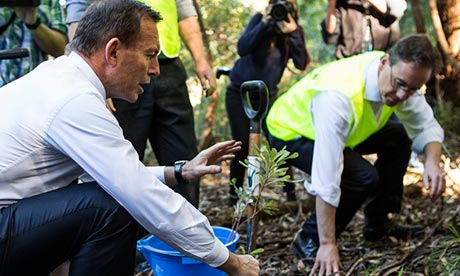
    Tony Abbott (left) plants a tree as part of the bush regeneration works in Carss bush park in Kogarah. Sydney on Friday. Photograph: AAP Image/Damian Shaw

    Tony Abbott has pared back the money available to his “green army”, recommitting to the 2010 election policy but saying it will now take five years for its “troops” to grow to the promised 15,000.

    In 2010 Abbott’s green army – a voluntary program for 17-to-24 year olds to do practical environmental work – was allocated $400 million over four years. The 2013 version has $300 million to spend.

    In both 2010 and 2013 the program began with a $50 million allocation. In 2010, that was estimated to be enough to pay for 4000 six-month training places, or 2000 army recruits at any one time. In 2013, after increases in the national training wage, the starting numbers in the army would have to be fewer than 2000.

    The Coalition has not provided a detailed year-by-year cost breakdown for the 2013 version of the green army. It says it will still build to a 15,000 strong workforce, but this will now take five years. In the first four years no more than the new allocation of $300 million will be available. It says that will be enough for 1,500 projects.

    Announcing the policy yesterday, the opposition leader said one of the first green army projects would be along the Georges River in Sydney.

    Army recruits can be school leavers, students on a gap year, or young unemployed for whom it can act as an alternative work for the dole program. It will be administered by the environment department and projects will be chosen for their environmental benefit, contribution to the local community and capacity to provide the participants with training in specific skills.

    As examples of possible projects, the coalition policy paper cites weed eradication, construction of sea walls, rehabilitating river banks and restoring walking tracks.

    Abbott said the army “complements” the coalition’s “direct action” approach to climate change.

    “At the same time as improving the local environment, the green army will foster teamwork, local ownership and community spirit in our young people,” he said.

    Daily Email

    close

    Sign up for the Guardian Today

    Our editors’ picks for the day’s top news and commentary delivered to your inbox each morning.

    Sign up for the daily email

    Daily Email

    close

    Get the Guardian’s daily US email

    Our editors’ picks for the day’s top news and commentary delivered to your inbox each morning. Enter your email address to subscribe.

    Sign up now
    Daily Email

    close

    Get the Guardian’s daily Australia email

    Our editors’ picks for the day’s top news and commentary delivered to your inbox every weekday.

  • China’s largest algal bloom turns the Yellow Sea green

    China’s largest algal bloom turns the Yellow Sea green

    The algae, which can suffocate marine life, is thought to be caused by pollution from agriculture and industry

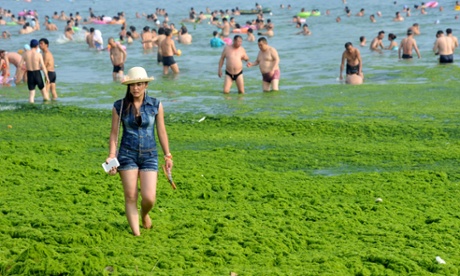
    Tourists bath at a beach covered by a thick layer of green algae in Qingdao, China.

    Tourists bath at a beach covered by a thick layer of green algae in Qingdao, China. Photograph: ChinaFotoPress/Getty Images

    The largest algal bloom ever recorded in China has turned the Yellow Sea green and may be related to pollution from agriculture and industry.

    Officials in the city of Qingdao had used bulldozers to remove 7,335 tonnes of the growth from beaches according to the Xinhua news agency.

    The phenomenon has become an annual occurrence in the region over the past six summers. This year’s incident has swathed 28 900 sq km (11 158 sq miles), twice as much as the previous biggest bloom in 2008.

    The algae, called Enteromorpha prolifera, is not toxic to humans or animals.

    However the carpet on the surface can dramatically change the ecology of the environment beneath it. It blocks sunlight from entering the ocean and sucks oxygen from the water suffocating marine life.

    The algae thrives on an abundance of nutrients in the sea. University of Cambridge and EnAlgae Project researcher Dr Brenda Parker said that the Chinese bloom may well be linked to industrial pollution.

    “Algal blooms often follow a massive discharge of phosphates or nitrates into the water. Whether it’s farming, untreated sewage or some kind of industrial plant that is discharging waste into the water,” she said.

    The recent explosion of the algae pointed to a dramatic change in the ecosystem which was probably not natural.

    “That would probably be an indicator that something is a little bit unbalanced,” said Parker.

    She said that the 2009 example algal bloom on the Brittany coast was a similar example of a human-induced algal bloom.