Author: Neville

  • Warming Ocean Biggest Driver of Antarctic Ice Melt


     44
     114  18
    comments

    0
    Print this page

    The Carbon Brief

    By Roz Pidcock

    Larsen Ice Shelf, NASA.

    Of Earth’s two vast ice sheets, Antarctica is perhaps the more mysterious. From the icy surface to the ocean below, there are several different ways the ice sheet is shrinking. How these processes compare is key to knowing how fast melting ice sheets are raising sea levels worldwide—and a new study may help to shed a bit more light.

    Ice Sheets and Sea Level Rise

    There is huge scientific interest in monitoring how the ice sheets are changing because when ice on land melts it drains into the ocean, causing sea levels to rise. Last week, a major review of how scientists’ understanding of ice sheet melt has advanced since the last Intergovernmental Panel on Climate Change (IPCC) report in 2007.

    But while Greenland is relatively well understood, at the other end of the planet in Antarctica, the picture is a little less clear, the report concludes.

    Antarctic Ice Shelves

    To understand how most of the ice is lost from Antarctica, a new study just published in Science looks to the ice shelves that surround 75 percent of the continent. Ice shelves are floating extensions of land ice that act as buttresses, stopping ice flowing from the interior straight out into the ocean.
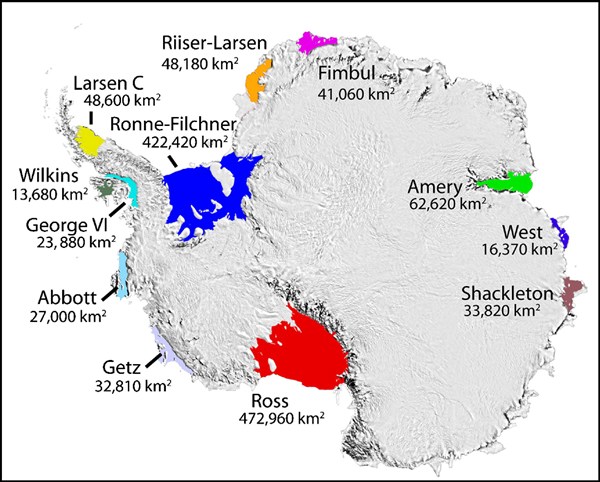
    Iceshelf _locationsIce shelves line 75 percent of the Antarctic coastline. The biggest ones are the Ross and Ronne-Filchner ice shelves, marked here in red and dark blue. Source: National Snow and Ice Data Centre

    Traditionally, scientists thought large chunks of solid ice breaking off the ice shelves was the main source of ice loss from Antarctica—a process known as iceberg calving. But there’s another way. As the ocean below the ice shelves warms, the ice melts from the bottom up—something scientists call basal melting. With melting from both the top and bottom, some ice shelves are getting noticeably thinner, says the new study.

    Bottom-up Melting

    The paper looked at both processes of ice loss across 99.5 percent of Antarctica’s ice shelves between 2003 and 2008. Overall, the scientists found basal melting caused 55 percent of ice loss, although they saw quite a lot of variation between regions. This makes bottom-up ice shelf melt the largest source of ice shelf loss in Antarctica. Previous studies have estimated the contribution to be more like 30 percent, or even as low as 10 percent.

    “[T]he role of the Southern Ocean in controlling the evolution of ice shelves, thereby the evolution of the ice sheet as a whole, is more significant  than estimated previously. This places more emphasis on understanding the evolution of the state of the Southern Ocean,” said Professor Eric Rignot from the University of California Irvine. Rignot, the lead author on the paper, also called the study a “game-changer.”

    The scientists found smaller ice shelves melted more than large ones. Giant ice shelves like the Ross, Filchner and Ronne occupy two-thirds of the total ice shelf area but accounted for just 15 percent of melting. Half of the meltwater came from 10 smaller ice shelves occupying just eight percent of the total area.

    An Uncertain Ice Sheet

    If Antarctica melted completely, scientists estimate it could add about 58 metres to global sea level. At the moment, satellite data indicates the Antarctic ice sheet is losing ice but only at a rate of about 0.2 mm per year—more than three times slower than Greenland.

    That’s partly because different parts of the ice sheet are changing in different ways. Even though ice shelves in West Antarctica and the Antarctic Peninsula are melting and breaking apart, this doesn’t contribute directly to sea level rise as they are already floating on water.

    But their thinning accelerates ice flow from the many glaciers in the continent’s interior, which does raise sea levels. Warmer air overlying the ice also causes melting on the surface. Nearly half of the ice shelves In East Antarctica are thinning too, according to the paper. But satellite data indicates the mass of ice in East Antarctica is growing overall thanks to an increase in snowfall.

    Scientists warn there are still lots of uncertainties about these estimates. So monitoring the contribution of different processes—and how they’re likely to change in the future—is critical for producing reliable projections of sea level rise.

    V

  • Pistols at Dawn ( MONBIOT )

    Monbiot.com


    Pistols at Dawn

    Posted: 21 Jun 2013 01:28 AM PDT

    A three-year, £100 bet on solar power has matured. Who won?


    By George Monbiot, published in the Guardian 21st June 2013

    Summer solstice. At dawn. What better time could there be for resolving a duel, albeit one not fought with flintlocks? The time is of my choosing, as the other party, though he accepted the challenge, would not agree terms. It is appropriate in another sense too, as this is the day with the longest hours of sunlight and therefore – for I honour the sporting tradition – it offers my opponent the best shot.

    Three years ago, in the course of our debate about the best means of generating electricity, I bet £100 against a claim made by Jeremy Leggett, chairman of the company SolarCentury. He had asserted that domestic solar power in Britain would achieve grid parity by 2013. This means that it would cost householders no more than conventional electricity.

    I’m interested in this question because I want to see carbon emissions cut as quickly and effectively as possible. If public money is used to back the wrong technologies, that represents a wasted opportunity. It is easy to become enthusiastic about domestic solar power, because it is produced on a small scale, gives people a satisfying sense of self-reliance, and is unobtrusive, unlike most other forms of generation.

    In fact it’s arguably the only form of electricity production which has widespread public support. The fact that it has been exceedingly lucrative for homeowners who installed their panels when state subsidies (the feed-in tariff) were high has contributed to that enthusiasm.

    But those of us who want carbon emissions to be greatly reduced should ask questions that are wider than only self-interest and aesthetics. We also have to ask whether a technology works. Solar power works well at low latitudes, especially in places where peak electricity demand coincides with peak sunlight, which is often the case where air conditioning is widely used. In terms of replacing conventional electricity, it works less well in places like the UK, which are far from the equator and have different patterns of use. Here, peak demand occurs between 5 and 7 o’clock on winter evenings.

    I was sceptical of Jeremy’s claim. So I bet that his prediction would not come to pass: grid parity would not be achieved by 2013. He accepted. I undertook to write an article in 2013 revealing the results, whether I won or lost. Here it is.

    To discover who had won, I first contacted the energy regulator, Ofgem, but it turned down my request. So I tried the Department for Energy and Climate Change. I asked two questions:

    – how should the outcome best be measured?

    – who will have to pay out £100?

    This is what it told me:

    “Grid parity can be defined as the point at which Government support for a technology is no longer required.”

    That seems like a reasonable definition to me, and one I’m prepared to accept. I hope Jeremy feels the same way: in 2010 I wrote to him several times to try to reach an agreement about how the outcome would be determined, but did not receive a reply.

    Here is DECC’s answer to my second question:

    “Grid parity for domestic scale solar power has not been reached. … The Feed-in Tariff scheme currently provides generation tariff of 15.44p per kWh, plus an export tariff of 4.64p per kWh for domestic scale installations.”

    Here is the source it gave me.

    In other words, though the subsidy has come down sharply from 2010, which partly reflects a real decline in the price of solar power and partly reflects the extraordinary generosity of the initial tariff, we’re a long way from grid parity.

    This, I think, highlights the danger of believing what we want to believe. Climate change is too serious to mess about with. We should be hard-headed in addressing it, and should subject the technologies which attract us to as much scrutiny and rigour as the technologies which repel us.

    It was this process which, after my initial enthusiasm, turned me away from solar power in the UK and led to my reluctant endorsement of large-scale wind and (later) nuclear power as the UK’s most viable sources of low-carbon electricity.

    I wish it were otherwise. But what counts for me is achieving the steepest and fastest possible cut in greenhouse gases. None of our options are great, but these are the best of a bad bunch. (I hope I don’t need to add that we should simultaneously pursue sharp reductions in energy demand).

    Though the costs will keep falling, solar power is unlikely to make a large contribution to electricity supply in the United Kingdom, unless a radically different technology becomes viable. This is because of the inherent constraints I mentioned earlier. It has some potential for mitigating carbon emissions in the summer, especially with the use of smart grids, but it seems to me that for a long time to come there are likely to be cheaper and simpler means of achieving the same aim. I would like to be proved wrong on this, but I don’t think it will happen.

    For all that, looking back across the past three years it seems to me that there is something of the circular firing squad about our duel.

    Two months after we struck our bet, the government changed. I don’t think either of us would have guessed just how bad it would be. In fact it wasn’t until the Any Questions programme two weeks ago that we were able to see how far the madness has gone. Owen Paterson, the environment secretary, revealed that he rejects the science of climate change, and trotted out a series of discredited factoids and myths. This is what he said.

    “the climate’s always been changing, er, Peter [Hain] mentioned the Arctic and I think in the Holocene the Arctic melted completely and you can see there were beaches there – when Greenland was occupied, you know, people growing crops. We then had a little ice age, we had a middle age warming. The climate’s been going up and down, but the real question which I think everyone’s trying to address is is this influenced by manmade activity in recent years and James [Delingpole] is actually correct. The climate has not changed – the temperature has not changed in the last seventeen years …”

    You can read a powerful deconstruction of these claims on the Skeptical Science website.

    Alongside an environment secretary in denial about climate change, we have a chancellor who seems to be attempting to sabotage every green initiative. We see constant efforts by both the press and MPs to prevent the deployment of wind farms. There is a widespread belief in government that the best substitute for natural gas is, er, natural gas, ideally extracted by the most damaging means. We’ve witnessed the abandonment of the energy-saving schemes launched by the last government and their replacement with a useless Green Deal.

    The European Emissions Trading Scheme has collapsed, international negotiations have ground to a halt, CO2 concentrations in the atmosphere have already passed 400 parts per million and there are no serious global efforts to prevent their rise, let alone bring them down. Far from leaving most fossil fuels in the ground – without which no progress on climate change can be made – energy companies and nation states are making unprecedented efforts to extract them from ever more remote and hazardous places.

    In other words, Jeremy and I have both lost. And so has everyone, except the fossil fuel companies.

    So I fire my shot into the air. We differ profoundly on which technologies are best deployed to address climate change. But we confront a government which appears to want none of them, and in this respect we are united.

    www.monbiot.com

  • CBA Planning scandal ( Mike Carlton )

    *******************************************************************************

    What a night of nights it must have been last May: the music, the champagne, the chatter and laughter, the bursts of applause. See the merry throng of gentlemen elegant in best black tie, the ladies soignee in satins and silks, a soft light sparkling on silver and pearls, on diamonds and gold.

    We are at Ivy on George Street – ”a sophisticated urban playground for grown-ups” – and it’s the 23rd annual Australian Banking & Finance Awards, 2013. The Oscars, the Grammys, the Logies for the banking business. How thrilling. And the winner of the hotly contested, highly coveted award for Australian Financial Institution of the Year (Major Banks)? Come on down, the Commonwealth Bank of Australia! Lord knows who chooses these things, or what the criteria might be. It seems unlikely, though, that anyone consulted the 725 and more clients of the CBA who lost hundreds of millions of dollars as a result of dodgy practices of financial planners at the bank over the years since 2007.

    This is – or should be – one of the great banking scandals of our time. In a nutshell, at least seven CBA advisers shoved their customers into disastrously high-risk investments without their knowledge or understanding. All the while, of course, charging humungous fees for doing so.

    Many of those dudded were elderly or infirm. Mervyn Blanch, aged 81, saw the value of his life savings with the CBA nosedive from $260,000 to just $92,000. He and his wife were forced onto the cold charity of Centrelink. Mrs Patricia Babbage, a widow and the mother-in-law of the federal shadow treasurer, Joe Hockey, lost more than half her investment of $200,000 even as she was dealing with the trauma of bowel cancer. There are hundreds of similar stories.

    The kingpin in this outrage was a planner named Don Nguyen, a CBA hotshot who has since been banned from the industry for seven years. Another was a spiv named Ricky Gillespie, who forged clients’ signatures and is now out for life, although he denies any wrongdoing and is appealing. Nobody, though, has been to jail.

    We know much of this from a handful of brave whistleblowers at the bank who, aghast at what was happening, went first to the finance industry watchdog ASIC, the Australian Securities and Investment Commission, and then to their bosses. Gradually, the truth began to emerge. So all’s well that ends well, you might think.

    But no. It’s just the start. The Commonwealth Bank writhed and wriggled, pulling every trick in the book to get out from under its responsibilities. Distressed clients were fobbed off with evasions and, at times, outright lies. Eventually, derisory amounts of compensation were offered. ASIC – famously about as useful as a fish on a bicycle – dithered and sat on its hands from October 2008 until March 2010, despite having been given chapter and verse by the whistleblowers.

    The Fairfax Media business writer Adele Ferguson has been reporting this scandal for months, with admirable clarity and resolve. On Thursday there was a result. The Senate agreed to run an inquiry into the fraud and forgery at the CBA and the hand-wringing indolence at ASIC.

    Already, of course, the arse-covering has started. The CBA wrote to the Herald claiming that ”everything we do is focused on securing and enhancing our customers’ financial wellbeing”. Bollocks. And ASIC’s deputy chairman, Peter Kell, stoutly maintains that his outfit ”took serious enforcement action”. Codswallop.

    This affair has a long way to run. For the moment, the Commonwealth Bank might like to hand back its glittering prize.

    ***********************************************************************************


  • Singapore haze hits record high from Indonesia fires

    2013 Last updated at 19:38 GMT

    Singapore haze hits record high from Indonesia fires

    The BBC’s David Shukman explains the impact and cause of the haze

    Pollution levels soared for a third day in a row in Singapore, as smoky haze from fires in Indonesia shrouded the city state.

    The Pollutant Standards Index (PSI) hit 401 at 12:00 on Friday (04:00 GMT) – the highest in Singapore’s history.

    The index also reached 400 in one part of Indonesia, which is readying helicopters and cloud-seeding equipment in an effort to tackle the fires.

    Indonesia has said it is unfair to blame it solely for the forest fires.

    A senior official in the Indonesian president’s office said fires had been spotted on land owned by 32 companies in the region, some of them based in Malaysia and Singapore.

    Schools in parts of Malaysia and Indonesia have closed temporarily.

    Singaporean Prime Minister Lee Hsieng Loong warned on Thursday that the haze could remain in place for weeks.

    “We can’t tell how this problem is going to develop because it depends on the burning, it depends on the weather, it depends on the wind,” he said.

    “It can easily last for several weeks and quite possibly it could last longer until the dry season ends in Sumatra which may be September or October.”

    ‘Life threatening’

    Continue reading the main story

    Analysis

    Karishma Vaswani BBC News, Jakarta

    Indonesia is struggling to contain the raging forest fires that are causing the thick smog which is enveloping Singapore, parts of Malaysia and some Indonesian cities.

    On Friday, the government despatched helicopters to the worst affected areas, in a bid to create artificial rain. The plan is to seed the clouds once the temperature is a bit cooler to induce rain over the burning forestland.

    It is a big challenge. Fire-fighters on the ground have been working around the clock to put out the blazes, but they have spread to peatlands and are proving to be very difficult to extinguish. Officials have complained about a lack of resources and say they desperately need some rain to help.

    Indonesia’s weather agency says rainfall is not likely until 29 June. Singapore and Malaysia have both urged Indonesia to do more to solve this crisis. Singapore has offered aircraft to help with the cloud-seeding operation, but there needs to be clouds in the sky for it to work. This time of year is typically the hottest and driest on the island of Sumatra.

    A PSI reading above 300 is defined as “hazardous”, while Singapore government guidelines say a PSI reading of above 400 sustained for 24 hours “may be life-threatening to ill and elderly persons”.

    “Healthy people [may also] experience adverse symptoms that affect normal activity,” the government says.

    The PSI dropped down to 143 at 17:00 (09:00 GMT), although this is still classed as “unhealthy”.

    Before this week’s episode, the previous air pollution record was from September 1997 during the 1997-1998 South East Asian Haze, when the PSI peaked at 226.

    Singapore resident Nicole Wu told the BBC that she had stayed indoors for the past two days.

    “It’s terrible. In my flat the windows are all closed with the air conditioning on,” she said. “My mother has to wear a mask to go shopping.”

    “I can’t even see what’s happening outside my house due to the smog. You can’t see birds [or] moving objects,” she added.

    Philip Koh, a doctor, told AFP news agency that the number of medical consultations he had had in the past week had increased by 20%.

    Continue reading the main story

    Office workers wearing masks wait to cross a road in Singapore on 21 June 2013 Singaporeans have donned face masks as the haze engulfing the city hit hazardous levels.

    Continue reading the main story

    1/5

    “My patients are telling me they are worried about how long this is going to last and how much higher this is going to go,” he said.

    In Indonesia’s Riau province, where the fires are concentrated, the PSI reached 400 on Friday, the head of the local health office told the BBC.

    Schools there are to remain closed until the air quality improves.

    The chief of the health department Zainal Arifin said there was an “increasing number of asthma, lung, eye and skin problems due to higher CO2 levels”.

    “I call for residents to stay at home and reduce outdoor activities,” he said.

    Diplomatic strain

    Continue reading the main story

    “Start Quote

    The face masks which are in high demand in Singapore can protect against the worst of the smog… [but] are unlikely to provide total protection”

    Singapore’s National Environment Agency has started providing hourly PSI updates on its website, in addition to the three-hourly updates it previously provided.

    Around 300 schools in southern Malaysia have now been closed as a result of the smog. Schools in Singapore are currently closed for the holidays.

    There are also reports of flight delays affecting both Singapore’s Changi airport and Riau province in Indonesia.

    The fires are caused by illegal slash-and-burn land clearance in Sumatra, to the west of Singapore.

    Chart

    The smog has strained diplomatic relations between Singapore and Indonesia – two countries that usually share good relations, the BBC’s Karishma Vaswani in Jakarta reports.

    Continue reading the main story

    Slash-and-burn clearances

    • Slash-and-burn farming is a technique that involves cutting down vegetation and burning to clear land for cultivation
    • It is cheaper than using excavators and bulldozers
    • The illegal burning of forests to clear land for palm oil plantations has long been a problem in Indonesia – particularly during the dry season in the summer
    • Indonesia’s Environment Minister Balthazar Kambuaya has said the government is investigating several palm oil companies in this respect
    • Some producers have already denied their companies use slash and burn land clearance

    Mr Lee said Singapore had provided satellite date to Indonesia to help it identify companies involved and said that if any Singapore firms were involved, that would be addressed.

    Indonesia’s National Disaster Management Agency said it would deploy two helicopters to conduct “water-bombing” operations, as well as planes with cloud seeding equipment.

    One of the Malaysian companies named by the Indonesian presidential official denied that it was burning forest to clear land, but said some small farmers operating on its property were doing so.

    Palm oil giant Sime Darby said in a statement that it was strictly following its zero-burning policy throughout its operations, but that it could not control the activities of local growers farming on its concession area.

    More than 100 Indonesian firefighters are attempting to put out the fires in Sumatra.

    Selina Latiff, from Novena, Singapore, filmed this footage of the smog from a 29th floor balcony

    However, an official in Riau province said they were “overwhelmed and in a state of emergency”.

    “We have been fighting fires 24 hours a day for two weeks,” Ahmad Saerozi, the head of the natural resources conservation agency in Riau, told AFP news agency.

    He added that the fires were in peat around three or four metres below the ground, making it particularly hard to fight them.

    “It is still burning under the surface so we have to stick a hose into the peat to douse the fire,” he said.

    “We take one to two hours to clear a hectare, and by then another fire has started elsewhere.”

    Indonesian President Susilo Bambang Yudhoyono said “all the country’s

  • With regret, Gillard must go, for nation’s sake ( Mike Carlton )

    nt Mike Carlton Article

    Search smh:

    Search in:

    With regret, Gillard must go, for nation’s sake

    Date
    June 22, 2013
    Category
    Opinion
    • 467 reading now
    Time for Prime Minister Julia Gillard to wave goodbye to office.Time for Prime Minister Julia Gillard to wave goodbye to office.

    Prime Minister, it’s time. Time for you to quit. As this Parliament draws to its close, it’s time for you to recognise that, for all your achievements, you are leading your government and your party to an electoral defeat of unprecedented disaster.

    As painful as it must be, it’s time for you to stand aside for the good of your colleagues, for Labor people everywhere, and for the nation itself. The plain fact is that Australians are no longer listening to you.

    Prime Minister … you are leading your government and your party to an electoral defeat of unprecedented disaster.

    Kevin Rudd is the most popular politician in the country, far and away better liked and respected than Tony Abbott. For all his many faults, he alone has a fighting chance of keeping Abbott out of The Lodge. Every opinion poll shows that you do not. Better to go now, with dignity, at your own chosen speed, than to be flung aside by your party and the people.

    It will not be easy. Not for you, not for anyone. Rudd Redux will need the saintly forbearance of Nelson Mandela returning from Robben Island, which means no payback, no vendetta. Half the cabinet will have to swallow its pride and loathing. And the Liberals will no doubt feast on the result.

    Advertisement

    But there is no choice. It gives me no pleasure to write this, Prime Minister. The decision is yours.

    ***********************************************************************************


  • Canadian floods prompt evacuation of entire downtown Calgary area

    Canadian floods prompt evacuation of entire downtown Calgary area

    Twenty-five neighborhoods in the city, with an estimated population of 75,000, have already been evacuated due to floods

    Residents evacuate Calgary

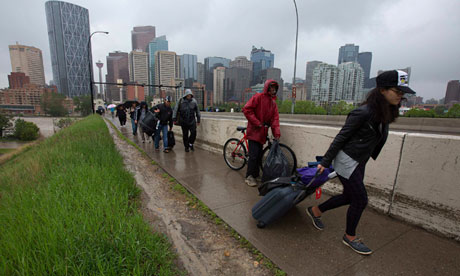
    Residents leave the flooding downtown core as new orders evacuating all of downtown were issued in Calgary, Alberta. Photograph: Todd Korol/Reuters

    Flooding forced the western Canadian city of Calgary to order the evacuation of the entire downtown area on Friday, as the waters reached the 10th row of the city’s hockey arena.

    About 230,000 people work downtown on a typical day. However, officials said very few people need to be moved out, since many heeded warnings and did not go to work on Friday.

    Twenty-five neighborhoods in the city, with an estimated population of 75,000, have already been evacuated due to floodwaters in Calgary, a city of more than a million people that hosted the 1988 Winter Olympics and is the center of Canada‘s oil industry.

    No deaths were reported since torrential rains hit the region Wednesday night, although one woman swept away with a mobile home was still missing.

    In the downtown, water was inundating homes and businesses in the shadow of skyscrapers. Water has swamped cars and train tracks.

    The city said the home rink of the National Hockey League Calgary Flames has flooded and the water inside is 10 rows deep. The 19,000-seat Saddledome is one of the feature buildings on the famed Calgary Stampede grounds, which is largely under water.

    Officials said there was little that can be done to pump the water out of the building because there is simply too much.

    About 1,500 have gone to emergency shelters while the rest have found shelter with family or friends, Mayor Naheed Nenshi said.

    Nenshi said he’s never seen the rivers that high or that fast, but said the flooding situation is as under control as it can be. Nenshi said the Elbow River, one of two rivers that flow through the southern Alberta city, has peaked. And if things don’t change, officials expect that the flow on the Bow River – which, in in the mayor’s words early Friday, looks like “an ocean at the moment” – will remain steady for the next 12 hours.

    Police urged people to stay away from downtown and not go to work.

    The flood was forcing emergency plans at the Calgary zoo, which is situated on an island near where the Elbow and Bow rivers meet. Lions and tigers were being prepared for transfer, if necessary, to prisoner holding cells at the courthouse.

    Schools and court trials were cancelled Friday and residents urged to avoid downtown. Transit service in the core was shut down.

    Alberta Premier Alison Redford promised the province will help flood victims put their lives back together and provide financial aid to communities that need to rebuild The premier said at a briefing that she has spoken to Prime Minister Stephen Harper, who is heading to Calgary and has promised disaster relief. She urged people to heed evacuation orders, so authorities could do their jobs. She called the flooding that has hit most of southern Alberta an “absolutely tragic situation.

    The premier warned that communities downstream of Calgary have not yet felt the full force of the floodwaters.

    It had been a rainy week throughout much of Alberta, but on Thursday the Bow River Basin was battered with up to 100 millimeters (four inches) of rain. Environment Canada’s forecast calls for more rain in the area, but in much smaller amounts.

    Calgary is not alone in its weather-related woes. There have been flashpoints of chaos from Banff and Canmore and Crowsnest Pass in the Rockies and south to Lethbridge.

    More than a dozen towns have declared states of emergency. Entire communities, including High River and Bragg Creek, near Calgary are under mandatory evacuation orders.

    Some of the worst flooding hit High River, where it’s estimated half of the people in the town have experienced flooding in their homes.

    Military helicopters plucked about 30 people off rooftops in the area. Others were rescued by boat or in buckets of heavy machinery. Some even swam for their lives from stranded cars.

    A spokesperson for Defense Minister Peter MacKay said 354 soldiers are being deployed to the entire flood zone.

    Further west, in the shadow of the Rocky Mountains, pictures from the mountain town of Canmore depicted a raging river ripping at house foundations.