Author: Neville

  • Labor’s unpopularity could be a disaster for the Greens in the Senate too

    20 June 2013, 3.25pm EST

    Labor’s unpopularity could be a disaster for the Greens in the Senate too

    The publicly available opinion polls are in agreement about the fate of the Labor government. A landslide defeat in the House of Representatives is looming, the magnitude of which might place Julia Gillard alongside Bert Evatt, Arthur Calwell, Gough Whitlam (twice) and Paul Keating as federal Labor’s…

    7k6p3cfg-1371697610
    The impending disaster for Julia Gillard’s government at the federal election could also spell trouble for the hopes of the Greens in the Senate. AAP/Alan Porritt

    The publicly available opinion polls are in agreement about the fate of the Labor government. A landslide defeat in the House of Representatives is looming, the magnitude of which might place Julia Gillard alongside Bert Evatt, Arthur Calwell, Gough Whitlam (twice) and Paul Keating as federal Labor’s biggest electoral losers.

    Little, however, has been said about the Senate contest. Opposition leader Tony Abbott clearly foresees an outcome that might frustrate his future government and has promised a double dissolution election if this should happen.

    The current polling data indicates that the disaster Labor is facing in the lower house will also impact on the Senate, notwithstanding the different electoral systems being used. What’s more, Labor’s poor performance has the potential to seriously affect the Greens as well.

    Forecasting Senate outcomes can be difficult given the complexity of the voting system, the potential for a vast number of candidates to nominate, and the lack of information about how preferences will be directed by the various parties. It is also difficult to find opinion poll data broken down by states. Using the polling data below, some preliminary predictions about the Senate can be made.

    Table 1: AC Nielsen polling by state. AC Nielsen/Fairfax polling
    Click to enlarge

    The table above uses the same polling data used by Fairfax last week to make claims about the state variations that might occur within the national swing as voters make their choices for the House of Representatives. In other words, these polls did not ask voters about their Senate voting intentions.

    Psephologist Malcolm Mackerras’ argument that, in normal circumstances, half-Senate election results usually end up seeing the collective left-of-centre (Labor, Greens) and the collective right-of-centre (Liberal, National, DLP, Family First and so on) sharing three seats each is a useful starting point. As the LNP Coalition rarely has serious competition from minor right-of-centre parties, the joint ticket usually wins three seats in each state.

    Labor, however, has lost ground to its competitive minor parties: the Australian Democrats for much of the 1980s and 1990s and more recently to the Greens. Therefore, a contemporary “normal” pattern involves Labor winning at least two seats in each state, with Labor and the Greens fighting for the third left-of-centre seat.

    As part of this process, the successful left-of-centre minor party has had to rely on a flow of surplus Labor votes to secure a seat. The importance of Labor’s preference direction was demonstrated in 2004 when Family First’s Steve Fielding won a Senate seat for Victoria owing to being preferenced ahead of the Greens on the Victorian Labor Senate ticket.

    For Labor to be in a position to assist the Greens – or whoever it prefers – to win a seat, its Senate ticket must poll more than at least 28.8% of the primary vote.

    Table 2: poll data as Senate quota by state.
    Click to enlarge

    To assist in making predictions, the data in Table 1 is calculated in Table 2 as a quota, with the parties winning a seat for every full quota achieved. The table also expresses the quota as an aggregated left-of-centre compared with right-of-centre result which can assist in indicating how the numbers might fall in terms of a left-right contest.

    The first important thing to note from this table is that in three states, the combined left-of-centre does not have enough support for three seats, whereas the right-of-centre has more than enough for four. If nothing else, these data are indicating a significant shift to the right-of-centre in terms of outcome of seats, although it is not clear which of the parties will win these seats.

    Both Table 1 and Table 2 show that in three states Labor is polling under the 28.8% threshold needed to secure two seats, let alone provide some surplus to help the Greens.

    The 2011 Senate being sworn-in: what will the Senate after July 1, 2014, look like? AAP/Alan Porritt

    It should be borne in mind that the above data may be worse than it appears. If the past is any guide, Labor’s primary Senate vote will be less than its national lower house vote (the average difference since 1949 is negative 3%), while the Greens can expect to poll better in the Senate than the House of Representatives (a difference of plus 1%). This won’t help the Greens, for in all likelihood Labor will need Green preferences to secure a second seat in Queensland and NSW.

    The situation in South Australia is complicated by the fact that independent senator Nick Xenophon is up for re-election. If Xenophon were to poll in excess of the quota and had surplus to distribute, the Greens’ Sarah Hanson-Young might be returned. Were Xenophon to poll less than 14.4%, however, Hanson-Young would be stranded and her preferences would elect the second Labor candidate.

    In Queensland the presence of populist parties such as the Katter Australia Party (KAP) and the Palmer United Party (PUP) are the wildcards. If the primary vote of Labor and the Greens is added together, the collective left-of-centre only has enough support to win 2.7 quotas. Meanwhile, the aggregated LNP and other right-of-centre (KAP, PUP, and all others) results in 4.19 quotas. Queensland will thus return two left (most likely Labor) and four right (most likely three LNP and probably one of the populist right, most likely from the KAP) to the Senate.

    The situation for Labor and the Greens is better in Victoria, where Labor will win two seats and the Greens one. No data has been given for Tasmania, where the Greens would nonetheless be confident of picking up one seat, and Labor two seats. The Liberals would have expectations of three seats, and this would be a gain: in 2007, the Liberals won only two seats.

    Table 3: Senate predictions.
    Click to enlarge

    Table 3 sets out tentative predictions for the Senate based on the available polling data. The predicted outcome in Tasmania is purely speculative, however, given the lack of specific polling data.

    The overarching theme of this table is that the Senate will shift to the right, and that Tony Abbott could be within a whisker of winning control of the Senate. These figures and the speculation about the outcome in Tasmania would result in the three “others” – existing DLP senator John Madigan, Nick Xenophon (predicted to be re-elected) and a right-of-centre senator from Queensland, possibly from the KAP – holding the balance of power.

    The prediction of the Greens’ success in Victoria and Tasmania can be made with confidence, but the situation in Western Australia is critical to everything. According to the Fairfax polls, Labor should win two and the Greens one seat. The result will be very close, however, and the possibility of the Liberal-National joint ticket picking up a seat at the expense of the Greens is a real possibility.

    If that happens, the Liberal-National government will take control of the Senate on July 1, 2014, and Tony Abbott will not have to worry about a double dissolution election.
  • Scientists tip 2025 for possible planetary collapse

    7 June 2012
    Scientists tip 2025 for possible planetary collapse
    by Will Parker

    Based on an evaluation of more than 1,000 previous studies, a new meta-review by an international group of 18 scientists suggests the Earth is perilously close to a tipping point where resource consumption, ecosystem degradation, climate change, biodiversity loss and population growth will trigger massive changes in the biosphere.


    “The last tipping point in Earth’s history occurred about 12,000 years ago when the planet went from being in the age of glaciers, which previously lasted 100,000 years, to being in its current interglacial state. Once that tipping point was reached, the most extreme biological changes leading to our current state occurred within only 1,000 years. That’s like going from a baby to an adult state in less than a year,” explains Arne Mooers, professor of biodiversity at Simon Fraser University and one of the paper’s authors. “Importantly, the planet is changing even faster now. The odds are very high that the next global state change will be extremely disruptive to our civilization.”


    The work, appearing in Nature, reads somewhat like the screenplay for a disaster movie, with the authors making urgent calls for unified global action. “Humans have not done anything really important to stave off the worst because the social structures for doing something just aren’t there,” said Mooers. “My colleagues who study climate-induced changes through the Earth’s history are more than pretty worried. In fact, some are terrified.”


    The paper notes that studies of ecosystems show that once 50 percent or more of an area has been altered, the entire ecosystem can tip irreversibly into a state far different from the original, in terms of the mix of plant and animal species and their interactions. This situation typically is accompanied by species extinctions and a loss of biodiversity. Currently, to support a population of 7 billion people, about 43 percent of Earth’s land surface has been converted to agricultural or urban use, with roads cutting through much of the remainder. Current trends suggest that half the Earth’s land surface will be human-transformed by 2025.


    “It really will be a new world, biologically, at that point,” warns Anthony Barnosky, professor of integrative biology at the University of California, Berkeley, and lead author of the new paper. “The data suggests that there will be a reduction in biodiversity and severe impacts on much of what we depend on to sustain our quality of life, including, for example, fisheries, agriculture, forest products and clean water. This could happen within just a few generations.”


    Another co-author, Elizabeth Hadly from Stanford University, thinks we may already be past these tipping points in particular regions of the world. “I just returned from a trip to the high Himalayas in Nepal, where I witnessed families fighting each other with machetes for wood – wood that they would burn to cook their food in one evening. In places where governments are lacking basic infrastructure, people fend for themselves, and biodiversity suffers. We desperately need global leadership.


  • Solar boat Türanor becomes a research vessel to study climate change

    Solar boat Türanor becomes a research vessel to study climate change

    Sun-powered craft that went around the world will now gather data on how global warming is affecting the Gulf Stream

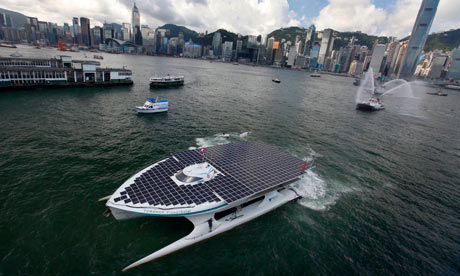
    Solar powered vessel, 'MS Turanor Planetsolar' enters Victoria Harbour, Hong Kong, China

    MS Türanor SolarPlanet will measure emissions in the open ocean. Photograph: Alex Hofford/EPA

    The solar-powered boat docked in Battery Park City in New York could easily have been packed off to a museum as a relic.

    The MS Türanor SolarPlanet saw its glory days last year, when the catamaran went around the world powered only by the sun and energy stored in the huge battery packs in each pontoon.

    Now the 102-ft craft has embarked on a new life as a research vessel for a team of scientists from the University of Geneva studying the Gulf Stream under climate change.

    The Swiss research team departs from New York on Friday for Boston, St John’s Newfoundland, Reyjavik, Iceland and Bergen, Norway to study the ocean current’s response to the warming of the atmosphere.

    “We know very little about what is taking place over the ocean,” said Prof Martin Benitson who heads the institute for environmental research at the University of Geneva.

    One big plus offered by the Türanor: the boat produces no emissions. Bentison said that zero emissions status means scientists for the first time will be able to collect data free of polluting substances, such as diesel fuel.

    “Once we start measuring emissions in the open ocean, we can be almost 100% certain that these are ocean emissions, and not biased by a ship’s chimney,” he said.

    The team will be collecting data from air and water to study the Gulf Stream’s response to climate change. The powerful ocean current carries water from the tropics up to the polar reaches of the Atlantic, taking the edge off winter temperatures in northern and western Europe.

    Benitson and his crew will be harvesting data on aerosols, tiny, airborne particles, over the ocean, as well as phytoplankton, the microscopic, plant-like animals that are at the bottom of the ocean food chain.

    They will also take a look at ocean eddies, the whirlpools that break off from the main current carrying large amounts of energy.

    Scientists believe slowing of the Gulf Stream under climate change could bring colder conditions to Europe.

    Projected changes in the Gulf Stream could also produce more intense hurricanes along the east coast of the United States.

    “Sandy might not have been a one off, but something that might repeat itself two or three times in a decade.” Benitson said.

    The research voyage offers a new lease of life for a ship that has outlasted its original purpose, said Gérard d’Aboville, the French captain.

    But there were also challenges, he said. In addition to the usual instrument panel, d’Aboville receives daily weather updates from the French weather service, enabling him to change course if he sees a patch of cloud ahead.

    Another monitor displays battery strength. Once fully charged, the boat can run on battery power for 72 hours. It was at 20% when it arrived in New York harbour on Monday afternoon. Within less than a day it was back up to full strength.

    “With a usual boat you take care of the sea, the winds, he currents. Now you have to take care of the sun,” he said.

    It was also strangely quiet, he said. “It’s a bit strange the first time you pilot the boat because you put it in forward motion, and there is absolutely no noise,” he said.

    And not much in the way of pick-up. Maximum cruising speed of the Turador is about 8 knots.

    But at least the catamaran remained at sea, he said. “Instead of being in a museum somewhere in some harbour, the boat is now engaged in this second life,” d’Aboville said. “We can have a second life and we can have a mission.”

  • Planktonic foraminiferal area density as a proxy for carbonate ion concentration: a calibration study using the Cariaco Basin Ocean Time Series

    Planktonic foraminiferal area density as a proxy for carbonate ion concentration: a calibration study using the Cariaco Basin Ocean Time Series

    Published 19 June 2013 Science Leave a Comment
    Tags: , , , , ,

    Biweekly sediment trap samples and concurrent hydrographic measurements collected between March 2005 and October 2008 from the Cariaco Basin, Venezuela are used to assess the relationship between [CO32-] and the area densities (ρA) of two species of planktonic foraminifera (Globigerinoides ruber (pink) and Globigerinoides sacculifer). Calcification temperatures were calculated for each sample using species-appropriate oxygen isotope (δ18O) temperature equations that were then compared to monthly temperature profiles taken at the study site in order to determine calcification depth. Ambient [CO32-] was determined for these calcification depths using alkalinity, pH, temperature, salinity, and nutrient concentration measurements taken during monthly hydrographic cruises. ρA, which is representative of calcification efficiency, is determined by dividing individual foraminiferal shell weights (± 0.43 µg) by their associated silhouette areas and taking the sample average. The results of this study show a strong correlation between ρA and ambient [CO32-] for both G. ruber and G. sacculifer (R2 = 0.89 and 0.86 respectively), confirming that [CO32-] has a pronounced effect on the calcification of these species. Though the ρA for both species reveal a highly significant (p < 0.001) relationship with ambient [CO32-], linear regression reveals that the extent to which [CO32-] influences foraminiferal calcification is species-specific. Hierarchical regression analyses indicate that other environmental parameters (temperature and [PO43-]) do not confound the use of G. ruber and G. sacculifer ρA as a predictor for [CO32-]. This study suggests that G. ruber and G. sacculifer ρA can be used as reliable proxies for past surface ocean [CO32-].


    Marshall B. J., Thunell R. C., Henehan M. J., Astor Y. & Wejnert K. E., in press. Planktonic foraminiferal area density as a proxy for carbonate ion concentration: a calibration study using the Cariaco Basin Ocean Time Series. Paleoceanography. Article (subscription required).

  • Wellington battered as storm heads north

    Wellington battered as storm heads north

    7:59pm June 20, 2013
    Share
    0
    Email

    Winds gusting up to 140km/h were battering downtown Wellington, lifting roofs from homes and cutting power to about 30,000 customers.

    The southerly winds were part of a storm which has already brought snow and heavy rain to much of the South Island on Thursday, and was expected to cause problems through the North Island moving into Friday.

    More than 200 people have called Wellington City Council’s call centre, reporting houses losing roofs, breaking windows and other structural damage due to the winds.

    The winds have also brought down trees and caused slips, and Middleton Rd between Johnsonville and Churton Park was closed after a tree blew onto a car.

    Acting civil defence controller Neville Brown says it’s essential people stay indoors if possible.

    “There is a lot of material being turned into missiles – it is a potentially lethal situation out there.”

    Mr Brown said the winds were so severe it was too treacherous in many cases to carry out repairs and clearance work, and he warned there were likely to be numerous obstructions for commuters on Friday.

    Wellington Electricity said trees and debris falling onto lines caused about 30,000 power outages through the region, particularly in the Hutt Valley and Porirua regions as well as the Miramar area.

    A spokesman said crews were doing what they can to repair the lines but the volume of outages and the danger caused by the winds might slow repair times.

    Wellingtonians were urged to stay clear of fallen power lines and anything touching them as they could be live and dangerous.

    MetService duty forecaster Heath Gullery said winds were averaging 85-90km/h in urban areas, gusting up to 140km/h.

    One resident told NZ Newswire she was having trouble driving her car home and it was the worst wind she could remember.

    Ferries, trains and flights in Wellington were all cancelled.

    Strong winds were also forecast in Nelson, Marlborough, the West Coast, Fiordland, Wairarapa, Whanganui, Taranaki, Auckland, the Coromandel and Northland, and were set to continue into Friday.

    The winds came as part of a storm which dumped snow through Otago and Canterbury on Thursday, and more

  • Immigration drives population growth to record levels

    Immigration drives population growth to record levels

    June 20, 2013 | Filed under: Breaking News,Environment,Government | Posted by:

    ABS population people

    The Australian Bureau of Statistics reports that Australia’s population grew by 1.8 per cent during 2012, returning to the excessive growth seen three years ago.

    This is the level advocated by then Prime Minister Kevin Rudd’s hugely unpopular ‘Big Australia’ policy, which was renounced by Julia Gillard on her ascension to the top job. Her government has in the intervening years quietly and gradually restored immigration levels to their Kevin Rudd-levels.

    The director of ABS Demography, Bjorn Jarvis, confirmed the increase in Australia’s population growth rate is being driven by net overseas migration.

    “Net overseas migration added 235,900 people to the population in 2012, which is a 17 per cent increase over 2011,” he said.

    “Net overseas migration accounted for 60 per cent of Australia’s total growth, with the remaining 40 per cent due to natural increase. Notably, 2012 also saw a 4 per cent rise in natural increase, which is the largest increase in almost four years.”

    Western Australia continued to lead the nation with an annual increase of 3.5 per cent, the highest of any state or territory, to reach 2.47 million by the end of December 2012. It also had the highest population growth by percentage over the ten years from 2002-2012, increasing by 27.6 per cent or 534,100 people.

    The lowest growth rate was in Tasmania where the population increased by just 0.1 per cent to reach 512,400.

    Victoria had the highest increase in natural increase for the year ending 31 December 2012, increasing by 18.6% (or 6,500 people).

    The number of births increased by 2.2 per cent over the past year while the number of deaths increased by 0.2 per cent.

    (92)