Author: Neville

  • Human Population Growth Could Cause Extinction of Many Birds and Mammals In Next 40 Years

    Human Population Growth Could Cause Extinction of Many Birds and Mammals In Next 40 Years

    By Sam Goodwin | Jun 20, 2013 04:11 AM EDT

    • icon
    • icon
    Human Population Growth Could Cause The Extinction of Many Birds and Mammals In Next 40 Years

    Human Population Growth Could Cause The Extinction of Many Birds and Mammals In Next 40 Years (Photo : Flickr)

    The rapid growth of human population could lead to the extinction of many birds and mammals within the next 40 years, state researchers from the Ohio State University.

    Earlier this month, the United Nations released a report predicting that the human population will increase by 1 million over the next 12 years and will reach 9.6 billion by 2050 and could reach 11 billion by 2100. This growing population could lead to the extinction of many birds and mammals within the next 40 years, state researchers from The Ohio State University in a press release after conducting a thorough research.

    Share This Story

    • 0
      inShare

    Though growth in population is predicted mostly in developing countries, the United States has been ranked sixth in the world in terms of new species expected to be threatened by 2050.  The study says that the world can see a rise of 3.3 per cent  in the number of threatened species, which can go up to  10.8 by 2050 including extinction.

    Previous studies have been conducted on how the growing human population poses a serious threat to many birds and mammal species; this is the first study that links this growth to the extinction of such species.

    For the study, researchers used a model that had earlier been used based on 2000 data to predict the effect of population growth on species and their future existence. The predictions were published in 2004. In  2010, the predictions were confirmed to be accurate and the effectiveness of the model was guaranteed. The same model was used containing data on 114 countries, to extend their predictions to the middle of this century.

    “Our projection is based on human population density alone. It doesn’t take into account climate change, industrialization or wars,” said Jeffrey McKee, professor of anthropology at Ohio State and lead author of the study. “So the actual numbers that we predict for 2050 will be very different because everything we do will exacerbate the problem.”

    Researchers also stated that the top country predicted with new species threats by the middle of the century is the Democratic Republic of the Congo, where more than 20 species might face extinction in that time frame.

    Apart from these predictions, the model also predicted that countries expected to witness a decline in human population growth will also experience an average reduction in threatened species, as much as 2.5 percent.

    The findings are published in the journal Human Ecology.

  • COLUMN – The price of ignoring climate change: Senator Sheldon Whitehouse

    COLUMN – The price of ignoring climate change: Senator Sheldon Whitehouse

    Source: Reuters – Wed, 19 Jun 2013 04:08 PM

    Author: Reuters
    cli-wea cli-ada cli-cli hum-aid
    TweetRecommendGoogle +LinkedInBookmarkEmailPrint

    Jump down to related content

    (US Senator Sheldon Whitehouse is a Reuters columnist but his opinions are his own.)

    By Senator Sheldon Whitehouse

    June 19 (Reuters) – The effects of climate change, driven by carbon pollution, hit Americans harder each year. Extreme weather events like hurricanes, wildfires and droughts are growing ever more frequent and severe.

    Beyond our borders, these changes are hitting developing nations.

    Since our nation’s founding, America has stood as an example for the world. Now, we owe it to ourselves and to other nations, who look to Washington, to lead the way on climate change by putting a price on carbon pollution and taking other steps to minimize the harm being done to developing nations – and our own.

    In many of the world’s poorest regions, the sun scorches drought-stricken farmland and parches freshwater sources. Fierce storms bring ravaging floods. Warming, rapidly acidifying oceans and shifting seasons drive off economically valuable species and foster pests and disease.

    This year, the worst flood in a decade killed at least 38 people in Mozambique and left 150,000 homeless. Warmer weather allows malaria-bearing mosquitoes to move into previously unaffected altitudes, infecting cities like Nairobi, which had purposely been built above the “malaria line.” Ten of the 15 largest cities in the developing world, including Shanghai, Mumbai and Cairo, are at risk of flooding from rising sea levels or coastal storm surges. Rising seas are swallowing low-lying land in countries such as Bangladesh and India.

    Climate change endangers much of the world economy as well. Economists calculate that a 3.5?F rise in global temperature would reduce global gross domestic product by 1 percent. But loss will be 4 percent in Africa, and 5 percent in India. The United Nations estimates that environmental disasters could drive as many as 3 billion people into extreme poverty by the year 2050.

    These regions face a crisis not of their making. Developed countries have churned out two-thirds of all the carbon dioxide pollution since the Industrial Revolution – one-quarter of that from the United States alone.

    We have much to gain here at home from efforts to mitigate the effects of climate change: safer coastal communities, healthier farming and fishing industries, and cleaner air to breathe. But the American experiment has always been about more than that.

    Indeed, as one of the largest emitters of carbon pollution, the United States has a responsibility to help emerging nations adapt to the stark reality of a changing climate, lest, as Daniel Webster warned, our own example “become an argument against the experiment.”

    We are now taking important steps to help poorer nations cope with climate change. Indeed, federal agencies, from the U.S. Agency for International Development and the Environmental Protection Agency, to the Agriculture and Defense Departments, support adaptation strategies in the developing world. We provide financing to support construction and hardening of physical infrastructure. We make available technology to improve weather forecasting and irrigation techniques. While these physical adaptation programs are crucial, the crisis of climate change also requires political and diplomatic adaptation.

    This is the mission of the State Department’s Environment, Science and Technology and Health (ESTH) officers. These officers engage on both a bilateral and a regional basis to promote good environmental governance, enable sustainable trade practices, advance resource and wildlife conservation, and improve access to healthcare. Many work closely with our allies around the globe, helping make communities more resilient to the devastating effects of climate change.

    This is still a small effort. As of 2011, 260 of the State Department’s more than 13,000 Foreign Service officers handled environment, science, technology and health issues in our embassies. Only 76 were full-time ESTH officers. Theirs is vital work. It is worth replicating on a larger scale.

    The United States must also set an example by putting a price on carbon pollution. I’m working with Representative Henry Waxman (D-Calif.) and others to finalize legislation that would do so. Right now, the big polluters pump billions of tons of carbon into our atmosphere, forcing the rest of us to pay the price through higher healthcare costs, higher rebuilding costs after carbon-driven extreme weather events, and more.

    Our proposal would put those costs back on the polluters. It would generate billions of dollars in new revenue, which could produce substantial benefits for the U.S. economy. But, just as important, it would improve the global environment by encouraging reduced emissions. It would also send a message that we are ready to lead once more on one of the great issues of our time.

    The effects of more than a century of Western pollution bear heavily on less-developed countries. The eyes of the world are on us. Without concerted action, we run the risk of allowing climate change to destabilize entire nations – and their confidence in America’s leadership.

    (U.S. Senator Sheldon Whitehouse (D-R.I.) is a member of the Environment and Public Works Committee and co-chairman of the Bicameral Task Force on Climate Change of the US Senate. He also serves on the Budget and Judiciary Committees. (Senator Sheldon Whitehouse)

    Topical news

    We welcome comments that advance the story through relevant opinion, anecdotes, links and data. If you see a comment that you believe is irrelevant or inappropriate, you can flag it to our editors by using the report abuse links. Views expressed in the comments do not represent those of the Thomson Reuters Foundation. For more

  • Take a ‘Snapshot’ of How Climate Change Affects Your Community

    Take a ‘Snapshot’ of How Climate Change Affects Your Community

    Kim Knowlton

    Posted June 19, 2013 in Curbing Pollution, Health and the Environment, Moving Beyond Oil, Solving Global Warming

    Tags:
    , , , , , , , , ,

    Today, NRDC is launching a new webtool that lets you take a ‘Snapshot’ of what climate change means in your area. You can read whether current conditions and trends in your area indicate a higher vulnerability to extreme weather events, such as heat waves, floods, and drought as well as health risks that climate change is fueling, right now.

    Here’s how it works: you enter your ZIP Code to get a quick ‘Snapshot” of how your county stacks up in several of the categories from our climate vulnerability maps: Extreme heat, air pollution, flooding, drought, infectious illness like dengue fever, wildfires, sea level rise, and extreme weather. It’s a quick way to get a sense of how these threats can affect the environment and your health, right where you live.

    You can also easily share your Snapshot on Facebook or Twitter with the webtool.

    NRDC has been bringing together scientific information about the local effects of global climate change on communities nationwide since 2007. We’ve created web tools that let you zoom in and ask, ‘What does climate change mean in my backyard?’ Our online maps connect the dots between climate change and the ways it harms our health.  We’ve mapped extreme weather events that are being fueled by climate change, and we also highlight preparedness steps that protect our kids’ health and our own, saving lives and dollars along the way.

    Climate change is one of the most serious public health threats facing our nation, but many people don’t yet realize how it could affect their local community and health. While climate change threatens all of us, children, the elderly, and communities living in poverty are among the most vulnerable. Storms like Hurricane Sandy and searing summers like 2012 – the hottest summer in America’s history – take a huge toll on health, and are themselves a ‘snapshot’ of what our future will look like more and more, with climate change. We need to be ready.

    Why the urgency now?

    • Extreme heat can be lethal. The annual death toll from extreme heat is already on the rise, according to a report released by the CDC at the beginning of June, with the number of heat-related deaths predicted to jump from the current annual rate of around 700 to between 3,000 and 5,000 by 2050.
    • Increasing flood risks with climate change will hammer homeowners. A new report released by FEMA suggests that, by 2100, the number of flood-prone properties in the U.S. could double. An estimated 70% of that additional flood risk will be from climate change (the other 30% due to projected population growth in at-risk areas).
    • Drought and wildfire risks are worsened by extreme heat. Much of Texas is in a state of drought emergency declared by Governor Rick Perry, and the costs of the 2012 drought have been estimated at $60-100 billion.
    • It’s been estimated that American taxpayers in 2012 paid $139 billion in damages related to many types of events fueled by climate change: severe weather, flooding, wildfire and drought.
    • The health-related costs of climate change add billions more – not to mention the costs in lives lost, illnesses, lost work and school days, and diminished quality of life on hot, smoggy days.

    Hopefully, our new webtool will bring these statistics home for people.  We want people to be able to think about and talk about their own local climate-health vulnerabilities — because taking action to protect the places and the people we love from climate change is an urgent matter.

    What kinds of actions could make a difference?

    Limiting heat-trapping carbon pollution, which is the root cause of climate change, would make an enormous difference. The US Environmental Protection Agency State has proposed limits on carbon pollution from power plants, which would cut about 40% of US emissions. This is a critical step forward. You can ‘Take Action’ here to write the President a letter saying so.

    At the same time as we work to prevent and reduce carbon pollution before it gets into the air by moving toward cleaner, less polluting fuels, we need to become better-prepared for climate change, too. State preparedness plans and policies have not kept pace with these health challenges. Only about one-third of US states have climate preparedness plans in place that include public health measures to cope with climate challenges.

    We have to do better than this.

    We need to prepare and plan for the future, not the past. And the future isn’t an abstraction: it’s where your kids and grandkids will live, and you, too, in a slightly older version. Your local climate-vulnerability Snapshot could be a different picture in the future, if we put the brakes on heat-trapping carbon pollution today and veer away from the worst effects of climate change.

  • Siberian Caves Warn of Permafrost Meltdown

    Siberian Caves Warn of Permafrost Meltdown

    June 19, 2013 — Climate records captured in Siberian caves suggest 1.5 degrees of warming is enough to trigger thawing of permafrost, according to a paper to be given at the Geological Society of London on 27 June.


    Share This:

    Permafrost regions cover 24% of the northern hemisphere land surface, and hold an estimated 17,000 Gt of organic carbon. Thawing releases CO2 and CH4, creating positive feedback during greenhouse warming.

    The researchers, led by Gideon Henderson at the University of Oxford’s Department of Earth Sciences, studied speleothem records from the caves to identify periods where temperatures were above freezing. Speleothems, such as stalactites and stalagmites, form when water seeps through cracks in cave walls, dissolving minerals which precipitate in the air filled cave.

    ‘Cave temperatures usually approximate the local mean annual air temperature’ says Anton Vaks, the paper’s lead author. ‘When they drop below 0 degrees, the rock above and around the cave freezes, and speleothem growth stops.’

    By dating the speleothems and comparing their ages to existing climate records, it is possible to identify the degree of warming which caused the permafrost to melt. New results from Ledyanaya Lenskaya Cave, Eastern Siberia, show major deposition of speleothems at around one million years and 400,000 years ago.

    ‘Both episodes occurred when global temperatures increased 1.5°C ± 0.5 above the pre-industrial level’ says Vaks, ‘showing that this degree of warming is a tipping point for continuous permafrost to start thawing.’

    Global temperatures are currently around 0.7 degrees above pre-industrial level, with current models suggesting that a warming of 1.5°C ± 0.5 will be achieved within 10-30 years.

    The paper will be read at the Geological Society’s forthcoming William Smith Meeting, held on 25-27 June, which celebrates the 100th anniversary of the beginning of modern dating methods.

    In 1913, Frederick Soddy’s research on the fundamentals of radioactivity led to the discovery of ‘isotopes’. Later that same year, Arthur Holmes published his now famous book ‘The Age of the Earth’, in which he applied this new science of radioactivity to the quantification of geologic time. Combined, these two landmark events did much to establish the field of ‘isotope geochronology’ — the science that underpins our knowledge of the absolute age of most Earth and extraterrestrial materials.

    Share this story on Facebook, Twitter, and Google:
  • Millions on Bangladesh coastline to be trapped

    Millions on Bangladesh coastline to be trapped

    Star Online Report

    An iceberg floats in Jacobshavn fjord in Greenland in 2006. Photo Reuters

    An iceberg floats in Jacobshavn fjord in Greenland in 2006. Photo Reuters

    The World Bank has warned that Bangladesh, under a 2°C warming, emerges as an impact hotspot with sea-level rise causing threats to food production, livelihoods, urban areas and infrastructure.
    Shifting rain patterns in South Asia leaving some parts under water and others without enough water for power generation, irrigation, or drinking are the likely impacts of a possible global temperature rise of 2 degrees Celsius  in the next few decades that threatens to trap millions of people in poverty, a World Bank report on climate change says.
    Under 4°C warming, the west coast and southern India, as well as Bhutan and northern Bangladesh, are projected to shift to new, high-temperature climatic regimes, the report said.
    The report, prepared for the World Bank by the Potsdam Institute for Climate Impact Research and Climate Analytics, reveals how rising global temperatures are increasingly threatening the health and livelihoods of the most vulnerable populations, crucially magnifying problems each region is struggling with today.
    Unusual heat is projected for 60–80 percent of the Northern Hemisphere summer months in most parts of the region, the WB report said
    Bangladesh emerges as an impact hotspot with increasing and compounding challenges occurring in the same timeframe from extreme river floods, more intense tropical cyclones, rising sea levels, extraordinarily high temperatures, and declining crop yields.
    Increased river flooding combined with tropical cyclone surges poses a high risk of inundation in areas with the largest shares of poor populations.
    A 27 cm sea-level rise, projected for the 2040s, in combination with storm surges from an average 10-year return period cyclone, such as Cyclone Sidr, could inundate an area more than 80-percent larger than the area inundated at present by a similar event, it adds.

    TURN DOWN THE HEAT

    Climate Extremes, Regional Impacts, and the Case for Resilience builds on a World Bank report released late last year, which concluded the world would warm by 4 degrees Celsius (4°C or 7.2 degrees Fahrenheit) above pre-industrial levels by the end of this century if we did not take concerted action now.
    This new report looks at the likely impacts of present day, 2°C and 4°C warming on agricultural production, water resources, coastal ecosystems and cities across Sub-Saharan Africa, South Asia and South East Asia.
    Deaths in India and Bangladesh currently account for 86 percent of global mortalities from cyclones even though only 15 percent of all tropical cyclones affect this region.
    “This new report outlines an alarming scenario for the days and years ahead – what we could face in our lifetime,” said World Bank Group President Jim Yong Kim.
    “The scientists tell us that if the world warms by 2°C — warming which may be reached in 20 to 30  years –  that will cause widespread food shortages, unprecedented heat-waves, and more intense cyclones.
    In the near-term, climate change, which is already unfolding, could batter the slums even more and greatly harm the lives and the hopes of individuals and families who have had little hand in raising the Earth’s temperature.”
    “These changes forecast for the tropics illustrate the level of hardships that will be inflicted on all regions eventually, it we fail to keep warming under control,” Kim said.
    “Urgent action is needed to not only reduce greenhouse gas emissions, but also to help countries prepare for a world of dramatic climate and weather extremes,” he added.

    Published: June 19, 2013 at 6:36 pm | Last Modified: June 19, 2013 at 6:59 pm
  • Breaking news: children off Manus! GET-UP

    Breaking news: children off Manus!

    Inbox
    x
    GetUp!
    6:32 PM (7 minutes ago)

    to me
    Breaking news: we’ve just learned that it appears that children and families were today relocated from Manus Island Detention Centre. Read on for a message from Leila. Your details have not been shared with anyone.

    Dear NEVILLE,

    Today, on World Refugee Day, I received the best message – the news I’ve been waiting to hear every day now for almost a year: “My family is finally getting off Manus Island!” my young friend told me.

    Overjoyed, she asked me to pass this on to you: “Thank you to all the Australians who haven’t abandoned us on the forgotten Island.”

    She is the young asylum seeker who earlier this year revealed the appalling conditions in the Manus Island detention centre during an exclusive recorded interview with us. Thanks to GetUp members, her message reached millions all over the country.

    In that interview she shared her grief for the very young children who felt like they were being punished for something, but couldn’t figure out what. She recounted the heartbreaking story of a young boy, only 8 years old, who would lie down next to the fence and stare off into the distance, wishing he was a dove so he could fly away. She feared for his mental health. I feared for hers.

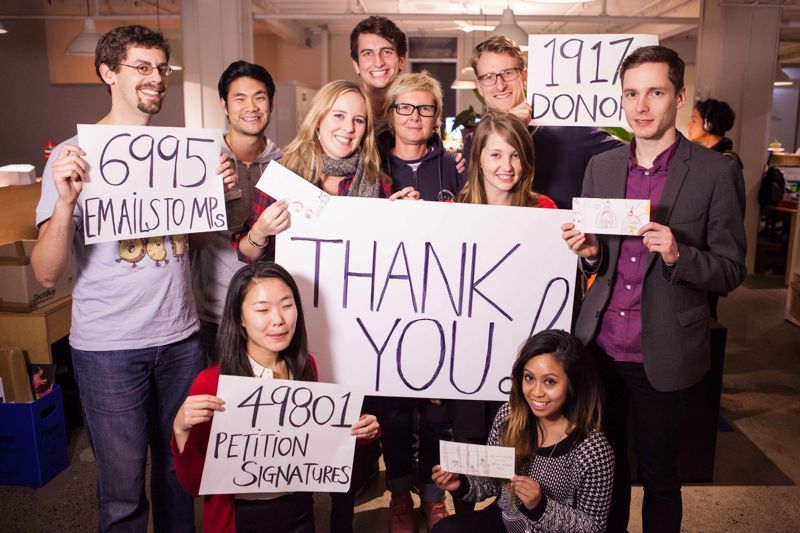
    But today, I’ve heard news that my friend was one of the sixty-five asylum seekers who were removed from the notoriously inhumane facilities on Manus Island detention centre. It’s because of you – and refugee advocates everywhere – that Manus is no longer ‘the forgotten Island’. Our movement rallied together – sending postcards, emailed MPs, and ran TV ads – sharing the stories of the children on Manus in order to ensure that these families would not remain out of sight, out of mind. We did it.

    You might remember the moment in the campaign, back in March, when the children saw their drawings on this website and learned their stories were being told on TV. She contacted me on that day and through tears of happiness said the children were literally dancing with joy. They were dancing because they felt that if we could hear their stories, they wouldn’t be forgotten. We’d have to help them. They were right.

    Today, on World Refugee Day, we should all take a moment to feel proud about what our movement’s actions have done to bring about the release of the most vulnerable people out of the shameful and inhumane facilities that make up the Manus Island detention centre. It’s a hard fought and long overdue victory.

    This is a big step, but it’s not yet over for the kids and families we’ve fought so hard to free. There are still some families – including children – who will need to wait until June 30 before they are released from Manus. Most of those whom have been released were transferred to Christmas Island, where the facilities are so overcrowded that we’ve heard families are crammed into the dining room. Processing has been stalled so numbers continue to rise.

    But for now, we should congratulate those who made it happen. Today would not have happened without the sustained and tireless campaigning from amazing people and groups in the refugee space including, but not limited to, ChilOut, Amnesty International, Sarah Hanson-Young and the Greens, retiring Liberal MP Judi Moylan and the countless other refugee advocacy groups. A big thank you!

    Today is a moment on the Manus campaign we can all be proud of, but the fight for a more humane system for processing asylum seekers and refugees who flee to Australia – including no child in detention – is one that we’ll continue to fight and continue to update you on.

    Thank you,
    Leila, for the GetUp team

    PS – Did you see coverage of the GetUp Manus campaign on the home pages of the Sun-Herald and The Sunday Age this past weekend? If not, make sure to check it out!

    PPS – In the coming months GetUp will endeavour to keep tabs on what is happening with the children who have left Manus Island, including visiting them in their new facilities and advocating for them to receive the support they need after what they’ve endured. If you would like to chip in to help us continue the campaign click here to donate: www.getup.org.au/great-news-from-manus. Watch this space – we’ll be in touch soon.


    GetUp is an independent, not-for-profit community campaigning group. We use new technology to empower Australians to have their say on important national issues. We receive no political party or government funding, and every campaign we run is entirely supported by voluntary donations. If you’d like to contribute to help fund GetUp’s work, please donate now! If you have trouble with any links in this email, please go directly to www.getup.org.au. To unsubscribe from GetUp, please click here. Authorised by Sam Mclean, Level 2, 104 Commonwealth Street, Surry Hills NSW 2010.