Author: Neville

  • Fight the Future (New York Times)

    Op-Ed Columnist

    Fight the Future

    By
    Published: June 16, 2013 Comment
    • Facebook
    • Twitter
    • Google+
    • Save
    • E-mail
    • Share
    • Print
    • Reprints

    Last week the International Monetary Fund, whose normal role is that of stern disciplinarian to spendthrift governments, gave the United States some unusual advice. “Lighten up,” urged the fund. “Enjoy life! Seize the day!”

    Fred R. Conrad/The New York Times

    Paul Krugman

    Opinion Twitter Logo.

    Connect With Us on Twitter

    For Op-Ed, follow @nytopinion and to hear from the editorial page editor, Andrew Rosenthal, follow @andyrNYT.

    Readers’ Comments

    Share your thoughts.

    O.K., fund officials didn’t use quite those words, but they came close, with an article in IMF Survey magazine titled “Ease Off Spending Cuts to Boost U.S. Recovery.” In its more formal statement, the fund argued that the sequester and other forms of fiscal contraction will cut this year’s U.S. growth rate by almost half, undermining what might otherwise have been a fairly vigorous recovery. And these spending cuts are both unwise and unnecessary.

    Unfortunately, the fund apparently couldn’t bring itself to break completely with the austerity talk that is regarded as a badge of seriousness in the policy world. Even while urging us to run bigger deficits for the time being, Christine Lagarde, the fund’s head, called on us to “hurry up with putting in place a medium-term road map to restore long-run fiscal sustainability.”

    So here’s my question: Why, exactly, do we need to hurry up? Is it urgent that we agree now on how we’ll deal with fiscal issues of the 2020s, the 2030s and beyond?

    No, it isn’t. And in practice, focusing on “long-run fiscal sustainability” — which usually ends up being mainly about “entitlement reform,” a k a cuts to Social Security and other programs — isn’t a way of being responsible. On the contrary, it’s an excuse, a way to avoid dealing with the severe economic problems we face right now.

    What’s the problem with focusing on the long run? Part of the answer — although arguably the least important part — is that the distant future is highly uncertain (surprise!) and that long-run fiscal projections should be seen mainly as an especially boring genre of science fiction. In particular, projections of huge future deficits are to a large extent based on the assumption that health care costs will continue to rise substantially faster than national income — yet the growth in health costs has slowed dramatically in the last few years, and the long-run picture is already looking much less dire than it did not long ago.

    Now, uncertainty by itself isn’t always a reason for inaction. In the case of climate change, for example, uncertainty about the impact of greenhouse gases on global temperatures actually strengthens the case for action, to head off the risk of catastrophe.

    But fiscal policy isn’t like climate policy, even though some people have tried to make the analogy (even as right-wingers who claim to be deeply concerned about long-term debt remain strangely indifferent to long-term environmental concerns). Delaying action on climate means releasing billions of tons of greenhouse gases into the atmosphere while we debate the issue; delaying action on entitlement reform has no comparable cost.

    In fact, the whole argument for early action on long-run fiscal issues is surprisingly weak and slippery. As I like to point out, the conventional wisdom on these things seems to be that to avert the danger of future benefit cuts, we must act now to cut future benefits. And no, that isn’t much of a caricature.

    Still, while a “grand bargain” that links reduced austerity now to longer-run fiscal changes may not be necessary, does seeking such a bargain do any harm? Yes, it does. For the fact is we aren’t going to get that kind of deal — the country just isn’t ready, politically. As a result, time and energy spent pursuing such a deal are time and energy wasted, which would have been better spent trying to help the unemployed.

    Put it this way: Republicans in Congress have voted 37 times to repeal health care reform, President Obama’s signature policy achievement. Do you really expect those same Republicans to reach a deal with the president over the nation’s fiscal future, which is closely linked to the future of federal health programs? Even if such a deal were somehow reached, do you really believe that the G.O.P. would honor that deal if and when it regained the White House?

    When will we be ready for a long-run fiscal deal? My answer is, once voters have spoken decisively in favor of one or the other of the rival visions driving our current political polarization. Maybe President Hillary Clinton, fresh off her upset victory in the 2018 midterms, will be able to broker a long-run budget compromise with chastened Republicans; or maybe demoralized Democrats will sign on to President Paul Ryan’s plan to privatize Medicare. Either way, the time for big decisions about the long run is not yet.

    And because that time is not yet, influential people need to stop using the future as an excuse for inaction. The clear and present danger is mass unemployment, and we should deal with it, now.

    • Save
    • E-mail
    • Share
  • Great Barrier Reef on the brink as politicians bicker

    Great Barrier Reef on the brink as politicians bicker

    Environment minister Tony Burke says the government has done its best to stop downgrading of UN heritage status

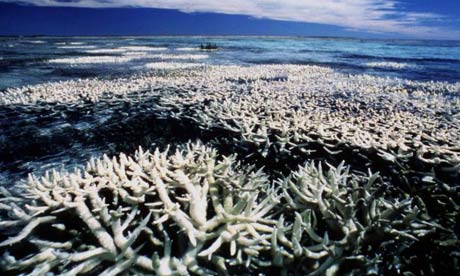
    Coral bleaching on the Great Barrier Reef.

    Coral bleaching on the Great Barrier Reef. Photograph: Reuters

    The federal government insists it is striving to avoid the Great Barrier Reef being listed “in danger” ahead of a crunch UN meeting, after rejecting a Senate recommendation to block new port developments near the World Heritage ecosystem.

    The world heritage committee begins an 11-day conference in Cambodia this week, where the UNESCO body will review the status of various prized ecological areas.

    The committee is expected to recommend that the Great Barrier Reef, which has been listed as a World Heritage site since 1981, be placed on the “in danger” list next year due to concerns over coal and gas expansion, increased shipping and water quality.

    A draft World Heritage report produced in May noted “concern” over water quality monitoring and the lack of a “a clear commitment toward limiting port development to existing port areas”. Unless “urgent and decisive action” was taken, the reef should be considered in danger, it said.

    The federal environment minister, Tony Burke, told Guardian Australia improvements made since May showed the government was committed to safeguarding the Reef.

    “I’m certainly hopeful that we can get some progress on what was in the draft report,” he said. “We committed a further $200 million for Reef Rescue in the budget, which was since the report. That’s one clear example of where they’ve expressed concern over water quality and we’ve acted.

    “It’ll be presumptuous to say what the world heritage committee will decide but I’m confident that we have evidence to show that Australia takes management of the reef seriously.”

    But Burke said the government would not support a Senate committee recommendation that a temporary halt be placed on new port developments in Queensland until an assessment, conducted by both state and federal governments, is released in 2015.

    The committee, which considered a bill introduced by Greens senator Larissa Waters, said in its report that existing regulations “may not be sufficient to protect the Great Barrier Reef’s outstanding values”.

    Burke said the move was unnecessary as there were no new developments planned before 2015. He said it was not straightforward to fulfill UNESCO’s key recommendation of banning substantial new infrastructure outside existing port areas.

    “I will follow the process properly, under law,” he said. “If I pre-judge applications, it’ll get thrown out in court. [UNESCO] understands the limits we have under Australian law. It’s a nuanced situation.

    “But they also understand that nothing has since been approved in pristine areas, and none was more sensitive than the proposed Xstrata development on Balaclava Island, which was cancelled after the draft report.”

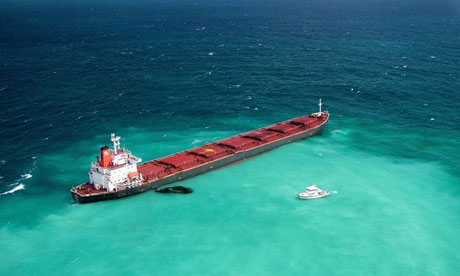
    Fuel oil leaks from a Chinese bulk coal carrier grounded on the reef in 2010. Fuel oil leaks from a Chinese bulk coal carrier grounded on the reef in 2010. Photograph: GettyIt is understood that several World Heritage delegates have been dismayed by what they see as a politicisation of the reef, with Burke involved in a series of public ructions with the Queensland government over the management of the vast coral ecosystem.

    Last week, Queensland’s deputy premier, Jeff Seeney, said Burke had been “held ransom” by “radical Greens”.

    “Mr Burke is beholden to the Greens who feed him dishonest and deceitful assertions about our government’s actions,” Seeney said. “It’s time Mr Burke represented every person in this state, rather than those he believes will keep the Gillard government in power.”

    But Burke has also come under fire from the Greens and environmental groups, who accuse him of doing little to safeguard the reef and caving into the demands of the mining industry, with eight ports planned or expanded during his tenure.

    Burke told Guardian Australia: “I find some of the political points quite bewildering. Jeff Seeney’s comments were just odd, certainly one of the weirder moments in Australian politics. I can’t understand what was going on in his head when he launched that diatribe.

    “Larissa Waters, the Greens and Greenpeace are, in a large part, using the reef as a proxy for an anti-coal campaign. Those groups say the best way to limit emissions is to price carbon and then they ask for a regulatory mechanism too. They can’t have it both ways.”

    Waters said it would be a “disaster” if the reef was placed on the “in danger” list, alongside sites predominantly found in developing or war-torn countries.

    “Tony Burke isn’t acting like an environment minister,” she said. “He says a lot of strong things and then doesn’t deliver.

    “The UNESCO report was clear that there should be no new ports but there are no state or Commonwealth moves to limit these ports. Responsibility lies on both sides so it’s farcical to see them pointing the finger at each other.

    “It’s amazing that it had to come down to me, a new member of the Senate, to draft a bill to protect the seventh wonder of the world because the government won’t do it.

    “The world heritage committee aren’t idiots. This is their area of expertise. I imagine the Australian delegation will be pressuring other delegates to water down the criticism because it’s embarrassing.”

    The reef faces a number of threats, including chemicals that flow onto it from agricultural land, a plague of crown-of-thorns starfish and climate change, which has been blamed for an increase in coral bleaching and severe weather events such as cyclones, which further damage the ecosystem.

    Another potential risk is the dredging of the seabed to allow ships access to new ports. The Great Barrier Reef Marine Park Authority recently warned MPs that the impact of dumping dredging spoil onto the reef could be worse than previously thought.

    The reef has lost half its coral cover in the past 27 years, the Australian Institute of Marine Sciences says. Last week, 150 Australian and international scientists signed a letter warning the reef was in crisis and required urgent action to protect it.

    The Queensland environment minister, Andrew Powell, told Guardian Australia the state government’s policy was consistent with UNESCO’s demand for ports to be kept to existing areas.

    “The Newman government firmly believes that we can have sustainable economic development and strong environmental protection – the two concepts are not mutually exclusive,” he said.

    “The Newman government is aware of the potential impacts of dredging which is one of the many reasons why we scaled back the previous Labor government’s crazy proposals for a massive multi-cargo facility at Abbot Point.”

    “We want to ensure any development occurs in a considered and measured way and as such all development applications are subject to a stringent environmental impact assessment process.”

  • Response of benthic foraminifera to ocean acidification in their natural sediment environment: a long-term culturing experiment

    Response of benthic foraminifera to ocean acidification in their natural sediment environment: a long-term culturing experiment

    Published 16 June 2013 Science Leave a Comment
    Tags: , , , , , , ,

    Calcifying foraminifera are expected to be endangered by ocean acidification, However, the response of a complete community kept in natural sediment and over multiple generations under controlled laboratory conditions has not been constrained to date. During six month incubation, foraminiferal assemblages were treated with pCO2 enriched seawater of 430, 907, 1865 and 3247 μatm pCO2. The fauna was dominated by Ammonia aomoriensis and Elphidium species, whereas agglutinated species were rare. After 6 months incubation, pore water alkalinity was much higher in comparison to the overlying seawater. Consequently, the saturation state of Ωcalc was much higher in the sediment than in the water column in all pCO2 treatments and remained close to saturation. As a result, the life cycle of living assemblages was largely unaffected by the tested pCO2 treatments. Growth rates, reproduction and mortality, and therefore population densities and size-frequency distribution of Ammonia aomoriensis varied markedly during the experimental period. Growth rates varied between 25 and 50 μm per month, which corresponds to an addition of 1 or 2 new chambers per month. According to the size-frequency distribution, foraminifera start reproduction at a diameter of 250 μm. Mortality of large foraminifera was recognized, commencing at a test size of 285 μm at a pCO2 ranging from 430 to 1865 μatm, and of 258 μm at 3247 μatm. The total organic content of living Ammonia aomoriensis has been determined to be 4.3% of dry weight. Living individuals had a calcium carbonate production rate of 0.47 g m−2 yr−1, whereas dead empty tests accumulated at a rate of 0.27 g m−2 a−1. Although Ωcalc was close to 1, some empty tests of Ammonia aomoriensis showed dissolution features at the end of incubation. In contrast, tests of the subdominant species, Elphidium incertum, stayed intact. This species specific response could be explained by differences in the elemental test composition, in particular the higher Mg-concentrations in Ammonia aomoriensis tests. Our results emphasize that the sensitivity to ocean acidification of endobenthic foraminifera in their natural sediment habitat is much lower compared to the experimental response of specimens isolated from the sediment.


    Haynert K., Schönfeld J., Schiebel R., Wilson B. & Thomsen J., 2013. Response of benthic foraminifera to ocean acidification in their natural sediment environment: a long-term culturing experiment. Biogeosciences Discussions 10: 9523-9572. Article.

    Rate this:

    Rate This

    Share this post!

    0 Responses to “Response of benthic foraminifera to ocean acidification in their natural sediment environment: a long-term culturing experiment”

    1. Leave a Comment

    Leave a Reply

    Subscribe to the RSS feed

    Subscribe to Ocean acidification by

  • Antarctic Ice Shelves Losing Mass As A Result Of The Undersides Melting — Not Iceberg Calving As Was Previously Thought

    Antarctic Ice Shelves Losing Mass As A Result Of The Undersides Melting — Not Iceberg Calving As Was Previously Thought

    Posted on June 15, 2013 by
    Print Friendly
    12 Share 7 Tweet 0 Share 22 22 Share

    The Antarctic ice shelves have been melting at ever increasing rates in recent years — losing mass, though not always extent, as much of the mass loss has been with regards to ice thickness. And now, new research has shed some new light on the causes of this ice loss — the warming ocean waters have been melting the ice shelves from underneath, it’s not primarily the result of icebergs calving into the ocean as was previously thought.

    "Aerial photo of front of Venable Ice Shelf, West Antarctica, an example of a small ice shelf that is a large meltwater producer. Such ice melts are far more common than previously thought and will change predictions about the thawing continent. Taken onboard the Chilean Navy P3 aircraft during the NASA/Centro de Estudios Cientificos fall 2008 campaign." Image Credit: NASA/JPL-Caltech/UC Irvine

    “Aerial photo of front of Venable Ice Shelf, West Antarctica, an example of a small ice shelf that is a large meltwater producer. Such ice melts are far more common than previously thought and will change predictions about the thawing continent. Taken onboard the Chilean Navy P3 aircraft during the NASA/Centro de Estudios Cientificos fall 2008 campaign.”
    Image Credit: NASA/JPL-Caltech/UC Irvine

    The new research — representing the first comprehensive survey of all Antarctic ice shelves — has found that basal melt (ice dissolving from underneath) was responsible for 55% of all ice shelf loss from 2003 to 2008. That is a much higher rate than was previously assumed. As a reminder of why this matters — ice shelves, which are essentially the floating extensions of glaciers, surround 75% of the absolutely enormous frozen continent.

    The researchers think that this new work will allow others in the field to “improve projections of how Antarctica, which holds about 60% of the planet’s fresh water locked in its massive ice sheet, will respond to a warming ocean and contribute to sea level rise.” How the ice sheets of Antarctica will respond to the significant warming that is predicted to occur over the next 100 years is an important question — one which is especially important when you consider that the vast majority of the world’s most important economic regions are relatively close to coastlines. Rising seas as well as increasing flood/storm events could have devastating consequences for many of the world’s largest economies.

    Back to the research — as the researchers put it “it turns out that the tug of seawaters just above the freezing point matters more than the breaking off of bergs.”

    “We find that iceberg calving is not the dominant process of ice removal. In fact, ice shelves mostly melt from the bottom before they even form icebergs,” explained lead author Eric Rignot, a UC Irvine professor, and also a researcher at NASA’s Jet Propulsion Laboratory. “This has profound implications for our understanding of interactions between Antarctica and climate change. It basically puts the Southern Ocean up front as the most significant control on the evolution of the polar ice sheet.”

    The press release provides context and details:

    Ice shelves grow through a combination of land ice flowing to the sea and snow falling on their surfaces. The researchers combined a regional snow accumulation model and a new map of Antarctica’s bedrock with ice shelf thickness, elevation and velocity data captured by Operation IceBridge — an ongoing NASA aerial survey of Greenland and the South Pole.

    Ocean melting is distributed unevenly around the continent. The three giant ice shelves of Ross, Filchner and Ronne, which make up two-thirds of Antarctica’s ice shelves, accounted for only 15 percent of the melting. Meanwhile, less than a dozen small ice shelves floating on relatively warm waters produced half the total meltwater during the same period.

    The researchers also compared the rates at which the ice shelves are shedding ice with the speed at which the continent itself is losing mass and found that, on average, the shelves lost mass twice as fast as the Antarctic ice sheet did.

    “Ice shelf melt can be compensated by ice flow from the continent,” Rignot said. “But in a number of places around Antarctica, they are melting too fast, and as a consequence, glaciers and the entire continent are changing.”

    While rising sea levels are themselves an issue, the real issue — and one that is not often mentioned — is that as sea levels rise, more and more economically and industrially important infrastructure will be exposed to storm and flood events. Events similar to Hurricane Sandy, to Hurricane Katrina, could become very common — that would have a devastating effect on the economies of the affected regions. Something to keep in mind…

    The new research was just published in the June 14 issue of Science.

    Read more at http://planetsave.com/2013/06/15/antarctic-ice-shelves-losing-mass-as-a-result-of-the-undersides-melting-not-iceberg-calving-as-was-previously-thought/#BGPyqTB8cwhPRcMH.99

  • My party causing ‘panic’ in Labor: Palmer

    My party causing ‘panic’ in Labor: Palmer

    AAPUpdated June 16, 2013, 2:59 pm

    Speculation hanging over Labor’s leadership is the result of “panic” at the prospect of facing the Palmer United Party, according to the party’s billionaire leader Clive Palmer.

    He said a leadership change could lead to an early election that would prevent the Palmer United Party being registered in time.

    “Kevin Rudd would like to call the election earlier so they can stop our party from being registered federally,” Mr Palmer said.

    “If they can issue the writs by the 3rd of July and have an election in August they haven’t got to face it and people don’t get a choice.”

    The businessman said his party will run candidates in all 150 lower house seats as well as the senate and will provide a “genuine alternative” to the two major parties.

    “They know we’ll be standing in 150 seats and they’re starting to panic.”

    Mr Palmer also said if he was elected to the top job, he would likely only stay for a single term.

    “If I’m elected as prime minister I’ll only be there for three years,” he said.

    “I don’t want to stay there and go there. I’m going out there as a sense of duty.”

    Mr Palmer was in Melbourne on Sunday to announce the Victorian candidates for the Palmer United Party.

    They included a nervous Joe Zappia who will be campaigning against Prime Minister Julia Gillard in the west Melbourne seat of Lalor.

    Mr Zappia stuttered through a short speech in which he confused the name of the party he was representing.

    “The Palmer Liberal … I’ve never done this before and I’m not here to read these sort of things,” Mr Zappia said.

    “I will get better at this but the nerves are unbelievable at the moment.

    “Sorry for what I’ve done to you today.”

    He joins Victorian senate candidate former AFL great Doug Hawkins.

  • O’Farrell to budget for $4b north-west rail link

    O’Farrell to budget for $4b north-west rail link

    Date
    June 16, 2013 – 2:29PM
    • 106 reading now
    • (105)

    Zoom in on this story. Explore all there is to know.

    The NSW government will spend $4 billion to develop Sydney’s North West Rail Link, which is due to be running in 2019.

    About $800 million will be set aside in the 2013-2014 state budget, due to be handed down on Tuesday, the NSW premier, treasurer and transport minister announced on Sunday.

    The rest of the government money will flow over the next four years and the remaining $4.3 billion needed for the project will come from private tenders.

    As part of the project, eight new train stations will be built at Cherrybrook, Castle Hill, Showground, Norwest, Bella Vista, Kellyville, Rouse Hill and Cudgegong Road along with 4000 commuter car parking spaces.

    Advertisement

    A train will run down the line every five minutes in peak hour and high-frequency single deck trains will operate between Cudgegong Rd and Chatswood.

    Treasurer Mike Baird said the funding would also be used to buy property where necessary.

    Premier Barry O’Farrell said the rail link will provide “high capacity public transport to Sydney’s northwest for the first time”, and work on it should begin next year.

    It will benefit the NSW economy to the tune of $35 billion over the next few decades, he said.

    Transport Minister Gladys Bereljiklian said the rail link “will forever change the face of the north west”.

    Three major contracts for the construction of the line are still to be awarded.

    In coming months, the government expects to announce who has won the tender to construct 15 kilometres of twin tunnels between Epping and Bella Vista – the longest rail tunnels in the nation.

    Contracts to develop a four-kilometre “skytrain” section and operate it are also yet to be awarded.

    AAP

    Read more: http://www.smh.com.au/nsw/ofarrell-to-budget-for-4b-northwest-rail-link-20130616-2oc1z.html#ixzz2WMFMPQa4