Author: Neville

  • Tropical Upper Atmosphere ‘Fingerprint’ of Global Warming

    Tropical Upper Atmosphere ‘Fingerprint’ of Global Warming

    May 22, 2013 — In the tropics at heights more than 10 miles above the surface, the prevailing winds alternate between strong easterlies and strong westerlies roughly every other year. This slow heartbeat in the tropical upper atmosphere, referred to as the quasibiennial oscillation (QBO), impacts the winds and chemical composition of the global atmosphere and even the climate at Earth’s surface.


    Share This:

    The pulse of the QBO has weakened substantially at some altitudes over the last six decades, according to a new study by scientists at the International Pacific Research Center, University of Hawaii at Manoa, and the Japan Agency for Marine-Earth Science and Technology. The decline in the strength of the QBO is consistent with computer model projections of how the upper atmosphere responds to global warming induced by increased greenhouse gas concentrations. The study appears in the May 23, 2013, online issue of Nature.

    “This is the first demonstration of a systematic long-term trend in the observed QBO record,” says co-author Kevin Hamilton and Director of the IPRC. “We see a similar trend in computer models of the global atmosphere when they simulate the last century using the historical changes of greenhouse gases. So this change in upper atmospheric behavior can be considered part of the “fingerprint” of the expected global warming signal in the climate system.”

    The global atmospheric circulation is characterized by air slowly rising in the tropics into the upper atmosphere and sinking at higher latitudes. While this circulation is so slow that a blob of air may take decades to travel to the upper atmosphere, it impacts the chemical composition of the global atmosphere because many chemical properties are very different in the lower and upper atmosphere layers. Although computer models used to project climate changes from increasing greenhouse gas concentrations consistently simulate an increasing upward airflow in the tropics with global warming, this flow cannot be directly observed.

    “We demonstrated that the mean upward-air motion suppresses the strength of the QBO winds in the models and thus interpret our observed weakened QBO trend as confirmation that the mean upward velocity in the tropics has indeed been increasing,” notes Hamilton.

    Hamilton provides an example of why the upward airflow is so significant: “The manufacture of ozone-destroying chemicals such as the freon compounds used in the past in spray cans and in refrigerators has been largely banned for over 20 years. These chemicals, however, remain in the atmosphere for many decades. They are slowly flushed out of the lower atmosphere into the upper atmosphere where they are destroyed. Stronger mean upward airflow transports these chemicals more quickly into the upper atmosphere, and the ozone layer will recover more quickly to its natural state before the introduction of man-made freon compounds.”

    Share this story on Facebook, Twitter, and Google:
  • Vast Methane-Based Ecosystem Uncovered

    Vast Methane-Based Ecosystem Uncovered

    May 22, 2013 — A marine research expedition sponsored by the U.S. Bureau of Ocean Energy Management (BOEM) and the National Oceanic and Atmospheric Administration (NOAA) has led to the discovery of perhaps the world’s largest methane cold seep by two university-based research teams and their partners, UNCW announced today.


    Share This:

    The seep lies deep in the western North Atlantic Ocean, far from the life-sustaining energy of the sun. Mussels blanketing the the seep rely on bacteria that use the methane to make energy. The process, known as chemosynthesis, forms the basis for life in the harsh environment and could help scientists better understand how organisms can survive under these types of extreme conditions.

    “UNCW and FSU have done two previous cruises together and this is perhaps our biggest discovery,” said UNCW researcher Dr. Steve Ross. “Studies of this kind and of these communities help scientists understand how life thrives in harsh environments, and perhaps even on other planets.”

    The new seep discovery is only the third documented seep site on the U.S. Atlantic Coast, and by far the most extensive; the two seep areas at this site are estimated to be at least a kilometer long and in places hundreds of meters across. Sea cucumbers were also seen tucked into the tight mounds of mussels and shrimp swam above them. Many species of fishes, including some with unusual behaviors, were also common around the unique ecosystem..

    Stationed aboard NOAA’s Ronald H. Brown research vessel, the research teams used the diverse capabilities of the Woods Hole Oceanographic Institution’s Remotely Operated Vehicle (ROV), Jason II, to document and study the newly discovered methane seep.. The teams have been able to capture high definition video, sample the sediment at the site, collect live mussels for genetic and reproductive studies, collect large dead shells and rocks for aging analysis, take water samples to examine water chemistry, and sample associated animals to examine food webs.

    The seep discovery could potentially play an important role in advancing scientific understanding of hydrocarbon resources and gas hydrates (important possible future energy resources) along the US continental slope .

    Major funding for the research expedition was provided by the Bureau of Ocean Energy Management, with NOAA providing funding for the Ronald H. Brown and Jason ROV. US Geological Survey and other collaborators also provided a variety of resources.

    Share this story on Facebook, Twitter, and Google:
  • Once again the ABC and SBS are under attack.

    Once again the ABC and SBS are under attack. GetUp members have stood up time and time again to protect independent media. Let’s get the Bananas’ backs. Click the image to take action.

    Save B1 and B2

    www.getup.org.au/save-our-abc

    Dear Inga

    What’s the ABC worth to you?

    On Saturday, the Victorian Liberal Party will vote on whether to lobby Tony Abbott to privatise the ABC and SBS. They want our beloved public broadcasters – and the iconic programs we grew up with – flogged off to the highest bidder.

    Sound familiar? It should. This is far from the first time politicians have tried to sell off our independent public resources. In 2006 when Howard tried to further slash funding to the ABC, GetUp members came out in force, holding grassroots demonstrations around the country, and forced a back down.

    It’s time for us to stand up again and defend our precious public services — the educational, independent and uniquely Australian content that’s for every Australian. Will you help continue GetUp’s proud tradition of standing up to threats to the ABC and SBS?

    Chip in to run this ad in The Age on in Melbourne on Saturday, when the Victorian Libs will be voting on what to do with our ABC:

    www.getup.org.au/save-our-abc

    Yesterday, Tony Abbott said a sell-off isn’t currently Federal Liberal Party policy – but he hasn’t ruled out Howardesque crippling budget cuts to the ABC and SBS. And a yes vote on Saturday will increase the pressure from within his party for cuts, sell-offs and worse.

    Right-wing think tank the IPA – the group you may remember Tony Abbott addressing earlier this year at a fundraising gala with Gina Rinehart and Rupert Murdoch – is still pushing hard for privatisation. As is Andrew Bolt, who just yesterday slammed Abbott for not being tougher on the ABC, writing “Doesn’t he see the ABC is morphing into… a state-backed media behemoth?” 1

    We know that’s not how the Australian public views some of the most trusted brands in the country – a recent survey found 90% of Australians believe the ABC is a “very valuable and important cultural institution”. 2

    Bananas in Pyjamas. 4 Corners. Margaret and David. Kath and Kim. Australian Story. World News Australia. Insight. 7:30. The list could go on and on; time tested and beloved Australian content of immeasurable value to so many of us.

    But for as long as commercial and political interests have their sights trained on the ABC, GetUp members have been there to defend Australia’s most trusted and honest institutions. Right now, we have an opportunity to make it crystal clear that the ABC won’t be up for cuts or sale under our watch.

    Will you help continue the fight? Help run this ad in The Age on Saturday: www.getup.org.au/save-our-abc

    It’s not just the politicians with the ABC in their sights. Just last year GetUp members exposed Lord Monckton’s secret media agenda by running a hard-hitting national ad and making the video footage of his meeting with mining executives go viral. Shortly afterwards – when Gina Rinehart moved to buy up Fairfax – GetUp members responded by buying up all the homepage advertising on every Fairfax online site.

    Thanks for continuing the fight,
    the GetUp team.

    PS – The ABC and SBS provide a public service that no other national broadcaster can provide. It’s legally obliged to provide a fair and balanced news service and provides the only commercial-free childrens television programming, playing a vital role in the education of our children through its programming for schools. The SBS provides a unique window into the world for all Australians, and it’s various foreign language broadcasts are highly valued by many Australians who are marginalised by language barriers. Let’s make sure we uphold this proud Australian tradition and defend the ABC: www.getup.org.au/save-our-abc

    [1] Opposition Leader Tony Abbott Gets A Touch of Fromer Prime Minister Kevin Rudd, The Australian

    [2] ABC one of Australia’s most trusted brands: Mark Scott, Radio Info


    GetUp is an independent, not-for-profit community campaigning group. We use new technology to empower Australians to have their say on important national issues. We receive no political party or government funding, and every campaign we run is entirely supported by voluntary donations. If you’d like to contribute to help fund GetUp’s work, please donate now! If you have trouble with any links in this email, please go directly to www.getup.org.au. To unsubscribe from GetUp, please click here. Authorised by Sam Mclean, Level 2, 104 Commonwealth Street, Surry Hills NSW 2010.

  • Solar Impulse plane’s trans-America bid continues

    Solar Impulse plane’s trans-America bid continues

    Solar Impulse plane taking off from Phoenix The flight from Phoenix to Dallas is expected to take about 18 hours

    The Solar Impulse solar-powered plane has set off on the second leg of its trans-American journey.

    It took off at 04:47 local time (12:47 BST) from Phoenix, Arizona on Wednesday, bound for Dallas, Texas.

    The craft will also stop over in St Louis and Washington DC before heading to New York in early July.

    It has the same wingspan as an Airbus A340 but at a weight of just 1.6 tonnes, its backers hope to show off the capabilities of renewable energy.

    By comparison, a fully laden A340 weighs about 370 tonnes.

    Continue reading the main story

    The Solar Impulse HB-SIA

    Solar impulse plane infographic
    • Wingspan – 63m (208ft)
    • Weight – 1,600kg (3,500lb)
    • Covered with 11,628 solar cells
    • Carries 400kg (900lb) of lithium-ion batteries
    • Maximum cruising altitude of 8,500m (28,000ft)

    The Across America bid is the first cross-continental flight of a solar-powered plane.

    It is the last showpiece with the prototype aircraft before the Solar Impulse co-founders and pilots, Bertrand Piccard and Andre Borschberg, attempt a trans-oceanic flight and an eventual around-the-world flight in 2015.

    Solar Impulse already holds records for the first night flight of a solar-powered craft in 2010, the first international flight in 2011, and first inter-continental flight in 2012.

    The plane’s wing and stabiliser are covered with nearly 12,000 solar cells, which drive its four propellers and charge the plane’s 400kg of lithium-ion batteries for night-time flying.

    The plane completed its first leg, between San Francisco and Phoenix in early May, in a flight lasting 18 hours.

    The two Swiss pilots will alternate on different legs of the journey; Wednesday’s flight, due to last about 18 hours, is being piloted by Andre Borschberg.

    The Across America bid coincides with the pair’s Clean Generation Initiative, an effort to encourage policy-makers and businesses to develop and adopt sustainable energy technologies.

    More on This Story

    Related Stories

  • Labor ‘tricked’ on plan to phase out coal

    Labor ‘tricked’ on plan to phase out coal

    By state political reporter Sarah Gerathy, ABCUpdated May 23, 2013, 2:10 pm

    New South Wales Opposition Leader John Robertson is backpedalling after he told an anti-mining forum that Labor was developing a plan to phase out the use of coal.

    Mr Robertson told the Beyond Coal and Gas conference at Kurri Kurri in the Hunter Valley on the weekend his colleague Luke Foley was working on a plan to phase out coal as Labor prepares its policy platform for the 2015 state election.

    “The plan to do that is being developed, and I gave the answer to your third question, which is yes, it does require courage,” Mr Robertson said during a question and answer session at the forum.

    But in a statement released today, Mr Robertson said he believed there was still an ongoing role for coal in the state’s energy future, and Labor would continue its tradition of supporting jobs in the industry.

    He added he also was committed to developing more sustainable alternative sources of energy.

    Mr Foley says Mr Robertson was tricked by the wording of the question to “invent words that I allegedly said that I haven’t said in order to construct a tricky question for a political leader”.

    But Energy Minister Chris Hartcher rubbished Mr Foley’s suggestion; he says vision from cameras at the event tell a different story.

    “[Mr Robertson] may now wish to correct the record, but he had a deliberate, careful, considered response – this was no offhand response,” he said.

    Mr Hartcher says the tens of thousands of workers in the state’s coal industry should no longer have any confidence in Mr Robertson.

    Greens MP Cate Faehrmann says Mr Robertson cannot have it both ways.

    “MPs need to be very careful what they say in public forums – they need to mean it,” she said.

    “They can’t say one thing to one audience and another thing to another audience, so John Robertson either believes in phasing out coal, and the Labor party should do that, or not.”

    Labor has previously described the Greens as extreme and unrealistic for suggesting phasing out coal, Ms Faehrmann says.

  • World on course to run out of water, warns Ban Ki-moon

    World on course to run out of water, warns Ban Ki-moon

    Freshwater supply and water quality under pressure, warns UN secretary general on International Day of Biological Diversity

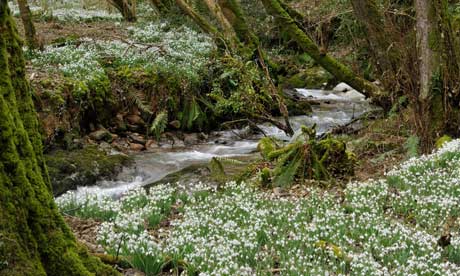
    Woodland stream with carpet of Snowdrops - Galanthus nivalis Snowdrop Valley, Exmoor, Somerset

    Woodland stream Snowdrop Valley, Exmoor. ‘Although seemingly abundant, only a tiny amount of the water on our planet is easily available as freshwater,’ said Ban Ki-moon. Photograph: Martin Fowler/Alamy

    Ban Ki-moon has warned the world is on course to run out of freshwater unless greater efforts are made to improve water security.

    Speaking on the UN’s International Day of Biological Diversity, Ban said there was a “mutually reinforcing” relationship between biodiversity and water that should be harnessed.

    “We live in an increasingly water insecure world where demand often outstrips supply and where water quality often fails to meet minimum standards. Under current trends, future demands for water will not be met,” Ban said.

    Water, food, energy and climate are all linked.

    Most forms of energy generation require water, variable weather is making agriculture harder while extreme weather events are hindering natural water storage.

    Ban believes there is an opportunity to address these challenges as the Millennium Development Goals are replaced with a new set of objectives.

    “As the international community strives to accelerate its efforts to achieve the Millennium Development Goals and define a post-2015 agenda, including a set of goals for sustainable development, water and biodiversity are important streams in the discussion.

    “Although seemingly abundant, only a tiny amount of the water on our planet is easily available as freshwater,” he said.

    The latest UN World Water Development Report, released last year, called for $13.7bn to $19.2bn of the Green Climate Fund’s annual targeted funding of $100bn to be directed at the challenges faced by the water sector.

    Much of this would be used to tackle supply shortfalls and flood management.

    Climate change is already impacting the availability of water through rainfall disruption, soil moisture, glacier, snow and ice melt and river, ground and water flows.

    Ban said the once competing campaigns for water and biodiversity protection could now be turned to the benefit of societies facing stresses on both water and food security.

    “Where once the focus was on trade-offs between water use and biodiversity, today we are coming to understand how biodiversity and water security are mutually reinforcing,” he said.

    “Ecosystems influence the local, regional and global availability and quality of water. Forests help regulate soil erosion and protect water quality and supply. Wetlands can reduce flood risks. Soil biodiversity helps maintain water for crops.

    “Integrating nature-based solutions into urban planning can also help us build better water futures for cities, where water stresses may be especially acute given the rapid pace of urbanization.”