

Green groups explore legal action to halt massive Queensland coal mine
Environmentalists claim Kevin’s Corner mine will damage groundwater supplies and contribute to climate change
 Email
Email- theguardian.com, Monday 4 November 2013 15.04 AEST
- Jump to comments (0)
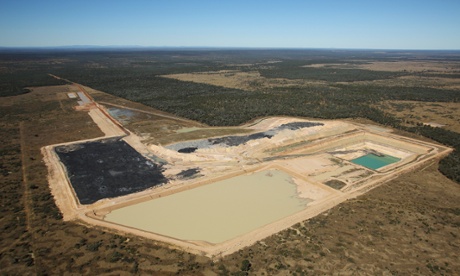
Environmentalists have threatened legal action to halt what is set to be Australia’s largest coal mine, claiming the federal government has overturned long-standing conservation principles by approving it.
The Kevin’s Corner mine has been approved by Greg Hunt, the federal environment minister, however, the approval is subject to more than 70 conditions.
Some of these conditions are designed to protect threatened species such as the black-throated finch, red goshawk and yakka skink.
Indian resources firm GVK, which will operate the mine, is also required to submit a water monitoring and management plan, which will help “establish baseline data for water quality”. This study will have to be peer reviewed and approved by Hunt.
GVK said the mine, located near the Queensland town of Alpha, is expected to last for at least 30 years, producing up to 30m tonnes of thermal coal a year for export. Mining magnate Gina Rinehart’s Hancock Prospecting sold its stake in the project in 2011.
Carbon emissions from coal mined at Kevin’s Corner are estimated at 58m tonnes a year – more than the entire annual emissions of Denmark. Construction is set to start in 2015, with the first coal mined in 2018.
GVK said in a statement: “In a timely and considered decision, the minister finely balanced the protection of environment with the need for economic investment and job creation.”
But opponents of the mine claim Hunt’s approval fails to protect the region’s groundwater and may be challenged in the courts.
Drew Hutton, president of anti-mining group Lock the Gate, told Guardian Australia: “We will certainly be reviewing our legal options on this. We are bitterly disappointed because this mine will have an enormous impact on the Great Artesian Basin.
“This has stood the whole approval system on its head. Once upon the time you had to show the impacts in order to get approval, but now you get approval and then work out exactly what damage it’ll do to the environment. We no longer have the precautionary principle in place in the whole approvals process.”
Hutton said Hunt’s decision showed that the government is disregarding the new “water trigger” provision in federal environment legislation, which demands that the environment minister assess any project that could impact water quality.
A coalition of six environmental and community groups are already waging a legal battle against the Rinehart part-owned Alpha coal mine, which would adjoin Kevin’s Corner.
Derec Davies, from one of the community groups, the Coast and Country Association of Queensland, told Guardian Australia that an objection to Kevin’s Corner has already been lodged.
“We see these two as brother and sister mines, with the technical assessments done together,” he said. “We would urge the government to wait on this new mine until the Alpha court case is finished, otherwise they could be wasting everyone’s time.
“We want the government to be provided with the best information to make the right decision and it’s clear the proponents haven’t done their homework, on groundwater and how they will mitigate the impact on climate change.
“Similar to Alpha, we believe their modelling on several issues is incorrect. We want more assessment and for the concerns of the community and farmers to be recognised.”
The Kevin’s Corner and Alpha coal mines are two of a series of developments planned for the coal-rich Galilee basin area of central Queensland.
The mines will, if completed, transport coal to the coast, where they will be shipped for export markets, primarily in China and India. Several port expansions are planned to facilitate this, although BHP has pulled out of one project amid concerns that Queensland already has a surplus of port capacity.
On Friday, a federal government strategic analysis of the Great Barrier Reef called for a more holistic approach to the health of the ecosystem by considering the overall impact of coastline development.
The report also stated that climate change was “the most serious long-term risk” facing the reef.
“Even a two degree celsius rise would be a very dangerous level of warming for coral reef ecosystems, including the Great Barrier Reef, and the people who derive benefits them,” it stated. “To ensure the reef remains a coral-dominated system, the latest science indicates global average temperature rise would have to be limited to 1.2 degrees celsius”
Lock the Gate’s Hutton said the government’s approach to approving massive coal mines runs contrary to this warning.
“It’s bordering on hypocrisy, really,” he said. “The Abbott government says it still recognises the link to climate change and the need to reduce greenhouse gases. They are prepared to make feel-good statements about the reef but not the hard decisions about resource development.”
Hunt’s office has been contacted for comment.