Israel has a stake in the Azeri oil fields, from which it imports some twenty percent of its oil. The opening of the pipeline will substantially enhance Israeli oil imports from the Caspian sea basin.
But there is another dimension which directly relates to the war on Lebanon. Whereas Russia has been weakened, Israel is slated to play a major strategic role in "protecting" the Eastern Mediterranean transport and pipeline corridors out of Ceyhan.
Militarization of the Eastern Mediterranean
The bombing of Lebanon is part of a carefully planned and coordinated military road map. The extension of the war into Syria and Iran has already been contemplated by US and Israeli military planners. This broader military agenda is intimately related to strategic oil and oil pipelines. It is supported by the Western oil giants which control the pipeline corridors. In the context of the war on Lebanon, it seeks Israeli territorial control over the East Mediterranean coastline.
In this context, the BTC pipeline dominated by British Petroleum, has dramatically changed the geopolitics of the Eastern Mediterranean, which is now linked , through an energy corridor, to the Caspian sea basin:
"[The BTC pipeline] considerably changes the status of the region’s countries and cements a new pro-West alliance. Having taken the pipeline to the Mediterranean, Washington has practically set up a new bloc with Azerbaijan, Georgia, Turkey and Israel, " (Komerzant, Moscow, 14 July 2006)
Israel is now part of the Anglo-American military axis, which serves the interests of the Western oil giants in the Middle East and Central Asia.
While the official reports state that the BTC pipeline will "channel oil to Western markets", what is rarely acknowledged is that part of the oil from the Caspian sea would be directly channeled towards Israel. In this regard, an underwater Israeli-Turkish pipeline project has been envisaged which would link Ceyhan to the Israeli port of Ashkelon and from there through Israel’s main pipeline system, to the Red Sea.
The objective of Israel is not only to acquire Caspian sea oil for its own consumption needs but also to play a key role in re-exporting Caspian sea oil back to the Asian markets through the Red Sea port of Eilat. The strategic implications of this re-routing of Caspian sea oil are farreaching.
What is envisaged is to link the BTC pipeline to the Trans-Israel Eilat-Ashkelon pipeline, also known as Israel’s Tipline, from Ceyhan to the Israeli port of Ashkelon. In April 2006, Israel and Turkey announced plans for four underwater pipelines, which would bypass Syrian and Lebanese territory.
"Turkey and Israel are negotiating the construction of a multi-million-dollar energy and water project that will transport water, electricity, natural gas and oil by pipelines to Israel, with the oil to be sent onward from Israel to the Far East,
The new Turkish-Israeli proposal under discussion would see the transfer of water, electricity, natural gas and oil to Israel via four underwater pipelines.
http://www.jpost.com/servlet/Satellite?cid=1145961328841&pagename=JPost%2FJPArticle%2FShowFull
“Baku oil can be transported to Ashkelon via this new pipeline and to India and the Far East.[via the Red sea]"
"Ceyhan and the Mediterranean port of Ashkelon are situated only 400 km apart. Oil can be transported to the city in tankers or via specially constructed under-water pipeline. From Ashkelon the oil can be pumped through already existing pipeline to the port of Eilat at the Red Sea; and from there it can be transported to India and other Asian countries in tankers. (REGNUM )
Water for Israel
Also involved in this project is a pipeline to bring water to Israel, pumping water from upstream resources of the Tigris and Euphrates river system in Anatolia. This has been a long-run strategic objective of Israel to the detriment of Syria and Iraq. Israel’s agenda with regard to water is supported by the military cooperation agreement between Tel Aviv and Ankara.
The Strategic Re-routing of Central Asian Oil
Diverting Central Asian oil and gas to the Eastern Mediterranean (under Israeli military protection), for re-export back to Asia, serves to undermine the inter-Asian energy market, which is based on the development of direct pipeline corridors linking Central Asia and Russia to South Asia, China and the Far East.
Ultimately, this design is intended to weaken Russia’s role in Central Asia and cut off China from Central Asian oil resources. It is also intended to isolate Iran.
Meanwhile, Israel has emerged as a new powerful player in the global energy market.
Russia’s Military Presence in the Middle East
Meanwhile, Moscow has responded to the US-Israeli-Turkish design to militarize the East Mediterranean coastline with plans to establish a Russian naval base in the Syrian port of Tartus:
"Defense Ministry sources point out that a naval base in Tartus will enable Russia to solidify its positions in the Middle East and ensure security of Syria. Moscow intends to deploy an air defense system around the base – to provide air cover for the base itself and a substantial part of Syrian territory. (S-300PMU-2 Favorit systems will not be turned over to the Syrians. They will be manned and serviced by Russian personnel.)
(Kommerzant, 2 June 2006, http://www.globalresearch.ca/index.php?context=viewArticle&code=IVA20060728&articleId=2847
Tartus is strategically located within 30 km. of the Lebanese border.
Moreover, Moscow and Damascus have reached an agreement on the modernization of Syria’s air defenses as well as a program in support to its ground forces, the modernization of its MIG-29 fighters as well as its submarines. (Kommerzant, 2 June 2006). In the context of an escalating conflict, these developments have farreaching implications.
War and Oil Pipelines
Prior to the bombing of Lebanon, Israel and Turkey had announced the underwater pipeline routes, which bypassed Syria and Lebanon. These underwater pipeline routes do not overtly encroach on the territorial sovereignty of Lebanon and Syria.
On the other hand, the development of alternative land based corridors (for oil and water) through Lebanon and Syria would require Israeli-Turkish territorial control over the Eastern Mediterranean coastline through Lebanon and Syria.
The implementation of a land-based corridor, as opposed to the underwater pipeline project, would require the militarisation of the East Mediterranean coastline, extending from the port of Ceyhan across Syria and Lebanon to the Lebanese-Israeli border.
Is this not one of the hidden objectives of the war on Lebanon? Open up a space which enables Israel to control a vast territory extending from the Lebanese border through Syria to Turkey.
"The Long War"
Israeli Prime minister Ehud Olmert has stated that the Israeli offensive against Lebanon would "last a very long time". Meanwhile, the US has speeded up weapons shipments to Israel.
There are strategic objectives underlying the "Long War" which are tied to oil and oil pipelines.
The air campaign against Lebanon is inextricably related to US-Israeli strategic objectives in the broader Middle East including Syria and Iran. In recent developments, Secretary of State Condoleeza Rice stated that the main purpose of her mission to the Middle East was not to push for a ceasefire in Lebanon, but rather to isolate Syria and Iran. (Daily Telegraph, 22 July 2006)
At this particular juncture, the replenishing of Israeli stockpiles of US produced WMDs points to an escalation of the war both within and beyond the borders of Lebanon.
Michel Chossudovsky is the author of the international best seller "The Globalization of Poverty " published in eleven languages. He is Professor of Economics at the University of Ottawa and Director of the Center for Research on Globalization, at www.globalresearch.ca . He is also a contributor to the Encyclopaedia Britannica. His most recent book is entitled: America’s "War on Terrorism", Global Research, 2005. To order Chossudovsky’s book America’s "War on Terrorism", click here.
Revised, 28 July 2006.
Annex
The BTC Co. shareholders are: BP (30.1%); AzBTC (25.00%); Chevron (8.90%); Statoil (8.71%); TPAO (6.53%); Eni (5.00%); Total (5.00%), Itochu (3.40%); INPEX (2.50%), ConocoPhillips (2.50%) and Amerada Hess (2.36%). (source BP)

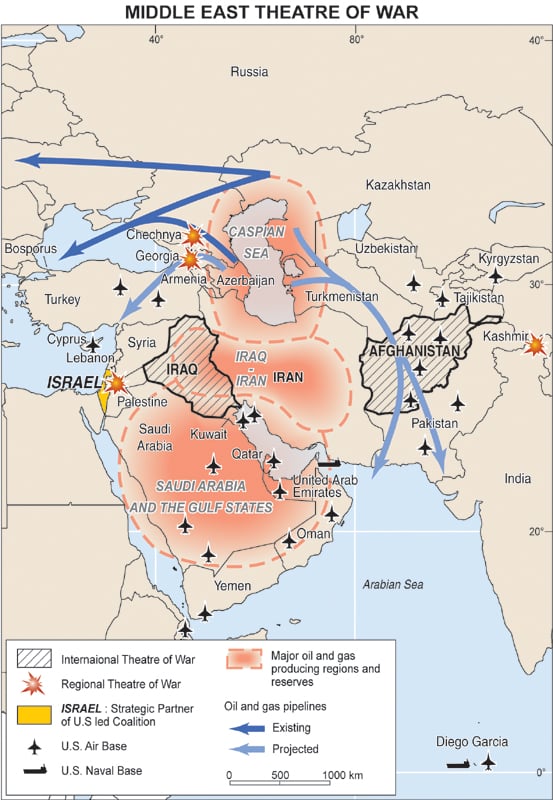
© Map by Eric Waddell, Global Research, 2003. (click to enlarge)
For details on th Campaign against the pipeline see http://www.bakuceyhan.org.uk/more_info/bp_pipeline.htm