The Cage, like the Matrix, ensnares and enslaves us. We voluntarily assist in building our own trap, borrowing money to make banks richer, plugging ourselves into a system that feeds off our energy and activity to enrich its owners. The Cage started life as a radio show, exposing the workings of the cage by turning the paradigm on its head, locking the powerful into “The Cage” until they answer the question …
White Australians struggling with approaches to justice for First Nations people might consider a Radical Republic, writes Geoff Ebbs.
Prince Andrew represents the sickening privilege of our European head of state.
The coincidence of the Queens Birthday long weekend and the Black Lives Matter rallies encouraged me to dust off an old idea during today’s episode of EcoRadio.
Many Australians have had enough of the Sax-Coburg-Gotha regime. Prince Andrew’s privileged attempts to avoid his association with Jeffrey Epstein’s trafficking of children only further sickens the public. The Palace letters between the Queen and her Governor General regarding his dismissal of an elected Australian Government 45 years ago emphasise the fraught nature of our relationship. We care little for an ancient and totally irrelevant European royal family and understand fully why Harry might want to leave the firm. Australian republicans certainly do.
Let’s juxtapose those reflections on the perverted nature of the British Crown with the impassioned demands for justice for the First Nations people over this weekend. This is an ancient and sustainable civilisation who had their land stolen by British colonists. Some of the white guilt accumulated over the last two hundred years has been assuaged by Land Rights legislation, the Mabo case and numerous Royal (there’s that word again) Commissions finding systemic injustice toward our First Nation people. The general feeling after this weekend is that we have talked enough. Now it is time for action and the first order of business is to stop killing black people.
Old White Men
As a stale pale male, literally a patriarch, I cannot and do not pretend to speak for First Nation people. I am speaking on behalf of myself, though, when I propose a simple solution to a purely white construct.
The British Navy came and stuck a British flag on this soil and claimed it for the British Crown using the legal fiction of Terra Nullius to justify the claim. As a result we emboss the Queen’s head on all our coins, we celebrate the Queen’s Birthday with the Queen’s Honours List and our head of state is a vice regal apparatchik reporting directly to the Queen. Any land which has not been bought, sold or assigned to a particular government department is legally known as Crown Land, our armies serve the Queen through our vice-regal head of state. The Governor General of Australia and the Governor of each state report directly to the Queen. All minerals under the surface of the earth are the property of the Crown and the mining companies that dig them up pay royalties to the Crown, collected and managed by the Australian Government on the Crown’s behalf. Public Servants may no longer have a picture of the Queen on every office wall, but they labour On Her Majesty’s Service (OHMS) and swear an oath of allegiance to her as the crowned Head of State. So do any applicants for citizenship to this country.
Give it back
The simple solution is just to give that all back.
Everything that we currently cede to the British Crown should just go back to the sovereign First Nation. This simple move directly reverses the fiction of Terra Nullius. Such a simple, legal declaration does not jeopardise the property rights of any Australians, in fact, the only rights affected are those of the so-called British Royals. The Australian Parliament, public servants, Scout Groups, the local copper and the Defense Forces will all serve the First Nation people in the same way that they have served the Queen.
It is up to the First Nation people how they want to organise their side of this arrangement. They get to decide what goes on the back of the Australian coinage, in the corner of the Australian flag, and on the front of official government correspondence. They determine who the Governor General is and whether any particular Act of Parliament receives assent. The top legal inquiries in the land will no longer be Royal Commissions but XXX Commissions, the lawyers who make representations to the highest courts in the land become XXX Counsels. Australian sailors will no longer serve on Her Majesty’s Australian Ship (HMAS) and so on, down the line.
It is simple, it is just, it is clean and it is logical.
All of the objections I have ever had to the idea are conceptual, rather than practical. Many of them express the view that it would be weird to be ruled by ‘a people’. My response is that it is no more weird to be ruled by a foreign family. The other response is that there is no formal structure to replace the Crown. Interestingly, the British Constitution is not documented. It is simply the accumulation of centuries of precedent. Under British and Australian law, anything that is not nailed down by some other written contract belongs, by default, to the Sax-Coburg-Gothas. I don’t like that.
A radical republic
I, for one, would gladly join a re-invigorated Republican movement dedicated to replacing the rule of the Sax-Coburg-Gothas with the primacy of our First Nations people.
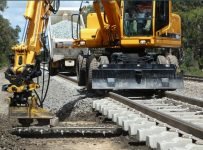
Alarm bells rang in the Cage when a derailment occurred on the Melbourne Sydney track on February 24th 2020 due to “mud holes” on the track. The Rail Tram and Bus Union reported in 2011 that the practice of replacing sleepers without lifting the track, known as sideways replacement, was causing mudholes that could lead to derailment. As a result, then transport minister, Anthony Albanese initiated a study by the Australian Transport Safety Bureau that decided in 2013 the train line was only safe if trains were slowed down and appropriate warnings given.
Last month’s derailment was caused when a train driver travelled at 100kmh through a section of track designated to be safe at speeds of 10kmh apparently unaware of the warning.
The sleepers are inserted without raising the tracks
The 2013 ATSB report concluded:
“the ATSB is satisfied that the necessary steps have been
taken to address any issues that might otherwise compromise the safety of rail
operations … at the expense of operational efficiencies through increased train
running times.”
Industry observers at the time, predicted disaster but, as the official report stopped short of recommending that anything be done about it, everyone, including the national news services packed up and went home until the deaths this week.
The facts are that the Australian Rail Track Company put out a request for tender in 2007 to upgrade the Melbourne to Sydney rail line. The problem was that the old wooden sleepers allowed the guage of the tracks to wander. New concrete sleepers wouild ensure the tracks ran straight and true. That tender was awarded to a consortium using Harry Bilt’s Platypus technology capable of replacing the sleepers without ripping up the rails. According to the ATSB in 2013, the decision to use this controversial technology was that there was not enough money available to do the job properly.
“It is also likely that the cost
associated with addressing the ballast, drainage or formation issues would have
precluded completely re-sleepering the Melbourne to Sydney line with the
funding available and therefore some residual safety risk associated with poor
track gauge would have remained if this path had been chosen.”
The dangers of sideways sleeper replacement have long been a topic for discussion on railway discussion boards such as railpage.com.au, unions such as the Victorian Rail, Tram and Bus Union (RBTU) and international forums. The looseness of the ballast put under the sleeper when it is inserted between the rail and the ground allows water to collect and mud-holes to form. The result is known as “fouled ballast.” These concerns were raised on Radio National when the Australian Transport Safety Board reported in 2013.
The gaps under the rails collect water, leading to mud-holes
The ATSB report suggested both short term and long term risk management processes would need to be employed to avoid a major incident. It spent some time outlining speed restrictions and additional monitoring of track failure as the short term measures but was deliberately vague about the methods of avoiding the risks in the long term.
“Longer term strategies ARTC
implemented … are unlikely to correct the more deep-seated formation problems. …
It is possible that water will continue to weaken the structure in some
locations, with a corresponding requirement for an increased regime of track
maintenance and the application of new or further speed restrictions.”
The final conclusion, that as long as we run the trains very slowly, we should be able to avoid deaths, is hardly a strategy for creating a safe, high speed rail network. Unfotunately, the problems of fouled ballast are not the only failure to maintain the national rail network during decades of cost-cutting. Analysis of the Wallan derailment also reveals issues with signals and possibly internal processes.
The question now is whether the unfortunate deaths of innocent workers and injury to passengers will inject enough steel into future inquiries to ensure that the national rail network is at least made safe and, ideally, brought up to something resembling international standards. 10km per hour is not an acceptable speed for the major passenger link between Australia’s two largest capital cities.
Familiar road tropes establish spine-tingling chills when you are directly immersed in the experience
There is nothing like a road trip to highlight personality
traits and set the scene for a battle between the small domestic world
established in the car interior and the big bad world outside the windows of
that private space.
So, a white Volvo and a domestic spat and a potentially
loving resolution in a dark and lonely rural setting provides the perfect seed for
a road drama.
In a brilliant piece of self reflective immersive theatre,
digital art outfit The Farm, invites audiences to attend the drama in their own
cars, circled around the paddock with their FM radio and headlights as an
integral part of the theatre experience.
The scene is set as soon as you turn up, and the experience
builds gradually as you queue in your cars, test the radio connection, are
reminded of your relationship with the car and are instructed in the etiquette
of this post-modern drive in theatre.
When the play begins, you have actually been transported
into the lonely, rural, roadside night where the drama takes place. The couple
in the car in front of you reflect the (mostly) couples in the car that form
the audience.
That the drama involves a series of familiar, even cliched road
centred scenarios only strengthens the trope that you are in the play, that the
play is exactly what you expect to see, in the same way that the familiar
components of the horror thriller, provide comfort and fear at the same time.
So, the play takes our couple through the dramas of a lone
attacker, a pedestrian accident, a gang of motorcycle riders and a zombie
apocalypse. As the action expands out from the paddock that is the stage into
the circle of cars that is the audience, the suspension of disbelief into which
we all surrendered early in the process immerses you thoroughly into the action.
I sweated with fear, my skin crawled in anticipation at the same time as I
laughed at the neighbouring theatre goers giggling hysterically in their
vehicle.
As well as the rich conceptual layering of the play itself,
the physical acting borders on the incredible. Actors emulating accident
victims float and jerk unrealistically in your headlights, slight young women
bundle giant zombies into the Volvo boot, one actors walks another along the
doors of the car so they fall in through an open window, this is magic rendered
in a paddock with a minimum of sets.
This is fully realised modern theatre in the making. It
combines digital technology, immersive experience, physical theatre and layered
cultural awareness.
The play is Throttle, the venue is the Mudgeeraba
Showgrounds, the production company is The Farm and tickets are available
through Bleach, the Gold Coast Arts Festival. The play is sold out, so you will
not get the chance to see it this time round but I’m sure you will have that
chance in the future. This is too good to disappear into the ether without
spawning other appeareances, derivative works or both.
This is in response to the recent New York Time’s commentary on the Empire of Rupert Murdoch, P&I 5th April. Murdoch’s insight has been passed to many of the publishers of commercial media and political parties. It has damaged society and there’s no easy way for it to be countered.
In 1998 Rupert Murdoch received a Papal Knighthood
Since Moses was a boy, one of the universal challenges of any person who needs to communicate, sell, preach, or evangelise, is of communicating to the maximum number of people at the smallest cost per person. It’s a maxim in trade, politics, religion and any form of communications. It’s the fundamental dynamic that undergirds the entire advertising industry. The vast majority of the population scarcely pay attention to the techniques used to attract their attention.
Larger audiences at the lowest cost
In recent history where trade, business and sales are perceived as vital to modern capitalist economies, this search for communications pathways has become more important than ever.
We are familiar with the way businesses and political parties seek out demographic segments. We see ’boutique businesses’ catering for the wealthy, or people seeking products that will ‘set them apart’. We see businesses, and political parties, targeting demographic segments such as the migrant vote, the blue collar vote, and so on.
The ‘genius’ of Rupert Murdoch is that he identified a sector of the population that is far larger than all the rest put together. Many, including the authors of the NYT’s study, mistake this for some ‘conservative sector’ in society. I’d argue that is a by-product of the brilliance of what Rupert discovered. Initially, his challenge was the changing media and technological landscape that was stealing the audiences that underpinned profits, largely sourced from advertising, in his newspapers. His quest has been to find a new audience to replace those who were no longer buying his newspapers and tuning in to his television and radio stations. Rupert is not stupid. What he came up with was sheer genius. It has not only delivered him wealth beyond imagination; it has also delivered him power to manipulate vast, even national audiences and populations.
Where did the inspiration come from?
Who knows how he came up with this strategic breakthrough? There might be a Catholic connection. Rupert isn’t a Catholic, but in 1967 he married his second wife, Anna Torv, a Catholic. Together they had three children, Elizabeth, Lachlan and James. The two boys are in contention to eventually be the successors to inherit their father’s empire. That ‘Catholic connection’ eventually led to Rupert being made a papal knight – a Knight Commander of the Order of St Gregory, KCSG – in 1998, three months before he split with Anna. You can read more at this article in the Los Angeles Times where a pile of these knighthoods were handed out like confetti to people who helped fund the reconstruction and refurbishment of Cardinal Roger Mahony’s cathedral in Los Angeles.
Back in 1979 another Cardinal, Joseph Ratzinger, who subsequently became Pope Benedict XVI, made an observation about the ordinary pew-sitters in the Church. In a homily he stated, “The Christian believer is a simple person: bishops should protect the faith of these little people against the power of intellectuals.” While only a small number of people in the educated, affluent, first world heard or read those words, it seems about 90% of the baptised picked up that it was how the hierarchs were going to treat them: as “little and simple people who needed to be protected from intellectuals”. In other words, Catholicism was for simpletons. The majority gave up listening and participating across the Western world.
There is insight and wisdom in Cardinal Ratzinger’s words…
Yet, I would argue, there was actually a lot of insight and wisdom in the future pope’s words, beside the fact that it reflected the outlook of the majority of bishops in what they saw as their chief role of protecting ‘the faithful’ from intellectuals and from thinking for themselves. More importantly, this insight is also linked to the genius insight of Rupert Murdoch KCSG.
The sad truth is that the majority of the human population do not aspire to be intellectuals or to devote a lot of energy to thinking about what they see as esoteric theories, and rules and laws in such fields as theology, politics, economics or even the sciences. They want, even demand, ‘simple answers’ answers than can be digested in three sentences and simple slogans. Look at how few people join political parties these days compared to the total population. Participation in political parties is declining as rapidly across the Western world as participation in religion.
Rupert’s genius insight is that most of the population want ‘simple answers’. Above all else they want a little bit of security. Yes, some of them do aspire to be as rich as the Murdoch family, but most are simply content to preserve what they already have. Insurance and superannuation have become massive growth industries. So have personal development courses offering people forms of security and the opportunity to ‘get ahead’. But they’re not going to invest a huge amount of intellectual, mental and emotional energy thinking about it.
The Romans learned this long ago. They built huge stadiums to entertain and distract the masses from having to think too much. This is also one of the inheritances of the institutional Catholic Church from Emperor Constantine and his successors: Keep It Simple for the masses. Provide them with what are essentially emotional distractions, such as superstitions and simple pieties, and big dollops of anxiety and fear about eternal damnation. Perhaps somewhere between 60 and 70% in any population operate out of this mindset.
Rupert Murdoch reads the minds, needs and wants of the populations where he operates better than any priest, politician or pope. He feeds them what they most want: wall-to-wall, 24/7 entertainment and distraction. All the major commercial media have borrowed his formula and today offer this constant diet of over-the-top sentimentality mixed in with slogans to generate anxiety and envy about others. Politicians also have adopted his genius and now offer ‘slogan solutions’: “Stop the Boats”; “Build a Wall”; “Make Us Great Again”.
None of it is about genuine conservatism. It’s an exercise in stirring up sentimentality – getting people crying on television is a common trick in commercial current affairs programs and talk-back radio – and then stirring up anxiety, anger and venting about somebody who’s going to steal your job or rip off all your hard-won assets.
Rupert was merely trying to maintain the audiences that had once caused the rivers of gold to flow through classified advertising in his newspapers. Stirring up the basest human instincts in the ‘fight or flight’ responses gave him access to a far larger audience than anything that could be expected through appealing to any particular demographic or sub-sector of the population. The truth is all of us have this ‘fight or flight’ instinct that is as old as humanity. Some refer to it as the ‘lizard’ part of our brain that we share in common with the lowest animals. It utilises a technique that appeals to those with a narcissistic streak who know how to exploit populations for their own acquisition of wealth or power.
What’s the answer to Rupert’s genius?
I don’t pretend to know the answers to how any nation can respond to this. We’re dealing with forces in the human psyche that are more powerful than virtually any other force known to humankind. We see it manifested in the increasing instability emerging all over our planet today: from Britain with Brexit and the refugee problems in Europe, to Trump’s efforts to build a wall in the United States. We see it in the political and economic instability in countries like Venezuela, Brazil, the Philippines, Italy, Hungary and even France.
We need to confront the narcissistic leaders who are exploiting this. But we also need to tame the insecurities and anxieties of this vast population who seek simple answers, hate ideas, thinking and intellectuals, and who think and act in very shallow ways. The task, and challenge, is not going to be easy.
The insults hurled by David Leyonhjelm at Sarah Hanson-Young recently put parliamentary discourse in the gutter. Leyonhjelm was roundly condemned, but not by our leaders. A limp slap across the knuckles from Turnbull and Shorten, then on to more pressing matters, hoping it will all go away.
But not so fast; in governance parlance “the fish rots from the head”. Our leaders need to acknowledge the amoral, unethical parliamentary morass they have created, and its implications.
Ian Dunlop was formerly an international oil, gas and coal industry executive, chair of the Australian Coal Association and CEO of the Australian Institute of Company Directors. He is a Fellow of the Centre for Policy Development, a Director of Australia21 and a Member of the Club of Rome.
Australian society today is not a pretty sight. Despite the hype around Australian “values”, years of neoliberal policy have seen money corrupt everything. The Banking Royal Commission, long resisted by the incumbency, is exposing not just a few bad apples but an industry rotten to the core from excessive remuneration, greed which is certainly not restricted to the finance sector. In sport, winning is everything, whatever the cost, but it long ceased to be sport in any true sense. Violence against women and minorities escalates, egged on by the Leyonhjelms of this world. Population pressure sees tolerance disappear. Inequality increases in leaps and bounds, exacerbated by mythical “trickle-down” economics. Drug and alcohol abuse is widespread. Terrorism threats and migration justify massive over-reaction in restricting individual liberties. Crass commercial media and shock jocks incite vindictive extremism. Continuing scandals suggest that few people in positions of public trust have any idea of the moral and ethical responsibilities which go with those roles.
Above it all sits a national parliament incapable of sane discussion on anything. Screamed abuse replaces reasoned debate, any sense of civility long gone. Little wonder societal standards decline when “leaders” set such an appalling example. But there are far more fundamental implications.
Concepts of left and right in politics long since became irrelevant to solving the critical issues facing Australia. The imperative is that those issues do actually get addressed, which is patently not happening.
The first priority of government, we are told, is to ensure the security of the people. In theory, we elect politicians to govern on our behalf to provide that security; politicians who, pre-election, profess undying commitment to public service.
What we get, with a few notable exceptions, are politicians who, once elected, focus largely on party machinations, getting re-elected or otherwise feathering their nest. Much sound and fury around minor issues, whilst the critical ones are ignored. It was not always thus; historically in politics and business there were statesmen and women prepared to set aside their personal interests in favour of the common good, but they are long gone since money came to dominate. Good people are elected to parliament, but their good qualities are rapidly subsumed by party politics.
Behind it all, the creeping cancer of the neoliberal agenda dominates the current government. Driven by right wing apparatchiks in the Institute of Public Affairs, the Minerals Council of Australia, the Business Council of Australia, the Murdoch press and elsewhere, every opportunity is taken to push deregulation, reduce the size of government, emasculate and politicise the public service making it subservient to ideologically-blinkered political advisers, with no regard for the “common good”. Power is concentrated in a few wealthy hands in the interests of “conservatism”, shorthand for maintaining the status quo for the benefit of existing elites. So dissent must be suppressed, activist groups muzzled, the ABC silenced, academic freedom undermined, public debate dumbed down and the public treated as fools. Few are even aware it is happening, except when the occasional stuff-up occurs as with Tony Abbott spilling the beans on the real intentions of the Ramsay project for the promotion of Western Civilisation [1]. This is where facism begins; the cancer must be stopped if we want a prosperous, sustainable and fair society [2].
In this, Australia is following the US, where the process is far more advanced. The insidious efforts of right wing billionaires such as the Koch brothers, to seize the levers of power has been going on for decades, the inevitable outcome flagged by Lord Acton long ago: “Remember, where you have a concentration of power in a few hands, all too frequently men with the mentality of gangsters get control. History has proven that. All power corrupts; absolute power corrupts absolutely”
The deterioration of US society, with increasing inequality, violence, crumbling infrastructure and much more has, to a significant extent been brought about by this venality. US and Australian neoliberals are inextricably linked in moving this agenda forward.
Except that the status quo can no longer be maintained, as neoliberalism has long since sown the seeds of its own destruction. The inevitable result of decades of exponential growth in both population and consumption is that we are now hitting the limits of the global biosphere, which cannot be circumvented. This is manifest in multiple ways, inter alia: increasing water stress, massive biodiversity loss, decreasing productivity of agricultural land, escalating social conflict over declining resources and associated migration. To the point that the economic growth model under which our economies operate is no longer sustainable, despite desperate efforts to keep it afloat with massive financial interventions such as “quantitative easing”.
Overshadowing it all is human-induced climate change.
Its risks are intensifying and the physical impact worsening, with global climate-related losses running at record levels [3]. Despite 30 years of political and corporate rhetoric, nothing has been done to seriously address it, notwithstanding increasingly urgent warnings [4][5].
The result is that climate change is now an immediate existential risk to humanity. That is, a risk posing large negative consequences which will be irreversible, resulting inter alia in major reductions in global and national population, species extinction, disruption of economies and social chaos, unless carbon emissions are rapidly reduced. The risk is immediate in that it is being locked in today by our insistence on expanding the use of fossil fuels when the carbon budget to stay below sensible temperature limits is already exhausted.
To prevent temperatures rising above the upper 20C limit of the 2015 Paris Climate Agreement, it is no longer possible to follow a gradual transition path. We have left it too late; emergency action, akin to wartime regulation, is inevitable. Market-based measures alone are insufficient [6][7].
Those still sceptical of this reality only have to look at the Northern Hemisphere now, particularly the Arctic [8], Asia [9][10][11]and the US [12], as extreme temperatures trigger positive feedback loops, creating global climate conditions which make normal life impossible .
Neoliberals in the US and Australian fossil fuel industries long ago saw climate change as the greatest threat to the stranglehold on power from which they have benefited for so long. Accordingly billions of dollars have been devoted to discrediting climate science, raising doubts about its authenticity through every possible means, with much US money flowing in to support Australian campaigns. A process which has been remarkably successful, albeit nothing less than a crime against humanity.
But even the Koch brothers, the IPA and the MCA cannot change the laws of physics. The climate science has been rock-solid for decades and the cost of neoliberal disinformation is now coming home to roost. Unfortunately that cost is being borne by the poor who can least afford it, and groups like Australian farmers, rather than the elites who created it.
As Churchill put it: “Want of foresight, unwillingness to act when action would be simple and effective, lack of clear thinking, confusion of counsel until the emergency comes, until self-preservation strikes its jarring gong—these are the features which constitute the endless repetition of history”
Which places Australia in an extremely dangerous position. We are one of the countries most exposed to the impacts of climate change, particularly our agricultural sector. Yet our dysfunctional parliament has left the country totally unprepared for what is to come.
The crux of the problem is that our government is in total climate change denial. Climate and energy policy is a shambles, the result of endless contortions trying to reconcile the irreconcilable. Namely expanding our fossil-fuel based economy, particularly coal, whilst pretending to meet our wholly inadequate voluntary commitments under the Paris Agreement. An Agreement which the government is doing its damndest to undermine, despite having ratified it in 2016.
Policy is dictated by scientifically and economically illiterate right wing hard-coalers, such as Messrs Canavan, Abbott, McCormack, Kelly and Abetz who cannot understand that reliable, dispatchable and lower-cost power is now available from renewable energy sources far more effectively and cheaply than from coal. Even when coal continues to be massively subsidised, far more than renewables, by the lack of a sensible carbon price to account for its externalities, namely the enormous damage done by the health and climate impacts of coal use, which have been ignored since the Industrial Revolution. None of which matters if you are in climate denial.
They stamp their feet like petulant schoolboys whose favourite coal toy is being taken away. They lie and dissemble, misrepresenting and cherry-picking sound technical reports, twisting them to achieve their preferred pro-coal outcomes, irrespective of the severe implications for the wider Australian community, egged on by the serried ranks of the neoliberal cheer squad.
Just because we have large coal resources does not give us the right to use them if the result is an existential threat to humanity. Commodities come and go; coal is no different. Coal has created great wealth, but it’s time has passed as its climate impact, along with that of other fossil fuels, is now destroying the societies it helped create. The development of Galilee Basin coal, along with CSG in NSW and Queensland, and shale gas in the NT and WA, would be suicidal in current circumstances.
As Sheikh Yamani put it in the oil context: “The Stone Age did not end for lack of stone, and the Oil Age will end long before the world runs out of oil”
Australia was built upon the innovative application of science. That is also its future, which the government is destroying with third-rate, anti-science policy such as the National Energy Guarantee. The certainty for energy investment which business and politicians crave will be non-existent until action on climate change is accepted as the absolute priority in determining energy policy. The solutions are available and blindingly obvious, including a realistic price on carbon and bans on any further fossil fuel expansion.
We have many opportunities to invest in low-carbon alternatives for both domestic and export use which provide far greater potential than traditional commodities such as coal. Particularly in providing distributed energy across the rural community. This is where our aspirations must lie, not in massive investment in propping up coal-fired power stations or investing in new ones. The cost to Australia as these investments inevitably become stranded assets, will be enormous, along with physical damage to the country from their climate impact. Rather than holding back renewable energy development, which is clearly the objective of current policy, we should be accelerating it to the maximum extent possible along with dramatic improvements to energy efficiency and conservation.
Neoliberal climate denialists insist that Australia’s domestic carbon emissions, 1.3% of the global total, are such as small amount that nothing we do will have any effect in addresssing climate change globally. That is nonsense; if exports are included, which they must be given the rapidly accelerating climate impact, Australia is already the sixth largest carbon polluter globally and will soon be fourth given the ramping up of our LNG exports. In short, we are a very big emissions player. What Australia does mattters.
The pretence that the government is serious about addressing climate change becomes ever more ludicrous. The most recent example is the $500 million allocated in a futile attempt to repair climate damage to the Great Barrier Reef, via the Great Barrier Reef Foundation [13], whilst simultaneously advocating the opening up of massive new coal mines in the Galilee Basin which would compound that damage, totally decimating the reef, along with tourism and other industries far more valuable than coal.
Likewise the announcement from Minister for Agriculture , David Littleproud, about an agreement with state ministers to help farmers adapt to climate change [14]. Why was this needed? Because the climate is changing. What are we doing to stop it? Nothing, just attempting to adapt whilst making the problem far worse by building new coal-fired power stations and mines. Just how long can this cognitive dissonance continue?
The Prime Minister proclaimed in 2010 that: “Our efforts to deal with climate change have been betrayed by a lack of leadership, a political cowardice, the like of which I have never seen — “. He promised never to lead a political party that did not take climate change seriously. He now revels in doing exactly that, placing the future of generations of Australians in jeopardy. An abject failure of principled leadership.
The Opposition are little better, continually sitting on the fence denying the urgency for climate action, and ambivalent toward new coal development such as Adani. Equally lacking in leadership and principle.
Many parliamentarians are climate deniers, but that does not absolve them of the fiduciary responsibility to set aside their personal prejudices and to act in the public interest with integrity, fairness and accountability. This requires them to understand the latest climate science; it is not acceptable for those in positions of public trust to dismiss scientific warnings in the cavalier manner which has typified the last few years. Particularly when the risk is existential.
Ministers in particular do not seem to understand that they have that fiduciary responsibility, along with the related public duty and a public trust.
“A fiduciary is a person to whom power is entrusted for the benefit of another. ——- Power is reposed in members of Parliament by the public for exercise in the interests of the public and not primarily for the interests of members or the parties to which they belong. The cry ‘whatever it takes’ is not consistent with the performance of fiduciary duty ———- All decisions and exercises of power should be taken in the interests of the public, and that duty cannot be subordinated to, or qualified by, the interests of the (parliamentarian or Minister)”
Effective action on climate change must be raised above political infighting if the government’s first responsibility to ensure the security of the Australian people is to have meaning. But nowhere in the political spectrum is there evidence of leadership that might step up to the challenge.
In the corporate sector, the widespread abuse of power, declining ethical standards and falling community trust in business is calling into question corporations’ “social licence to operate”, and their right to enjoy the privilege of limited liability, which has been the cornerstone of business since the early 1800s [16], on the grounds that it should be a privilege to be earned, not an inalienable right.
Trust “is a belief that a person or institution will perform their role or function in accordance with its obligations, or where not bound by duty, in a predictable manner”
Beyond trust is legitimacy “ a recognised and well-founded right to claim a certain status, role or function.” [17]
Our parliament must be held to higher standards than the corporate world. But community trust in parliamentarians is non-existent. Further, a parliament that is incapable of firstly, understanding, secondly, addressing and thirdly, is deliberately worsening, the critical issues which Australia faces, particularly climate change, has forfeited any legitimacy. It has no right to continue in its present form.
When the risks are existential, it is not acceptable to allow parliamentary renewal to await the next election and the likely continuation of dysfunctional government. The parliament is on Winter Break; it should not reconvene. The Governor General should disband it and consider alternative national governance arrangements.
Different forms of democratic structure are being canvassed widely, recognising the profound weaknesses of the current system [18][19]. This expertise should be used to create something akin to a wartime Government of National Unity, with leaders of foresight and integrity.
Because the brutal reality is that climate risk now has to be handled as an emergency. Either we act, or we face a bleak future. Parliament must work for the people, not destroy them.
Ian Dunlop was formerly an international oil, gas and coal industry executive, chair of the Australian Coal Association and CEO of the Australian Institute of Company Directors. He is a Fellow of the Centre for Policy Development, a Director of Australia21 and a Member of the Club of Rome.
References
1] “Academic Independence Threatened by US-Style Philanthropy”, Mike Seccombe, Saturday Paper. 30th June 2018:
Two contradictory technological currents combine to further disempower the already disadvantaged.
On one hand, the assumption that people in general have a certain technical capacity (both access and skills) means that those without that capacity are left on the wrong side of the digital divide pushing them into a downward spiral that mirrors the compounding impacts of economic disadvantage.
On the other hand, the concerns around privacy and individual control of their online profile are a luxury that only the rich can afford. If you are not securely and comfortably connected to the digital systems that underpin modern life, you do not get the right to be choosy about the manner in which your profile is built or managed.
Excluding the technologically disadvantaged
An example may help.
To log into any of the major government agencies – Taxation, Medicare, My Health, NDIS, Veteran Services as well as any of the welfare services on which millions of Australian depends – you must enter your username and password and then verify your identity by entering the code that arrives at your mobile phone. If you do not have a mobile phone you are advised that you cannot use the online services and you must go to an office of the relevant service.
Thus, the elderly, the digitally illiterate, those with a physical or mental characteristic that causes them to struggle with a smart phone are forced to physically attend offices while the rest of us blithely manage our health records or report our taxation figures online. In many cases, those offices present another range of barriers. At the Centrelink office, for example, you are encouraged to reduce the load on staff by using the computers at the side of the office to access your claim online.
So far, this example defines the relatively straightforward argument that we increasingly rely on services that demand a technological capacity that is not universally available. It is easy to understand that people with limited, flawed or no access to digital technology are at a disadvantage when it comes to engaging with certain aspects of modern life. While the scale of this disadvantage is not widely understood – partly because of its compound nature – the concept it easy to grasp.
Profiling them regardless
The second force at work, though, is more subtle. The privacy implications of digital technology are far reaching and complex. Consider the case of a person completely refusing to engage in the digital world, thereby maintaining their privacy by maintaining what is known in the business as an “air gap”.
Refusing to participate in the digital world certainly ensures complete protection from direct access to your activity, it does not guarantee that you do not have a digital footprint and it certainly does not allow you to manage or shape your digital profile.
Take the example of an elderly person who has no mobile phone or debit card.
Even though they do not participate in social media, for example, they still have a digital profile compiled from references to them made by their friends and relatives. Similarly, face recognition software that draws on databases of passport and license photos does not require their online engagement to store the photograph from their passport or driver’s license.
The My Health record is a recent and controversial example of an online database that requires every citizen to engage, even if it simply to state that you wish to disengage.
So, the complete refusal to engage is the simplest example of disengagement and it still involves complex ethical and practical considerations. If we consider those people who use debit cards for banking and mobile telephones to make calls and send text messages but otherwise resist engagement in the more advanced digital platforms the complexities multiply significantly.
The implications
Once we start to examine how much control someone has over the digital profile that they willingly create but wish to manage, the issues become so complex that we struggle to find the boundaries.
Consider a woman fleeing domestic violence, applying for help from the government to support her in a safe refuge form her violent partner.
The first thing that any domestic violence support organisation will do is remove the SIM card from her phone, cut it in half, smash the mobile phone to pieces and deposit the lot in a bin. The mobile phone is the most common mechanism whereby perpetrators of domestic violence track down their victims. The days following the departure from the scene of domestic violence represent the greatest danger to victims of violence. More women are killed attempting to flee domestic violence than enduring it, this is one of the major challenges for agencies attempting to support women who face violence in a relationship.
Now, because government departments insist that citizens have a mobile phone to gain online access to their own records, the next thing the agency has to do is to assist the woman to set up new telephone and email account so that she can start applying to government agencies for assistance.
And so now the complexities begin. Existing email addresses and telephone numbers are often the very tools used by these agencies to verify the identity of an applicant. If they have just smashed their phone into small pieces this may represent a significant challenge.
Even without exploring the legal requirements regarding consent of a spouse before some details can be accessed and changed, or a partner can be excluded, the situation is riddled with the anomaly we commonly call a Catch 22. You cannot log into your record without the mobile phone that you wish to report as no longer available. Changing these details at the offices of various agencies may be the only means possible. That relies on having original documents that may well be in the filing cabinet in the family home where an angry spouse sits armed and waiting for the opportunity to punish the person fleeing the control and abuse to which they have been subject for years.
Without getting into the tangled web that faces every victim of domestic violence it is apparent that anyone outside what is considered the standard digital capacity of the modern citizen faces the traps and pitfalls of those systems once the cracks open up because one piece of the puzzle is missing.
The My Health record is a recent example of a controversial system that we are assured is perfectly easy to control, simply by logging in and specifying how we want it managed. The assumption, again, is that we all have access to our record online.
Does it matter?
To test how dependent you are on your online connection, try leaving your phone at home and going through a normal day. Turn off your domestic wifi and see how well you can meet the demands of your family. Watch the people landing at an international airport. They will queue for half an hour to get access to WiFi so they can reconnect to the services that locate and verify them.
Reflect on the news stories that emerge when the power is off for more than 24 hours across large sections of a community. The water runs out, fuel pumps stop working, food rots in refrigerators that no longer remain cold, cold, hungry desperate people take advantage of the darkened streets to help themselves to what they need.
We live in a highly integrated and fragile world that relies on all its constituent parts functioning correctly to maintain the lifestyle to which we have become accustomed. Those people who do not have access to all those components work twice as hard to maintain a base level of engagement. The exclusion of these people from our online activity is a major disempowerment and disadvantage for a whole class of people that is largely invisible to those of us who never experience it.
It is the assertion of this article that we need to address this imbalance by supporting the digitally challenged as an integral part of our social safety net.
It is a topic of further exploration that their inability to engage removes any degree of control over how they occupy that digital world. The irony of that situation that may seem abstract and of little interest but it actually identifies a major challenge. The digital representation of ourselves now occupies an important place in the global systems by which we define ourselves that is rapidly becoming more significant than the physical self. We have already forgotten that not so long ago, the physical self completely defined us.