Category: Cross

A rigorous examination of the role of religion in our society. Inspired by the movement to tax the church and eliminate its priviledged position as the preferred provider of outsourced welfare and driven by the Royal Commission into Institutional Child Abuse, The Cross deals with the complex issues of spirtuality, meaning and belief as a mechanism of the state.

  • A moral framework for the Anthropocene

    A moral framework for the Anthropocene

    A moral framework for the Anthropocene
    A moral framework for the Anthropocene

    We have adorned the lowest heaven with lamps, missiles for pelting devils. We have prepared a scourge of flames for these, and the scourge of hell for unbelievers:  an evil fate!

    The Koran 67:6

    The Cross is on a mission to explore the terrain of a moral framework without god as its central reference and that recognises the immorality of the mega-machine.

    Organised religion, like corporations, and state bureaucracies are evil to the extent that they negate humanity and they are at the extreme edge of negative territory in this regard, right now. The sexual abuse scandal in the church, the corporate trafficking in slave labour the willingness of political rulers to sacrifice millions of lives to abstract ends are all examples of this.

    Havec Pavel put it this way in an interview forming the first chapter of Disturbing the Peace.

    A genuinely fundamental and hopeful improvement in “systems” cannot happen without a significant shift in human consciousness. … It’s hard to imagine the sort of systems I’ve tried to describe here, coming about unless man, as I’ve said, “comes to his senses”. This is something that no revolutionary or reformer can bring about, it can only be the natural expression of a more general state of mind, the state of mind in which man can see beyond the tip of his nose a d prove capable of taking on – under the aspect of eternity – responsibility even for the things that don’t immediately concern him, and relinquish something of his private interest in favour of the interest of the community, the general interest. Without such a mentality, even the most carefully considered projects aimed at altering systems are bound to fail.

    Pavel proposes a moral framework without mentioning spirituality. He proposes that it is central that we take responsibility for the world beyond the immediate material environment and the consequences that we can detect in it. That additional awareness needs to be nurtured. Its development will be a significant evolutionary process. We must do more than simply damn religion and faith for the blind alleys down which they have led us.

    We can damn religious institutions for the fact that their character as mega-machines consumes and depcreciates humanity. We can damn gods for the fact that we have used their elevated status to create meaning and justify our own purpose. Simply leaving behind the tribal competition as to whose god is more powerful, however, gets us no closer to describing or developing the state of mind we must enter to live harmoniously. Of course we need to leave blind faith behind to create the space in which greater awareness can evolve, but that alone is not enough. It is a necessary but not a sufficient condition.

    Our task is to transcend the selfish grasping that has provided the evolutionary impetus that has created the Anthropocene. That means recognising values other than accumulation and consumption. Those higher values, then, are not simply material. Transcendence requires the recognition of the non-material character of those values.

    This is vastly different than the second step of the twelve step program. That step directs its adherents to recognise that there is a larger force than themselves, it is cast as an acceptance of our own limitations. The opposite is true. We must remain responsible for our own actions. We must take responsibility for the fact that we are imperfect, but our actions impact on it. We must accept that the world is imperfect, and strive to take the real, flawed substance of reality and improve on it.

    The second law of thermodynamics describes the nature of the life force as it applies to the material world. Structure is potential energy. As structures collapse, energy is released. The compost pile becomes hot as the complex plant matter breaks down, releasing the energy captured from sunlight as it energised the synthesis of that plant matter. Entropy is the lowering of energy, the “natural” end point of the universe. Life is the gathering and harnessing of energy to organise matter, to add structure. Plants provide the bulk of the energy for the ecosystem, converting carbon dioxide and water into complex carbohydrates using the energy of the sun.

    Life then accumulates energy to create order. Civilized societies are more complex, involve more infrastructure, than primitive ones. When empires collapse civilisation decays. The ants nest is weakened and retreats to one corner of its physical space.

    Our task, then, is not to reject structure and order, as they are the natural legacy of life. Our task is to direct our lives to enhance rather than destroy the environment that nourishes us: to determine principles that inform the design and implementation of our structures. Our task is the application of the principles of deep ecology to the ancient idea of husbandry.

    The relevance of religion to this discussion and the raison d’etre for The Cross is that we currently do not have a cohesive value system beyond the material and commercial one that has usurped traditional systems.

    Most importantly, the institutions with the most to lose are using the fear generated by the crises engendered by our self-centred materialism to generate a nostalgia in traditional faith-based moral frameworks. This is a backward step that can only accelerate the existential crisis that faces us in the Anthropocene.

    It is imperative, then, that we clarify the discussion by separating morality, spirituality and belief. Further, we must underpin the mechanistic view of science with a moral framework that guides the application of its evidence-based research. This has economic, political and spiritual implications that all need to be explored.


    https://www.facebook.com/Crossycrosscross/posts/1666201490285639
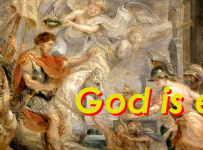
  • God is Evil

    God is Evil

    And the anger of the Lord was against Israel, and he delivered them into the hands of the spoilers that spoiled them and he sold them into the hands of the enemies round about.

    Judges, 3:14

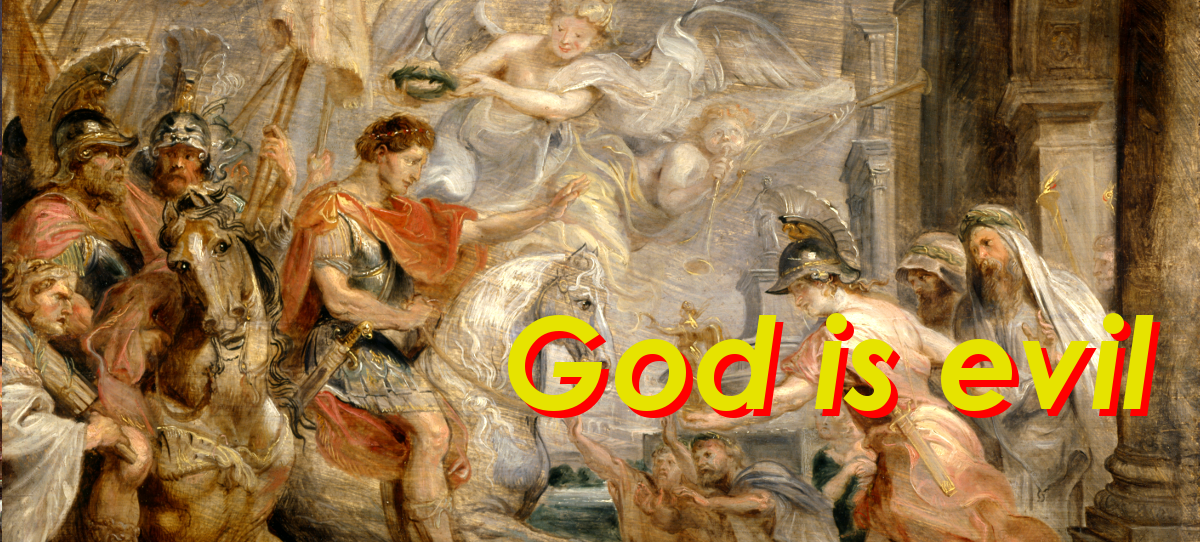
    Constantine harnessed God to subdue the population
    Constantine enters Rome – by Rubens.

    The events at the 2015 hearings Royal Commission into Institutional Responses to Child abuse almost exclusively occupied The Cross last year. As a result you could be excused, Dear Reader, for thinking that might be this project’s raison d’etre.

    Not so! Justifiable on past performance, perhaps, but incorrect.

    The Cross exists to challenge the dominant assumptions of the Christian West and its hegemonic view of the geopolitical landscape. This ranges from the institutional rumblings of the established churches and the governments that protect them, the hysterical self-satisfaction of the Christian right as it carves a swathe through the falling middle-class, the arrogant rantings of the anti-theists and the empty posturing of the agnostic left.

    In short, current discourse completely fails to apprehend the many and varied influences of religion, its role in society and therefore the damage it continues to do and the good that it should.

    Worse, the dialectic of attacking or defending religion further fails to offer any evolution away from the tribal defensive ”My god is better than your god” and the disastrous consequences of that position in a time where weapons of mass destruction abound.

    As a consequence, there is a complete misunderstanding of the role of secular government and so almost no healthy policy development to deal with the population’s need for narrative frameworks to meet the challenges of overpopulation, peak energy and climate chaos.

    Some starting points.

    There is no external god, driving the universe. There is no intelligent design.

    We know this because we continually recreate God in our own image. All metaphysical frameworks mirror the structures of our apprehension of reality. Just as the aliens that visit earth and molest its citizens have evolved over the last century with the technology those citizens use in their day to day life and experience in their collective imagination through the shared fiction of cinema, television and radio, so has god evolved with human society.

    Religion is an important cultural glue.

    There is always common, agreed narrative that provides the shorthand that allows us to assume the meaning of things so we can get on with the rest of our lives. This cultural agreement allows us to meet with a common agenda and engage peacefully in quite complex dialogues and sophisticated activities. Culture need not be faith based, but there are always belief systems and it serves no purpose to deny the historical role of religion in providing that cultural glue.

    Religion is an apparatus of the state.

    Agriculture was developed at sword point to feed a standing army: There was no initial benefit for the farmer in stocking the king’s granary.

    Since the emergence of the city, made possible by agriculture, the state has required more complex disciplinary and revenue raising structures to support its internal complexity. The marriage of religion and state was perfected by the Roman Church starting with Julius Caesar’s assumption of the roles of both Flamen Dialis and Pontifex Maximus and culminating in Constantine’s Nicene Conference which agreed on a Creed that served both the Christian priesthood and the imperial apparatus.

    Ironically, JC (of the coin) was appointed Flamen Dialis by a jealous uncle precisely because it was the ancient religion that was deliberately powerless in state affairs. The high priest could not touch iron and all his trappings of office dated from an earlier Bronze age. By merging the Flamen Dialis, the Pontifex Maximus and the role of Consul, Caesar made himself a divine ruler, transcending the democratic apparatus of the Republic.

    Constantine specifically recognised that religion was more effective (and cost effective) than brute force and it was easier to work with the priests than use a standing army to oppose them. He was opposed by the religious philosophers who understood that harnessing religion to the state was about power not spirituality.

    We stand roughly 1700 years down the track, with a couple of centuries of Inquisition, brutal Crusades and three centuries of christian-justified colonialism under our belts.

    Money is the new religion

    Money provides the abstract value system by which we measure good.

    In the last century we have shifted our focus of worship from the cross to the dollar. We believe in money because the institutional apparatus tells us this is the glue that holds society together.

    Economic rationalism identifies the monetary cost of services as the yardstick by whether we know something is working. Social services are funded on the basis of outcomes that are accounted for to determine if funding should continue.

    This befits a material world understood by the abstraction of numbers. The centrality of commerce to governance was perfected by the Venetians when they invented that great tool of economic rationalism, double entry book keeping. We now know, as Oscar Wilde so eloquently put it, the price of everything and the value of nothing.

    It is notable that the Venetians accepted large wads of cash from the French Pope to transport French troops to the holy lands and fight for control of the religious relics of Jerusalem. Instead of heading to the Levant, the Venetians took the troops to Constantinople to gain control of the centre of commerce.

    Thus began the process of supplanting religious values with commercial ones.

    God is evil

    This demonstrably illogical statement provides a dramatic starting point that is consistent with the full article published on The Generator. On one level it is not consistent with atheism in that god cannot be evil if god does not exist. In the context that god was only ever a human construct to provide meaning and has always been abused by those with the power to do so, it is as close to the truth as we are going to get. My final point is a perfect illustration of this illogical truth.

    Commerce uses God to justify its wars.

    Given this past, our furious refusal to acknowledge it, the fact that we still use it to justify increasingly complex and nasty wars over the geopolitical end-game for the planet’s last cheap energy, it is more critical than ever that these layers of belief, assumption and deliberate falsification are exposed examined and questioned. We have an “amoral” network of global corporations using Gods they do not believe in to exploit the passions of populations obstructing access to the resources they wish to control.

    Even more challenging, we confront the existential crisis that we have the power to destroy our own species or, at least, civilisation and, without some moral framework underpinning radical change, this appears to be an almost inevitable outcome. As a result, there is a real and urgent imperative to create a new metaphysical framework that is not materialistic and self-centred but is rights and evidence based.

    That is the mission The Cross sets itself at the beginning of the 2016th year of our lord, as they say in the Christian establishment of the European dominated globe in which I write.

  • The Vatican needs thought leaders

    The Vatican needs thought leaders

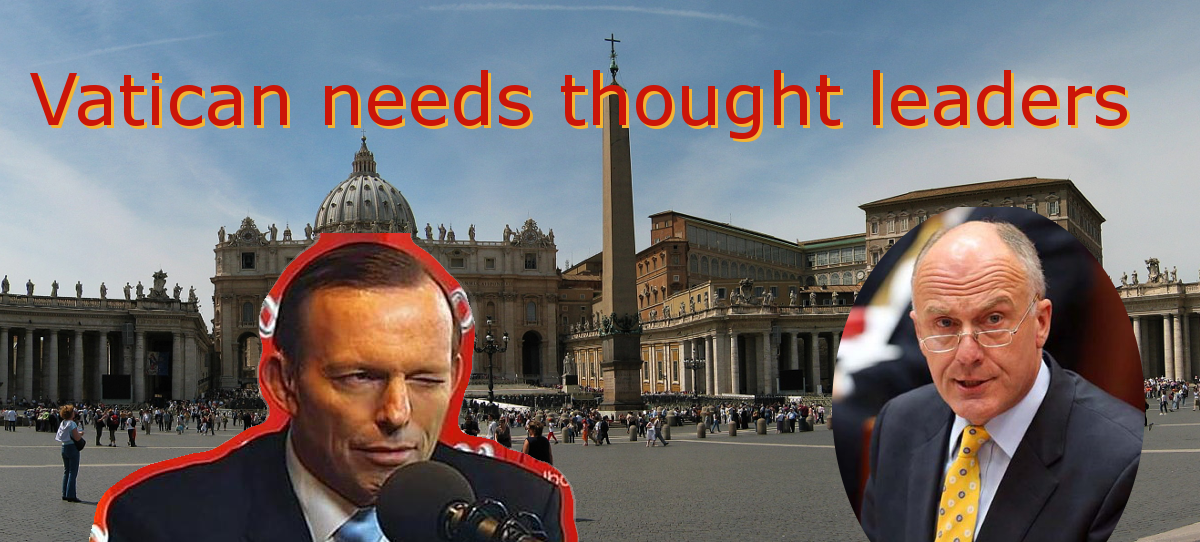
    Send Tone to the Vatican

    Eric Abetz bemoaned this week the hegemony of the left wing press – he must mean Rupert, surely – in running down the Christian Right while failing to name, let alone declare its alliance with, the Secular Left. It is time he said, quoting from his Climate Denier’s handbook, that the press put both sides of the debate.

    I dispute his binary analysis, but he is entitled to his 15 minutes of fame like the rest of us.

    Eric the Hun crossed the line into satire, though, when he lamented the loss of the Thought Leader, Tony Abbott, who was busy in a bow tie, lecturing the Angela Merkel on her misplaced altruism. Only by following Australia down the well-trodden path of torturing the politically unpalatable on remote islands as a deterrent to the more deserving poor can we find it in our colonist hearts to offer inclusion to a select few who fill in the paperwork and plead correctly.

    As The Cross sat down to push aside the latest sex abuse scandals and wax lyrical about the failure of the Abbott to sear his fanatic brand of religion onto Australian society through sheer political incompetence (he was made Prime Minister for god’s sake, and blew it!) the Curia started to tear itself apart in response to the Pope’s edict to stamp out corruption.

    Like a flash of divine inspiration, like the slashing of the Gordian knot, The Cross solved a number of problems with one simple thought. We can leave Abbott in Europe to advise the Vatican. He is trained up in the faith, his surname gives him the semblance of some sort of liturgical authority. Born in England he can wangle an EU passport.

    Abetz can join him. He only renounced his German citizenship in the weeks before the federal election. Even if there is not a cool-off period that allows him to cancel the cancellation, he can eat some humble pie and throw himself on Chancellor Merkel’s charity to get himself allowed in.

    Once there they will be able to apply their brilliance to the problems confronted by the Vatican. After all they are used to the budget emergency and the internal leaks.

    Tone has learned a thing or two about the rat in the ranks through the coup he has just suffered down under and will be able to plot with his old mate Pell about how best to bring the radical reformer Frankie under control before he goes to Hollywood and wins the hearts and minds of middle class whites.

    While Russia and the US harness Islam to battle out the positioning of the pipeline from the last reserves of cheap oil in the world, Tone and Eric can harness the energy of the Vatican to answer the important questions of whether or not women can be abolished and if God the Son is made of the same substance as God the father.

    Many of you will have assumed that Constantine settled this 320 years after the death of our lord by killing and banishing all the Arian bishops and putting together the Nicene Creed. Unfortunately for those who like their philosophy simple, though, Simeon the Stylite took the awful truth deep into the caves of Syria and sat on a pole for thirty years to protect it.

    The tearing apart of Syria to pipe the world’s last cheap oil west has released Simeon’s Secret. Observing Constantine at work, he noted that religion as we know it (as Constantine presented it) is simply a servant of the state that harnesses the fanaticism of the fringe dwellers in society to work for the State instead of against it. Using force to subdue your population is hard work and expensive, telling them that you are fighting for their beliefs though has the double bonus of freeing up your army to do other work and swelling its ranks with a bunch of manic fighters simply frothing at the mouth to die in the name of the cause.

    As it was in the third century so it is now.

    The fact that Tone failed to convince secular Australia that he was the true representative of the spirit on earth will not stop him having a go elsewhere.

    The Cross will watch with interest.

  • Sunday Assembly – ‘live better, help often, and wonder more’

    Sunday Assembly – ‘live better, help often, and wonder more’

    Cameron Reilly and Chrissy Dunaway at Sunday Assembly - Jo Stevens
    Cameron Reilly and Chrissy Dunaway at Sunday Assembly – Jo Stevens

    Church is about God isn’t’ it?

    Or so I thought until a few weeks ago when I first attended the Brisbane Sunday Assembly.

    I’d read a little of Alain De Botton’s 2013 book “Religion for Atheists: A Non-believer’s Guide to the Uses of Religion”, but still wondered what a god-free ‘church’ would be like, and why you would want one in the first place.

    I put these questions to Anne Reid, who I had met when she was the Secular Party candidate in Griffith in the 2013 election. Anne invited me along to the Brisbane Sunday Assembly to see for myself.

    Anyone stumbling into a meeting of the Sunday Assembly for the first time could be forgiven for thinking they were in a church. The group meets in a school hall but so do a lot of religious groups these days.

    The meeting commenced with music provided by a live band (clapping and singing along), followed by a reading, a key speaker, a word of testimony, more singing, and some silent contemplation.

    Brisbane Sunday Assembly - Photo by Jo Stevens
    The congregation is much like any other Sunday gathering

    This structure was familiar to me from my past life in a Protestant community church. The similarities stop however with these outwards trappings.

    The songs were not hymns: on the day I attended, songs included Cat Stevens’ ‘Peace Train’ and John Lennon’s ‘Imagine’. The reading was not from the Bible: it was a poem titled, “A Square Deal” by iconic Australian, CJ Dennis. The key speaker was not a minister or priest, but a professor of quantum physics (and the custodian of the world famous Pitch Drop Experiment) at the University of Queensland. Professor Andrew White did not present us with a sermon or a homily; instead, he gave an amusing and accessible overview of an aspect of his work.

    This is certainly not church as I had known it.

    In the final segment of the meeting, Chrissy Dunaway, one of the founders of Brisbane’s Sunday Assembly, explained why, as an atheist, the concept and practice of Sunday Assembly are important to her. Brought up in the Mormon Church in the United States she came to a point where she could no longer accept the religious dogma and she left. Her mother, she said, characterised her life after Mormonism is a being like “a ship without a rudder” and that, she said, was a fair description of how she had felt. Ms Dunaway said that what she had been looking for was a philosophy and a supportive community; the very things that she had lost when she had left the church.

    The concept for Sunday Assembly began just one year ago with UK comedians, Sanderson Jones, and Pippa Evans. They say on their website that, “they wanted to do something that had all the best bits of church, but without the religion, and awesome pop songs.” In the short time that has followed, Sunday Assembly groups have been established in a number of UK and US cities, as well as in all mainland Australian capital cities. The Brisbane Assembly attracted over 200 people to its first meeting and around 100 people routinely attend its monthly meetings.

    Grant Richards, well known in Brisbane as “Grant, the polite guy,” told me that he first encountered Sunday Assembly as an invited speaker. Once homeless himself, Grant is the founder of Signal Flare which runs barbecues and raises funds for the homeless. Sunday Assembly and Signal Flare have since developed an ongoing relationship, with Sunday Assembly helping at barbecues and providing clothes and toiletries and other essentials for homeless people living in and around Brisbane and Ipswich.

    Asked if he is happy with the non-theist basis of Sunday Assembly, Grant said, “I love the community spirit here, and the three point philosophy: ‘live better, help often, and wonder more.’” Adding, “It is awesome, it’s the community coming together to celebrate life.”

    Brisbane Sunday Assembly
    The ritual is familiar to those brought up in a church

    Commenting on the Assembly’s work with Signal Flare, Ms Reid said that some people think that charity is the province of the churches, “but I have been openly atheist for some time, and I have been involved in a lot of charity work.” “In that [charity] scene,” she said, “the question is always about what church you belong to. The assumption being that only the religious do charity work. I would very much like to change that perception”.

    Ms Reid considers that in the future Sunday Assembly could provide a base for the many overseas students she meets. Such students, she said, are often in need of a community in Australia, and they are frequently drawn to the churches for support. She thinks that it could be important to have non-religious organisations available to these students to help them navigate the basics of living in a foreign country without the associated belief system.

    Both Ms Reid and Brisbane Sunday Assembly President Cameron Reilly said that criticism of Sunday Assembly has mostly come from other atheist organisations which consider it is too similar to a church. Ms Reid said this was a pity because, “atheists come in all ‘makes and models’ and all outlets of atheist expression should be encouraged.”

    Mr Reilly said, “We really do like people, and we like community, and we want to help other people. This criticism that atheists should not get together as a community just doesn’t make a lot of sense to me”. He added that the structure of the meetings is intentionally similar to a church service, “we deliberately take what we think are the best parts of religion, because it works. What a lot of people are looking for is a community and that sense of knowing your neighbours, and having a group of people you care about, that care about you…that you share some common interests with”. “The thing with Atheism,”.” he said, “is that it tends to be a solitary thing. You may be part of a music group, or a sports group, but nothing that really talks about how you live your life, about how you support one another in times of need; what your philosophy is. I think there are a lot of us that are yearning for something like that.”

    De Botton says much the same thing in ‘Religion for Atheists’: “For too long non-believers have faced a stark choice between either swallowing lots of peculiar doctrines or doing away with a range of consoling and beautiful rituals and ideas.”

    I asked Mr Reilly whether Sunday Assembly will create its own rituals to mark life events, such as births, marriages, and deaths. He said that he and his partner have a baby due in 3-4 weeks, and they have been talking about how Sunday Assembly will welcome this new life. “Those sorts of rituals are an important part of the human experience and an important part of being a community: celebrating and supporting people through major life events.”

    Sunday Assembly meets each month. For more information on their meeting times and events, see the Sunday Assembly website or look them up on Facebook.

    For Signal Flare’s next event see their Facebook site.

    I’d like to thank Jo Stevens for providing the images that accompanying this story.

  • Scripps Lecture to Explore Crossroads of Science and Religion

    Scripps Lecture to Explore Crossroads of Science and Religion

    Free public Rosenblatt Lecture scheduled April 2 by expert on science teaching and evolution-creation debate

    Scripps Institution of Oceanography / University of California, San Diego
    Join Scripps Institution of Oceanography at UC San Diego for a lively presentation at the hotly debated crossroads of science and religion. Eugenie Scott, executive director of the National Center for Science Education and an internationally known expert on the evolution-creation controversy, will present “In the Beginning: Science, Religion, and Origins” during the annual Richard H. and Glenda G. Rosenblatt Lectureship in Evolutionary Biology.

    The event is scheduled for 3 p.m. on April 2, 2013, at the Robert Paine Scripps Forum for Science, Society and the Environment (Scripps Seaside Forum) on the Scripps Oceanography campus (8610 Kennel Way, La Jolla, CA 92037). The event is free and the public is invited. Seating is available on a first come, first served basis.

    During the presentation Scott will address the origins of life, Earth, and the universe, topics pondered by religions around the world.

    “Science, as a relatively recent actor on the intellectual stage, also considers these topics, coming up with answers at variance with those of most religions, including Christianity,” says Scott. “How do these two approaches differ? Are there similarities? And is there an uncrossable divide between the two? The answer is not just philosophically interesting, but directly relevant to decisions being made about what to teach in public school science courses.”

    In her current position, Scott oversees the National Center for Science Education, a not-for-profit membership organization of scientists, teachers, and others who seek to improve the teaching of science, evolution, and climate change. A former college professor, Scott is regularly featured in news reports regarding science teaching.

    Four years ago Scientific American named Scott “one of 10 outstanding leaders involved in research, business, or policy pursuits that have advanced science and technology.”

    She authored the book Evolution vs. Creationism: An Introduction and co-edited Not in Our Classrooms: Why Intelligent Design Is Wrong for Our Schools, in addition to many articles in science journals.

    In addition to holding several honorary degrees, Scott has been honored with several prestigious awards from a long list of scientific organizations, including the National Academy of Sciences Public Welfare Medal, the American Association for the Advancement of Science (AAAS) Award for Scientific Freedom and Responsibility, and the California Science Teachers Association Distinguished Service Award.

    # # #

  • Impact of religions will have ‘deeper roots ‘ than Copenhagen

    Impact of religions will have ‘deeper roots’ than Copenhagen

    Ecologist

    31st October, 2009

    Archbishop speaks of the lasting impact of a religious movement to tackle climate change ahead of major summit of religious leaders

    The Archbishop of Canterbury, Rowan Williams, has spoken out about the crucial role of the world’s religions in tackling climate change ahead of a major summit of faith leaders.

    Speaking at Lambeth Palace this week, the Archbishop said religions held the ‘moral vision’ and that ultimately their impact would have ‘deeper roots’ than anything achievable at the Copenhagen summit.

    His comments come as leaders from nine of the world’s major faiths – Baha’ism, Christianity, Daoism, Hinduism, Islam, Judaism, Dhintoism and Sikhism – gather at a major summit in Windsor next week to announce commitments to tackling climate change.

    Faith commitments

    Among the practical measures being announced is a commitment by  The Northern Diocese of the Evangelical Lutheran Church of Tanzania to plant 8.5 million trees, and by Sikhs to source sustainable fuel for India’s Sikh gurdwaras, or temples, which cater for 30 million people every day.

    Leaders will also announce a new Islamic eco label for goods and services, eco-tourism packages for pilgrimages (still the world’s biggest tourism events) and the turning of Shabbat into an environmental celebration of avoiding consumption.

    Biggest civil movement

    The event, being organised by the Alliance of Religions and Conservation (ARC), has been described as ‘the biggest civil society movement on climate change in history,’ by the UN.

    Faith communities own between 7-8 per cent of the habitable land surface of the planet, run (or are involved in) half the world’s schools and control more than 7 per cent of international financial investments.

    UN Assistant Secretary-General Ola Kjorven said with more than 85 per cent of the world’s population adhering to a religion the commitments made at the Windsor summit had the potential to be, ‘the biggest mobilisation of people and communities that we have ever seen on this issue.’