Category: Articles

  • Global majority faces water shortages ‘within two generations’

    Global majority faces water shortages ‘within two generations’

    Experts call on governments to start conserving water in face of climate change, pollution and over-use

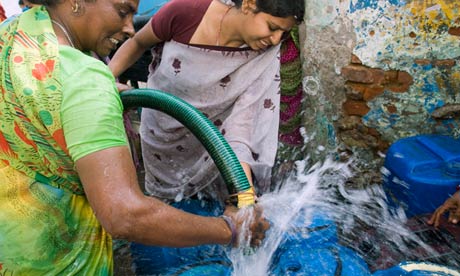
    Slum dwellers scramble for water

    Most of the areas where water will be scarcest soonest are in poor countries, which have little resilience to cope. Photograph: Stuart Freedman

    The majority of the 9 billion people on Earth will live with severe pressure on fresh water within the space of two generations as climate change, pollution and over-use of resources take their toll, 500 scientists have warned.

    The world’s water systems would soon reach a tipping point that “could trigger irreversible change with potentially catastrophic consequences”, more than 500 water experts warned on Friday as they called on governments to start conserving the vital resource. They said it was wrong to see fresh water as an endlessly renewable resource because, in many cases, people are pumping out water from underground sources at such a rate that it will not be restored within several lifetimes.

    “These are self-inflicted wounds,” said Charles Vörösmarty, a professor at the Cooperative Remote Sensing Science and Technology Centre. “We have discovered tipping points in the system. Already, there are 1 billion people relying on ground water supplies that are simply not there as renewable water supplies.”

    A majority of the population – about 4.5 billion people globally – already live within 50km of an “impaired” water resource – one that is running dry, or polluted. If these trends continue, millions more will see the water on which they depend running out or so filthy that it no longer supports life.

    The threats are numerous. Climate change is likely to cause an increase in the frequency and severity of droughts, floods, heatwaves and storms. The run-off from agricultural fertilisers containing nitrogen has already created more than 200 large “dead zones” in seas, near to rivermouths, where fish can no longer live. Cheap technology to pump water from underground and rivers, and few restrictions on its use, has led to the over-use of scarce resources for irrigation or industrial purposes, with much of the water wasted because of poor techniques. And a rapidly rising population has increased demand beyond the capability of some water resources.

    In some areas, so much water has been pumped out from underground that salt water has rushed in to fill the gap, forcing farmers to move to other areas because the salination makes their former water sources unusable.

    Most of the areas where water will be scarcest soonest are in poor countries, which have little resilience to cope. Many are also in areas where there is already political instability, tension or outright conflict, and the competition for water resources will heighten these problems.

    Water in the Anthropocene from WelcomeAnthropocene on Vimeo.

    But the scientists warned that the developed world would also suffer. For instance, there are now 210 million citizens of the US living within 10 miles of an “impaired” water source, and that number is likely to rise as the effects of global warming take hold. In Europe, some water sources are running dry because of over-extraction for irrigation, much of which is carried on in an unsustainable fashion.

    Pollutants are also causing severe problems in the rich world – the scientists highlighted the role of endocrine disruptors, which can cause fish to change gender, and the long-term effects of which on human populations are as yet barely known.

    “There is no citizen of the world who can be complacent about this,” said Janos Bogardy, director of the UN University’s Institute for Environment and Human Security.

    On Wednesday, UN secretary general, Ban Ki-moon, added his voice to concerns about water security: “We live in an increasingly water insecure world where demand often outstrips supply and where water quality often fails to meet minimum standards. Under current trends, future demands for water will not be met,” he said.

    The scientists, meeting in Bonn this week, called on politicians to include tough new targets on improving water in the sustainable development goals that will be introduced when the current millennium development goals expire in 2015. They want governments to introduce water management systems that will address the problems of pollution, over-use, wastage and climate change.

  • World on course to run out of water, warns Ban Ki-moon

    World on course to run out of water, warns Ban Ki-moon

    Freshwater supply and water quality under pressure, warns UN secretary general on International Day of Biological Diversity

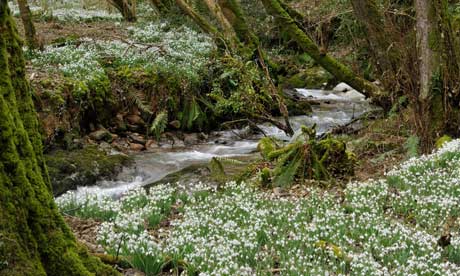
    Woodland stream with carpet of Snowdrops - Galanthus nivalis Snowdrop Valley, Exmoor, Somerset

    Woodland stream Snowdrop Valley, Exmoor. ‘Although seemingly abundant, only a tiny amount of the water on our planet is easily available as freshwater,’ said Ban Ki-moon. Photograph: Martin Fowler/Alamy

    Ban Ki-moon has warned the world is on course to run out of freshwater unless greater efforts are made to improve water security.

    Speaking on the UN’s International Day of Biological Diversity, Ban said there was a “mutually reinforcing” relationship between biodiversity and water that should be harnessed.

    “We live in an increasingly water insecure world where demand often outstrips supply and where water quality often fails to meet minimum standards. Under current trends, future demands for water will not be met,” Ban said.

    Water, food, energy and climate are all linked.

    Most forms of energy generation require water, variable weather is making agriculture harder while extreme weather events are hindering natural water storage.

    Ban believes there is an opportunity to address these challenges as the Millennium Development Goals are replaced with a new set of objectives.

    “As the international community strives to accelerate its efforts to achieve the Millennium Development Goals and define a post-2015 agenda, including a set of goals for sustainable development, water and biodiversity are important streams in the discussion.

    “Although seemingly abundant, only a tiny amount of the water on our planet is easily available as freshwater,” he said.

    The latest UN World Water Development Report, released last year, called for $13.7bn to $19.2bn of the Green Climate Fund’s annual targeted funding of $100bn to be directed at the challenges faced by the water sector.

    Much of this would be used to tackle supply shortfalls and flood management.

    Climate change is already impacting the availability of water through rainfall disruption, soil moisture, glacier, snow and ice melt and river, ground and water flows.

    Ban said the once competing campaigns for water and biodiversity protection could now be turned to the benefit of societies facing stresses on both water and food security.

    “Where once the focus was on trade-offs between water use and biodiversity, today we are coming to understand how biodiversity and water security are mutually reinforcing,” he said.

    “Ecosystems influence the local, regional and global availability and quality of water. Forests help regulate soil erosion and protect water quality and supply. Wetlands can reduce flood risks. Soil biodiversity helps maintain water for crops.

    “Integrating nature-based solutions into urban planning can also help us build better water futures for cities, where water stresses may be especially acute given the rapid pace of urbanization.”

  • Cheap drugs on the table in Lima

    Cheap drugs on the table in Lima

    Australia’s Pharmaceutical Benefits Scheme is under attack at the 17th round of Trans Pacific Partnership (TPP) negotiations underway in Lima. It is not just the cheap drugs enjoyed by Australia thanks to this brilliant scheme, it is the very question of national sovereignty.

    The Australian delegation  is winning accolades around the world for its stand on national sovereignty but this has not yet made headlines locally.

    This article discusses the reasons why these negotiations are so critical to our future and concludes with a plea to bring all the pressure we can to bear on politicians of all stripes to maintain our proud bipartisan stance on this issue.

    (more…)

  • Urgent meetings over water sediment threat

    Dirty water turbidity at Mt Crosby water treatment plant.Dirty water turbidity at Mt Crosby water treatment plant. Photo: Supplied
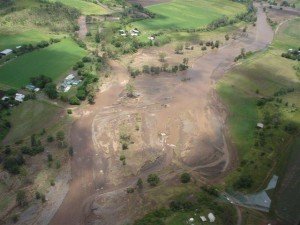
    Directors-general of three state government departments have been called in to urgent meetings to discuss the threat which silt in the Brisbane River poses to Brisbane’s water supply.

    (more…)

  • 2011 report confirms locals concerns about flood management

    Energex_Mt_SylviaThe 2011 Queensland Floods report confirms the concerns of locals Diane and Mark Bruhn about the lunacy of the flood measures being taken by local and state governments.

    Published in The Generator last week they provided new evidence that they are bulldozing and burning, increasing the speed and ferocity of the floods and the subsequent damage. If instead they listened to the science, slowed down the rivers and dispersed the water into the landscape, it would reduce flood damage and  have drought reduction value as well. It is well documented that the majority of water in streams comes from groundwater. Clearing the landscape and increasing the speed of run-off reduces the availability of groundwater significantly.

    Qld Floods 2011

  • 4BC picks up Greens concerns on coal dust

    IMG_1207Geoff Ebbs, Greens candidate for Griffith in inner-city Brisbane, appeared on 4BC yesterday discussing the economic madness of expending the national budget on coal infrastructure when the rest of the world is phasing out coal.

    The piece opens with John Gordon of Stop Brisbane’s Coal Trains discussing the huge volume of coal traffic through the suburbs of Brisbane.

    4BC – Coal Trains