Category: General news

Managing director of Ebono Institute and major sponsor of The Generator, Geoff Ebbs, is running against Kevin Rudd in the seat of Griffith at the next Federal election. By the expression on their faces in this candid shot it looks like a pretty dull campaign. Read on

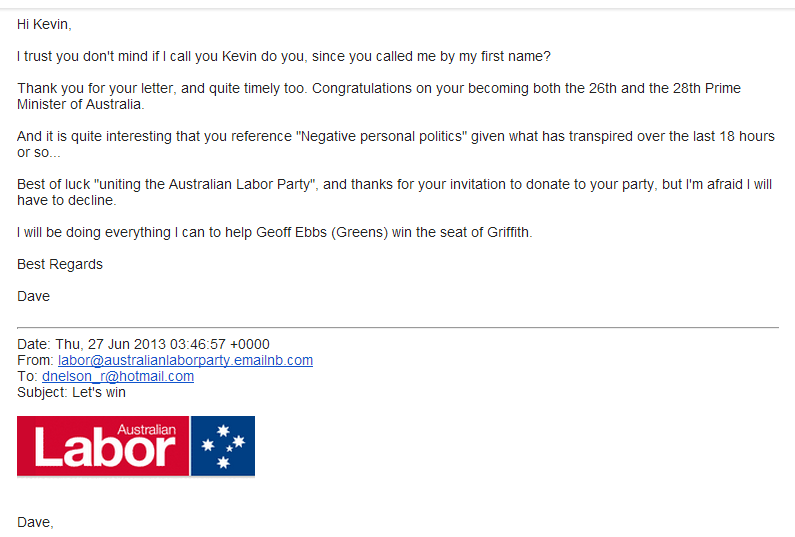
  • Constituent rejects KRudd call for support

    Hi Kevin,

    NoThanksKevI trust you don’t mind if I call you Kevin do you, since you called me by my first name?

    Thank you for your letter, and quite timely too. Congratulations on your becoming both the 26th and the 28th Prime Minister of Australia.

    And it is quite interesting that you reference “Negative personal politics” given what has transpired over the last 18 hours or so…

    (more…)

  • Griffith Green Greets KRudd

    Griffith Green Greets KRudd

    OLYMPUS DIGITAL CAMERAGreens candidate for Griffith, Geoff Ebbs, congratulates his opponent on his return to the role of Prime Minister.

    The people of Griffith can now send a message to the highest office in the land that they are sick of the political gamesmanship and want a government that is building for a long term future.”

    He said that the Labor leadership wrangle contrasts with the strong and steady leadership displayed by the Greens.

    Our leadership, like our policies, is stable over a long period and changes gradually with the broad support of the party,” he said.

    (more…)

  • Recycling saves Councils money

    As environment ministers await the final economic analysis on a national container deposit system(CDS) – a just released study has confirmed significant savings for local councils.*CDS1

    “Some members of the beverage and packaging industry have attempted a scare campaign saying that councils will be disadvantaged by a CDS. However this latest study* backs up the findings of the last 5 government-initiated reports – local councils will benefit by reduced collection costs. As well there is a significant increase in value of remnant material in kerbside because the bottles and cans each have a 10cent deposit,” said Jeff Angel, National Convenor of the Alliance.

    “The study has important implications for the economic work being done for environment ministers who will soon decide whether to adopt a CDS.”

    “It calls into question the findings of a recent report by the Equilibrium group for Sustainability Victoria**, that claimed some metro councils would be financially disadvantaged by a CDS. This study stated there could be no change in collection costs. However the new data clearly shows this is wrong. It also omitted payments to MRFs made under the Boomerang model.”

    “Controversially, the Equilibrium report failed to include savings in sorting and processing in its primary findings – strangely, an appendix in this report did calculate such savings and found local councils would save a net $4.59 million per year!”

    “The beverage industry and their allies should stop disseminating misleading or incomplete analysis. The demand for a national CDS will not go away with such studies and the more there is a delay in a decision – the more industry will face the risk of multiple state based schemes as Tasmanian now looks like being the next state to go it alone.”

    * The study by Anne Prince Consultants (2012) shows that the absence of glass bottles in kerbside collection due to a CDS allows improved compaction rates and less transport and labour costs without adversely affecting resource recovery. ‘Optimum Compaction Rate for Kerbside Recyclables’

    **Equilibrium (2012), ‘The financial impacts of Container Deposit Legislation to local governments in Victoria’

    Â

  • Water a “first world” worry

    WajirMore than half of Queenslanders are so concerned about water prices, they would consider cutting off water access at certain times of day to keep their bills down, a new Oxfam Australia study shows.

    But despite worrying about their rising household bills, 40 per cent admitted they still wasted water and took having clean, safe water for granted.

    The survey of 1000 Australians examined attitudes to water to coincide with Oxfam’s Water Appeal, which is raising funds for the international aid agency’s water, hygiene and sanitation programs for people living in poverty.

    Oxfam Australia Chief Executive Dr Helen Szoke said the research found that Australians believed water should be a basic human right for everyone.

    “It is no surprise Australians expect water to be available at reasonable prices, but we are very lucky to have clean, safe drinking water as one in nine people around the world don’t have access to safe drinking water at all,” she said.

    “In some countries, a family will survive for a day on the same amount of water we use to flush a toilet.

    “Oxfam is working with communities around the world to provide sustainable sources of clean water and education about hygiene and sanitation practices.”

    Highlighting just how unsafe water can be in other countries, the Oxfam survey also revealed nearly a quarter (23 per cent) of Queensland residents had been sick overseas, with half of those illnesses caused by drinking unsafe water.

    The majority of the people who became ill from drinking dirty water overseas took between three days and a week of annual leave (56 per cent) to recover and a further 38 per cent took between one and two days.

    Dr Szoke said communities without access to clean water and sanitation lost many more work and school days than Australian travellers, given their water-borne diseases and infections kept recurring because they were forced to continue drinking dirty water.

    In developing countries, where poverty is rife, more than 443 million school days are lost by children overseas because they are suffering water-borne diseases.

    “Providing access to a sustainable source of clean water that women don’t have to walk hours to reach will change the lives of many families living in poverty,” Dr Szoke said.

    To donate to Oxfam’s Water Appeal visit https://www.oxfam.org.au/explore/water-sanitation-and-hygiene/clean-water-saves-lives/

    Â

  • On the streets where we live

    West End Street musicians Stunn.

    You’ve probably seen Ray, River and Oits (members of the band Stunn) jamming on Melbourne St in West End. I stopped by for a chat and discovered that the three indigenous musicians are enchanting and charming. Ray told me a little about the band.

    “We got together to produce ethnic and cultural music that’s selected from our various cultures. All three of us are from different backgrounds. Our ethnic backgrounds include Eastern-Polynesian, Samoan, Aboriginal and Malay cultures. We combine that with modern music and our own style. We try to create some sort of fusion and identity based on this.”

    “Do you think there are any other artists or bands draw on various cultures like you guys do?”

    “Well if they don’t they’re limiting themselves. They should do it and explore what’s out there. The collaboration that we have is pretty good.”

    “Do you think music is a big deal in West End?”

    “Music is one of the major spiritual forces in West End, without a doubt. West End wouldn’t have the commercial success that it’s enjoying today without music. West End has boosted from music. It’s a street energy. The business people here should take note. Without the freedom to creatively express on a street level or at any level really, you have a dead street.”

    “Do you think other suburbs in Brisbane have as much street music as West End does?”

    “We’ll we’re from outside the West End area but we play here because it’s already been created for us. We hope that other musicians take advantage of what West End has to offer.”

    Three weeks from now Stun will be hitting the road. However there are no concrete plans for the tour.

    “We don’t have a plan as such, simply because we don’t believe in planning. You can only live life for today, not tomorrow or yesterday. You can only live right now. I cannot tell you what’s going to happen tomorrow. In the present, right now, I’m doing music and that’s all I can guarantee. That’s all I can give.”

    Ray’s advice for life: “Create your own culture and become yourself. Seek a wider perspective rather than an individual one.”

    Â

    There’s no place like home

    Brendan Barclay was born and grew up in West end. After a long time away from the area, Brendan has returned home.

    “I moved back to settle down. It’s the best place in Brisbane. There’s a real community vibe, there are gardens on every corner. Everyone is really friendly and lovely. They like bringing everyone into their homes and sharing their lives with everyone. It’s the best community around, easily in Brisbane.”

    “There’s no place like home. I think West End is one of the last places in Brisbane that still has culture. I like the Valley and New Farm, but West End still has a lot of old culture. It’s still holding onto it, whereas new development has really changed the city. West End is the most amazing place.”

    “What’s your day been like so far?”

    “I had some coffee and breakfast at Blackstar. It’s a cafe that’s tucked away in Thomas Street. It’s serves amazing coffee. Now I’m going to buy a lantern at Dandelion. I love that shop. I’m like a kid in a candy store there.”

    “Later on I’ll go out for evening drinks at Rumpus (Rumpus Room). It’s happy hour for all of Monday. It has a really nice evening feel too. It has a garden outside and a lot of the locals will gather around that area. You can drink and smoke at the same time. It’s a nice little place to hang out.

    Brendan’s advice for life: “Don’t sweat the small stuff.”

    Â

    West End’s movie buff

    Â

    John Swain has been a West End resident for only 12-months and says he loves the location, restaurants and shops.

    “Saturday and Sunday is very busy around here. I lived near by a while ago. It’s changed quite a bit, there used to be trams, double-decker buses and steam trains. But we shouldn’t be losing our hospitals and although we have some good police, we need more.”

    John’s a trusted local around west end with close relationships with restaurant owners and the South Bank cinema.

    “I’m waiting to go to an Italian restaurant across the road. They’ll give me a meal today and let me pay them tomorrow.”

    “You must be a pretty trustworthy person, for them to believe that you’ll pay them back.”

    “I’m pretty good that way. I’ve known them for a while.”

    When I ask what John’s plans are for the rest of the day, I discover his great joy- going to the movies.

    “I’m going to see the Titanic, they reckon it’s pretty damn good.”

    “Have you never seen the Titanic?”

    “Not yet, I also want to see the new car racing movie, The Fast and The Furious. I get a good deal at the South Bank cinemas; I’ve been going there since the place was opened. I sure do love my movies. The South bank cinema is great, the Imax screens are terrific and it’s real cheap too. I’m also really excited to see the new cartoons they have coming out. The new Superman movie looks good too.

    John claims he sees at least two movies a week at the local cinema.

    “Who’s your favourite actor?”

    “Mel Gibson.” John’s advice for life: “Wear sunscreen.”

    Â
  • South Korea says no to GMO

    News about the GMO contamination of U.S. wheat crops seems to be spreading faster than the GMOs themselves. On Friday, South Korea joined Japan in announcing a halt on imports of U.S. wheat due to the USDA’s recent announcement that commercial wheat grown in the USA is contaminated with Monsanto’s genetically engineered wheat.

    Some Americans may still not realize this, but GMOs are outlawed or shunned nearly everywhere around the world. Only in the USA have GMOs managed to avoid being labeled or outlawed — and that’s primarily due to Monsanto’s financial influence over lawmakers.

    Monsanto shares plummeted 4 percent on Friday following the announcement by South Korea. This is completely in line with predictions made here at Natural News, where I said earlier in the week, before Japan and South Korea announced their wheat boycotts.

    All wheat produced in the United States will now be heavily scrutinized — and possibly even rejected — by other nations that traditionally import U.S. wheat. This obviously has enormous economic implications for U.S. farmers and agriculture.

    How much of the U.S. wheat supply is now contaminated with GMOs?

    “…the mysterious appearance of the Monsanto wheat has raised questions about how the strain traveled there and whether it is lurking in the commercial wheat crop,” reports the Washington Post.

    WashPo goes on to report that Monsanto, “is still testing strains of gene-altered wheat in Hawaii and North Dakota.”

    In truth, nobody knows how much of the wheat is contaminated. Every more shockingly, food companies don’t bother testing wheat for GMOs, either!

    Until now, that is. All of a sudden, food importers all around the world are wondering whether they are inadvertently buying U.S. wheat that’s contaminated with GMOs. Consumers, too, are asking the question, “Have I been eating GMO wheat without even knowing it?” These Monsanto wheat experiments, after all, have been taking place since 1998.

    Is Monsanto lurking in your Wheaties?

    U.S. farmers suddenly seeing the economic damage that Monsanto can do.

    The real issue in all this, however, is an economic issue. Suddenly U.S. farmers are seeing the kind of economic destruction that can be caused by Monsanto’s genetic engineering experiments.

    Thanks to Monsanto and the USDA — which approved the open-field experiments — every U.S. farmer who grows wheat is now at high risk of losing enormous sums of money on a food crop that’s increasingly being rejected around the world. This means Monsanto is pushing U.S. farmers toward bankruptcy while harming America’s exports and GDP. Monsanto has become a force of economic destruction in America.

    Will Monsanto reimburse all these farmers who suffer an economic loss? Not without being sued, of course. Perhaps it’s time for a nationwide class-action lawsuit against Monsanto, supported by all commercial farmers who hope to be able to protect their crops from market-crushing GMO contamination.

    Nobody wants GMOs except Monsanto!

    Consumers don’t want GMOs, farmers don’t want GMOs, foreign nations don’t want GMOs and food companies don’t want to deal with the hassle of GMOs either. The only entity that still wants GMO in America is the very company making money off GMO: Monsanto.

    Republised from http://www.naturalnews.com/040604_GMO_contamination_wheat_South_Korea.html

    Â