Category: General news

Managing director of Ebono Institute and major sponsor of The Generator, Geoff Ebbs, is running against Kevin Rudd in the seat of Griffith at the next Federal election. By the expression on their faces in this candid shot it looks like a pretty dull campaign. Read on

  • Flooding rated as worst climate change threat facing UK

    Flooding worst threat facing UK

    Flooding rated as worst climate change threat facing UK
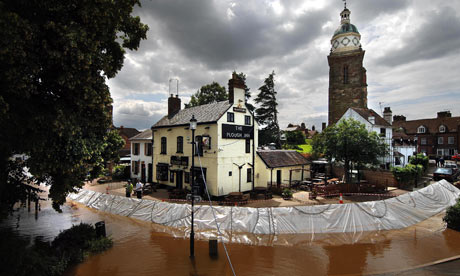
    Flood defences in summer 2007 at Upton on Severn, Worcestershire

    Flooding is the greatest threat to the UK posed by climate change, with up to 3.6 million people at risk by the middle of the century, according to a report published on Thursday by the environment department.

    The first comprehensive climate change risk assessment for the UK identifies hundreds of ways rising global temperatures will have an impact if no action is taken. They include the financial damage caused by flooding, which would increase to £2bn-£10bn a year by 2080, more deaths in heatwaves, and large-scale water shortages by mid-century.

    Unusually for such documents, it also highlighted ways in which the country could benefit from milder winters and drier summers, such as fewer cold-related deaths, better wheat crops and a more attractive climate for tourists.

    Lord John Krebs, chairman of the adaptation committee of the independent advisory group Committee on Climate Change, said that without planning and investment to deal with the threats the UK would “sleepwalk into disaster”. The benefits of climate change should also not be taken as reason to stop worrying about it, even with policies to reduce the threats, said Krebs: “Whether it will result in a net benefit we simply can’t tell.”

    Scientists and other experts, led by Defra, identified 700 impacts of climate change in the UK, including the possibility of refugees arriving from wars over dwindling water and food.

    High-impact events expected by mid-century included decreased forestation caused by red band needle blight, shortages in public water supply (especially in the north, Midlands and south of England), and worse water quality.

    The assessors selected the 100 most pressing threats and opportunities and rated these according to their impact, the confidence of the modellers, and how soon the threats might occur. All the report’s forecasts assume no governmental action to reduce or remove the threats.

    The four most immediate “high consequence” risks all concerned flooding, with the expectation that in 10 years or so there will be increased flood damage to homes, with knock-on effects on insurance premiums and mental health.

    Between 1.7 million and 3.6 million people are expected to be at risk of flooding by 2050, without investment to lessen the threat.

    Other issues highlighted by the report include changes in wildlife migration, alterations in species communities as plants and animals fail to move fast enough to thrive, sewer overflows polluting the coast, changes in the soil, erosion from heavier rains, loss of staff working-time from heat stress, changes in fish stocks, and wildfires in drier summers.

    Julian Hunt, emeritus professor of climate modelling, at University College London, said the report’s finding that there would be longer periods of “static weather” and cloud cover, could threaten solar and wind energyfrom solar and wind sourcesenergy.

    “This leads to dangerous urban heat island temperatures and droughts. But it also indicates the danger of lengthy, very low, wind conditions, or cloudy conditions – so low-carbon energy alternatives to wind and solar are essential,” said Hunt.

    Peter Mallaburn, reader in climate policy at De Montfort University, said the need to save energy was in conflict with government policies not pushing for higher energy efficiency standards for commercial buildings.

    “This report says, for the first time, that not only are our homes and offices leaky, but that they will start to overheat in a warmer world,” said Mallaburn. “We need a coherent strategy to sort out this mess. Let’s hope that this report acts as a wake-up call.”

    ul.shr-socials li.shareaholic { background-image: url(“http://planetextinction.com/blog/wp-content/uploads/shareaholic/spritegen/sprite.png”) ! important; }

  • Teetering on a tipping point: dangerous climate change in the Arctic

    Teetering on a tipping point: dangerous climate change in the Arctic

    We are seeing the first signs of dangerous climate change in the Arctic. This is our warning that humanity is facing a dire future. [From Carlos Duarte, http://theconversation.edu.au]

    The Arctic region is fast approaching a series of “tipping points” that could trigger an abrupt domino effect of large-scale climate change across the entire planet. The region contains arguably the greatest concentration of potential tipping elements.

    If set in motion, these can generate profound alterations which will place the Arctic not at the periphery, but at the core of the Earth system. There is evidence that these chain reactions have begun. This has major consequences not just for “nature”, but for the future of humankind as the changes progress.

    Research shows that the Arctic is now warming at three times the global average.

    For the whole report click here

  • EU nuclear waste disposal plans ‘not safe’ claim scientists.

    EU nuclear waste disposal plans ‘not safe’ claim scientists

    Emily Shelton

    16th September 2010

    Experts warn EU proposals for deep geological disposal of radioactive waste have ‘serious potential for something to go badly wrong’

    There are ‘serious flaws’ in the advice being given to EU ministers on disposing of nuclear waste deep underground, scientists have concluded.

    Geological disposal, where radioactive waste is buried in rock formations underground, is the preferred approach of a number of European countries, with potential sites having already been identified in Finland, Sweden and the UK, in Cumbria.

    However, scientists and environmentalists have revealed ‘serious flaws in the advice being given to the Commission’ and are calling for more research into alternative options.

    A major review of the science surrounding deep geological disposal, commissioned by Greenpeace, has highlighted numerous risks of failure which could result in highly radioactive waste being released into our groundwater or seas for centuries. Problems include: corrosion of containers; heat and gas formation leading to pressurisation and cracking of the storage chamber; unexpected chemical reactions; geological uncertainties; future ice ages, earthquakes and human interference.

    Report author Dr Helen Wallace says people need to ‘grasp the enormity of the challenge’.

    ‘We’re talking about trying to contain this waste for a greater amount of time than human beings have been living on the planet, so although [we] might be able to predict the consequences over a short time scale, that’s an enormous scientific challenge’.

    ‘This waste is extremely radioactive and very hot so it’s going to significantly change the water flow deep underground; the corrosion of materials and the repository will release large quantities of gas which have to escape somehow.’ She warned the waste will ‘remain dangerous for many generations’.

    Recent proposals from the EU’s Joint Research Centre (JRC) and the European ‘Implementing Geological Disposal’ Technology Platform (IGD-TP) claim there is a scientific consensus in support of deep geological disposal but Dr Wallace suggests this consensus is a ‘political rather than scientific one’.

    The EU Commission is expected to publish a draft nuclear waste plan this autumn with ambitions for the first geological disposal facilities for nuclear waste to be ready by 2025.

    Greenpeace is calling on EU leaders to look at alternatives, such as near surface or above ground storage or deep bore holes. Storing waste above ground was seen by Dr Wallace as the ‘least bad option’ because corrosion and leaking could be prevented.

    Useful links
    Greenpeace report ‘Rock Solid?’
    Vision Document of the European ‘Implementing Geological Disposal’ Technology Platform (IGD-TP)

  • The right’s climate denialism is part of something larger


    However! It does seem to me that the right’s climate denialism hasn’t been properly linked to the larger phenomenon of epistemic closure on the right. When Jim Manzi, everyone’s favorite sensible conservative, criticized fellow conservative Mark Levin for peddling intellectually shoddy skeptic arguments in his bestselling book Liberty and Tyranny, Levin went nuts, joined by a half-dozen other NRO writers. How could they not? The very same skeptic talking points in Levin’s book appear in thousands of blogs and comment sections across the interwebs. If they are intellectually bankrupt, a whole lot of people are going to look stupid.

    Regardless, to restrict discussion to climate science — how many scientists say what, who signed what statement, how many peer-reviewed papers say what — misses the forest for the trees. Climate denialism is part of something much broader and scarier on the right. The core idea is most clearly expressed by Rush Limbaugh:

    We really live, folks, in two worlds. There are two worlds. We live in two universes. One universe is a lie. One universe is an entire lie. Everything run, dominated, and controlled by the left here and around the world is a lie. The other universe is where we are, and that’s where reality reigns supreme and we deal with it. And seldom do these two universes ever overlap. …

    The Four Corners of Deceit: Government, academia, science, and media. Those institutions are now corrupt and exist by virtue of deceit. That’s how they promulgate themselves; it is how they prosper.

    The right’s project over the last 30 years has been to dismantle the post-war liberal consensus by undermining trust in society’s leading institutions. Experts are made elites; their presumption of expertise becomes self-damning. They think they’re better than you. They talk down to you. They don’t respect people like us, real Americans. Here’s Americans’ trust in institutions, also from Gallup data (click for larger version):

    Gallup: trust in institutions over time

    Of course the decline of trust in institutions is multi-causal, but the right’s relentless assault has certainly exacerbated matters. Here’s another graph to chill your blood, showing the only two institutions in which trust is rising:

    Gallup: trust in police and military

    (I was tipped off to these graphs by Chris Hayes, who has written about America’s institutional crisis and is working on a book on the subject, which I expect will be one of the big political books of 2011.)

    The decline in trust in institutions has generated fear and uncertainty, to which people generally respond by placing their trust in protective authorities. And some subset of people respond with tribalism, nationalism, and xenophobia. The right stokes and exploits modern anxiety relentlessly, but that’s not all they do. They also offer a space to huddle in safety among the like-minded. The conservative movement in America has created a self-contained, hermetically sealed epistemological reality — a closed-loop system of cable news, talk radio, and email forwards — designed not just as a source of alternative facts but as an identity. That’s why when you question climate skepticism you catch hell. You’re messing with who people are.

    Consider what the Limbaugh/Morano crowd is saying about climate: not only that that the world’s scientists and scientific institutions are systematically wrong, but that they are purposefully perpetrating a deception. Virtually all the world’s governments, scientific academies, and media are either in on it or duped by it. The only ones who have pierced the veil and seen the truth are American movement conservatives, the ones who found death panels in the healthcare bill.

    It’s a species of theater, repeated so often people have become inured, but if you take it seriously it’s an extraordinary charge. For one thing, if it’s true that the world’s scientists are capable of deception and collusion on this scale, a lot more than climate change is in doubt. These same institutions have told us what we know about health and disease, species and ecosystems, energy and biochemistry. If they are corrupt, we have to consider whether any of the knowledge they’ve generated is trustworthy. We could be operating our medical facilities, economies, and technologies on faulty theories. We might not know anything! Here we are hip-deep in postmodernism and it came from the right, not the left academics they hate.

    Scientific claims are now subject to ideological disputation. Rush Limbaugh is telling millions of people that they’ve taken the red pill and everything they once knew and could trust is a lie. They’ve woken up outside the Matrix and he is their corpulent, drug-addicted, thrice-divorced Morpheus. What could go wrong?


  • John James Newsletter No. 10

    John James Newsletter No. 10

    The Pentagon’s Strategy is Full Spectrum Dominance, from Asia to Africa
    Mikhail Gorbachev, 2009: “Unless we prevent weaponization of outer space, all talk about a nuclear-weapon-free world will be inconsequential rhetoric.” I recommend a careful and full reading of the following. It will take no more than 5 minutes, but will change your perspective.
    http://www.informationclearinghouse.info/article39516.htm
    The following graph makes the point.
    https://static.nationalpriorities.org/images/charts/2015/discretionary-desk.png

    The Dahiya Doctrine: Israel’s Intentional Mass Slaughter in Gaza
    A recent release by WikiLeaks founder Julian Assange shows brutal depths of Israeli policy towards Gaza. In Israel’s war planning, the Dahiya doctrine refers to Israel’s intentional and massive killing of civilians and destruction of civilian villages, the intentional disproportionate use of force constituting collective punishment of a population. Dahiya plan leaves no doubt, none, that it involves the knowing and intentional commission in carrying out of war crimes. The killing of civilians and destroying civilian infrastructure, whether in Lebanon then or Gaza today, is no mistake.
    http://www.informationclearinghouse.info/article39508.htm

    How Serious Is The California Drought?
    A picture paints a thousand words… but these 3 before-and-after images in California over the past 3 years
    http://www.zerohedge.com/news/2014-08-25/how-serious-california-drought

    Abbott’s RET Review panel calls for large-scale, solar schemes to close
    The RET Review panel has effectively rubber stamped the lobbying of the fossil fuel industry and called for the closure of Australia’s renewable energy target to new entrants as one of two options. It is also calling for the immediate closure of the small-scale renewable energy scheme, which supports rooftop solar and solar hot water. It also says it should be restricted to installations of less than 10kW – effectively cutting out the commercial-scale solar market.
    http://reneweconomy.com.au/2014/ret-review-panel-calls-for-large-scale-solar-schemes-to-close-39648
    Fears it will kill off the industry for decades to come
    http://reneweconomy.com.au/2014/bnef-ret-changes-to-cause-bankruptcies-kill-industry-for-decade-56425

    The next nail In The Petrodollar Coffin
    Gazprom begins accepting Yuan and Roubles for oil delivered via the Eastern Siberia-Pacific Ocean pipeline. Meaning Russia will export energy to either Europe or China, and receive payment in either Rubles or Yuan completely away from the US dollar, and thus for a Petrodollar-free world. Right now the use of the US dollar in trade creates a huge demand for the American currency. If countries were to begin trading in other currencies, that demand would wane and possibly reverse as countries begin selling their dollars.
    http://www.informationclearinghouse.info/article39533.htm

  • Upper atmosphere shrinking say scientists


    “Our work demonstrates that the solar cycle not only varies on the typical 11-year time scale, but also can vary from one solar minimum to another,” said study lead author Stanley Solomon.

    A narrower, less dense thermosphere is good news for satellites orbiting Earth, including the International Space Station, since reduced friction means they can remain aloft longer, said University of Colorado professor and study co-author Thomas Woods.

    “This is good news for those satellites that are actually operating, but it is also bad because of the thousands of non-operating objects (debris) remaining in space that could potentially have collisions with our working satellites,” he added.

    Professor Woods said the research shows the sun could be going through a period of relatively low activity, as it did in the early 19th and 20th centuries.

    “If it is indeed similar to certain patterns in the past, then we expect to have low solar cycles for the next 10 to 30 years,” he added.