Category: General news

Managing director of Ebono Institute and major sponsor of The Generator, Geoff Ebbs, is running against Kevin Rudd in the seat of Griffith at the next Federal election. By the expression on their faces in this candid shot it looks like a pretty dull campaign. Read on

  • The Sermilik Fjord in Greenland: a chilling view of a warming world


    This is also the season for science in Greenland. Glaciologists, seismologists and climatologists from around the world are landing on the ice sheet in helicopters, taking ice-breakers up its inaccessible coastline and measuring glaciers in a race against time to discover why the ice in Greenland is vanishing so much faster than expected.

    Gordon Hamilton, a Scottish-born glaciologist from the University of Maine’s Climate Change Institute, is packing up equipment at his base camp in Tasiilaq, a tiny, remote east coast settlement only accessible by helicopter and where huskies howl all night.

    With his spiky hair and ripped T-shirt, Hamilton could be a rugged glaciologist straight from central casting. Four years ago he hit upon the daring idea of landing on a moving glacier in a helicopter to measure its speed.

    The glaciers of Greenland are the fat, restless fingers of its vast ice sheet, constantly moving, stretching down into fjords and pushing ice from the sheet into the ocean, in the form of melt water and icebergs.

    Before their first expedition, Hamilton and his colleague Leigh Stearns, from the University of Kansas, used satellite data to plan exactly where they would land on a glacier.

    “When we arrived there was no glacier to be seen. It was way up the fjord,” he says. “We thought we’d made some stupid goof with the co-ordinates, but we were where we were supposed to be.” It was the glacier that was in the wrong place. A vast expanse had melted away.

    When Hamilton and Stearns processed their first measurements of the glacier’s speed, they thought they had made another mistake. They found it was marching forwards at a greater pace than a glacier had ever been observed to flow before. “We were blown away because we realised that the glaciers had accelerated not just by a little bit but by a lot,” he says. The three glaciers they studied had abruptly increased the speed by which they were transmitting ice from the ice sheet into the ocean.

    Raw power

    Standing before a glacier in Greenland as it calves icebergs into the dark waters of a cavernous fjord is to witness the raw power of a natural process we have accelerated but will now struggle to control.

    Greenland’s glaciers make those in the Alps look like toys. Grubby white and blue crystal towers, cliffs and crevasses soar up from the water, dispatching millenniums of compacted snow in the shape of seals, water lilies and bishops’ mitres.

    I take a small boat to see the calving with Dines Mikaelsen, an Inuit guide, who in the winter will cross the ice sheet in his five-metre sled pulled by 16 huskies.

    It is not freezing but even in summer the wind is bitingly cold and we can smell the bad breath of a humpback whale as it groans past our bows on Sermilik Fjord. Above its heavy breathing, all you can hear in this wilderness is the drip-drip of melting ice and a crash as icebergs cleave into even smaller lumps, called growlers.

    Mikaelsen stops his boat beside Hann glacier and points out how it was twice as wide and stretched 300 metres further into the fjord just 10 years ago. He also shows off a spectacular electric blue iceberg.

    Locals have nicknamed it “blue diamond”; its colour comes from being cleaved from centuries-old compressed ice at the ancient heart of the glacier. Bobbing in warming waters, this ancient ice fossil will be gone in a couple of weeks.

    The blue diamond is one vivid pointer to the antiquity of the Greenland ice sheet. A relic of the last Ice Age, this is one of three great ice sheets in the world. Up to two miles thick, the other two lie in Antarctica.

    While similar melting effects are being measured in the southern hemisphere, the Greenland sheet may be uniquely vulnerable, lying much further from the chill of the pole than Antarctica’s sheets. The southern end of the Greenland sheet is almost on the same latitude as the Shetlands and stroked by the warm waters of the Gulf Stream.

    Driven by the loss of ice, Arctic temperatures are warming more quickly than other parts of the world: last autumn air temperatures in the Arctic stood at a record 5C above normal. For centuries, the ice sheets maintained an equilibrium: glaciers calved off icebergs and sent melt water into the oceans every summer; in winter, the ice sheet was then replenished with more frozen snow. Scientists believe the world’s great ice sheets will not completely disappear for many more centuries, but the Greenland ice sheet is now shedding more ice than it is accumulating.

    The melting has been recorded since 1979; scientists put the annual net loss of ice and water from the ice sheet at 300-400 gigatonnes (equivalent to a billion elephants being dropped in the ocean), which could hasten a sea level rise of catastrophic proportions.

    As Hamilton has found, Greenland’s glaciers have increased the speed at which they shift ice from the sheet into the ocean. Helheim, an enormous tower of ice that calves into Sermilik Fjord, used to move at 7km (4.4 miles) a year. In 2005, in less than a year, it speeded up to nearly 12km a year. Kangerdlugssuaq, another glacier that Hamilton measured, tripled its speed between 1988 and 2005. Its movement – an inch every minute – could be seen with the naked eye.

    The three glaciers that Hamilton and Stearns measured account for about a fifth of the discharge from the entire Greenland ice sheet. The implications of their acceleration are profound: “If they all start to speed up, you could have quite a large rise in sea level in the near term, much larger than the official estimate by the Intergovernmental Panel on Climate Change (IPCC) would project,” says Hamilton.

    The scientific labours in the chill winds and high seas of the Arctic summer seem wrapped in an unusual sense of urgency this year. The scientists working in Greenland are keen to communicate their new, emerging understanding of the dynamics of the declining ice sheet to the wider world. Several point out that any international agreement forged at the UN climate change conference in Copenhagen in December will be based on the IPCC’s fourth assessment report from 2007. Its estimates of climate change and sea-level rise were based on scientific research submitted up to 2005; the scientists say this is already significantly out of date.

    The 2007 report predicted a sea level rise of 30cm-60cm by 2100, but did not account for the impact of glaciers breaking into the sea from areas such as the Greenland ice sheet. Most scientists working at the poles predict a one metre rise by 2100. The US Geological Survey has predicted a 1.5 metre rise. As Hamilton points out: “It is only the first metre that matters”.

    Record temperatures

    A one metre rise – with the risk of higher storm surges – would require new defences for New York, London, Mumbai and Shanghai, and imperil swaths of low-lying land from Bangladesh to Florida. Vulnerable areas accommodate 10%of the world’s population – 600 million.

    The Greenland ice sheet is not merely being melted from above by warmer air temperatures. As the oceans of the Arctic waters reach record high temperatures, the role of warmer water lapping against these great glaciers is one of several factors shaping the loss of the ice sheet that has been overlooked until recently.

    Fiamma Straneo, an Italian-born oceanographer, is laboriously winding recording equipment the size of a fire extinguisher from the deck of a small Greenpeace icebreaker caught in huge swells at the mouth of Sermilik fjord.

    In previous decades the Arctic Sunrise has been used in taking direct action against whalers; now it offers itself as a floating research station for independent scientists to reach remote parts of the ice sheet. It is tough work for the multinational crew of 30 in this rough-and-ready little boat, prettified below deck with posters of orang-utans and sunflowers painted in the toilets.

    Before I succumb to vomiting below deck – another journalist is so seasick they are airlifted off the boat – I examine the navigational charts used by the captain, Pete Willcox, a survivor of the sinking of the Rainbow Warrior in 1985. He shows how they are dotted with measurements showing the depth of the ocean but here, close to the east coast of Greenland, the map is blank: this part of the North Atlantic was once covered by sea ice for so much of the year that its waters are still uncharted.

    Earlier in the expedition, the crew believe, they became the first boat to travel through the Nares Strait west of Greenland to the Arctic Ocean in June, once impassable because of sea ice at that time of year. The predicted year when summers in the Arctic would be free of sea ice has fallen from 2100 to 2050 to 2030 in a couple of years.

    Jay Zwally, a Nasa scientist, recently suggested it could be virtually ice-free by late summer 2012. Between 2004 and 2008 the area of “multiyear” Arctic sea ice (ice that has formed over more than one winter and survived the summer melt) shrank by 595,000 sq miles, an area larger than France, Germany and the United Kingdom combined.

    Undaunted by the sickening swell of the ocean and wrapped up against the chilly wind, Straneo, of Woods Hole Oceanographic Institution, one of the world’s leading oceanographic research centres, continues to take measurements from the waters as the long Arctic dusk falls.

    According to Straneo, the rapid changes to the ice sheet have taken glaciologists by surprise. “One of the possible mechanisms which we think may have triggered these changes is melting driven by changing ocean temperatures and currents at the margins of the ice sheet.”

    She has been surprised by early results measuring sea water close to the melting glaciers: one probe recovered from last year recorded a relatively balmy 2C at 60 metres in the fjord in the middle of winter. Straneo said: “This warm and salty water is of subtropical origin – it’s carried by the Gulf Stream. In recent years a lot more of this warm water has been found around the coastal region of Greenland. We think this is one of the mechanisms that has caused these glaciers to accelerate and shed more ice.”

    Straneo’s research is looking at what scientists call the “dynamic effects” of the Greenland ice sheet. It is not simply that the ice sheet is melting steadily as global temperatures rise. Rather, the melting triggers dynamic new effects, which in turn accelerate the melt.

    “It’s quite likely that these dynamic effects are more important in generating a near-term rapid rise in sea level than the traditional melt,” says Hamilton. Another example of these dynamic effects is when the ice sheet melts to expose dirty layers of old snow laced with black carbon from forest fires and even cosmic dust. These dark particles absorb more heat and so further speed up the melt.

    After Straneo gathers her final measurements, the Arctic Sunrise heads for the tranquillity of the sole berth at Tasiilaq, which has a population of fewer than 3,000 but is still the largest settlement on Greenland’s vast east coast. Here another scientist is gathering her final provisions before taking her team camping on a remote glacier.

    Invisible earthquakes

    Several years ago Meredith Nettles, a seismologist from Colombia University, and two colleagues made a remarkable discovery: they identified a new kind of earthquake. These quakes were substantial – measuring magnitude five – but had been invisible because they did not show up on seismographs. (While orthodox tremors registered for a couple of seconds, these occurred rather more slowly, over a minute.)

    The new earthquakes were traced almost exclusively to Greenland, where they were found to be specifically associated with large, fast-flowing outlet glaciers. There have been 200 of them in the last dozen years; in 2005 there were six times as many as in 1993.

    Nettles nimbly explains the science as she heaves bags of equipment on to a helicopter, which will fly her to study Kangerdlugssuaq glacier. “It’s quite a dramatic increase, and that increase happened at the same time as we were seeing dramatic retreats in the location of the calving fronts of the glaciers, and an increase in their flow speed,” she says. “The earthquakes are very closely associated with large-scale ice loss events.”

    In other words, the huge chunks of ice breaking off from the glaciers and entering the oceans are large enough to generate a seismic signal that is sent through the Earth. They are happening more regularly and, when they occur, it appears that the glacier speeds up even more.

    The scientists rightly wrap their latest observations in caution. Their studies are still in their infancy. Some of the effects they are observing may be short-term.

    The Greenland ice sheet has survived natural warmer periods in history, the last about 120,000 years ago, although it was much smaller then than it is now. Those still sceptical of the scientific consensus over climate change should perhaps listen to the voices of those who could not be accused of having anything to gain from talking up climate change.

    Inuit warnings

    Arne Sorensen, a specialist ice navigator on Arctic Sunrise, began sailing the Arctic in the 1970s. Journeys around Greenland’s coast that would take three weeks in the 1970s because of sea ice now take a day. He pays heed to the observations of the Inuit. “If you talk to people who live close to nature and they tell you this is unusual and this is not something they have noticed before, then I really put emphasis on that,” he says. Paakkanna Ignatiussen, 52, has been hunting seals since he was 13. His grandparents travelled less than a mile to hunt; he must go more than 60 miles because the sea ice disappears earlier – and with it the seals. “It’s hard to see the ice go back. In the old days when we got ice it was only ice. Today it is more like slush,” he says. “In 10 years there will be no traditional hunting. The weather is the reason.”

    The stench of rotting seal flesh wafts from a bag in the porch of his house in Tasiilaq as Ignatiussen’s wife, Ane, remarks that, “the seasons are upside down”.

    Local people are acutely aware of how the weather is changing animal behaviour. Browsing the guns for sale in the supermarket in Tasiilaq (you don’t need a licence for a gun here), Axel Hansen says more hungry polar bears prowl around the town these days. Like the hunters, the bears can’t find seals when there is so little sea ice. And the fjords are filled with so many icebergs that local people find it hard to hunt whales there.

    Westerners may shrug at the decline of traditional hunting but, in a sense, we all live on the Greenland ice sheet now. Its fate is our fate. The scientists swarming over this ancient mass of ice, trying to understand how it will be transformed in a warming world, and how it will transform us, are wary of making political comments about how our leaders should plan for one metre of sea level rise, and what drastic steps must be taken to cut carbon emissions. But some scientists are so astounded by the changes they are recording that they are moved to speak out.

    What, I ask Hamilton, would he say to Barack Obama if he could spend 10 minutes with the US president standing on Helheim glacier?

    “Without knowing anything about what is going on, you just have to look at the glacier to know something huge is happening here,” says the glaciologist. “We can’t as a scientific community keep up with the pace of changes, let alone explain why they are happening.

    “If I was, God forbid, the leader of the free world, I would implement some changes to deal with the maximum risk that we might reasonably expect to encounter, rather than always planning for the minimum. We won’t know the consequences of not doing that until it’s way too late. Even as a politician on a four-year elected cycle, you can’t morally leave someone with that problem.”
  • Turning charcoal into carbon gold

    Turning charcoal into Carbon Gold


    A chocolate maker and music promoter aim to create a £1bn biochar industry, in a controversial effort to fight climate change


    In a patch of woodland on the outskirts of Hastings, on the English south coast, a group of men huddle around a brick laboratory as smoke curls from its two chimneys. The men are trying, with some chemical trickery, to bring a lucrative piece of South America to Sussex, to spark what they believe could be a £1bn industry in Britain.


    The business is controversial. Some maintain it should be outlawed, and others say that only full-scale legalisation would control the risks. Until the fuss dies down, the men have decided to bury the powder they make in a nearby field.


    Craig Sams, a millionaire chocolate maker, and Dan Morrell, a former music promoter and entrepreneur, are producing charcoal, and their aim is to get rich by selling it to tackle global warming.


    Together Sams and Morrell make Carbon Gold, a company they have set up to exploit the growing interest in green solutions to climate change. The brick laboratory is, they claim, Britain’s first dedicated facility to produce biochar, which is what you call charcoal when you are selling it as a solution to global warming.


    Their idea is a low-tech take on the futuristic concept of carbon capture and storage. Carbon, in the form of wood from trees and agricultural waste, can be turned to charcoal and buried in the ground, so storing it away from the atmosphere. If enough carbon can be buried in this way, then it could bolster so-far feeble global attempts to address climate change through cuts greenhouse gas emissions.


    Making and burying biochar to help reduce carbon levels in the atmosphere has some heavy green backing, including scientist and author James Lovelock and Jim Hansen of Nasa. The journal Nature Reports Climate Change said that biochar “could be the closest contender yet for a silver-bullet solution to climate change“.


    But it also has some high profile critics. Writing in this newspaper in March, George Monbiot said: “The idea that biochar is a universal solution that can be safely deployed on a vast scale is as misguided as Mao Zedong’s Great Leap Backwards.” He added: “According to the magical thinkers who promote it, the new miracle stops climate breakdown, replaces gas and petroleum, improves the fertility of the soil, reduces deforestation, cuts labour, creates employment, prevents respiratory disease and ensures that when you drop your toast it always lands butter side up.”


    Good idea or bad, if Sams and Morrell have their way, green consumers who want to offset the damaging emissions from their flights or cars will soon be able to pay Carbon Gold to make biochar on their behalf. Within weeks, the company expects to be approved by the offset industry’s unofficial watchdog. Bigger markets could follow: the firm is among those lobbying for biochar credits to be included in the UN’s clean development mechanism – a global carbon trading scheme used by countries such as Britain to meet ambitious carbon targets. A decision could be made as soon as December, at key climate talks in Copenhagen.


    Morrell, who founded Future Forests, which later became the Carbon Neutral Company, said: “Biochar is the only technology that enables us to take invisible carbon dioxide out of the atmosphere, transform it into black lumps of pure carbon and, by ploughing it into the soil, prevent it from going back into the atmosphere.”


    He added: “We don’t want to clear-cut woodland and turn it to dust. That’s slightly alarmist. We’re not saying this is the answer to global warming, but I don’t see why it can’t be one of a suite of solutions.”


    The duo’s biochar facility runs on wood from surrounding trees, part of a woodland owned by Sams. By lighting a fire in a chamber beneath and fiddling with the way air flows through the device, the team says it can convert about a third of the carbon locked in the wood to charcoal in 24 hours. The wood part burns and is part baked, in a process called pyrolysis.


    Biochar is not emissions free – the rest of the carbon from the wood goes up in smoke, but Morrell says it is better for the climate than burning or leaving it to rot, which can produce methane. He says their primary targets are large agricultural sites such as vineyards and olive producers, which have large amounts of waste cuttings.


    Under Carbon Gold’s business model, the firm would supply the technology to farmers and others, and take a cut of the valuable carbon credits generated by each tonne of carbon they store. It is already working on a similar project in Belize.


    “It’s almost like a franchise,” says Sams, a founder of Green and Black’s chocolate and former chair of the Soil Association. “It’s the same principle as McDonalds,” he adds, then wishes he hadn’t.


    Morrell’s answer to the critics of biochar is a rule book produced by the company that is currently being considered by the Voluntary Carbon Standard, which regulates carbon offsets. Morrell says it includes safeguards to make sure wood and other feedstocks used are sustainable, as well as to preserve biodiversity and to give work to local people. “Of course it will be easier to just clear cut forest, but we think we can set the bar high enough to keep those people out.”


    There could be other benefits too, he says. Biochar could help make more soil productive, because it offers a surface for bugs to thrive. Charcoal mixed into the ground by Indian tribes centuries ago is often credited for the acclaimed rich and dark terra preta soils of the Amazon basin. If benefits can be proven, and Carbon Gold says local soil scientists are investigating, then biochar could perhaps claim extra carbon credits based on reduced fertiliser use. Sams is already experimenting with charcoal sprayed and ploughed onto a field next to the Sussex woodland.


    Mike Childs, climate campaigner with Friends of the Earth, said: “The problems with biochar are largely the same as biofuel. If you manage it properly then making limited amounts is OK, sensible and useful. But there is massive pressure on forests for land and protecting ecosystems, and the potential to produce lots [of biochar] comes up against those pressures. In the short term it is not the answer to climate change.”

  • Bottled water bumps up parliament’s carbon footprint

    Bottled water bumps up parliament’s carbon footprint


    A report commissioned by Commons authorities into the Houses of Parliament’s use of bottled water found that it uses over 21,000 bottles of water each year, resulting in a carbon footprint of 12 tonnes. From BusinessGreen.com, part of the Guardian Environment Network


    Bottled water

    Parliament uses 21,000 bottles of water each year, resulting in a carbon footprint of 12 tonnes. Photograph: Bruno Vincent/Getty Images


    A report commissioned by Commons authorities into the Houses of Parliament’s use of bottled water found that it uses over 21,000 bottles of water each year, resulting in a carbon footprint of 12 tonnes.


    The study, carried out by environmental consultants Best Foot Forward, was not published but was leaked to the Evening Standard.


    It revealed that each year 10,000 bottles of sparkling and 11,400 bottles of still water are used in Parliament, while the associated delivery lorries have clocked up more than 70,000 miles over five years.


    A blog posting by Best Foot Forward confirmed the findings of the report.


    “The study, which quantifies the life cycle emissions of several different options, found that bottled water performed the worst – and that savings of 11tCO2 per year were possible through a switch to tap water,” it said.


    However, the Commons Administration Committee controversially decided last year that it would offer only bottled water in meetings.


    The revelations will be especially damaging to MPs, some of whom have campaigned against bottled water.


    Last year, government minister Phil Woolas told the BBC that consumers should switch from bottled to tap water whereever possible. “It borders on morally being unacceptable to spend hundreds of millions of pounds on bottled water when we have pure drinking water, when at the same time one of the crises that is facing the world is the supply of water,” he said.


    US studies have found the total energy required for bottled water production was as much as 2,000 times the energy cost of producing tap water.


    • This article was shared by our content partner BusinessGreen.com, part of the Guardian Environment Network

  • The Business and Politics of Carbon

    August 13, 2009
    The Business and Politics of Carbon
    by Alison Wise, National Renewable Energy Lab
    The activity around making markets for carbon continues to grow as climate issues gain more traction in the policy realm under a new administration. For those who are not up to speed on the ins and outs of carbon markets in general, I would refer them to the last time I wrote about the issue, a link to which can be found at the end of this article.


    This time around I will focus on the business case for carbon offsetting and on the treatment of carbon in the Waxman-Markey legislation currently being debated in Congress. Broadly speaking, voluntary carbon markets refer to the markets for carbon credits outside the scope of regulated carbon reduction. They are driven by businesses and organizations that pay a third party to make a measurable reduction in greenhouse gas emissions (usually CO2) though they have no legal requirement to do so. This reduction “offsets” the organization’s current carbon footprint, “crediting” it with the equivalent reduction.
    Until legislation mandates some sort of action towards carbon mitigation, whether a cap and trade mechanism or a carbon tax, there is no compliance market for carbon nationally in the United States. According to a recent report by New Energy Finance, the value of the transactions in the voluntary carbon market globally has doubled in the past two years, increasing from US $335 million in 2007 to $705 million in 2008.
    It is interesting to dig a bit deeper into why these voluntary markets are growing despite having no compliance mechanisms. Ultimately, a regulated market for carbon based on mandatory parameters may be the most effective, but in the interim there has been increasing involvement with voluntary carbon markets, with the drivers coming from the private sector. The New Energy Finance report outlines some interesting findings for the “business case” for carbon off-setting:
    First, New Energy Finance identified 3,000 organizations that were end-buyers of voluntary carbon offsets. This number was seen as “significant” given the industry’s common characterization as a “fringe” entity.
    The greatest business benefit from carbon offsetting is the protection or enhancement of corporate reputation, according to those surveyed in the New Energy Finance report. This is interesting in light of the fact that one of the drivers for sustainability measures within corporations in general is risk mitigation. Companies have reported that a motivating factor for adopting sustainability principles is the protection or enhancement of brand value, an intangible asset that all companies need to protect. It seems that this motivation applies to carbon offsetting as well.
    While a business case can be made for carbon offsetting, it was not the only reason for engaging in that activity. According to their respondents, 15% of those companies New Energy Finance surveyed said that offsetting their emissions was driven by the desire to be a good corporate citizen (that said, one could argue that being a good corporate citizen inherently protects your brand’s reputation, which is good for the bottom line).
    Surprisingly, carbon offsetting activity did not positively impact employee morale in any significant way. In fact, employees were confused about how carbon offsets worked and why it was beneficial to engage in this activity.
    Finally, given the “scale and diversity” of offset users, New Energy Finance predicted that the voluntary carbon market will continue to grow, once the global recession is over.
    While the voluntary carbon market is an important transitional step toward an economy that captures the true cost of a carbon intensive energy system, it will most likely take some sort of regulatory approach to accelerate the internalization of carbon externalities in the marketplace. So, let’s turn to the most prevalent legislative mechanism that is seeking to accomplish that end: The Waxman-Markey Clean Energy Bill (H.R.2454), otherwise known as the American Clean Energy and Security Act of 2009 (ACES Act).
    According to many spectators and participants, this bill represents a demonstrable move towards the United States adopting clear, identifiable carbon reductions. That said, according to those involved with the clean energy industry, there are many challenges to be met in terms of decision-makers crafting a piece of legislation that would effectively address the carbon issue, in turn accelerating the markets for energy efficiency and renewable energy.
    Tim Greeff, political director at the Clean Economy Network, puts it this way, “While there are many important provisions in the legislation that will help facilitate a more rapid transition to the deployment of cleaner technologies, the legislation faces a substantial hurdle in the Senate. As it stands now, there are well over a dozen Senators who have significant concerns with different provisions of the bill and are not convinced of its benefits for clean energy, jobs and the economy. ”
    The bill outlines a cap and trade mechanism for greenhouse gas emissions reduction, aiming to decrease emissions by 17% by 2020. However, the cap and trade program being designed within this legislation would give away 81% of allowances for free, as opposed to the cap and trade program advocated by the White House which would auction off the allowances and use the proceeds for clean energy investments and a tax cut for the underprivileged. Other aspects of the legislation:
    The bill allocates 36% of allowances to the power generation sector through 2025
    Auctioned volumes would increase dramatically after 2025, rising from 19% to 65% by 2030. Beginning at a low auction rate would allow covered entities (the power sector) time for the technological transition they will need to make in a carbon constrained economy
    The legislation would ease restrictions on offset usage to reduce compliance costs. After 2017, it would remove an 80% offset discount factor for international offsets and allow increased international offset usage to compensate for domestic shortages of offsets when domestic prices are less than or equal to allowance prices
    The bill relaxes criteria for inclusion in the early offset supply pool to broaden the scope of eligible programs beyond the Climate Action Registry and the Regional Greenhouse Gas Initiative (this may address some of the shortage issues of domestic offsets)
    Getting the program and the price right in this new approach to carbon mitigation will be key to making sure that we are creating the right landscape for accelerating markets for renewables, efficiency services and technology. The internalization of carbon costs into our economic infrastructure will be important for creating the right market environment for the uptake of renewables, perhaps as important as the creation of a smart grid to be able to integrate distributed generation beyond niche applications. But that’s a story for another day.

  • Nile Delta: ‘We are going underwater. The sea will conquer our lands’

    Nile Delta: ‘We are going underwater. The sea will conquer our lands’


    The Nile Delta is under threat from rising sea levels. Without the food it produces, Egypt faces catastrophe


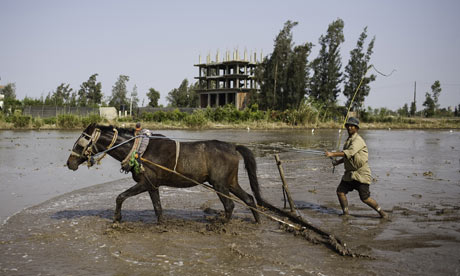
    A farmer ploughs his rice paddy in the Delta

    A farmer ploughs his rice paddy in the Delta. Photograph: Jason Larkin


    Maged Shamdy’s ancestors arrived on the shores of Lake Burrulus in the mid-19th century. In the dusty heat of Cairo at the time, French industrialists were rounding up forced labour squads to help build the Suez Canal, back-breaking labour from which thousands did not return. Like countless other Egyptians, the Shamdys abandoned their family home and fled north into the Nile Delta, where they could hide within the marshy swamplands that fanned out from the great river’s edge.


    As the years passed, colonial rulers came and went. But the Shamdys stayed, carving out a new life as farmers and fishermen on one of the most fertile tracts of land in the world. A century and a half later, Maged is still farming his family’s fields. In between taking up the rice harvest and dredging his irrigation canals, however, he must contemplate a new threat to his family and livelihood, one that may well prove more deadly than any of Egypt‘s previous invaders. “We are going underwater,” the 34-year-old says simply. “It’s like an occupation: the rising sea will conquer our lands.”


    Maged understands better than most the menace of coastal erosion, which is steadily ingesting the edge of Egypt in some places at an astonishing rate of almost 100m a year. Just a few miles from his home lies Lake Burrulus itself, where Nile flower spreads all the way out to trees on the horizon. Those trunks used to be on land; now they stand knee-deep in water.


    Maged’s imperial imagery may sound overblown, but travel around Egypt’s vast, overcrowded Delta region and you hear the same terms used time and again to describe the impact climate change is having on these ancient lands. Egypt’s breadbasket is littered with the remnants of old colonisers, from the Romans to the Germans, and today its 50 million inhabitants jostle for space among the crumbling forts and cemeteries of those who sought to subjugate them in the past.


    On the Delta’s eastern border, in Port Said, an empty stone plinth is all that remains of a statue of Ferdinand de Lesseps, the man who built the Suez Canal; somewhere along the Delta’s westernmost reaches, the long-lost tomb of Cleopatra lies buried. With such a rich history of foreign rule, it’s only natural that the latest hostile force knocking at the gates should be couched in the language of occupation.


    “Egypt is a graveyard for occupiers,” observes Ramadan el-Atr, a fruit farmer near the antiquated town of Rosetta, where authorities have contracted a Chinese company to build a huge wall of concrete blocks in the ocean to try to save any more land from melting away. “Just like the others, the sea will come and go – but we will always survive.”


    Scientists aren’t so sure. Two years ago, the Intergovernmental Panel on Climate Change declared Egypt’s Nile Delta to be among the top three areas on the planet most vulnerable to a rise in sea levels, and even the most optimistic predictions of global temperature increase will still displace millions of Egyptians from one of the most densely populated regions on earth.


    The Delta spills out from the northern stretches of the capital into 10,000 square miles of farmland fed by the Nile’s branches. It is home to two-thirds of the country’s rapidly growing population, and responsible for more than 60% of its food supply: Egypt relies unconditionally on it for survival. But with its 270km of coastline lying at a dangerously low elevation (large parts are between zero and 1m above sea level, with some areas lying below it), any melting of the polar ice caps could see its farmland and cities – including the historical port of Alexandria – transformed into an ocean floor. A 1m rise in the sea level, which many experts think likely within the next 100 years, will cause 20% of the Delta to go underwater. At the other extreme, the 14m rise that would result from the disappearance of Greenland and western Antarctica would leave the Mediterranean lapping at the northern suburbs of Cairo, with practically all of the Delta underwater.


    Already, a series of environmental crises are parking themselves on the banks of the Nile. Some are subtle, like the river’s quiet vanishing act in the Delta’s northern fields; others, like the dramatic collapse of coastal lands into the ocean, are more striking. Major flooding is yet to become a reality but, from industrial pollution to soil salinity, a whole new set of interconnected green concerns is now forcing its way into Egyptian public discourse for the first time.


    “The Delta is a kind of Bangladesh story,” says Dr Rick Tutwiler, director of the American University in Cairo’s Desert Development Centre. “You’ve got a massive population, overcrowding, a threat to all natural resources from the pressure of all the people, production, pollution, cars and agricultural chemicals. And on top of all that, there’s the rising sea. It’s the perfect storm.”


    Follow the Nile north out of Cairo on the old agricultural road, and you find it hard to pinpoint where the city ends and the lotus-shaped Delta begins. Carpeted with redbrick apartment blocks and spliced with streets in every direction, the lush greenery of the Nile’s splintered arteries is almost impossible to appreciate in isolation. This is where the urban and the rural get lost in each other, with livestock living in doorways and workers camping out in fields. In the past, literary giants venerated the Delta’s wild marshlands; today, any clear-cut divisions between the metropolis and the countryside have long faded away.


    Urban encroachment – the steady chipping away at arable land through unauthorised construction – haunts the Delta everywhere you look. Despite a web of legislation outlawing illegal building practices and theoretically “fencing off” agricultural land, in every direction the sweeping vista of wheat fields and rice paddies always ends abruptly in a cluster of half-built homes. There are more than 4,000 people per square mile in the Delta; it’s hard to think of any other place where humans and the environment around them are more closely intertwined. With Egypt’s present-day population of 83 million set to increase to more than 110 million in the next two decades, the seemingly unstoppable spread of bricks and mortar over the soil is both the most visible symptom of the country’s demographic time-bomb and an inevitable response to it.


    More people in the Delta means more cars, more pollution and less land to feed them all on, just at a time when increased crop production is needed most. Yet the desertification of land through human habitation is, worryingly, only the beginning of the problem. Although few in the Delta have noticed it yet, the freshwater of the Nile – which has enabled Egypt to survive as a unified state longer than any other territory on earth – is creaking under the strain of this population boom. The world’s most famous river has provided the backdrop to all manner of dramas throughout history, real and fictional. Now, around its northernmost branches where the minarets and pylons thin out and the landscape becomes more windswept, another is playing out to devastating effect.


    The villain is salinity. I visit one of the worst-affected regions, Kafr el-Sheikh, on a Friday morning when the fields have emptied out for the noon prayer. The streets are eerily silent; with its people gone, the area takes on the appearance of one of Italo Calvino’s fantastical string cities, chock-a-block with the shells of human habitation but no living souls remaining. The exception is Maged, who owns six feddan (about six acres) of land near the village of el-Hadadi.


    Maged is halfway down a hole when I approach his house. Clambering out apologetically, he explains that German experts visited this area last year and declared that the fresh water being pumped to local villages “wasn’t fit for a dog to drink”. After months of phone calls to the national water company, none of which were answered, Maged decided to lay down a new set of pipes himself in the hope it would improve the quality of drinking water for his two young daughters. It’s hot, exhausting work, which he fits in between his farming duties and a new part-time job as an accountant in a local alfalfa plant. “We don’t have much time on our hands at the moment,” Maged says, dusting himself off and gulping down some fresh melon juice. “Nobody can make a living solely off the land any more.”


    On a tour of his fields, I see why. The rich brown soil has greyed out in recent years, leaving a barren salt-encrustation on the surface. The cause is underground saltwater intrusion from the nearby coast, which pushes up through the soil and kills off roots. Coastal farmland has always been threatened by saltwater, but salinity has traditionally been kept at bay by plentiful supplies of fresh water gushing over the soil and flushing out the salt. It used to happen naturally with the Nile’s seasonal floods; after the construction of Egypt’s High Dam in the 70s (one of the most ambitious engineering projects on earth), these seasonal floods came to an end, but a vast network of irrigation canals continued to bring gallons of fresh water to the people who worked the land, the fellahin, ensuring salinity levels remained low.


    Today, however, Nile water barely reaches this corner of the Delta. Population growth has sapped its energy upstream, and what “freshwater” does make it downriver is increasingly awash with toxins and other impurities. Farmers such as Maged now essentially rely on waste water – a mix of agricultural drainage and sewage – from the nearby town of Sidi Salim.


    The result is plummeting fertility; local farmers say that whereas their fathers spent just a handful of Egyptian pounds on chemicals to keep the harvests bountiful, they now have to put aside between 25 and 80% of their profits for fertilisers just to keep their crops alive.


    “We can see with our own eyes that the water is no good, it’s less and less pure,” Maged says. He points out huge swaths of neighbouring land that once glimmered with rice paddies; recently they have been dug up and replaced by fish farms, the ground too barren for crop cultivation. Further out, in the village of Damru, the green fields of 10 years ago are cracked and brown, now put into service as informal football pitches and rubbish dumps.


    Experts believe the problem is only going to get worse. “We currently have a major water deficit in Egypt, with only 700 cubic metres of freshwater per person,” explains Professor Salah Soliman of Alexandria University. “That’s already short of the 1,000 cubic metres per person the UN believes is the minimum needed for water security. Now, with the population increase, it will drop to 450 cubic metres per person – and this is all before we take into account the impact of climate change.”


    That impact is likely to be a 70% drop in the amount of Nile water reaching the Delta over the next 50 years, due to increased evaporation and heavier demands on water use upstream. The consequences of all these ecological changes on food production are staggering: experts at Egypt’s Soils, Water and Environment Research Institute predict that wheat and maize yields could be down 40% and 50% respectively in the next 30 years, and that farmers who make a living off the land will lose around $1,000 per hectare for each degree rise in the average temperature.


    The farmers here feel abandoned by the state; there are regular dismissive references to the “New Age”, a euphemism for the much-hated regime of President Hosni Mubarak, whose neoliberal reform programmes and widespread corruption scandals have provoked a wave of popular discontent across the country. This disconnect between the state and its people has led to distrust of government scientists who think coastal erosion, rather than freshwater scarcity, is the main reason for the farmers’ problems. And, in a worrying twist for Egypt’s creaking economy, the erosion isn’t only affecting farmers. “Unfortunately, most of our industry and investment has been built on sites very close to the shore,” says Soliman. “There’s only so much water we can hold back.”


    Ras el-Bar is a small holiday resort at the mouth of the Nile’s Damietta branch. This was the summer paradise that Nobel prizewinning novelist Naguib Mahfouz’s well-heeled characters would escape to when the heat of the capital became unbearable; today its squat pink lighthouse and endless boulevards of deserted, low-rise holiday homes have the faded feel of a 50s Disneyland.


    Although still popular in July and August, Ras el-Bar has been overtaken as a seaside destination by the brash consumerism of a new generation of towns: Sharm el-Sheikh, Marina, Hurghada. In place of tourists, however, new factories have arrived here in abundance, including some that nearby residents believe are poisoning the air. The arrival of one industrial plant in Damietta, which coincided with the ministry of environment’s last-minute decision not to designate the area a protected nature reserve, is a familiar story of shady backdoor deals, public outrage and the studious disregard of local opinions. In this case, the locals managed to postpone the factory’s construction, but other plants remain. “In the morning here you can see nothing but smoke,” says Mohammed Fawzia, who is fishing in a canal down by the side of an industrial complex run by the state-owned Mopco company. “Take photos of it for us so we can show who is killing our children. We want the factories gone.”


    Many Cairo-based experts, however, insist that the task of coping with the dramatic ecological changes faced by the Delta is made harder by the ignorance of people such as Mohammed. They claim the fellahin are too uneducated to change their ways. But they are wrong: while farmers in the southern Delta, where Nile water is still relatively plentiful, have little knowledge of climate change, those in the north are painfully aware of the science behind the death of their land. However, they also have little time to listen to the harrying of a government which is widely seen to preach green rhetoric on the one hand but is only too willing to sell out the environment on the other, along with the local people.


    Money talks in Egypt, and sustainable development is forgotten when the interests of the rich and powerful – such as the industrial plants in Damietta or the influential Badrawi clan in Daqahliyah – are at stake. The repression and self-interest of Mubarak’s inner circle have left them bereft of any moral authority on environmental issues.


    And while scientists, academics and community organisers are making a concerted effort to educate Egyptians about the dangers of climate change, there is confusion over whether the focus of all these programmes should be on promoting ways to combat climate change, or on accepting climate change as inevitable and instead encouraging new forms of adaptation to the nation’s uncertain ecological future.


    Efforts are further hampered by a popular feeling that this is a crisis made by the west. “We’re not responsible for climate change,” says Soliman, pointing out that Egypt’s contribution to global carbon emissions is an underwhelming 0.5%, nine times less per capita than the US. “But unfortunately the consequence of climate change is no respecter of national borders.”


    The scale of the crisis – more people, less land, less water, less food – is overwhelming, and has infected discussion of climate change with a toxic combination of cynicism and fatalism at every level. There are senior environmental officials in top scientific jobs here who do not believe climate change is real; others are convinced the problem is so great that human intervention is useless. “It’s down to God,” one environmental officer for a major Delta town tells me. “If the Delta goes we’ll find new places to live. If Egypt was big enough for Mary and Joseph, then it will be big enough for all of us.”


    Of course, if sea levels do rise significantly, “then the debate is over,” says Dr Tutwiler. “The land will be underwater and crop production will be over.”


    As a result, many now believe that Egypt’s future lies far away from the Delta, in land newly reclaimed from the desert. Since the time of the pharaohs, when the Delta was first farmed, Egypt’s political leaders have rested their legitimacy on their ability to feed it by taming the Nile. Mohammed Ali, Lord Cromer and Gamal Abdel Nasser all launched major projects to control and harness the river’s seasonal floods; now Mubarak is following in their footsteps – not by saving the Delta, but by creating a bewildering array of canals and pumping stations that draw water out from the Nile into sandy valleys to the east and west, where the desert is slowly being turned green.


    You can see evidence of these new lands on the Delta’s fringes; mile upon mile of agri-business-owned fields peeking out behind the advertising billboards of the Cairo-Alexandria desert road. The billboards depict gated compounds and luxury second homes, escapist dreams for the Egyptian upper-middle class.


    The new lands behind them are another sort of escape, this time for the whole country. Their very water-intensive existence is, though, only hastening the demise of the Delta; once the glittering jewel of Egypt and bedrock of its survival, but now a region whose death warrant may already have been signed.


    Invasion of the Nile: The Delta’s troubled history


    • 4,000 – 3,000 BC approx – The Delta is populated by migrants from the Sahara and intensive farming begins in the region


    • 1,300 BC approx – According to the Bible, the Delta is home to the Israelites, and miraculously survives God’s plague of hail


    • 343 BC – The Persians kill Egypt’s last native pharaoh, ushering in more than 2,000 years of foreign rule over the Delta


    • 332 BC – Alexander the Great invades and founds Alexandria at the tip of the Delta


    • 30 BC – Cleopatra and Marc Anthony kill themselves


    • 639 AD – Muslim Arabs sweep into the Delta, forcing out the Byzantine rulers


    • 1517 AD – The Delta is absorbed into the Ottoman Empire and ruled from Turkey


    • 1798 AD – Napoleon Bonaparte begins a three-year French occupation


    • 1805 AD – The Albanian pasha Muhammad Ali seizes power but his dynasty falls under the control of the British Empire


    • 1952 AD – Gamal Abdel Nasser restores Egyptian rule for the first time in two millennia


    • 1970 AD – The Aswan Dam is completed, ending seasonal flooding in the Delta


    • 2007 AD – Delta declared among top three areas vulnerable to rising sea levels


    Alexandria: An ancient city under threat


    Alexandria has been through several reincarnations: as a small Pharaonic town in the 4th century BC, as the capital of Egypt for 1,000 years, and as a cosmopolitan melting-ground in the early 20th century. While most of its former glories are already lying on the seabed, scientists now fear the city’s outer fringes could be among the first victims of any rise in sea levels.


    A rise of only 1m will leave the city centre cut off from the mainland. If it does disappear, its literary chroniclers may provide some comfort. Lawrence Durrell called it “the capital of memory”, a city where recollections stay “clinging to the minds of old men like traces of perfume upon a sleeve”. The Greek poet Constantine Cavafy shared Durrell’s sense of being trapped by history. In what may prove a remarkable piece of foresight, he wrote in The City:


    You’ll find no new places, you won’t find other shores.


    The city will follow you. The streets in which you pace


    will be the same, you’ll haunt the same familiar places,


    and inside those same houses you’ll grow old.


    You’ll always end up in this city. Don’t bother to hope


    for a ship.

  • Is there any point in fighting to stave off industrial apocalypse?

    Is there any point in fighting to stave off industrial apocalypse?


    The collapse of civilisation will bring us a saner world, says Paul Kingsnorth. No, counters George Monbiot – we can’t let billions perish


    Dear George


    On the desk in front of me is a set of graphs. The horizontal axis of each represents the years 1750 to 2000. The graphs show, variously, population levels, CO2 concentration in the atmosphere, exploitation of fisheries, destruction of tropical forests, paper consumption, number of motor vehicles, water use, the rate of species extinction and the totality of the human economy’s gross domestic product.


    What grips me about these graphs (and graphs don’t usually grip me) is that though they all show very different things, they have an almost identical shape. A line begins on the left of the page, rising gradually as it moves to the right. Then, in the last inch or so – around 1950 – it veers steeply upwards, like a pilot banking after a cliff has suddenly appeared from what he thought was an empty bank of cloud.


    The root cause of all these trends is the same: a rapacious human economy bringing the world swiftly to the brink of chaos. We know this; some of us even attempt to stop it happening. Yet all of these trends continue to get rapidly worse, and there is no sign of that changing soon. What these graphs make clear better than anything else is the cold reality: there is a serious crash on the way.


    Yet very few of us are prepared to look honestly at the message this reality is screaming at us: that the civilisation we are a part of is hitting the buffers at full speed, and it is too late to stop it. Instead, most of us – and I include in this generalisation much of the mainstream environmental movement – are still wedded to a vision of the future as an upgraded version of the present. We still believe in “progress”, as lazily defined by western liberalism. We still believe that we will be able to continue living more or less the same comfortable lives (albeit with more windfarms and better lightbulbs) if we can only embrace “sustainable development” rapidly enough; and that we can then extend it to the extra 3 billion people who will shortly join us on this already gasping planet.


    I think this is simply denial. The writing is on the wall for industrial society, and no amount of ethical shopping or determined protesting is going to change that now. Take a civilisation built on the myth of human exceptionalism and a deeply embedded cultural attitude to “nature”; add a blind belief in technological and material progress; then fuel the whole thing with a power source that is discovered to be disastrously destructive only after we have used it to inflate our numbers and appetites beyond the point of no return. What do you get? We are starting to find out.


    We need to get real. Climate change is teetering on the point of no return while our leaders bang the drum for more growth. The economic system we rely upon cannot be tamed without collapsing, for it relies upon that growth to function. And who wants it tamed anyway? Most people in the rich world won’t be giving up their cars or holidays without a fight.


    Some people – perhaps you – believe that these things should not be said, even if true, because saying them will deprive people of “hope”, and without hope there will be no chance of “saving the planet”. But false hope is worse than no hope at all. As for saving the planet – what we are really trying to save, as we scrabble around planting turbines on mountains and shouting at ministers, is not the planet but our attachment to the western material culture, which we cannot imagine living without.


    The challenge is not how to shore up a crumbling empire with wave machines and global summits, but to start thinking about how we are going to live through its fall, and what we can learn from its collapse.


    All the best, Paul


    Dear Paul


    Like you I have become ever gloomier about our chances of avoiding the crash you predict. For the past few years I have been almost professionally optimistic, exhorting people to keep fighting, knowing that to say there is no hope is to make it so. I still have some faith in our ability to make rational decisions based on evidence. But it is waning.


    If it has taken governments this long even to start discussing reform of the common fisheries policy – if they refuse even to make contingency plans for peak oil – what hope is there of working towards a steady-state economy, let alone the voluntary economic contraction ultimately required to avoid either the climate crash or the depletion of crucial resources?


    The interesting question, and the one that probably divides us, is this: to what extent should we welcome the likely collapse of industrial civilisation? Or more precisely: to what extent do we believe that some good may come of it?


    I detect in your writings, and in the conversations we have had, an attraction towards – almost a yearning for – this apocalypse, a sense that you see it as a cleansing fire that will rid the world of a diseased society. If this is your view, I do not share it. I’m sure we can agree that the immediate consequences of collapse would be hideous: the breakdown of the systems that keep most of us alive; mass starvation; war. These alone surely give us sufficient reason to fight on, however faint our chances appear. But even if we were somehow able to put this out of our minds, I believe that what is likely to come out on the other side will be worse than our current settlement.


    Here are three observations: 1 Our species (unlike most of its members) is tough and resilient; 2 When civilisations collapse, psychopaths take over; 3 We seldom learn from others’ mistakes.


    From the first observation, this follows: even if you are hardened to the fate of humans, you can surely see that our species will not become extinct without causing the extinction of almost all others. However hard we fall, we will recover sufficiently to land another hammer blow on the biosphere. We will continue to do so until there is so little left that even Homo sapiens can no longer survive. This is the ecological destiny of a species possessed of outstanding intelligence, opposable thumbs and an ability to interpret and exploit almost every possible resource – in the absence of political restraint.


    From the second and third observations, this follows: instead of gathering as free collectives of happy householders, survivors of this collapse will be subject to the will of people seeking to monopolise remaining resources. This will is likely to be imposed through violence. Political accountability will be a distant memory. The chances of conserving any resource in these circumstances are approximately zero. The human and ecological consequences of the first global collapse are likely to persist for many generations, perhaps for our species’ remaining time on earth. To imagine that good could come of the involuntary failure of industrial civilisation is also to succumb to denial. The answer to your question – what will we learn from this collapse? – is nothing.


    This is why, despite everything, I fight on. I am not fighting to sustain economic growth. I am fighting to prevent both initial collapse and the repeated catastrophe that follows. However faint the hopes of engineering a soft landing – an ordered and structured downsizing of the global economy – might be, we must keep this possibility alive. Perhaps we are both in denial: I, because I think the fight is still worth having; you, because you think it isn’t.


    With my best wishes, George


    Dear George


    You say that you detect in my writing a yearning for apocalypse. I detect in yours a paralysing fear.


    You have convinced yourself that there are only two possible futures available to humanity. One we might call Liberal Capitalist Democracy 2.0. Clearly your preferred option, this is much like the world we live in now, only with fossil fuels replaced by solar panels; governments and corporations held to account by active citizens; and growth somehow cast aside in favour of a “steady state economy”.


    The other we might call McCarthy world, from Cormac McCarthy’s novel The Road – which is set in an impossibly hideous post-apocalyptic world, where everything is dead but humans, who are reduced to eating children. Not long ago you suggested in a column that such a future could await us if we didn’t continue “the fight”.


    Your letter continues mining this Hobbesian vein. We have to “fight on” because without modern industrial civilisation the psychopaths will take over, and there will be “mass starvation and war”. Leaving aside the fact that psychopaths seem to be running the show already, and millions are suffering today from starvation and war, I think this is a false choice. We both come from a western, Christian culture with a deep apocalyptic tradition. You seem to find it hard to see beyond it. But I am not “yearning” for some archetypal End of Days, because that’s not what we face.


    We face what John Michael Greer, in his book of the same name, calls a “long descent”: a series of ongoing crises brought about by the factors I talked of in my first letter that will bring an end to the all-consuming culture we have imposed upon the Earth. I’m sure “some good will come” from this, for that culture is a weapon of planetary mass destruction.


    Our civilisation will not survive in anything like its present form, but we can at least aim for a managed retreat to a saner world. Your alternative – to hold on to nurse for fear of finding something worse – is in any case a century too late. When empires begin to fall, they build their own momentum. But what comes next doesn’t have to be McCarthyworld. Fear is a poor guide to the future.


    All the best, Paul


    Dear Paul


    If I have understood you correctly, you are proposing to do nothing to prevent the likely collapse of industrial civilisation. You believe that instead of trying to replace fossil fuels with other energy sources, we should let the system slide. You go on to say that we should not fear this outcome.


    How many people do you believe the world could support without either fossil fuels or an equivalent investment in alternative energy? How many would survive without modern industrial civilisation? Two billion? One billion? Under your vision several billion perish. And you tell me we have nothing to fear.


    I find it hard to understand how you could be unaffected by this prospect. I accused you of denial before; this looks more like disavowal. I hear a perverse echo in your writing of the philosophies that most offend you: your macho assertion that we have nothing to fear from collapse mirrors the macho assertion that we have nothing to fear from endless growth. Both positions betray a refusal to engage with physical reality.


    Your disavowal is informed by a misunderstanding. You maintain that modern industrial civilisation “is a weapon of planetary mass destruction”. Anyone apprised of the palaeolithic massacre of the African and Eurasian megafauna, or the extermination of the great beasts of the Americas, or the massive carbon pulse produced by deforestation in the Neolithic must be able to see that the weapon of planetary mass destruction is not the current culture, but humankind.


    You would purge the planet of industrial civilisation, at the cost of billions of lives, only to discover that you have not invoked “a saner world” but just another phase of destruction.


    Strange as it seems, a de-fanged, steady-state version of the current settlement might offer the best prospect humankind has ever had of avoiding collapse. For the first time in our history we are well-informed about the extent and causes of our ecological crises, know what should be done to avert them, and have the global means – if only the political will were present – of preventing them. Faced with your alternative – sit back and watch billions die – Liberal Democracy 2.0 looks like a pretty good option.


    With my best wishes, George


    Dear George


    Macho, moi? You’ve been using the word “fight” at a Dick Cheney-like rate. Now my lack of fighting spirit sees me accused of complicity in mass death. This seems a fairly macho accusation.


    Perhaps the heart of our disagreement can be found in a single sentence in your last letter: “You are proposing to do nothing to prevent the likely collapse of industrial civilisation.” This invites a question: what do you think I could do? What do you think you can do?


    You’ve suggested several times that the hideous death of billions is the only alternative to a retooled status quo. Even if I accepted this loaded claim, which seems designed to make me look like a heartless fascist, it would get us nowhere because a retooled status quo is a fantasy and even you are close to admitting it. Rather than “do nothing” in response, I’d suggest we get some perspective on the root cause of this crisis – not human beings but the cultures within which they operate.


    Civilisations live and die by their founding myths. Our myths tell us that humanity is separate from something called “nature”, which is a “resource” for our use. They tell us there are no limits to human abilities, and that technology, science and our ineffable wisdom can fix everything. Above all, they tell us that we are in control. This craving for control underpins your approach. If we can just persaude the politicians to do A, B and C swiftly enough, then we will be saved. But what climate change shows us is that we are not in control, either of the biosphere or of the machine which is destroying it. Accepting that fact is our biggest challenge.


    I think our task is to negotiate the coming descent as best we can, while creating new myths that put humanity in its proper place. Recently I co-founded a new initiative, the Dark Mountain Project, which aims to help do that. It won’t save the world, but it might help us think about how to live through a hard century. You’d be welcome to join us.


    Very best, Paul


    Dear Paul


    Yes, the words I use are fierce, but yours are strangely neutral. I note that you have failed to answer my question about how many people the world could support without modern forms of energy and the systems they sustain, but 2 billion is surely the optimistic extreme. You describe this mass cull as “a long descent” or a “retreat to a saner world”. Have you ever considered a job in the Ministry of Defence press office?


    I draw the trifling issue of a few billion fatalities to your attention not to make you look like a heartless fascist but because it’s a reality with which you refuse to engage. You don’t see it because to do so would be to accept the need for action. But of course you aren’t doing nothing. You propose to stiffen the sinews, summon up the blood, and, er … “get some perspective on the root cause of this crisis”. Fine: we could all do with some perspective. But without action – informed, focused and immediate – the crisis will happen. I agree that the chances of success are small. But they are non-existent if we give up before we have started. You mock this impulse as a “craving for control”. I see it as an attempt at survival.


    What could you do? You know the answer as well as I do. Join up, protest, propose, create. It’s messy, endless and uncertain of success. Perhaps you see yourself as above this futility, but it’s all we’ve got and all we’ve ever had. And sometimes it works.


    The curious outcome of this debate is that while I began as the optimist and you the pessimist, our roles have reversed. You appear to believe that though it is impossible to tame the global economy, it is possible to change our founding myths, some of which predate industrial civilisation by several thousand years. You also believe that good can come of a collapse that deprives most of the population of its means of survival. This strikes me as something more than optimism: a millenarian fantasy, perhaps, of Redemption after the Fall. Perhaps it is the perfect foil to my apocalyptic vision.


    With my best wishes, George