Category: General news

Managing director of Ebono Institute and major sponsor of The Generator, Geoff Ebbs, is running against Kevin Rudd in the seat of Griffith at the next Federal election. By the expression on their faces in this candid shot it looks like a pretty dull campaign. Read on

  • The John James Newsletter 65

    Click here to enable desktop notifications for Gmail.   Learn more  Hide


    More


    2 of 26


    The John James Newsletter 65

    Inbox x

    John James

    2:08 PM (7 minutes ago)

    The John James Newsletter 65
    20 June 2015 – Provence


    Nations, like metal, shine only on the surfaceAntoine de Riverol

    Full text of Pope Francis on Climate Changehttp://www.washingtonpost.com/news/acts-of-faith/wp/2015/06/18/read-pope-franciss-full-document-on-climate-change/  US Catholics ready to follow Pope’s ‘marching orders’ on climate changehttp://www.theguardian.com/world/2015/jun/18/pope-encyclical-climate-change-catholics-us-response?CMP=ema_565
    We are in the business of creating a miracle on earthAn Inspiring talk that describes a new approach to money and capitalismhttp://sacred-economics.com/
    Iceland Jailed Bankers and Rejected Austerity—and It’s Been a SuccessInstead of imposing devastating austerity measures and bailing out its banks, Iceland let its banks go bust and focused on social welfare policies. It has now repaid 85% of UK claims. When the global economic crisis hit in 2008, Iceland suffered terribly—perhaps more than any other country. The savings of 50,000 people were wiped out, plunging Icelanders into debt and placing 25% of homeowners in mortgage default. Now, less than a decade later, it will become the first European country that faced collapse to beat its pre-crisis peak of economic output. The IMF declared that Iceland had achieved economic recovery ‘without compromising its welfare model’ of universal healthcare and education.http://www.belfasttelegraph.co.uk/news/world-news/imf-data-shows-icelands-economy-recovered-after-it-imprisoned-bankers-and-let-banks-go-bust-instead-of-bailing-them-out-31292885.html
    A Psychologist Explains Why People Don’t Give a Shit About Climate ChangeThe more people start believing we can create a better society with lower emissions, the sooner they can start taking action. http://www.vice.com/read/a-psychologist-explains-why-people-dont-really-give-a-shit-about-climate-change-608?utm_source=vicefbus  To get a feel for what is going onhttps://www.google.fr/search?q=youth+climate+change+activists&ie=utf-8&oe=utf-8&gws_rd=cr&ei=7l96VdKjHOSt7gaZpIKoCAHow to  turn young people into climate change activists http://www.theguardian.com/global-development-professionals-network/2013/jul/02/climate-change-campaigns-youth-engagement
    France Removes Roundup from Store ShelvesMonsanto product will no longer be sold in aisles of nurseries frequented by amateur gardenershttp://www.commondreams.org/news/2015/06/15/offensive-against-monsanto-france-removes-roundup-store-shelves German companies have halted sales of Monsanto’s glyphosate herbicide.http://www.countercurrents.org/zuesse120615.htm
    Arctic Sea Ice Area Drops 320,000 Square Kilometers in Just One Dayhttps://robertscribbler.wordpress.comhttp://www.columbia.edu/~jeh1/mailings/2012/20121226_GreenlandIceSheetUpdate.pdf
    WikiLeaks: Big-Pharma Measures in TPP Will Raise Drug Pricesthe TPP would steer member states towards pro-business, anti-consumer healthcare policies.It would crush the public health system of  New Zealand and Australia. It would restrain governments’ abilities to provide healthcare and medicine to citizens. http://www.telesurtv.net/english/news/WikiLeaks-TPP-to-End-Cheap-Medicine-in-New-Zealand-20150610-0092.html
    German Banker: Obama Is Destroying EuropeBecause of sanctions against Russia, German exports declined by 18% in 2014, and by 34% in the first two months of 2015. The damage gets worse over time. For example, losing contract for the railway line from Moscow to Beijing. http://www.washingtonsblog.com/2015/06/german-banker-obama-is-destroying-europe.html
    South China Sea dispute updatesPlanes downed, ships blocked, naval battles, and more, a list of eight incidents that have rattled the South China Sea region.http://www.smh.com.au/world/south-china-sea-dispute-updates-20150522-gh5kd4
    Beefing up for war?WikiLeaks cables reveal secret Nato plans to “defend” Baltics from Russia:http://www.theguardian.com/world/2010/dec/06/wikileaks-cables-nato-russia-baltics China tests supersonic nuclear delivery vehiclehttp://www.thehindubusinessline.com/news/international/china-confirms-test-of-supersonic-nuclear-delivery-vehicle/article7313032.ece China confirms test of new hypersonic strike vehicle ‘Wu-14’http://rt.com/news/267115-china-tests-hypersonic-missile/Putin: 40+ ICBMs targeted for 2015 nuclear force boosthttp://rt.com/news/267514-putin-ballistic-missiles-army/ Pentagon ‘poised to send heavy weapons, troops to Eastern Europe’http://www.dw.de/pentagon-poised-to-send-heavy-weapons-troops-to-eastern-europe/a-18516115 Russia readies hybrid amphibious drone for test flighthttp://rt.com/news/225591-chirok-uav-amphibious-drone/ Senior Iranian commander says Tehran ready for war with UShttp://rt.com/news/256773-iran-war-us-nuclear/ Russia will take part in multinational navy drills in disputed South China Seahttp://rt.com/news/263533-rusia-multinational-navy-drills/
    Skills become drudgery We know that our conditions of life are deteriorating. Interesting jobs are sliced up, through digital Taylorism, into portions of meaningless drudgery.http://www.monbiot.com/2015/06/09/work-force/
    Writing’s On The Wall: Texas Pulls $1 Billion In Gold From NY Fed, Makes It “Non-Confiscatable”The lack of faith in central bank trustworthiness is spreading. First Germany, then Holland, and Austria, and now Texas.http://www.zerohedge.com/news/2015-06-13/writings-wall-texas-pulls-1-billion-gold-ny-fed-makes-it-non-confiscatable
    As currency dies, Zimbabweans will get $5 for 175 quadrillion local dollarsZimbabwean dollar was ruined by hyperinflation, when people had to carry bags of notes to buy bread and milk. Prices were rising at least twice a day. http://www.cnbc.com/id/102752428
    What Musical Taste Tells Us About Social ClassClass informs the way we listen to music. Poorer, less-educated people tended to like country, disco, easy listening, golden oldies, heavy metal and rap. The wealthier and better-educated preferred classical, blues, jazz, opera, choral, pop, reggae, rock, world and musical theatre. http://phys.org/news/2015-06-musical-social-class.html
    Thinking Like an ElephantI believe the disappearance of our megafauna impoverishes human life as well as wildlife. We evolved in a wonderful, terrible world, of horns and tusks and fangs and claws, and we carry with us the vestigial psychological equipment – a ghost psyche – required to navigate it.http://www.monbiot.com/2015/06/15/thinking-like-an-elephant

    to John
  • Big miners cunning plan comes awry

    1 of 25

    Big miners cunning plan comes awry

    Inbox
    x

    The Australia Institute <mail@tai.org.au>

    10:32 AM (23 minutes ago)

    to me
    The Australia Institute

    Dear Neville —

    — Warning: The following contains high levels of irony and schadenfreude —

    The mining lobby, representing the big miners like Santos, Rio and BHP, had a cunning plan.

    They called for environmental groups to lose their tax-deductable status in a submission to a parliamentary inquiry.

    It must have seemed like a good idea at the time. All those pesky environmental organisations getting tax deductable donations! Oh weep for the poor taxpayers! They lose $18 million because of key environmental groups’ tax deductibility according to the NSW Minerals Council (forget the mining company’s habit of off-shoring their profits and avoiding billions in tax).

    The Australia Institute thought there was more to the story.

    Our submission to the inquiry challenged the mining lobby’s numbers, and also pointed out that the funding of groups like the Minerals Council comes from mining companies – and those ‘fees’ are… wait for it… tax deductable!

    So how much does the taxpayer lose out on tax deductions to pay for big mining lobbyists? $20 million a year! Media coverage, including lots of chatter on social media, got the irony.
    outrage_tweet.png

    Negative gearing loses ‘sacred cow’ status

    Negative gearing has long been a sacred cow in Australian politics. It was untouchable. Why?The two main reasons given were that it keeps rents down and the benefits flowed widely to ‘mum and dad’ investors.

    On rents, Joe Hockey claims: “There is a very strong argument that if you were to abolish negative gearing, you would see a significant increase in rent.”

    Which strong argument is he talking about? His is the tale of two cities, Sydney and Perth, in the 1980s when negative gearing was briefly scrapped and rents in those cities did indeed go up.

    However, there were other cities in Australia back in the 80s, and they kept data on rental prices too. Low and behold, rents were stable or even went down elsewhere.

    For more details, check out TAI’s Facts Fight Back on Negative Gearing. Alternatively, listen to Emma Alberici put these facts to Finance Minister, Mathias Cormann on Lateline.

    But what about ‘mum and dad’ investors?

    Our paper, Top gears, looked at the benefit of negative gearing, in dollar terms. It showed that while a number of ‘mum and dad’ investors might be involved in negatively gearing a rental property, over half the tax benefits go to the richest 20 per cent of households. The idea that the benefits flow mainly to average Australian households is not born out by the facts.

    The research also highlights that the combination of negative gearing and the capital gains tax discount makes housing less affordable. This is the issue that has lit up the media with news stories and articles connecting negative gearing and housing affordability.

    The issue has gained so much momentum that the Labor Party is now looking at making changes to restrict negative gearing and the Greens have a costed policy to wind back the tax break. This is a huge shift in such a short period of time. The idea that one of the two big political parties would take on negative gearing was unthinkable even 12 months ago.

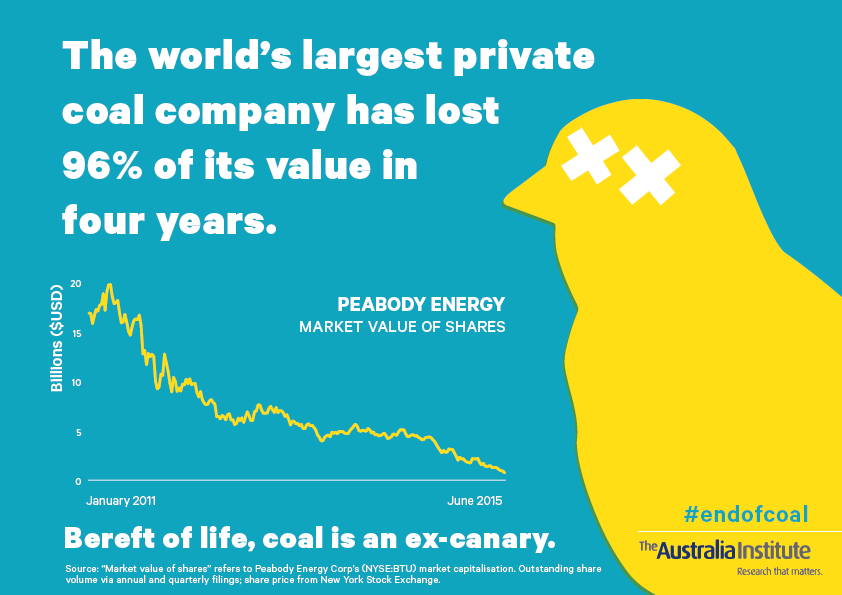
    The #endofcoal

    ex_canary_infographic.png

    Four Corners may have sounded the gong on Monday night with their program The End of Coal?For years we have argued not just that coal would end, but that the big miners have over-hyped their industry well before the end. We fought and won two court cases over whether the economics of Hunter coal projects stacked up – they didn’t. Earlier this year we were in court against the Adani coal project in Queensland – we don’t think it stacks up either.

    But the big issue is not whether or even when coal will end, but how we plan for it. Planning departments in our coal regions don’t seem to want to face this as acknowledging the need for a plan would acknowledge the end of coal, which is definitely against government policy in NSW and Queensland.

    Divestment movement gaining support

    The global fossil fuel divestment movement is growing so quickly that Australia’s universities are at risk of being left behind. The last few months have seen announcements from Oxford, Edinburgh and it looks like MIT might soon follow. There are now around 35 unis with some divestment commitment (depending on what you allow on your list).

    The really big news was Norway’s $900 billion sovereign wealth fund, based on oil money, now divesting from coal extraction and burning. In Australia, the Royal Australasian College of Physicians has agreed to dump fossil fuel companies.

    Australian unis are wary, after the mining lobby and its mates in government attacked the ANU’s divestment decision last year. Our vice chancellors should realise that ethical investment decisions on fossil fuels have the support of most of the public, as emphasised in our recent report, Leading by Degrees which finds:

    • Most Australians agree universities should avoid fossil fuel investments.
    • Support is highest among younger people and those who accept that humans are changing the climate.
    • Most alumni say they would be more likely to donate to their university if it divests.
    • Many say university decisions influence their personal investment choices, such as superannuation.

    Universities should not sit idly by and watch the divestment debate unfold. They should think deeply about their role in leading the community – divestment is a powerful option for forward thinking institutions.

    TAI in the media

    New Matilda: Inquiry Targeting Green Groups Accidentally Exposes $145 Million Mining Tax Dodge

    Guardian: Deductions for mining company lobbying cost taxpayers $20m a year

    Australian Financial Review: Abbott blind to coal’s decline

    Sydney Morning Herald: Planning for coal ignores prospect of declining global demand

    Herald Sun: Every weekend should be a long weekend

    The Australian (Business Insider): The Budget Office revealed Australia would be $42.5 billion better off by scrapping negative gearing

    The Age: Federal budget hangover? Peter Costello’s to blame

    Property Observer: Property market facts are stubborn things

    Weekly updates from TAI

    We aim to keep you updated every week. Every fortnight we send out the Between The Lines which provides an overview of our research and topical issues. On alternate weeks we send out a newsletter based on our work in equity and mining. If you would like to receive those, click here, choose your newsletter, and we’ll make sure they land in your inbox.

    Connect with Us:

  • Key excerpts from the Pope’s encyclical on the environment

    Key excerpts from the Pope’s encyclical on the environment

    Posted about 10 hours ago

    Pope Francis has issued a major encyclical on the environment, called Laudato Si (Praise Be), On the Care of Our Common Home. Here are some key excerpts from the official English version:

    On climate change and its causes

    In recent decades this warming has been accompanied by a constant rise in the sea level and, it would appear, by an increase of extreme weather events, even if a scientifically determinable cause cannot be assigned to each particular phenomenon. Humanity is called to recognise the need for changes of lifestyle, production and consumption, in order to combat this warming or at least the human causes which produce or aggravate it. It is true that there are other factors (such as volcanic activity, variations in the Earth’s orbit and axis, the solar cycle), yet a number of scientific studies indicate that most global warming in recent decades is due to the great concentration of greenhouse gases (carbon dioxide, methane, nitrogen oxides and others) released mainly as a result of human activity. Concentrated in the atmosphere, these gases do not allow the warmth of the sun’s rays reflected by the Earth to be dispersed in space. The problem is aggravated by a model of development based on the intensive use of fossil fuels, which is at the heart of the worldwide energy system.

    On dangers to the planet

    If present trends continue, this century may well witness extraordinary climate change and an unprecedented destruction of ecosystems, with serious consequences for all of us. A rise in the sea level, for example, can create extremely serious situations, if we consider that a quarter of the world’s population lives on the coast or nearby, and that the majority of our megacities are situated in coastal areas. Climate change is a global problem with grave implications: environmental, social, economic, political and for the distribution of goods. It represents one of the principal challenges facing humanity in our day. Its worst impact will probably be felt by developing countries in coming decades.

    Doomsday predictions can no longer be met with irony or disdain. We may well be leaving to coming generations debris, desolation and filth. The pace of consumption, waste and environmental change has so stretched the planet’s capacity that our contemporary lifestyle, unsustainable as it is, can only precipitate catastrophes, such as those which even now periodically occur in different areas of the world. The effects of the present imbalance can only be reduced by our decisive action, here and now. We need to reflect on our accountability before those who will have to endure the dire consequences.

    On consumption, sustainable development and wealth disparity

    We all know that it is not possible to sustain the present level of consumption in developed countries and wealthier sectors of society where the habit of wasting and discarding has reached unprecedented levels. The exploitation of the planet has already exceeded acceptable limits and we still have not solved the problem of poverty.

    We fail to see that some are mired in desperate and degrading poverty, with no way out, while others have not the faintest idea of what to do with their possessions, vainly showing off their supposed superiority and leaving behind them so much waste, which, if it were the case everywhere, would destroy the planet. In practice, we continue to tolerate that some consider themselves more human than others, as if they had been born with greater rights.

    On fossil fuels

    There is an urgent need to develop policies so that, in the next few years, the emission of carbon dioxide and other highly polluting gases can be drastically reduced – for example, substituting for fossil fuels and developing sources of renewable energy. Worldwide there is minimal access to clean and renewable energy. There is still a need to develop adequate storage technologies.

    We know that technology based on the use of highly-polluting fossil fuels – especially coal, but also oil and, to a lesser degree, gas – needs to be progressively replaced without delay. Until greater progress is made in developing widely accessible sources of renewable energy, it is legitimate to choose the lesser of two evils or to find short-term solutions. But the international community has still not reached adequate agreements about the responsibility for paying the costs of this energy transition.

    On political myopia and bureaucratic inertia

    Recent world summits on the environment have not lived up to expectations because, due to lack of political will, they were unable to reach truly meaningful and effective global agreements on the environment.

    A politics concerned with immediate results, supported by consumerist sectors of the population, is driven to produce short-term growth. In response to electoral interests, governments are reluctant to upset the public with measures, which could affect the level of consumption or create risks for foreign investment. The myopia of power politics delays the inclusion of a far-sighted environmental agenda within the overall agenda of governments.

    On market forces and carbon credits

    Once more, we need to reject a magical conception of the market, which would suggest that problems can be solved simply by an increase in the profits of companies or individuals. Is it realistic to hope that those who are obsessed with maximising profits will stop to reflect on the environmental damage which they will leave behind for future generations? Where profits alone count, there can be no thinking about the rhythms of nature, its phases of decay and regeneration, or the complexity of ecosystems which may be gravely upset by human intervention.

    The strategy of buying and selling “carbon credits” can lead to a new form of speculation, which would not help reduce the emission of polluting gases worldwide. This system seems to provide a quick and easy solution under the guise of a certain commitment to the environment, but in no way does it allow for the radical change which present circumstances require. Rather, it may simply become a ploy which permits maintaining the excessive consumption of some countries and sectors.

    On relationship between banks, environment and production

    Saving banks at any cost, making the public pay the price, foregoing a firm commitment to reviewing and reforming the entire system, only reaffirms the absolute power of a financial system. A power which has no future and will only give rise to new crises after a slow, costly and only apparent recovery. The financial crisis of 2007-08 provided an opportunity to develop a new economy, more attentive to ethical principles, and new ways of regulating speculative financial practices and virtual wealth. But the response to the crisis did not include rethinking the outdated criteria which continue to rule the world.

    Production is not always rational, and is usually tied to economic variables which assign to products a value that does not necessarily correspond to their real worth. This frequently leads to an overproduction of some commodities, with unnecessary impact on the environment and with negative results on regional economies.

    The financial bubble also tends to be a productive bubble. The problem of the real economy is not confronted with vigour, yet it is the real economy which makes diversification and improvement in production possible, helps companies to function well, and enables small and medium businesses to develop and create employment.

    On effect of mining on the environment and local people

    Underground water sources in many places are threatened by the pollution produced in certain mining, farming and industrial activities, especially in countries lacking adequate regulation or controls. It is not only a question of industrial waste. Detergents and chemical products, commonly used in many places of the world, continue to pour into our rivers, lakes and seas.

    The export of raw materials to satisfy markets in the industrialised north has caused harm locally, as for example in mercury pollution in gold mining or sulphur dioxide pollution in copper mining. There is a pressing need to calculate the use of environmental space throughout the world for depositing gas residues which have been accumulating for two centuries and have created a situation which currently affects all the countries of the world.

    In this sense, it is essential to show special care for indigenous communities and their cultural traditions. They are not merely one minority among others, but should be the principal dialogue partners, especially when large projects affecting their land are proposed. For them, land is not a commodity but rather a gift from God and from their ancestors who rest there – a sacred space with which they need to interact if they are to maintain their identity and values. When they remain on their land, they themselves care for it best. Nevertheless, in various parts of the world, pressure is being put on them to abandon their homelands to make room for agricultural or mining projects which are undertaken without regard for the degradation of nature and culture.

    On public pressure on companies and boycotts

    A change in lifestyle could bring healthy pressure to bear on those who wield political, economic and social power. This is what consumer movements accomplish by boycotting certain products. They prove successful in changing the way businesses operate, forcing them to consider their environmental footprint and their patterns of production. When social pressure affects their earnings, businesses clearly have to find ways to produce differently. This shows us the great need for a sense of social responsibility on the part of consumers.

    Read the full text of Pope Francis’s encyclical.

  • They’re just kids Graeme, Amnesty International Australia

    1 of 7

    They’re just kids

    Inbox
    x

    Graeme, Amnesty International Australia <actioncentre@amnesty.org.au> Unsubscribe

    7:03 PM (15 minutes ago)

    to me
    There are 81 kids locked up in detention on Nauru.

    What will their childhood memories be?


    Dear Neville,

    It’s International Refugee Week. People around the world are celebrating the incredible achievements and contributions made by refugees to the countries that offer them safety.
    That safety is more important than ever.  
    We’re in the middle of a global refugee crisis — the worst since World War II. It’s forced almost 20 million refugees from their homes, fleeing war and persecution in countries like Syria and Burma.
    Half of them are children, who have a right to a real childhood.
    Australia could make a real difference to the lives of these children and their families.
    Instead, for almost two years, children have been locked up in Australia’s detention centre on Nauru in inhumane conditions.
    Just this month, former Nauru staff came forward with testimony that has brought to light numerous cases and allegations of sexual harassment, assault and rape of women and children on Nauru, including the abuse of children as young as two years old.
    It’s heartwrenching. Nothing can justify exposing children to this.
    In June 2013 — with the support of people like you — we got all children released from detention on Manus Island. We can give the kids on Nauru the same chance to have a safe, happy childhood in Australia.
    But we need your help.
    If you haven’t already, please share your favourite childhood memory. If you already have, please share our Lost Children page on Facebook and Twitter.

    We’ll present your memory — alongside thousands of others — to the government to show them just what they’re taking away from refugee kids by detaining them. We’ll demand that these children are no longer denied their childhood.

    In hope,
    Graeme McGregor
    Refugee Campaign Coordinator
    Amnesty International Australia
    
PS. The more people take action, the more powerful our message will be. Please forward this email to your friends and family and ask them to help the children on Nauru.
  • ACT NOW: Stop AGL’s unfair solar charge Solar Citizens

    Click here to enable desktop notifications for Gmail.   Learn more  Hide
    More

    1 of 25

    ACT NOW: Stop AGL’s unfair solar charge

    Inbox
    x

    Dan, Solar Citizens

    6:46 PM (15 minutes ago)

    to me
    Dear Neville —

    We’re shocked: disturbing reports today* revealed that AGL plans to charge up to an extra $434 for new solar meters in the ACT and NSW. These unfair charges will make it harder for thousands of households to take control of their electricity bills and go solar.

    SIGN AND SHARE: Tell the NSW and ACT energy ministers to stop these outrageous and unfair charges.
    Here’s the situation. New rules set by the Australian Energy Regulator mean that from July 1, electricity giant AGL will push up the price of new meters from $66 to $500 in the ACT, and by about $200 in NSW.

    Recent polling shows that 71% of people think Australia should put more emphasis on solar power ahead of all other forms of electricity generation**. What’s more galling is that only last month, AGL launched extensive TV and digital advertising pushing its expertise in solar products with the tagline “Not all solar is created equal” – now they want to make it harder for Australians to go solar!

    AGL has actively campaigned to cut the Renewable Energy Target and is now putting the proverbial boot in to everyday consumers by ratcheting up these enormous charges.

    These increases will create a huge disincentive to the many thousands of people who want to go solar in New South Wales and the ACT – not to mention the huge precedent this could set for other big power companies to try and charge solar owners more. People switching to solar are making the sensible decision to generate cheap, clean electricity from the sun. This decision should be easy, but AGL wants to price ordinary people out of the solar market.

    Sign our petition now – call on the ACT and NSW governments to stop AGL introducing these outrageous charges for new meters.

    For a fair, sun-powered country,

    Dan, Campaigns Director

    P.S. The more solar supporters who sign the petition, the stronger our voice will be. Click here to share the petition with friends and family. 

    *http://reneweconomy.com.au/2015/nsw-act-households-face-big-hike-in-cost-of-installing-solar-pv-77179
    ** http://www.essentialvision.com.au/energy-sources-2

    Solar Citizens
    http://www.solarcitizens.org.au/

  • The Pope said what?! AVAAZ

    Something’s not right.
    We’re having trouble connecting to Google. We’ll keep trying…
    Errors: 101
    More

    2 of 27

    The Pope said what?!

    Inbox
    x

    Emily Mulligan – Avaaz Unsubscribe

    11:58 AM (8 minutes ago)

    to me

    Dear friends,

    Pope Francis just made history. He’s taken the climate debate to a new level — more than an environmental issue, he’s declared a clear moral imperative to protect our planet, and it’s front page news.

    Our Prime Minister has made dozens of excuses not to act on climate change, but a call from the head of his own church could be the tipping point. And it can’t come soon enough — Abbott’s deciding Australia’s climate targets right now!

    Let’s help our PM ‘see the light’ on climate. If we flood the PM’s office with calls while the encyclical is in the headlines, we can amplify Pope Francis’ message and get Abbott to commit to targets worthy of the Pope’s call.

    Phone the PM’s office now:

    (02) 6277 7700

    Here are some talking points to help with your call. Don’t forget to let the PM’s office know if you’re Catholic!

    1. I read about the Pope’s encyclical on climate change and I think he’s got it right. I hope Mr Abbott will listen to Pope Francis’ call for bold climate action in Australia.
    2. I understand that Cabinet is considering Australia’s climate targets right now. This is a great place for Mr Abbott to show he’s heard the Pope by putting us on track to a pollution free future by 2050.
    3. It’s not too late for Australia to lead on climate action. Our nation has huge potential to benefit from a clean energy future, and we can play a powerful and constructive role in global negotiations if we commit to doing so.

    Remember to be polite and succinct — the PM’s staff will take a note of your message and pass on your comments.

    Tell us how the call went:

    https://secure.avaaz.org/en/pope_encyclical_abbott_call_in/?bhPqncb&v=60566

    The Pope’s encyclical is a demonstration of faith, love and hope for a brighter future in which we all act to protect our climate. There’s still a chance for Australia to show the leadership we’re capable of and present strong targets at the Paris summit this year.

    Make a call to ensure the messages from the Pope’s encyclical reach the politicians that are deciding our climate targets right now:

    (02) 6277 7700

    Our movement is a source of determination and inspiration in the fight against climate change. We’re always looking for key moments to shift the dial towards a pollution free future in Australia and around the world. This is a moment — let’s seize it together.

    With hope,

    Emily, Oli, Nic, Iain, David, Mais and the whole Avaaz team

    MORE INFORMATION:
    Pope Francis calls for action ‘here and now’ to tackle climate change and halt ‘unprecedented destruction’ of ecosystems (ABC)
    http://www.abc.net.au/news/2015-06-19/pope-urges-world-to-act-before-climate-change-destroys-planet/6557540

    Pope Francis, in Sweeping Encyclical, Calls for Swift Action on Climate Change (New York Times)
    http://www.nytimes.com/2015/06/19/world/europe/pope-francis-in-sweeping-encyclical-calls-for-swift-action-on-climate-change.html?_r=0


    Avaaz.org is a 41-million-person global campaign network
    that works to ensure that the views and values of the world’s people shape global decision-making. (“Avaaz” means “voice” or “song” in many languages.) Avaaz members live in every nation of the world; our team is spread across 18 countries on 6 continents and operates in 17 languages. Learn about some of Avaaz’s biggest campaigns here, or follow us on Facebook or Twitter.