Category: Energy Matters

The twentieth century way of life has been made available, largely due to the miracle of cheap energy. The price of energy has been at record lows for the past century and a half.As oil becomes increasingly scarce, it is becoming obvious to everyone, that the rapid economic and industrial growth we have enjoyed for that time is not sustainable.Now, the hunt is on. For renewable sources of energy, for alternative sources of energy, for a way of life that is less dependent on cheap energy. 

  • Coal aid rides high above wave power

    Coal aid rides high above wave power


    Amount invested in marine energy is a drop in the ocean against more than £50m for collieries


    The government has spent 20 times more subsidising the coal industry over the past six years than it has put into marine energy, new figures show.


    Ministers have given away £52.8m of a £60m coal investment aid scheme to extend operations at a range of mines around Britain, including Daw Mill in Warwickshire where energy minister Mike O’Brien is the local MP. This contrasts with the £2.3m handed out from a £50m pot created under the Marine Renewables Deployment Fund, which started in 2004 just 12 months after the launch of the latest coal scheme.


    “At a time when we need to deliver a major expansion in renewable energy, it’s astonishing to find that less than 5% of the investment promised to give Britain a lead in marine energy has actually been made,” said Greg Clark, shadow energy and climate change secretary.


    “It is little wonder that Britain punches way below its weight on renewables – we have the third-lowest contribution from renewable energy in Europe, despite some of the best resources.”


    The Observer revealed last month that ministers had spent almost nothing out of the Marine Renewables Deployment Fund, with potential users complaining the conditions attached to grants were so onerous that they could not gain access.


    The amount of cash handed out under the coal aid scheme was recently revealed in parliament and the Conservatives say that all of it – bar one grant – has been spent in Labour constituencies.


    The government has sought to make up lost ground, with money being promised in the recent energy white paper to various tidal and other schemes. More than £20m has been earmarked for a new Marine Renewables Proving Fund with a further £9.5m going to develop a Wave Hub off Cornwall and £8m for a European Marine Energy Centre in Orkney.


    But the Tories argue that ministerial promises mean very little. “It is easy to talk about support for renewables but what we need is action,” said a spokeswoman. The opposition says it would use the money from the Marine Renewables Deployment Fund to establish a network of large-scale marine energy parks to be run on a commercial basis.


    When the coal subsidies were launched in 2003 by the then trade and industry secretary, Patricia Hewitt, the main emphasis was on job retention.


    Last night a spokesman for the Department of Energy and Climate Change said it was not helpful to compare two completely different technologies – coal having been in development for generations, and marine very much cutting edge.


    He added: “We want to be a global leader in wave and tidal energy, that’s why we announced £60m of low carbon investment funding in the budget. That included £22m to help pre-commercial testing of marine technology, which should enable access to the Marine Renewables Deployment Fund.”

  • Shell and BP keen to buy into Tullow’s new oil find in Uganda

    Shell and BP keen to buy into Tullow’s new oil find in Uganda


    Tullow needs cash to fund development of pipelines and infrastructure


    Lake Albert

    Fishermen near an oil rig on the edge of Lake Albert in western Uganda, where 700m barrels of oil have been discovered Photograph: Xan Rice


    The world’s biggest oil companies – including BP and Shell as well as state-owned operations from China – are trying to muscle their way into the world’s largest new oil region: Uganda.


    Tullow Oil, the relatively small British-based firm at the centre of the huge energy strikes in Lake Albert, says it plans to hand over part of the oil riches in return for financial help to build pipelines and other vital infrastructure.


    Excitement over the Ngara wells increased when Tullow reported it had encountered further shows of oil and was more convinced than ever about the enormous prospects in the region.


    But the company also announced an 83% slump in first-half profits to £21.4m and a 16% drop in its existing production from the North Sea and elsewhere, while needing billions of pounds to bring oil out of the ground and refine it in Uganda.


    “It is not every day you find a new oil province similar in size to the central Graben region of the North Sea. Practically all the oil majors and some national oil corporations have been on our doorstep seeking to pre-empt a competitive [sales] process”, said Angus McCoss, Tullow’s exploration director.


    Tullow plans to sell part of its 100% stake in Block 2, one of three blocks which cover the Ugandan side of Lake Albert, in the next 12 months, it said, but only through a public offer and not via a bi- lateral deal with one other company.


    Among the possible partners is Eni of Italy which has already been tipped as a potential buyer of the whole Tullow company although the British firm said it was clearly not for sale.


    Tullow shares fell 4% to 1052p on profit-taking following a period where euphoria around the Uganda exploration success has driven the value of the stock up by nearly a third in value since early July.


    McCoss said 700m barrels of recoverable reserves had already been proved up but the latest oil shows put the company on the way to proving that there was a further 1.5bn waiting to be exploited.


    Tullow said Eni, which has a 43% stake in pipeline builder Saipem, would be a suitable partner as would Chinese companies and others but insisted there was currently no favoured partner in mind.


    Tullow said its Ngassa-2 well in Block 2 found signs of oil at two intervals in the reservoir being tested.


    “The pressures in these intervals are higher than normal, which may indicate that they are associated with significant oil columns,” it added.


    Investment bank Citigroup said in a research note that the results of the latest well would pave the way for a part sale of the block as it makes clear how much it is worth.


    The Ugandan government has made clear to Tullow that it would like the company to refine the oil in the area so that the relatively impoverished country could gain as much added value from the energy as possible.


    The African country is also acutely aware that many developing countries have found oil riches can be curse as well as cure with charities warning it can bring corruption and wealth only for the political elite. Nigeria is often held up as an example of this.

  • Islay to be entired powered by tides

    Islay to be entirely powered by tides


    Exclusive: ScottishPower is to build turbines in the Sound of Islay that will generate enough electricity for the island’s 3,500 inhabitants – and its famous distilleries


    Islay tidal stream project

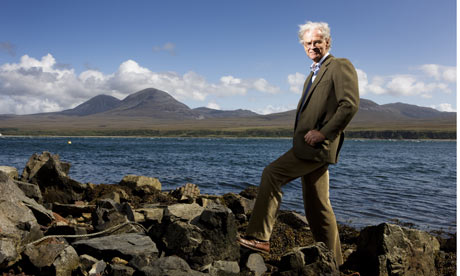
    Philip Maxwell, chairman of the Islay Energy Trust, by the Sound of Islay where the ScottishPower turbines will be sited. Photograph: Murdo MacLeod/Murdo MacLeod


    ScottishPower is planning a tidal energy project that will supply all the electricity for one of Scotland‘s most famous islands, the Guardian can reveal.


    The company is close to signing a supply contract with Diageo, the drinks group, to provide electricity from the project to eight distilleries and maltings on Islay – including the makers of the renowned Laphroaig and Lagavulin whiskies.


    The 10MW tidal project, one of the world’s largest, will provide enough electricity for Islay’s 3,500 inhabitants for 23 hours a day.


    ScottishPower will submit a planning application in the next couple of months and expects the ten 30-metre underwater turbines to be operational in 2011. The turbines will cost about £50m to install.


    The tidal waters in the Sound of Islay, the channel dividing Islay from the Jura, move at up to three metres a second.


    Energy companies and representatives from the Scottish government will publish on Wednesday a “marine energy roadmap” outlining how to reach the target of generating up to 2GW (2,000MW) of electricity from tidal and wave power by 2020. It will call for more grants and revenue support to enable developers to build commercial scale demonstration projects, such as the Islay installation, over the next two years.


    The renewable energy industry admits the techniques to generate electricity from marine energy are in their infancy. Morna Cannon, from Scottish Renewables, said: “This makes it very hard to pin down the costs of the technology at the moment.”


    Alan Mortimer, head of renewables at ScottishPower, admitted tidal energy is more expensive than offshore wind, which costs up to £3m for each megawatt built and itself is only barely economic. Tidal developers earn more subsidies under the Renewable Obligation Scheme than offshore wind, but only once schemes are operational.


    Marine energy developers such as Martin Wright, managing director of start-up company MCT, complain that few investors want to risk their money. But the Islay project has heavyweight backers. ScottishPower is owned by Spanish group Iberdrola and has teamed up with Norwegian oil firm StatoilHydro to develop and finance the project.


    There is also strong support on the island, although it is by no means universal. Kevin Sutherland, manager of the Islay group of Diageo distilleries, works at the Caol Ila distillery, which overlooks the Sound. The distillery, like the rest of the island, gets the majority of its electricity from the Hunterston nuclear reactor on the mainland. But the reactor is being decommissioned in 2016 and the distillery suffers frequent power cuts in stormy weather when pylons are blown over.


    When the tidal project is built, the distilleries on the island will enjoy a much more secure electricity supply, confounding critics of renewable energy – primarily wind power – who say it is intermittent and unreliable.


    One of the biggest obstacles for renewables in Britain has been planning permission. Onshore wind applications are frequently rejected because locals object to the visual impact. Because the Islay generators will be on the seabed, no one can see them and the Scottish government will have the final say on planning.


    Operating underwater brings its own problems, says Cannon from Scottish Renewables. George J Gillies is a local fisherman who fishes for crab and lobster at either end of the channel in winter. He complains that his lobster nets could get tangled in the turbines and says the project threatens the livelihood of eight local fishing families. But he seems resigned: “If it’s going to generate money, it will get the go-ahead.”


    The Islay Energy Trust, a community organisation chaired by Philip Maxwell, has been helping to lobby local politicians and opponents of the project. In return, it will receive a small slice of the revenue to fund community projects on the island, such as a swimming pool

  • South-east chosen as wind-power hub

    South-east chosen as wind-power hub


    ABC August 26, 2009, 9:09 am


    The New South Wales Government plans to fast-track renewable energy projects in the state’s south-east.


    The Far South Coast and Monaro are among six areas to be included in a green energy planning initiative.


    Benefits include a four-month planning turn-around, access to staff dedicated to regional projects and a moratorium on fees until June 2011.


    Member for Monaro Steve Whan says the region has been selected because of dependable wind patterns.


    “The key thing about wind energy is that you need a steady supply of the basic ingredient, natures wind,” he said.


    “That’s certainly something we’ve got and … we seem to have almost too much of it right at the moment.


    “We’ve got a terrific wind resource in the area.


    “We’ve also got strong community grass roots support for clean energy.”

  • ‘Simple changes’ fight climate change


    ‘Simple changes’ fight climate change


    Updated: 14:07, Friday August 21, 2009


    'Simple changes' fight climate change


    Australians need to join the fight against climate change by making simple changes in how they live, the federal government says.


    A day after finalising a significant commitment to renewable energy, the government has set its sights on ordinary households, saying they can do more to assist the climate change challenge.


    Solar panel rebates of up to $7,000 were passed on Thursday as part of the drive to lower emissions of greenhouse gases.


    Environment Minister Peter Garrett on Friday launched initiatives to offer practical tips on how to live a ‘greener’ lifestyle.


    The new livinggreener.gov.au website provides a range of information on sustainable living, including composting, how to buy an environmentally friendly oven and the installation of rainwater tanks.


    ‘Almost 10 per cent of Australia’s greenhouse gas emissions come from households,’ Mr Garrett said in a statement.


    ‘But every Australian can make a big difference to the environment and their wallets through simple, cost-effective, everyday actions.’


    For a first-hand look at how it can be done, some 170 homes across the country will open their doors as part of Sustainable House Day on September 13.


    Environmentally aware householders have been welcoming visitors since 2001, giving them a first-hand look at how homes can be modified, Mr Garrett said.


    But the event will be fully sponsored for the first time since 2001, so admission will be free.


    Agriculture Minister Tony Burke believes the sugarcane industry will also play a part in achieving the 20 per cent renewable energies target by 2020.


    He’s called for greater investment in sugarcane-powered energy, which currently accounts for five per cent of electricity generation in Queensland.


    Up to 180,000 homes in the sunshine state and northern NSW could benefit, he said.

  • New cheaper SolarTechnology


    There are warnings that a delay in passing the renewable energy targets would put green jobs at risk. (File photo)

    ABC News © Enlarge photo


      Scientists from Canberra’s Australian National University (ANU) and Tianjin University in China have teamed up to develop new cheaper solar technology.


      The two year project will pioneer the use of solar cells immersed in cooling fluid to make them more efficient and less expensive than current solar panels.


      ANU Professor Andrew Blakers says the new solar systems will be able to simultaneously heat households, water and generate electricity.


      “This combines the two functions into a single lightweight, low profile concentrator system,” he said.


      “And because you’re utilising the same infrastructure for both electricity and heat collection you can aim to have a substantially reduced cost.”


      Mr Blakers says it has the potential to make buildings carbon neutral.


      “Inside that receiver immersed in mineral oil is a solar cell that absorbs about 20 per cent of the reflected sunlight to make electricity,” he said.


      “The other 80 per cent becomes heat and can be used to make solar hot water and to heat houses in winter and to drive solar cooling in the summer.”