Category: Energy Matters

The twentieth century way of life has been made available, largely due to the miracle of cheap energy. The price of energy has been at record lows for the past century and a half.As oil becomes increasingly scarce, it is becoming obvious to everyone, that the rapid economic and industrial growth we have enjoyed for that time is not sustainable.Now, the hunt is on. For renewable sources of energy, for alternative sources of energy, for a way of life that is less dependent on cheap energy. 

  • Electric car industry boost as leading developer plans production of tens of thousands of vehicles a year.

    Electric car industry boost as leading developer plans production of tens of thousands of vehicles a year


    Carmaker developing three models with Renault for sale in Denmark and Israel, with plans to expand scheme further


    Renault Kangoo Be-Bop Z.E. electric car

    Renault’s Kangoo Be-Bop ZE electric car. The carmaker plans to mass produce three new electric models with Better Place


    The electric car industry received a boost yesterday after a leading developer of low-emission vehicles said it would produce of tens of thousands vehicles a year from 2011. Better Place, which will run the scheme with Renault, plans to market them initially in Denmark and Israel.


    The French carmaker is developing three models: a saloon, a compact city car and a van. In Denmark, a car will cost up to 200,000 kroner (£23,080).


    “We expect the production of electric vehicles to be in the tens of thousands per year for the Danish market from 2011,” said Jens Moberg, chief executive of Better Place Denmark, the Danish subsidiary of the transport company developing the lithium batteries fitted in the vehicles.


    Electric car drivers will need to sign up for a monthly subscription with Better Place to get access to the batteries. “It will be like signing up for a mobile phone contract,” said Moberg.


    He declined to say how much a subscription would cost but said the battery would cost €8,000 (£6,900) to manufacture in 2011-12. “I expect the cost to come down afterwards as production expands,” he said.


    Drivers can recharge the batteries at home, which would take several hours, or switch batteries at a “swap station”, taking three to five minutes – less time than it takes to fill a petrol tank.


    In Denmark, close to 100 battery swap stations will be available around the country, with plans to expand further.


    Drivers will also be able to top up their batteries at charge spots installed at car parks and on the streets. Copenhagen is working to install up to 60 by the time of the UN climate change summit in December, when world leaders will attempt to broker a worldwide deal to reduce carbon emissions.


    A number of electric Renault cars will also be available to drive during the conference. Those trying out the cars will not have to worry about parking, as it is already free to park an electric car anywhere in Copenhagen.


    Moberg said Better Place was in discussion with a number of European countries, including France, about expanding the scheme further from Israel and Denmark.

  • Wind farm projects fees to be waived

    Wind farm project fees to be waived


    ABC August 17, 2009, 8:27 am


    The New South Wales Government has announced that it will waive all project fees for investors wanting to build wind farms.


    The Premier Nathan Rees says New South Wales is ready for the clean energy revolution.


    He has announced a number of measures designed to boost investment in clean energy generation.


    The Premier says wind farms that are at least 30 megawatts will be treated as critical infrastructure and planning decision will be made within four months.


    The Government will also waive project fees until the middle of 2011.


    New South Wales Climate Change Minister, Carmel Tebbutt, says the measures will help to attract clean energy projects to the state.


    “We know that with the Federal Government introducing the renewable energy target scheme that we’re going to see some sisgnificant investment in this area,” she said.


    “We’re making sure that NSW is ready to take a chunk of that investment.”


    The New South Wales Greens M-P John Kaye, says the measures need to be extended further to make any difference.


    “A 22 month holiday from development applications for wind farms is not long enough,” he said.


    “It’ll just take us through to the next election. NSW is so far behind the ball on wind generation that we need much more than 22 months”


    The Government’s announcement comes after the ABC revealed on Friday that project application fees for wind farms are about five time greater than for gas-fired power stations – based on their Megawatt capacity.


  • Greens propose amendments to unleash renewable energy

    Greens propose amendments to unleash renewable energy

    Friday 14 August 2009

    The Australian Greens today released proposed amendments to strengthen
    the Renewable Energy Target bill and unleash the tremendous potential of
    renewable energy.

    Greens Deputy Leader, Senator Christine Milne, wrote to Ministers Wong
    and Combet setting out the amendments which have been circulated to all
    Senators this morning. Senator Milne also moved in the Senate yesterday
    to give precedence to the RET bill over all other business of the Senate
    as soon as it is passed in the House of Representatives.


    “It is time to end the unnecessary and damaging delays both old parties
    have caused to the renewable energy bill,” Senator Milne said.

    “Unlike the Continue Polluting Regardless Scheme, which would have held
    back action on the climate crisis, the renewable energy target bill is a
    vital step in the right direction, even if it is not as strong as it
    could and should be.

    “The collapse of the CPRS opens the door to a suite of other measures
    that can be implemented immediately to move ahead with ambitious action
    on the climate crisis, before an amended CPRS returns to the Parliament.
    The renewable energy target is the first step.

    “We Greens are calling on the Government to immediately bring on the
    renewable energy target legislation, to unleash the tremendous potential
    of renewable energy to re-energise Australia and create tens of
    thousands of jobs.

    “Both the big old parties have been using Australia’s clever and clean
    renewable energy industry as a political football. Both old parties bend
    over backwards to sandbag the old polluters, but neither is willing to
    give priority to the renewable energy powerhouse that the Australian
    community wants.”

    The letter, from Senator Milne to Ministers Wong and Combet, sets out
    the Greens’ proposed amendments to:
    * Lift the target to 30% by 2020, expressed as a percentage of
    total energy demand, and introduce a two-yearly review of the adequacy
    of the target;
    * Decouple the bill from the Carbon Pollution Reduction
    Scheme by simply removing the exemptions for polluting industry (since
    there is compelling evidence that the pool price for electricity will
    drop due to the RET, an exemption would give a windfall gain to
    polluters);
    * Fix the problem of ‘phantom renewable energy credits’ created by
    the solar multiplier and lift the size limit on solar installations;
    * Replace the ill-thought-out solar multiplier with a
    gross national feed-in tariff for all forms of renewable energy; and
    * Strengthen the definition of renewable energy by removing native
    forest bioenergy, solar water heating and heat pumps.

    “I look forward to working with Minister Wong to improve the renewable
    energy bill and get it signed into law as swiftly as possible.”


    Tim Hollo
    Media Adviser
    Senator Christine Milne | Australian Greens Deputy Leader and Climate
    Change Spokesperson
    Suite SG-112 Parliament House, Canberra ACT | P: 02 6277 3588 | M: 0437
    587 562
    http://www.christinemilne.org.au/| www.GreensMPs.org.au
    <http://www.greensmps.org.au/>


    PROTECTING THE CLIMATE IS A JOB FOR EVERYONE

    Sign-up to GreensMPs <http://greensmps.org.au/stay-informed>
    GreensBlog <http://greensblog.org/>
    Twitter <http://twitter.com/GreensMPs>

    Please consider the environment before printing this email.


    Another message from the Greens Media mailing list.

    Too many messages? Don’t unsubscribe – try switching to a daily digest.
    You can unsubscribe or change your subscription settings here:
    <http://lists.greens.org.au/cgi-bin/mailman/options/media>
    Or send an email to <media-unsubscribe@lists.greens.org.au>

  • Spanish Researchers Show That Mines Could Provide Geothermal Energy

    August 11, 2009

    Spanish Researchers Show That Mines Could Provide Geothermal Energy


    by FECYT – Spanish Foundation for Science and Technology

    Mine shafts on the point of being closed down could be used to provide geothermal energy to local towns. This is the conclusion of two engineers from the University of Oviedo, whose research is being published this month in the journal Renewable Energy. The method they have developed makes it possible to estimate the amount of heat that a tunnel could potentially provide.


    “One way of making use of low-intensity geothermal energy is to convert mine shafts into geothermal boilers, which could provide heating and hot water for people living nearby”, Rafael Rodríguez, from the Oviedo Higher Technical School of Mining Engineering, said. This type of energy, which is hardly used in Spain, is obtained from the internal heat of the Earth.


    The engineer and his colleague María Belarmina Díaz have developed a “semi-empirical” method (part mathematical and part experimental) to calculate the amount of heat that could be produced by a mine tunnel that is due to be abandoned, based on studies carried out while it is still in use.


    “When the mine is still active one can access the tunnels easily in order to gather data about ventilation and the properties of the rocks, as well as to take samples and design better circuits, and even program the closure of some sections in order to use them for geothermal energy production”, says the engineer, who stresses that, although geothermal energy can be made use of once the mine is closed, “it is no longer possible by that stage to make any modifications, or to gather any useful data to evaluate and improve the system”.


    The study looks into geothermal exploitation of a two-kilometer-long mine shaft, in which the temperature of the rocks 500m below the surface is around 30º C. This is typical of many of the mining areas in Asturias, although it could also be applied to other parts of the world. Water could be forced in through tubes at 7º C and return at 12º C, a big enough heat gain to be of benefit to towns located above the mines.


    Advantages of Geothermal Energy from Mines


    Rodríguez and Díaz highlight the benefits of building geothermal boilers in mine shafts in that, aside from their predictable energy production levels, they also function practically as an open tube system “but without any risk of heat contamination of aquifers”.


    Using geothermal energy also helps to reduce CO2 emissions, and is not dependent upon climatic conditions (unlike other renewable energies such as solar or wind power). Other advantages are that these facilities make use of a country’s own resources, do not require new developments on large sites, do not pollute the immediate environment, and are believed to be profitable over the long term.


    Geothermal energy can be used directly in family homes, housing developments, swimming pools, fish farms, industrial units and other buildings.

  • Sea Power, Part 3

    August 10, 2009

    Sea Power, Part 3


    No, not fleets of warships — this power comes from warm and cold running water. Part 3 of our 3-part series.

    by Mason Inman

    Washington, D.C. United States [RenewableEnergyWorld.com]

    In Part 2 of this 3-part series on ocean thermal energy conversion (OTEC), we documented several pilot OTEC plants that are in the works, including the U.S. Navy’s 8-MW plant on the island of Diego Garcia. Along with creating electricity, this plant will desalinate nearly 5 million gallons of drinking water each day. In this third and final installation, we’ll explore other side benefits of OTEC and look at OTEC’s electricity potential.


    OTEC is moving ahead despite minimal government funding, but the technology needs more R&D to test new pipe designs and plant configurations and to transition from demonstration to commercial plants. As with other renewables, OTEC plants would be very expensive to build. Although they’d be cheap to run, and proponents think the plants would last decades, investors are reluctant to dive in.


    In addition to drinking water, researchers have devised many other spin-off applications for this cold water from the deep, from cooling buildings to feeding fish to nurturing crops. The key to each of these applications is that the deep water can bring something that’s normally in short supply.


    In seawater air conditioning, the cool, deep water is run through tubes alongside others containing freshwater, cooling it down. The cooled freshwater then circulates in pipes through buildings. All of NELHA’s buildings on Hawaii’s Big Island use this system, cutting energy use for air conditioning by 80 percent, says Ronald Baird, CEO of of the National Energy Laboratory of Hawaii Authority (NELHA). “It’s probably saving us 25 to 30 thousand dollars per month,” he says. “We don’t even think about maintenance on it. It’s so simple it borders on ridiculous.” Stockholm has a similar system, drawing from the Baltic Sea, as do Toronto and Cornell University, which draw on cool water in nearby lakes. “This technology is commercially viable right now,” says Reb Bellinger of Makai Ocean Engineering. “We’re currently doing design on a seawater air conditioning system to air con?dition downtown Honolulu. That’s a very big project.”


    The deep water is also rich in nutrients, especially phosphates and nitrates, and it’s free from pollution and pathogens that can afflict sea life near the surface. Companies are using this deep water for aquaculture at NELHA’s site, raising lobsters, abalone, algae, and more. Running the deep-water tubes through soil can even aid agriculture, some hope. Chilling the soil could allow temperate crops to grow in tropical climes, and the cooling would also make vapor in the air condense on the fields, helping to water the crops.


    McIslands?


    This combination of water, energy, and food could help support development on remote tropical islands. Many people, such as Terry Penney of the U.S. National Renewable Energy Laboratory in Golden, Colorado, think it’s important to take advantage of these spin-offs, especially as the technology is getting off the ground. “You can have food, water, and electricity,” Penney says. “Maybe one plant can supply all three needs,” which could allow a “cookie cutter” approach to development he calls “McIslands.”


    To tap into the huge amounts of ocean thermal energy that are out there, though, OTEC needs to move away from land. In some places, such as in the Gulf of Mexico and off the coast of Indonesia, OTEC plants could sit on platforms similar to those built for offshore oil drilling. In these spots, there’s warm surface water and cold deep water close enough to shore that the plants could produce electricity and send it to shore, through power cables up to 100 kilometers long.


    This approach could help power cities such as New Orleans and Tampa, Florida, argues Robert Cohen who in the 1970s was the first manager of the US DOE’s research on ocean thermal energy. Taiwan and Brazil’s coast are other possible sites, Gerard Nihous of the Hawaii Natural Energy Institue says, and in the future it may become affordable for countries such as Indonesia, the Philippines, and Papua New Guinea, which are in one of the best regions for the technology.


    Taking OTEC to the next level, according to many of its proponents, would require “plantships” — huge floating factory-like vessels, with long cold-water pipes descending to the depths below. They could produce electricity on board, but as Cohen puts it, “getting the power to the people is the real question.”


    This electricity couldn’t be stored affordably, but it could be used to produce valuable and energy-intensive products. A top candidate is ammonia; its production for fertilizer (made from fossil fuels using the Haber-Bosch process) now consumes about 2 percent of the entire world’s energy use and accounts for a sizeable chunk of global CO2 emissions. Ammonia can also be burned as a fuel or used as a way of ferrying hydrogen around (each ammonia molecule contains three hydrogen atoms), which can be released and used as a fuel as well.


    These ideas of offshore platforms and floating factories may seem far-fetched, but OTEC supporters argue they’re feasible and worth the bother. “While we [OTEC researchers] were orphaned, the oil people have been making great strides,” Cohen says.


    Harry Jackson, president of OCEES, agrees: “Ten years ago, an oil rig in 500 feet [150 meters] of water was thought to be deep. Now they’re going down 15,000 feet [4,500 meters]. A lot of the technology and advances they use, we’ve been able to tap into.” This includes new materials and ways of building offshore platforms and mooring them to the sea floor. The oil industry “can also provide investment,” Cohen hopes. “They have deep pockets.” Given their experience working in rough seas, he adds, “their perceived risk is minimal compared to those who haven’t done it.” He’s now trying to build bridges with the oil and drilling industries, in hopes of furthering OTEC—and moving people away from oil.


    Electrical Potential


    If OTEC did scale up, how much energy could it produce? “There are all sorts of claims about how much energy is out there,” says John Varley of Lockheed Martin. “We’re taking the conservative route, using [Gérard] Nihous’s figures.” Nihous estimates OTEC could sustainably generate between 3 and 10 terawatts—up to five times the electricity the world uses now.


    Building OTEC plants capable of tapping ocean thermal energies efficiently will be a huge challenge, though, in part because they have never been built in anywhere near the sizes that would be needed to fully exploit the resource. The biggest challenge may be scaling up the deep-water pipeline in an affordable way.


    Reb Bellinger of Makai Ocean Engineering believes that the minimum commercially viable size is 100 megawatts; if so, that will require some pretty big pipes. Because of the basic physics of how water moves through a tube, it’s much more efficient to pump water through a few fat pipes than through many skinnier ones. The fattest deep-water pipe ever used for OTEC is 1.4 meters in diameter—not quite tall enough for an average person to stand up in. “When people talk about a 100-megawatt plant, it’s hard to imagine how big that pipe is,” Nihous says. Such plants would likely need pipes 10 meters across—nearly the diameter of the biggest giant sequoias, the world’s most massive trees—and 10 times taller.


    Yet Lockheed Martin aims to build such a pipe. “We’ve got a design that we believe is scalable to 10 meters,” Varley says. It would be made from a proprietary composite material, which is light and strong yet has a bit of flexibility that would help it cope with ocean currents. Most importantly, he adds, this composite material would be cheaper than either the plastic or steel pipes that have been used in OTEC plants before and could be scaled up to enormous sizes.


    OTEC is ready to be scaled up, Cohen argues: “I don’t know of any showstoppers.” Christopher Barry, a naval engineer with the Society of Naval Architects and Ocean Engineers, agrees. “We just need good engineering,” he says. “It’s not like going to the moon, where you need some breakthrough technology.”


    OTEC boosters are also excited about another possible benefit. Not only would OTEC create clean energy, potentially free from CO2 emissions, it might even be able to suck CO2 out of the air and thus help to reverse global warming. In theory, by bringing the deep, nutrient-rich water up near the ocean surface, it could make the open ocean bloom with microbes. The blooms would suck up CO2 from the water around them, allowing more CO2 in the air to dissolve into that water.


    If the blooms happen in the right way — spurring first plankton and then organisms called cyanobacteria — then it could help draw CO2 out of the air and lock it away in a stable form, according to an as-yet-untested hypothesis from David Karl, a University of Hawaii microbial oceanographer. Doing this, however, would cool down the water near the surface, which could disrupt ocean ecosystems. The OTEC plants built so far, and those proposed in the near term, instead send the cool water stream back to the deep, to avoid tampering with the ocean’s temperatures.


    But apart from the issue of ocean temperatures, many are skeptical about whether artificial upwelling will really make a difference, since it may only sequester carbon when the conditions are just right. And even if it did work reasonably well, according to a recent estimate it would take enormous flows of upwelled water to put even a tiny dent in global warming. What’s worse, artificial upwelling could liberate the CO2 in the deep water, allowing it to escape into the atmosphere. The deep water has about 15 percent more CO2 dissolved in it than the surface waters do, and after the deep water is brought to the surface, some of this extra CO2 could escape into the atmosphere, where it would contribute to global warming.


    “We really don’t need any other ways of releasing CO2 to the atmosphere, so that’s a big question about OTEC,” Barry says. Nihous argues, however, that this release would still be small compared with that from fossil fuels. “Even if plankton didn‘t do anything and the carbon [dioxide] escaped and was never recaptured, [OTEC plants] would still produce a fraction of what a fossil fuel plant produces,” he says. “So kilowatt for kilowatt, this is a carbon-denying technology.”


    OTEC is moving ahead despite minimal government funding, but the technology needs more R&D to test new pipe designs and plant configurations and to transition from demonstration to commercial plants. As with other renewables, OTEC plants would be very expensive to build. Although they’d be cheap to run, and proponents think the plants would last decades, investors are reluctant to dive in.


    In 1977, U.S. President Jimmy Carter made a famous speech, saying that tackling the energy crisis is the “moral equivalent of war, except that we will be uniting our efforts to build and not to destroy.” The situation today brings out a similar feeling in Gérard Nihous. “To go to war, we spend billions like there is no tomorrow. I wish we had the same reckless, rash attitude when it comes to energy independence,” he says. “My great fear is that we’ll be so timid about it that we’ll reach a point that when we must do it, we won’t have the resources to do it. Waiting is not a good strategy.”


    Mason Inman is a freelance science journalist currently based in Karachi, Pakistan.


    This article originally appeared in World Watch Magazine May/June 2009 and is reprinted by permission.

  • Fall in power demand ‘unprecedented’ says Drax

    Fall in power demand ‘unprecedented’ says Drax


    • Industry demand for power station’s electricity slumps 8%
    • Factory closures and fall in demand for new cars a factor


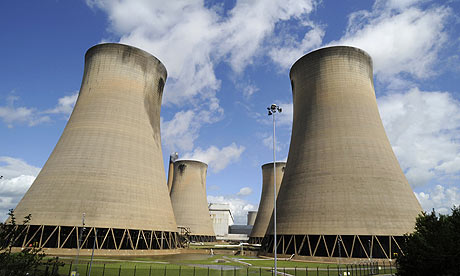
    Power station chimneys near Drax in northern England

    The Drax power station is the largest coal-fired power station in Europe and supplies around 7% of Britain’s electricity. Photograph: Nigel Roddis/Reuters


    Electricity demand from British industry has fallen by an unprecedented 8% this year as factories have shut down in droves, power station operator Drax said today.


    Household demand has also declined – by 2% – but that was due to mild weather rather than economic reasons, the company’s chief executive, Dorothy Thompson, said, as she unveiled half-year results.


    Overall demand for the power station’s electricity fell by 6% in the first six months of 2009, compared with the same period a year earlier. The station, in Yorkshire, is the largest coal-fired power station in Europe and supplies around 7% of Britain’s electricity.


    Thompson said it was usual for energy demand to fluctuate in line with changes in overall economic output, but this time the drop was abnormally large. “For our sector it’s a very unusual movement … in fact, unprecedented in my experience,” she said.


    A slump in world trade volumes in the second half of last year and a collapse in demand for things like new cars meant Britain’s industry has borne the brunt of the recession. Many car plants closed for several months around the turn of the year as they tried to run down stocks of unsold cars. That also caused many parts suppliers to shut down temporarily, which could explain such a sharp drop in electricity demand.


    Drax – the country’s biggest carbon dioxide emitter, which burns around 100m tonnes of coal a year – said its carbon abatement projects were on track. These include an upgrading of existing turbines to increase their efficiency, the conversion of some to also burn biomass such as wood pellets, and the building of new, biomass-only plants.


    It said that on completion, the biomass co-firing facility would be the largest of its type in the world. Along with Drax’s existing co-firing capability, it would provide a total of 500MW of renewable electricity, or the equivalent output of over 600 wind turbines, by mid-2010. That will be equivalent to 12.5% of its total output.


    The biomass co-firing facility will reduce Drax’s emissions of CO2 by over 2.5m tonnes each year. With the upgrade in efficiency of the standard turbines, the station will have cut its carbon emissions by 3.5m tonnes, or 17.5%, by 2011 compared with 2006 levels.


    Drax posted a sharp fall in first half earnings due to lower power prices, but said profit should rise sharply in 2010 thanks to more favourable hedging contracts for its electricity. Pretax profit fell to £33.8m in the first six months of the year from £149.5m in the same period last year after revenues declined 12% to £706.9m.