

The dirty topic of peak oil : get ready to reduce your reliance
The dirty topic of peak oil: get ready to reduce your reliance
Wouldn’t it be funny if we spent so long arguing about what to do about climate change that we ran out of cheap oil first? No, it wouldn’t really, it would be catastrophic.
But given the government’s delay in producing an Energy White Paper and the steady backsliding on the need to actually reduce our greenhouse gas emissions in Australia, it is not beyond the realms of possibility. Even the usually optimistic International Energy Agency (IEA) is starting to sound a little nervous.
Running on empty? The peak oil debate.
Publications

Running on empty? The peak oil debate
Like climate change, the possibility of peak oil poses an uncomfortable challenge to citizens and governments alike in the 21st century. ‘Peak oil’ is the term used to describe the point in time at which the worldwide production of crude oil extraction will be maximised. But while it is inevitable that production will peak at some point, it is uncertain when that point will be reached.
The Scale of the low-carbon task is immense
The scale of the low-carbon task is immense
We cannot hope to replace fossil fuel energy infrastructure and prevent unmanageable climate change at the current rate of growth in low-carbon energy

-
- guardian.co.uk, Friday 10 September 2010 10.04 BST
- Article history
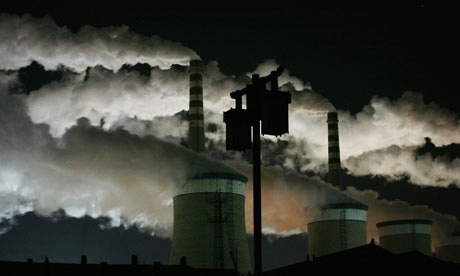 A coal-fired power plant in Datong, China. If the world stopped building new coal-fired power plants and manufactured no new cars or trucks, warming would remain well below a 2C increase. Photograph: Jason Lee/Reuters
If we were starting afresh, we probably wouldn’t chose to build an energy infrastructure based around fossil fuels. But like it or not, we are stuck with power stations, cars and homes that use carbon-based energy sources. The problem is that almost all these buildings and vehicles last a long time. If they stay in use, we are committed to large-scale future production of greenhouse gases. But how large?
World bank hints Africa is ‘quick win’ for land grabbing investors
World bank hints Africa is ‘quick win’ for land grabbing investors Ecologist 14th September, 2010 Report on land-grabbing reveals large-scale farmland deals amounted to 45 million hectares in 2009 alone with 6 million hectares expected to be added every year in less industrialised countries Activists have criticised the World Bank for effectively ignoring the harsh Continue Reading →
The right’s climate denialism is part of something larger
The right’s climate denialism is part of something much larger 58


If you read RL Miller’s post on “climate zombies” you know that open climate denialism is back in vogue in the GOP. However muted denialism may have gotten in the late 2000s, it has come roaring back — like everything reactionary — with the economic downturn. This is from Gallup:

For the most part the American public’s feelings on climate change are shallow, sloshing around with the economic and political tides. When people are feeling safer and more prosperous, climate scientists will magically become more persuasive.
As for the professional skeptics and culture warriors, there’s little point hashing out the same arguments with them again and again. I have long since abandoned it. Many people do it well and G*d bless them but I’ve had my fill of sunspots and medieval warming periods and Pacific Decadal Oscillations. Ideological trench warfare is wearisome and there are many other issues in dire need of attention, principally how we’re going to respond to climate change. That’s a conversation that engages people outside the armed camps.
MIT Researchers Develop a Way to Funnel Solar Energy
MIT Researchers Develop a Way to Funnel Solar Energy
Cambridge, MA, USA — Using carbon nanotubes (hollow tubes of carbon atoms), MIT chemical engineers have found a way to concentrate solar energy 100 times more than a regular photovoltaic cell. Such nanotubes could form antennas that capture and focus light energy, potentially allowing much smaller and more powerful solar arrays.
“Instead of having your whole roof be a photovoltaic cell, you could have little spots that were tiny photovoltaic cells, with antennas that would drive photons into them,” says Michael Strano, the Charles and Hilda Roddey Associate Professor of Chemical Engineering and leader of the research team.