Sue Whyte … has vowed to fight plans to build 800 new homes. Photo: Simone DePeak
A CONTROVERSIAL development proposal at Catherine Hill Bay will proceed but residents have been given a sweetener in the form of heritage protection for parts of the town.
The Planning Minister, Tony Kelly, has proposed state heritage listing for the coastal hamlet south of Newcastle, and rezoning of land for residential development in bushland areas next to it.
The town’s dilapidated jetty has not been included within the ”cultural precinct” marked for protection, but 126 19th-century properties – mostly workers’ cottages from the town’s coal mining heyday – will be considered.
”If the listing is approved, major developments within the precinct will need to respect the area’s significant heritage values,” Mr Kelly said.
Last year, the Land and Environment Court threw out a planned development by Rosecorp for about 800 dwellings in Catherine Hill Bay because of an unlawful land swap deal.

admin /28 July, 2010
Islanders plead for help as homes sink
By Liam Fox in Bougainville
Posted 1 hour 10 minutes ago
Residents of Papua New Guinea’s sinking Carteret Islands are known as the world’s first climate change refugees but international attention has not translated into relief from their plight.
A relocation process started several years ago but only a handful of islanders have moved to nearby Bougainville.
They are pleading for help to save their relatives from their sinking island homes.
The isolated islands are slowly disappearing under the Pacific Ocean, with rising water inundating crops and spoiling water supplies.
admin /28 July, 2010
Engineers race to design world’s biggest offshore wind turbines
British firm to design mammoth offshore wind turbines with 275m wingspan that produce three times power of standard models
• Interactive: The race to build bigger turbines
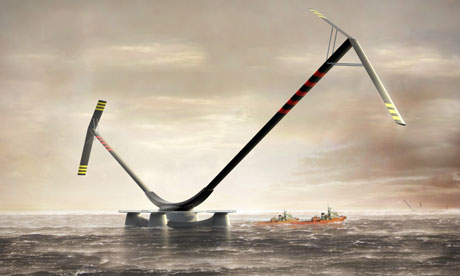
The revolutionary 10MW Aerogenerator X, a new breed of mammoth offshore wind turbine in development by British firm Arup. Illustration: Wind Power Limited and Grimshaw
British, American and Norwegian engineers are in a race to design and build the holy grail of wind turbines – giant, 10MW offshore machines twice the size and power of anything seen before – that could transform the global energy market because of their economies of scale.
Today, a revolutionary British design that mimics a spinning sycamore leaf and which was inspired by floating oil platform technology, entered the race. Leading engineering firm Arup is to work with an academic consortium backed by blue-chip companies including Rolls Royce, Shell and BP to create detailed designs for the “Aerogenerator”, a machine that rotates on its axis and would stretch nearly 275m from blade tip to tip. It is thought that the first machines will be built in 2013-14 following two years of testing.