

Vehicle scrappage scheme drives down emissions of new cars
Vehicle scrappage scheme drives down emissions of new cars
Average carbon emissions of new cars reduced by 5.4% in 2009 as drivers trade in their old car for cleaner models
- guardian.co.uk, Tuesday 9 March 2010 10.40 GMT
- Article history
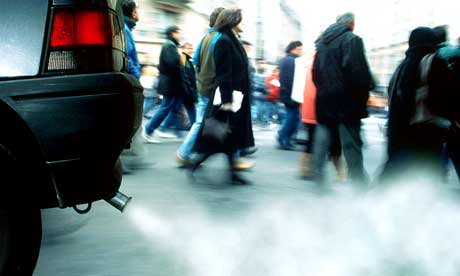
Average new car emissions are down 21% since 1999
The average emissions from a new car dropped at the fastest rate in 13 years last year because of the UK government’s “cash for bangers” vehicle scrappage scheme, it was announced today.
On average, new cars emitted 149.5g of CO2 per kilometre in 2009 – a 5.4% reduction on the average 2008 figure, according to a report from the Society of Motor Manufacturers and Traders (SMMT). This was the best year-on-year improvement since the SMMT began to keep records of this kind in 1997.
SMMT chief executive Paul Everitt said the scrappage scheme was a key contributor to the lower emission figure last year.
The average emissions of cars bought through the scheme was 133.3g per kilometre, which was 26.8% below the average of the vehicle being scrapped (182.3g/km). Average new car emissions are down from nearly 190g/km in 1999 to below 150g/km last year, a cut of 21.2%.
UK import emissions are the highest in Europe , figures show.
UK import emissions are the highest in Europe, figures show
Study finds 253m tonnes of CO2 are released annually in the manufacture of products bound for UK shores – mostly in the developing countries
- guardian.co.uk, Monday 8 March 2010 20.00 GMT
- Article history
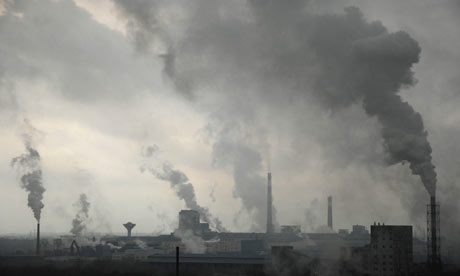
The majority of the UK’s import emissions are released in rapidly industrialising parts of the developing world such as China. Photograph: Stringer Shanghai/Reuters
Britain’s demand for imported goods is responsible for more greenhouse gas emissions abroad than any other European country, according to a new study published today.
The report shows that 253m tonnes of carbon dioxide are released overseas each year in the manufacture of products bound for UK shores, the equivalent of 4.3 tonnes per person. The average Briton’s carbon footprint is 9.7 tonnes, not including emissions from goods.
Only the US and Japan have higher emissions linked to their imports, at 699m tonnes and 284m tonnes of carbon dioxide per year respectively, the study found.
How food and water are drivng a 21 st-century African land grab
How food and water are driving a 21st-century African land grab
An Observer investigation reveals how rich countries faced by a global food shortage now farm an area double the size of the UK to guarantee supplies for their citizens
-
- The Observer, Sunday 7 March 2010
- Article history
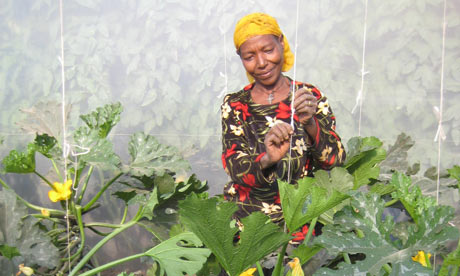
A woman tends vegetables at a giant Saudi-financed farm in Ethiopia.
We turned off the main road to Awassa, talked our way past security guards and drove a mile across empty land before we found what will soon be Ethiopia‘s largest greenhouse. Nestling below an escarpment of the Rift Valley, the development is far from finished, but the plastic and steel structure already stretches over 20 hectares – the size of 20 football pitches.
The farm manager shows us millions of tomatoes, peppers and other vegetables being grown in 500m rows in computer controlled conditions. Spanish engineers are building the steel structure, Dutch technology minimises water use from two bore-holes and 1,000 women pick and pack 50 tonnes of food a day. Within 24 hours, it has been driven 200 miles to Addis Ababa and flown 1,000 miles to the shops and restaurants of Dubai, Jeddah and elsewhere in the Middle East.
Nothing will drive the suburbs away
car culture Nothing will drive the suburbs away 5 by Lisa Selin Davis 4 Mar 2010 12:00 PM The news that GM will cease production of Hummers revived the brewing argument that suburbia is in fatal decline. Hummers are the perfect corollary to McMansions, symbols of excess, leftovers from the roaring aughts that now seem Continue Reading →
Ancient tradition of water purification could save lives
Ancient tradition of water purification could save lives Ecologist 5th March, 2010 Thousand-year-old Indian method of using tree seeds to purify water should be used more widely for tackling waterborne diseases Indian tree seeds that purify water could dramatically reduce disease in the less-industrialised world, say researchers. The technique of crushing seeds from Continue Reading →