

Nitrous oxide concerns cloud future of biofuels
Nitrous oxide concerns cloud future of biofuels
European scientists cast doubt on whether oil alternatives can ever be sustainably produced in significant quantities
- guardian.co.uk, Tuesday 8 December 2009
- Article history
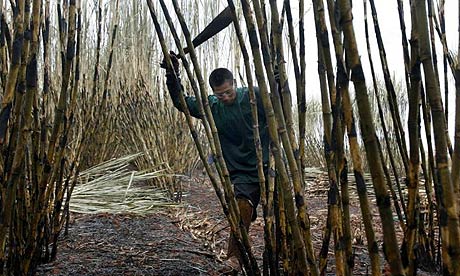
Scientists have cast doubt over the sustainability of biofuels: Jamil Bittar/Reuters
Scientists at the European commission have cast doubt on whether biofuels could ever be produced sustainably in significant quantities, dealing a blow to the aviation industry, which sees such fuel as a key way to reduce its emissions.
The researchers argue that the greenhouse gases emitted in making biofuel may well negate most of the carbon dioxide savings made by replacing fossil fuels. Of particular concern is the uncertainty over emissions of the potent greenhouse gas nitrous oxide.
World’s largest ice sheet melting faster than expected
World’s largest ice sheet melting faster than expected
East Antarctic sheet shedding 57bn tonnes of ice a year and contributing to sea level rises, according to Nasa aerial survey
- guardian.co.uk, Sunday 22 November 2009 18.00 GMT
- Article history
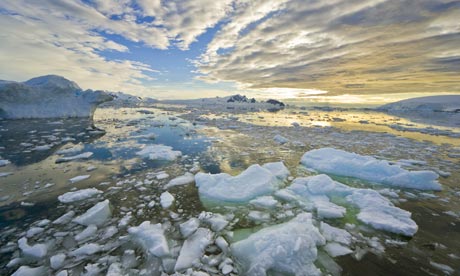
Scientists believe that Antarctica could lose more ice than Greenland within a few years. Photograph: Momatiuk-Eastcott/Corbis
The world’s largest ice sheet has started to melt along its coastal fringes, raising fears that global sea levels will rise faster than scientists expected.
The East Antarctic ice sheet, which makes up three-quarters of the continent’s 14,000 sq km, is losing around 57bn tonnes of ice a year into surrounding waters, according to a satellite survey of the region.
Scientists had thought the ice sheet was reasonably stable, but measurements taken from Nasa‘s gravity recovery and climate experiment (Grace) show that it started to lose ice steadily from 2006.
Climate change? Well, we’ll be dead by then
Climate change? Well, we’ll be dead by then

-
- The Guardian, Saturday 12 December 2009
- Article history
So as we career towards a mediocre outcome in Copenhagen, why do roughly half the people in this country not believe in man-made climate change, when the overwhelming majority of scientists do?
Firstly we have the psychological issues. We’re predisposed to undervalue adverse outcomes which are a long way off, especially if we might be old or dead soon. We’re inherently predisposed to find cracks in evidence that suggests we should do something we don’t want to do, hence the enduring appeal of stories about alcohol being good for you.
China rejects draft climate deal
China rejects draft climate deal
- From: The Australian
- December 12, 2009
CHINA has accused the developed world of retreating from its undertakings to cut greenhouse gas emissions, rejected a proposal at the Copenhagen conference to reduce financial help to China and described the draft deal Kevin Rudd worked on as creating “a lot of problems”.
The Chinese have accused the developed world of abandoning the Kyoto Protocol and pressuring the developing nations to cut emissions without proper compensation for the “luxury emissions” the West has put out for the past century.
The so-called “commitment circle” draft document worked out between Denmark, Australia and other nations was said to be from a small and isolated group and designed to lift the political standing of individuals.
China’s ambassador to Australian, Junsai Zhang, has forcefully put the Chinese government’s case against proposals to bind developing nations to targets to cut greenhouse gases, drop the Kyoto commitments made by the developed nations and cut the share for China, India and Brazil of a $US10 billion-a-year financial help fund for developing countries to fight climate change.
As climate talks drag on, low-lying atolls are already beimg flooded
As climate talks drag on, low-lying atolls are already being flooded.
I am 17 years old. For my entire life, countries have been negotiating a climate agreement. My future is in front of me. In the year that I was born, amid an atmosphere of hope, the world formed the United Nations Framework Convention on Climate Change to solve the climate crisis.
This week I told negotiators at the main plenary session of the UN Climate Change Conference that time is running out and my generation needs them to work together to come up with the agreement that we deserve.
In the Solomon Islands, my homeland, communities on low-lying atolls are already being displaced by rising sea levels. Communities have lived on these atolls for generations. Moving from one province to another in the Solomon Islands is not just like moving house. Your land is your identity. It is part of your culture. It is who you are.
Vulnerable nations at Copenhagen summit reject 2C target
Vulnerable nations at Copenhagen summit reject 2C target
Alliance of Small Island States say any deal that allows temperatures to rise by more than 1.5C is ‘not negotiable’
- guardian.co.uk, Thursday 10 December 2009 13.55 GMT
- Article history
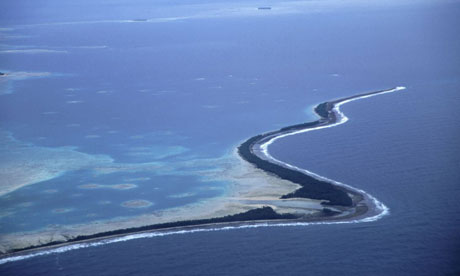
The Alliance of Small Island States is a grouping of 43 of the smallest and most vulnerable countries, including Tuvalu (pictured). Photograph: Matthieu Paley/Corbis
More than half the world’s countries say they are determined not to sign up to any deal that allows temperatures to rise by more than 1.5C – as opposed to 2C, which the major economies would prefer.
But any agreement to reach that target would require massive and rapid cuts in greenhouse gas emissions combined with removal of CO2 in the atmosphere. An extra 0.5C drop in temperatures would require vastly deeper cuts in carbon dioxide and up to $10.5 trillion (£6.5tr) extra in energy-related investment by 2030, according to the International Energy Agency.