

Global warming could create 150 million ‘climate refugees’ by 2050
Global warming could create 150 million ‘climate refugees’ by 2050
Environmental Justice Foundation report says 10% of the global population is at risk of forced displacement due to climate change
- guardian.co.uk, Tuesday 3 November 2009 00.05 GMT
- Article history
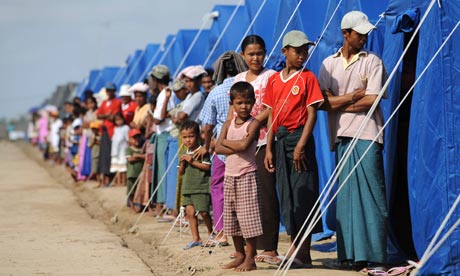
People displaced by Cyclone Nargis line up by their tents for a visit from UN secretary-general Ban Ki-Moon in 2008 in Kyondah, Myanmar. Photograph: Stan Honda/AFP/Getty Images
Global warming will force up to 150 million “climate refugees” to move to other countries in the next 40 years, a new report from the Environmental Justice Foundation (EJF) warns.
In 2008 alone, more than 20 million people were displaced by climate-related natural disasters, including 800,000 people by cyclone Nargis in Asia, and almost 80,000 by heavy floods and rains in Brazil, the NGO said.
Crumbling icesheets could add 5m to sea levels
Crumbling icesheets could add 5m to sea levels
- From: AFP
- November 23, 2009
THE East Antarctic icesheet, once seen as largely unaffected by global warming, has lost billions of tonnes of ice since 2006 and could boost sea levels in the future, according to a new study.
Published yesterday in Nature Geoscience, the same study shows that the smaller but less stable West Antarctic icesheet is also shedding significant mass.
Scientists worry that rising global temperatures could trigger a rapid disintegration of West Antarctica, which holds enough frozen water to push up the global ocean watermark by about five metres.
Sticking with GDP could be the best safeguard for nature.
Sticking with GDP could be the best safeguard for nature Tom Levitt 20th November, 2009 Although much maligned as a measurement of progress, some believe a Gross Domestic Product (GDP) measurement that includes natural capital could be the way forward Economic growth is ‘destroying more than it is creating’, said French President Nicholas Sarkozy in Continue Reading →
Clamping down on logging in brazil moves it to paraguay
Clamping down on logging in Brazil moves it to Paraguay Ecologist 20th November, 2009 Former Paraguayan government minister makes plea for West to intervene in runaway illegal logging situation displaced from Brazil Paraguay has called for urgent international assistance to cope with deforestation after 437,000 acres of the country’s forest have been destroyed in Continue Reading →
Global temperatures could rise 6C by end of century, say scientists.
Global temperatures could rise 6C by end of century, say scientists
Most comprehensive CO2 study to date is expected to give greater urgency to diplomatic manoeuvring before CopenhagenAlok Jha
- guardian.co.uk, Tuesday 17 November 2009 18.00 GMT
- Article history

By studying data on carbon emissions the team was able to estimate how much CO2 is being absorbed naturally by forests, oceans and soil. Photograph: Evan Hurd/Getty Images
Global temperatures are on a path to rise by an average of 6C by the end of the century as CO2 emissions increase and the Earth’s natural ability to absorb the gas declines, according to a major new study.
Why Can’t We All Just Agree?
countdown to copenhagen
20 Nov 2009
Why Can’t We All Just Agree?
As far as climate change is concerned, it remains unclear whether international law will be part of the solution or part of the problem, writes Professor Gerry Simpson
The slow roasting of the planet, in effect, combines two problems: a scientific-environmental problem and a political-legal one. Interestingly, the environmental consequences of man-made greenhouse gas emissions are the subject of both widespread agreement and scientific uncertainty. There is now a consensus (give or take the occasional corporate-funded oddity) that the planet is warming, that burning fossil fuels are a large part of the problem, and that warming will cause us to enter a period in history marked by regular environmental catastrophe.
The Copenhagen negotiations will tell us a great deal about the possible role of international law, based on the will of self-interested sovereigns, in global survival.