

US puts climate debate on hold for five weeks despite plea by Merkel
US puts climate debate on hold for five weeks despite plea by Merkel
• Senate delay means no bill likely before Copenhagen
• German leader makes historic Congress address
- guardian.co.uk, Tuesday 3 November 2009 20.55 GMT
- Article history
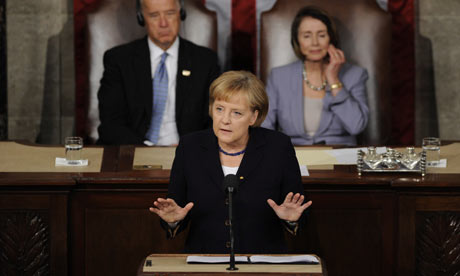
Chancellor of Germany Angela Merkel delivers remarks to a joint session of Congress on Capitol Hill, Washington DC, USA, 03 Nov 2009. Photograph: Rainer Jensen/EPA
International negotiators lost one of the key elements to a successful deal on global warming today after Democratic leaders in the US Congress ruled out passing a climate change law before 2010. In the latest obstacle on the road to the UN summit in Copenhagen next month, Senate leaders ordered a five-week pause to review the costs of the legislation.
We only have months, not years, to save civilisation from climate change
We only have months, not years, to save civilisation from climate change
International agreements take too long, we need a swift mobilisation not seen since the second world war
-
- guardian.co.uk, Tuesday 3 November 2009 16.30 GMT
- Article history

Time is running out to save civilisation from climate change. Photograph: Lionel Bonaventure/AFP/Getty Images
For those concerned about global warming, all eyes are on December’s UN climate change conference in Copenhagen. The stakes could not be higher. Almost every new report shows that the climate is changing even faster than the most dire projections of the Intergovernmental Panel on Climate Change (IPCC) in their 2007 report.
Yet from my vantage point, internationally negotiated climate agreements are fast becoming obsolete for two reasons. First, since no government wants to concede too much compared with other governments, the negotiated goals for cutting carbon emissions will almost certainly be minimalist, not remotely approaching the bold cuts that are needed.
Kilimanjaro ice could vanish within 20 years, study suggests
Kilimanjaro ice could vanish within 20 years, study suggests
Global warming not local weather variations to blame for loss of up to 17 feet of ice, say scientists
- guardian.co.uk, Tuesday 3 November 2009 12.05 GMT
- Article history
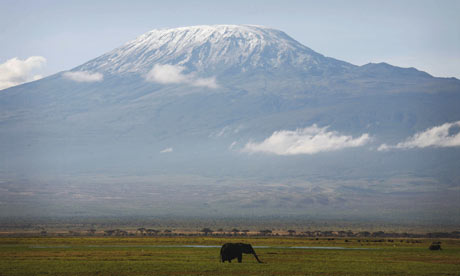
An elephant grazes at the foot of Mount Kilimanjaro in the Amboseli national park, southern Kenya. Photograph: Finbarr O’Reilly/Reuters
The famous Snows of Kilimanjaro that cap Africa’s highest mountain are melting so fast they could be gone within two decades, according to a study of the mountain’s ice fields that used data going back nearly a century.
Scientists believe global warming rather than local weather changes is chiefly to blame for the rapid loss of ice from the Tanzanian peak.
African nations make a stand at UN climate talks
African nations make a stand at UN climate talks
- guardian.co.uk, Tuesday 3 November 2009 23.26 GMT
- Article history
African countries have said they are prepared to provoke a major UN crisis if the US and other rich countries do not start to urgently commit themselves to deeper and faster greenhouse gas emission cuts.
In a dramatic day in Barcelona, UN officials were forced to step in after 55 African countries, in an unprecedented show of unity, called for a suspension of all further negotiations on the Kyoto protocol until substantial progress was made by rich countries on emission cuts.
Earlier, the UN chair had been forced to abandon two working groups after the Africa group refused to take part.
UK bans Malaysian palm oil advert
UK bans Malaysian palm oil advert Ecologist 3rd November, 2009 Second advert from palm oil industry lobby group is banned for its sustainability claims A magazine advert that endorsed the sustainability of palm oil has been banned by the UK’s Advertising Standards Agency (ASA) for making unsubstantiated and untruthful claims. The advert, produced by the Continue Reading →
Solar Industry Emerging from the Darkness
Solar Industry Emerging from the Darkness
Last year at this time, the solar industry was staring into the abyss, uncertain about how disastrous 2009 would be. As it turned out, this year did not bring the apocalypse, and today we have a clear (but somewhat cluttered) path ahead of us.

After meeting with more than 30 solar executives at the Solar Power International conference, we came away with a positive view of the prospects for the industry in 2010. Sure, executives are paid to be upbeat and sell their company — but we believe that much of the optimism is warranted. Companies are getting new orders, capital is flowing back into the space, workers are getting re-hired and some businesses have re-structured themselves to meet current market challenges.