

Schellnhuber: developed countries are ‘carbon insolvent’
Schellnhuber: developed countries are ‘carbon insolvent’
Hans Joachim Schellnhuber, Germany’s climate adviser and respected physicist, shares his stark but simple view of how much CO2 we can emit by 2050. From Carbon Commentary, part of the Guardian Environment Network
- guardian.co.uk, Thursday 10 September 2009 11.42 BST
- Article history
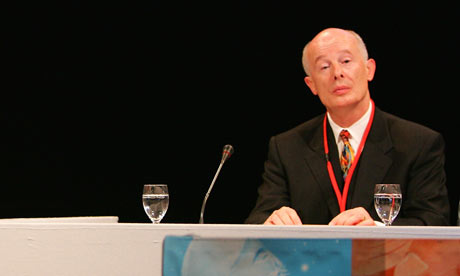
Germany’s climate protection adviser has given a stark view of how much CO2 the world can emit. Photograph: Andreas Rentz/Getty Images
Hans Joachim Schellnhuber is the German government’s climate protection adviser and a distinguished physicist. He was interviewed by the German magazine Der Spiegel last week and gave a starkly simple view of how much CO2 the world can emit.
To achieve a two-in-three chance of keeping temperature increases below 2 degrees, humanity can only emit about 750 billion tonnes of CO2 between now and 2050, he said. (I assume that after 2050 Schellnhuber believes that net emissions must fall to zero or below.) 750 billion tonnes spread over today’s world population of 6.7bn means about 110 tonnes per person between now and mid-century.
Labour’s great green whimper
Labour’s great green whimper
The How to Solve Climate Change handbook seems to be empty except for “increase taxes” scrawled on every page
-
- guardian.co.uk, Wednesday 9 September 2009 16.30 BST
- Article history
If the total collapse of the world’s economy has accomplished anything, I’d like to pretend it’s undermined the all-too-common misinterpretation of Adam Smith, which dictates that the market always knows best. Yet government strategies for reducing greenhouse gas emissions still presume we can spend our way towards carbon neutrality. Increase the cost of polluting behaviour enough and we’ll change our behaviour, emissions will tumble and climate change will recede until it’s just a bogey man climatologists once used to frighten their children.
Total bottled water consumption by region
Total bottled water consumption by region
The impact of bottled water extends to packaging and emissions

Bottled water consumption doubled in some regions between 1997 and 2004. Photograph: Linda Nylind
The amount of bottled water consumed globally has increased phenomenally from 1997 to 2004. This poses a problem, as more bottles mean more greenhouse gases from production and transportation, plus more plastic waste. Perhaps more towns should take a leaf out of the Australian town Bundaboon’s book and ban the sale of bottled water completely.
Most regions have doubled their bottled water consumption, and – in the case of south America – almost tripled it. Globally, bottled water consumption has risen from 80,649 thousand cubic metres in 1997 to 154,381 in 2004. Africa consumed merely 4,823 thousand cubic metres in 2004.
Renewables Impact on the Grid? Answers from Telecom History
Renewables Impact on the Grid? Answers from Telecom History
If I were a senior executive at an investor-owned utility (IOU), I would be more than a little nervous about the spread of Renewables, and grid-tied distributed energy generation sources in general. What would happen to the integrity of my operations if these proliferated in dense clusters in my service areas, and over which I exercised limited control? Can I co-opt them or are they competition? AMI, SmartGrid, and “cap and trade” regulations are innovation enough, I might think, do we have to accommodate distributed generation too?
Personal carbon trading: the next step in tackling carbon emissions?
Personal carbon trading: the next step in tackling carbon emissions?
A report published by the IPPR this week will say personal carbon trading may be the next step in tackling climate change. From the Ecologist, part of the Guardian Environment Network
- guardian.co.uk, Tuesday 8 September 2009 12.10 BST
- Article history
Last week saw the launch of the 10:10 campaign by Age of Stupid film director Franny Armstrong, hailed as a real opportunity to re-engage individuals with the task of reducing domestic CO2 emissions.
To coincide with the launch, the Guardian commissioned a poll, presumably hoping to show people’s willingness to accept carbon reduction measures.
But looking closely at the figures reveals instead the public’s resistance to some forms of carbon pricing.
Although 85 per cent of respondents accepted the threat of climate change, just 33 per cent were willing to accept something like a pay per mile road charging scheme.
So if the necessary carbon reductions cannot be made through voluntary measures will it soon be time to reconsider compulsory carbon allowances?
Elimination of food waste could lift 1 bn out of hunger , say campaigners/
Elimination of food waste could lift 1bn out of hunger, say campaigners
Excessive consumption in rich countries ‘takes food out of mouths of poor’ by inflating food prices on global market
- guardian.co.uk, Tuesday 8 September 2009 17.25 BST
- Article history

Surplus tomatoes are dumped on farmland in Tenerife, Canary Islands, Spain. Photograph: Sally A. Morgan/Ecoscene/Corbis
Eliminating the millions of tonnes of food thrown away annually in the US and UK could lift more than a billion people out of hunger worldwide, experts claim.
Government officials, food experts and representatives of the retail trade brought together by the Food Ethics Council argue that excessive consumption of food in rich countries inflates food prices in the developing world. Buying food, which is then often wasted, reduces overall supply and pushes up the price of food, making grain less affordable for poor and undernourished people in other parts of the world. Food waste also costs UK consumers £10.2bn a year and when production, transportation and storage are factored in, it is responsible for 5% of the UK’s greenhouse gas emissions.