Category: News

Add your news
You can add news from your networks or groups through the website by becoming an author. Simply register as a member of the Generator, and then email Giovanni asking to become an author. He will then work with you to integrate your content into the site as effectively as possible.
Listen to the Generator News online

 
The Generator news service publishes articles on sustainable development, agriculture and energy as well as observations on current affairs. The news service is used on the weekly radio show, The Generator, as well as by a number of monthly and quarterly magazines. A podcast of the Generator news is also available.
As well as Giovanni’s articles it picks up the most pertinent articles from a range of other news services. You can publish the news feed on your website using RSS, free of charge.
 

  • Coal aid rides high above wave power

    Coal aid rides high above wave power


    Amount invested in marine energy is a drop in the ocean against more than £50m for collieries


    The government has spent 20 times more subsidising the coal industry over the past six years than it has put into marine energy, new figures show.


    Ministers have given away £52.8m of a £60m coal investment aid scheme to extend operations at a range of mines around Britain, including Daw Mill in Warwickshire where energy minister Mike O’Brien is the local MP. This contrasts with the £2.3m handed out from a £50m pot created under the Marine Renewables Deployment Fund, which started in 2004 just 12 months after the launch of the latest coal scheme.


    “At a time when we need to deliver a major expansion in renewable energy, it’s astonishing to find that less than 5% of the investment promised to give Britain a lead in marine energy has actually been made,” said Greg Clark, shadow energy and climate change secretary.


    “It is little wonder that Britain punches way below its weight on renewables – we have the third-lowest contribution from renewable energy in Europe, despite some of the best resources.”


    The Observer revealed last month that ministers had spent almost nothing out of the Marine Renewables Deployment Fund, with potential users complaining the conditions attached to grants were so onerous that they could not gain access.


    The amount of cash handed out under the coal aid scheme was recently revealed in parliament and the Conservatives say that all of it – bar one grant – has been spent in Labour constituencies.


    The government has sought to make up lost ground, with money being promised in the recent energy white paper to various tidal and other schemes. More than £20m has been earmarked for a new Marine Renewables Proving Fund with a further £9.5m going to develop a Wave Hub off Cornwall and £8m for a European Marine Energy Centre in Orkney.


    But the Tories argue that ministerial promises mean very little. “It is easy to talk about support for renewables but what we need is action,” said a spokeswoman. The opposition says it would use the money from the Marine Renewables Deployment Fund to establish a network of large-scale marine energy parks to be run on a commercial basis.


    When the coal subsidies were launched in 2003 by the then trade and industry secretary, Patricia Hewitt, the main emphasis was on job retention.


    Last night a spokesman for the Department of Energy and Climate Change said it was not helpful to compare two completely different technologies – coal having been in development for generations, and marine very much cutting edge.


    He added: “We want to be a global leader in wave and tidal energy, that’s why we announced £60m of low carbon investment funding in the budget. That included £22m to help pre-commercial testing of marine technology, which should enable access to the Marine Renewables Deployment Fund.”

  • Shell and BP keen to buy into Tullow’s new oil find in Uganda

    Shell and BP keen to buy into Tullow’s new oil find in Uganda


    Tullow needs cash to fund development of pipelines and infrastructure


    Lake Albert

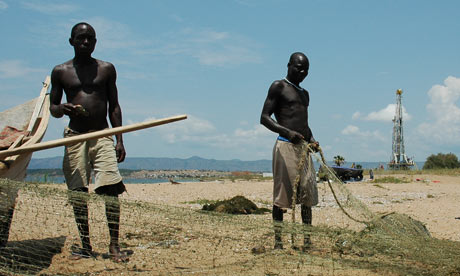
    Fishermen near an oil rig on the edge of Lake Albert in western Uganda, where 700m barrels of oil have been discovered Photograph: Xan Rice


    The world’s biggest oil companies – including BP and Shell as well as state-owned operations from China – are trying to muscle their way into the world’s largest new oil region: Uganda.


    Tullow Oil, the relatively small British-based firm at the centre of the huge energy strikes in Lake Albert, says it plans to hand over part of the oil riches in return for financial help to build pipelines and other vital infrastructure.


    Excitement over the Ngara wells increased when Tullow reported it had encountered further shows of oil and was more convinced than ever about the enormous prospects in the region.


    But the company also announced an 83% slump in first-half profits to £21.4m and a 16% drop in its existing production from the North Sea and elsewhere, while needing billions of pounds to bring oil out of the ground and refine it in Uganda.


    “It is not every day you find a new oil province similar in size to the central Graben region of the North Sea. Practically all the oil majors and some national oil corporations have been on our doorstep seeking to pre-empt a competitive [sales] process”, said Angus McCoss, Tullow’s exploration director.


    Tullow plans to sell part of its 100% stake in Block 2, one of three blocks which cover the Ugandan side of Lake Albert, in the next 12 months, it said, but only through a public offer and not via a bi- lateral deal with one other company.


    Among the possible partners is Eni of Italy which has already been tipped as a potential buyer of the whole Tullow company although the British firm said it was clearly not for sale.


    Tullow shares fell 4% to 1052p on profit-taking following a period where euphoria around the Uganda exploration success has driven the value of the stock up by nearly a third in value since early July.


    McCoss said 700m barrels of recoverable reserves had already been proved up but the latest oil shows put the company on the way to proving that there was a further 1.5bn waiting to be exploited.


    Tullow said Eni, which has a 43% stake in pipeline builder Saipem, would be a suitable partner as would Chinese companies and others but insisted there was currently no favoured partner in mind.


    Tullow said its Ngassa-2 well in Block 2 found signs of oil at two intervals in the reservoir being tested.


    “The pressures in these intervals are higher than normal, which may indicate that they are associated with significant oil columns,” it added.


    Investment bank Citigroup said in a research note that the results of the latest well would pave the way for a part sale of the block as it makes clear how much it is worth.


    The Ugandan government has made clear to Tullow that it would like the company to refine the oil in the area so that the relatively impoverished country could gain as much added value from the energy as possible.


    The African country is also acutely aware that many developing countries have found oil riches can be curse as well as cure with charities warning it can bring corruption and wealth only for the political elite. Nigeria is often held up as an example of this.

  • Water shortage threatens two million people in southern Iraq

    Water shortage threatens two million people in southern Iraq


    Electricity supply to Nasiriyah has dropped by 50% because of falling levels of Euphrates river


    Two million people face life without water Link to this video


    A water shortage described as the most critical since the earliest days of Iraq‘s civilisation is threatening to leave up to 2 million people in the south of the country without electricity and almost as many without drinking water.


    An already meagre supply of electricity to Iraq’s fourth-largest city of Nasiriyah has fallen by 50% during the last three weeks because of the rapidly falling levels of the Euphrates river, which has only two of four power-generating turbines left working.


    If, as predicted, the river falls by a further 20cm during the next fortnight, engineers say the remaining two turbines will also close down, forcing a total blackout in the city.


    Down river, where the Euphrates spills out into the Shatt al-Arab waterway at the north-eastern corner of the Persian Gulf, the lack of fresh water has raised salinity levels so high that two towns, of about 3,000 people, on the northern edge of Basra have this week evacuated. “We can no longer drink this water,” said one local woman from the village of al-Fal. “Our animals are all dead and many people here are diseased.”


    Iraqi officials have been attempting to grapple with the magnitude of the crisis for months, which, like much else in this fractured society, has many causes, both man-made and natural.


    Two winters of significantly lower than normal rainfalls – half the annual average last year and one-third the year before – have followed six years of crippling instability, in which industry barely functioned and agriculture struggled to meet half of subsistence needs.


    “For thousands of years Iraq’s agricultural lands were rich with planted wheat, rice and barley,” said Salah Aziz, director of planning in Iraq’s agricultural ministry, adding that land was “100% in use”.


    “This year less than 50% of the land is in use and most of the yields are marginal. This year we cannot begin to cover even 40% of Iraq’s fruit and vegetable demand.”


    During the last five chaotic years, many new dams and reservoirs have been built in Turkey, Syria and Iran, which share the Euphrates and its small tributaries. The effect has been to starve the Euphrates of its lifeblood, which throughout the ages has guaranteed bountiful water, even during drought. At the same time, irrigators have tried tilling marginal land in an attempt for quick yields and in all cases the projects have been abandoned.


    “Not even during Saddam’s time did we face the prospect of something so grave,” said Nasiriyah’s governor, Qusey al-Ebadi. Just east of the city, the Marsh Arabs are also on the edge of a crisis – unprecedented even during the three decades of reprisals they faced under the former dictator.


    “The current level of the Euphrates cannot feed the small tributaries that give water to the marshlands,” he continued. “The people there have started to dig wells for their own survival. There is no water to use for washing, because it is stagnant and contaminated. Many of the animals have contracted disease and died and people with animals are leaving their areas.”


    Nowhere is Iraq’s water shortage more stark than in what used to be the marshlands. Towards the Iranian border and south to the Gulf, rigid and yellowing reeds jut from a hard-baked landscape of cracked mud.


    Skiffs that once plied the lowland waters lie dry and splintering and ducks wallow in fetid green ponds that pocket the maze of feeder streams. Steel cans of drinking water bought by desperate locals line dirt roads like over-sized letter boxes.


    The Euphrates, once broad and endlessly green, is now narrow and drab. In parts it is a slick black ooze, fit only for scores of bathing water buffalo. Giant pumps lay metres out of reach. Some are rusting. “Not long ago, the level of the Euphrates was at this rust line,” said Awda Khasaf, a local leader in the al-Akerya marshlands, as he pointed at the dwindling river.


    “It has now dropped more than 1.5m. This river feeds all the agriculture lands and marsh lands in Nasiriyah. It smells like this because it is stagnant,” he said. “We turned to agriculture in 1991 after Saddam’s rampage, but now the government has ordered us to stop rice farming.”


    Further up the river Sheikh Amar Hameed, 44, from Abart village said: “We have lost the soul of our lives with the vanishing water. We have lost everything. We are buying drinking water now. The government must find a solution. The young will all become thieves. They have no prospects.”


    Iraq’s water minister, Dr Abdul Latif Rashid, this week estimated that up to 300,000 marshland residents are on the move, many of them newly uprooted and heading for nearby towns and cities that can do little to support them.


    The Marsh Arabs are semi-nomadic and large numbers have remained displaced since Saddam drained the marshes in 1991.


    “In the last 20-30 years our neighbouring countries have built a number of structures for collecting water or diverting water for their agricultural lands,” Dr Rashid said.


    “In some cases, they have diverted the path of the river for their internal use. This has had a very damaging effect. We have a large number of branches of the Tigris that we share with Iran. In most their volumes are low, or completely dried up. In 2006/07 [the marshlands] almost reached 75% of original levels. Now the surface water is around 20%. Water resources have this year become not only serious, but critical. Iraq has not faced a water shortage like this.”


    Officials have tried to compensate by digging wells and bores, especially in the ravaged provinces of the south and in Anbar, west of Baghdad. Delegations have also travelled to Turkey and Syria, where they were warmly received, but have achieved few changes. “We were expecting much more of a release from Turkey,” Dr Rashid said. “Iran has been less receptive. We have had no response from them at all.”


    River wars


    Nile Nine Nile basin countries are in dispute over water-sharing. Countries including Uganda and Rwanda are attempting to overrule a 1959 treaty that restricted building on the river without Egypt’s consent. Egypt is reliant on the volume of water it currently receives.


    Euphrates Iraq and Syria oppose the building of dams on the river by Turkey. Iraq is reliant on the river for irrigation, and damming upriver seriously affects water flow.


    Jordan Israel and Palestine share a water aquifer along the West Bank, but Palestinians only have access to one fifth of the water held there. They are also in dispute over the river Jordan, with Israel claiming 90% control.


    Indus Pakistan is in dispute with India over the Indus river that supplies water to millions. Reservoirs and dams have caused water shortages in downstream areas, such as Karachi. A presidential decision to provide more water to the population in Sindh by closing the Tarbela Dam also caused outrage in neighbouring Punjab, whose water was being diverted.


    Katy Stoddard
  • Islay to be entired powered by tides

    Islay to be entirely powered by tides


    Exclusive: ScottishPower is to build turbines in the Sound of Islay that will generate enough electricity for the island’s 3,500 inhabitants – and its famous distilleries


    Islay tidal stream project

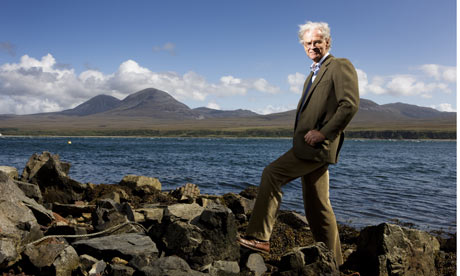
    Philip Maxwell, chairman of the Islay Energy Trust, by the Sound of Islay where the ScottishPower turbines will be sited. Photograph: Murdo MacLeod/Murdo MacLeod


    ScottishPower is planning a tidal energy project that will supply all the electricity for one of Scotland‘s most famous islands, the Guardian can reveal.


    The company is close to signing a supply contract with Diageo, the drinks group, to provide electricity from the project to eight distilleries and maltings on Islay – including the makers of the renowned Laphroaig and Lagavulin whiskies.


    The 10MW tidal project, one of the world’s largest, will provide enough electricity for Islay’s 3,500 inhabitants for 23 hours a day.


    ScottishPower will submit a planning application in the next couple of months and expects the ten 30-metre underwater turbines to be operational in 2011. The turbines will cost about £50m to install.


    The tidal waters in the Sound of Islay, the channel dividing Islay from the Jura, move at up to three metres a second.


    Energy companies and representatives from the Scottish government will publish on Wednesday a “marine energy roadmap” outlining how to reach the target of generating up to 2GW (2,000MW) of electricity from tidal and wave power by 2020. It will call for more grants and revenue support to enable developers to build commercial scale demonstration projects, such as the Islay installation, over the next two years.


    The renewable energy industry admits the techniques to generate electricity from marine energy are in their infancy. Morna Cannon, from Scottish Renewables, said: “This makes it very hard to pin down the costs of the technology at the moment.”


    Alan Mortimer, head of renewables at ScottishPower, admitted tidal energy is more expensive than offshore wind, which costs up to £3m for each megawatt built and itself is only barely economic. Tidal developers earn more subsidies under the Renewable Obligation Scheme than offshore wind, but only once schemes are operational.


    Marine energy developers such as Martin Wright, managing director of start-up company MCT, complain that few investors want to risk their money. But the Islay project has heavyweight backers. ScottishPower is owned by Spanish group Iberdrola and has teamed up with Norwegian oil firm StatoilHydro to develop and finance the project.


    There is also strong support on the island, although it is by no means universal. Kevin Sutherland, manager of the Islay group of Diageo distilleries, works at the Caol Ila distillery, which overlooks the Sound. The distillery, like the rest of the island, gets the majority of its electricity from the Hunterston nuclear reactor on the mainland. But the reactor is being decommissioned in 2016 and the distillery suffers frequent power cuts in stormy weather when pylons are blown over.


    When the tidal project is built, the distilleries on the island will enjoy a much more secure electricity supply, confounding critics of renewable energy – primarily wind power – who say it is intermittent and unreliable.


    One of the biggest obstacles for renewables in Britain has been planning permission. Onshore wind applications are frequently rejected because locals object to the visual impact. Because the Islay generators will be on the seabed, no one can see them and the Scottish government will have the final say on planning.


    Operating underwater brings its own problems, says Cannon from Scottish Renewables. George J Gillies is a local fisherman who fishes for crab and lobster at either end of the channel in winter. He complains that his lobster nets could get tangled in the turbines and says the project threatens the livelihood of eight local fishing families. But he seems resigned: “If it’s going to generate money, it will get the go-ahead.”


    The Islay Energy Trust, a community organisation chaired by Philip Maxwell, has been helping to lobby local politicians and opponents of the project. In return, it will receive a small slice of the revenue to fund community projects on the island, such as a swimming pool

  • South-east chosen as wind-power hub

    South-east chosen as wind-power hub


    ABC August 26, 2009, 9:09 am


    The New South Wales Government plans to fast-track renewable energy projects in the state’s south-east.


    The Far South Coast and Monaro are among six areas to be included in a green energy planning initiative.


    Benefits include a four-month planning turn-around, access to staff dedicated to regional projects and a moratorium on fees until June 2011.


    Member for Monaro Steve Whan says the region has been selected because of dependable wind patterns.


    “The key thing about wind energy is that you need a steady supply of the basic ingredient, natures wind,” he said.


    “That’s certainly something we’ve got and … we seem to have almost too much of it right at the moment.


    “We’ve got a terrific wind resource in the area.


    “We’ve also got strong community grass roots support for clean energy.”

  • The Business and Politics of Carbon

    August 13, 2009
    The Business and Politics of Carbon
    by Alison Wise, National Renewable Energy Lab
    The activity around making markets for carbon continues to grow as climate issues gain more traction in the policy realm under a new administration. For those who are not up to speed on the ins and outs of carbon markets in general, I would refer them to the last time I wrote about the issue, a link to which can be found at the end of this article.


    This time around I will focus on the business case for carbon offsetting and on the treatment of carbon in the Waxman-Markey legislation currently being debated in Congress. Broadly speaking, voluntary carbon markets refer to the markets for carbon credits outside the scope of regulated carbon reduction. They are driven by businesses and organizations that pay a third party to make a measurable reduction in greenhouse gas emissions (usually CO2) though they have no legal requirement to do so. This reduction “offsets” the organization’s current carbon footprint, “crediting” it with the equivalent reduction.
    Until legislation mandates some sort of action towards carbon mitigation, whether a cap and trade mechanism or a carbon tax, there is no compliance market for carbon nationally in the United States. According to a recent report by New Energy Finance, the value of the transactions in the voluntary carbon market globally has doubled in the past two years, increasing from US $335 million in 2007 to $705 million in 2008.
    It is interesting to dig a bit deeper into why these voluntary markets are growing despite having no compliance mechanisms. Ultimately, a regulated market for carbon based on mandatory parameters may be the most effective, but in the interim there has been increasing involvement with voluntary carbon markets, with the drivers coming from the private sector. The New Energy Finance report outlines some interesting findings for the “business case” for carbon off-setting:
    First, New Energy Finance identified 3,000 organizations that were end-buyers of voluntary carbon offsets. This number was seen as “significant” given the industry’s common characterization as a “fringe” entity.
    The greatest business benefit from carbon offsetting is the protection or enhancement of corporate reputation, according to those surveyed in the New Energy Finance report. This is interesting in light of the fact that one of the drivers for sustainability measures within corporations in general is risk mitigation. Companies have reported that a motivating factor for adopting sustainability principles is the protection or enhancement of brand value, an intangible asset that all companies need to protect. It seems that this motivation applies to carbon offsetting as well.
    While a business case can be made for carbon offsetting, it was not the only reason for engaging in that activity. According to their respondents, 15% of those companies New Energy Finance surveyed said that offsetting their emissions was driven by the desire to be a good corporate citizen (that said, one could argue that being a good corporate citizen inherently protects your brand’s reputation, which is good for the bottom line).
    Surprisingly, carbon offsetting activity did not positively impact employee morale in any significant way. In fact, employees were confused about how carbon offsets worked and why it was beneficial to engage in this activity.
    Finally, given the “scale and diversity” of offset users, New Energy Finance predicted that the voluntary carbon market will continue to grow, once the global recession is over.
    While the voluntary carbon market is an important transitional step toward an economy that captures the true cost of a carbon intensive energy system, it will most likely take some sort of regulatory approach to accelerate the internalization of carbon externalities in the marketplace. So, let’s turn to the most prevalent legislative mechanism that is seeking to accomplish that end: The Waxman-Markey Clean Energy Bill (H.R.2454), otherwise known as the American Clean Energy and Security Act of 2009 (ACES Act).
    According to many spectators and participants, this bill represents a demonstrable move towards the United States adopting clear, identifiable carbon reductions. That said, according to those involved with the clean energy industry, there are many challenges to be met in terms of decision-makers crafting a piece of legislation that would effectively address the carbon issue, in turn accelerating the markets for energy efficiency and renewable energy.
    Tim Greeff, political director at the Clean Economy Network, puts it this way, “While there are many important provisions in the legislation that will help facilitate a more rapid transition to the deployment of cleaner technologies, the legislation faces a substantial hurdle in the Senate. As it stands now, there are well over a dozen Senators who have significant concerns with different provisions of the bill and are not convinced of its benefits for clean energy, jobs and the economy. ”
    The bill outlines a cap and trade mechanism for greenhouse gas emissions reduction, aiming to decrease emissions by 17% by 2020. However, the cap and trade program being designed within this legislation would give away 81% of allowances for free, as opposed to the cap and trade program advocated by the White House which would auction off the allowances and use the proceeds for clean energy investments and a tax cut for the underprivileged. Other aspects of the legislation:
    The bill allocates 36% of allowances to the power generation sector through 2025
    Auctioned volumes would increase dramatically after 2025, rising from 19% to 65% by 2030. Beginning at a low auction rate would allow covered entities (the power sector) time for the technological transition they will need to make in a carbon constrained economy
    The legislation would ease restrictions on offset usage to reduce compliance costs. After 2017, it would remove an 80% offset discount factor for international offsets and allow increased international offset usage to compensate for domestic shortages of offsets when domestic prices are less than or equal to allowance prices
    The bill relaxes criteria for inclusion in the early offset supply pool to broaden the scope of eligible programs beyond the Climate Action Registry and the Regional Greenhouse Gas Initiative (this may address some of the shortage issues of domestic offsets)
    Getting the program and the price right in this new approach to carbon mitigation will be key to making sure that we are creating the right landscape for accelerating markets for renewables, efficiency services and technology. The internalization of carbon costs into our economic infrastructure will be important for creating the right market environment for the uptake of renewables, perhaps as important as the creation of a smart grid to be able to integrate distributed generation beyond niche applications. But that’s a story for another day.