Category: News

Add your news
You can add news from your networks or groups through the website by becoming an author. Simply register as a member of the Generator, and then email Giovanni asking to become an author. He will then work with you to integrate your content into the site as effectively as possible.
Listen to the Generator News online

 
The Generator news service publishes articles on sustainable development, agriculture and energy as well as observations on current affairs. The news service is used on the weekly radio show, The Generator, as well as by a number of monthly and quarterly magazines. A podcast of the Generator news is also available.
As well as Giovanni’s articles it picks up the most pertinent articles from a range of other news services. You can publish the news feed on your website using RSS, free of charge.
 

  • Men- not the only greens


    Men – not the only greens


    When it comes to climate change talks, women are an endangered species. But our input is crucial


    I am always amazed when I walk into meetings with the prime minister and groups campaigning on climate change to find that I suddenly appear to be an endangered species. As a woman involved in climate change campaigning on a national and international level, I am often left stunned to think that over half the world’s population is being represented in meetings across the world by a tiny number of female voices.


    From Britain’s environment ministers, past and present, to prominent campaigners such as Jonathan Porritt or George Monbiot, global converts such as Al Gore, and the panoply of climate change negotiators from Kyoto to Copenhagen, men are dominating this debate.


    What is it about the issue of climate change that means women do not get involved? Undoubtedly, in the realm of decision-making, it is a failure of politics to catch up with 21st-century equality. In terms of campaigning, environmental journalism and grassroots activism, I suspect the reasons may be more complex, and stem from women themselves feeling shut out from a lot of very male-dominated debates.


    I am privileged to represent more than 205,000 women across England and Wales, many of whom have spent the last few years raising awareness about the threat of climate change in their communities. Building on this, the National Federation of Women’s Institutes recently launched a national campaign to get the government to recognise the unique role that women can play. Our members are sending postcards to urge Ed Miliband, the climate change secretary, to do more than pay lip service and to recognise the role of women in agreements at the December climate conference in Copenhagen.


    Women remain particularly influential consumers of domestic products and utilities, and could choose greener energy suppliers and appliances. Britain’s women control over £400m more expenditure every week than men do. The consequences of even a tiny proportion of that total being spent with the environment in mind would be huge, and would create demand for more sustainable goods. Think of that the next time you’re standing in the cleaning product aisle in the supermarket.


    Women are also still the primary educators of the next generation and so have huge power to change the way children think about their coexistence with the planet. In developing countries, women are the guardians of natural resources – collecting food, water and fuel for their families. They also make up over 70% of the world’s poorest citizens, and because of this they will be hit the hardest when the impacts of climate change are felt, as their position in society in many countries makes them less well equipped to deal with emergencies.


    Projects and examples from all around the world have demonstrated that women can be powerful agents of change when they are provided with the right tools, helping to make a better life for themselves, their families and their communities. Individual women can make a difference to the future of our planet. Our members have demonstrated this by building eco-homes, reducing their car use, switching to green suppliers or reducing the energy they use in their homes.


    If we want our children and grandchildren to have a world worth enjoying, now is the time for women to stand up and be counted. Forget being indifferent to climate change – make some noise, be an environmental consumer, find out more about the issues, get interested, get involved. Rise up and make your voices known. The status quo is not good enough: women have a powerful and important place in tackling climate change, and know more than anyone the direct impact on families and communities across the world.

  • AGL to develop renewable energy projects.


    AGL to develop renewable energy projects


    Updated: 14:52, Sunday August 23, 2009


    AGL to develop renewable energy projects


    AGL Energy says it will develop $6 billion to $7 billion in renewable energy projects over the next decade.


    AGL Energy chief executive Michael Fraser said the recent passage of renewable energy target (RET) legislation through parliament was ‘very significant’ for AGL.


    The passage of the RET means that from January there will be a target requiring 20 per cent of electricity to be generated from renewable energy sources by 2020.


    ‘We are the largest developer of renewable assets in the country, and this really means that we are going to be able to accelerate our development program,’ Mr Fraser told the ABC’s Inside Business program on Sunday.


    Mr Fraser said that in total, about $25 billion to $30 billion of renewable projects would have to be built over the next decade to meet the RET target.


    ‘We intend to develop a pipeline of our projects so when we look over the next decade that’s probably six to seven billion dollars worth of projects on our own,’ he said.


    ‘We’ve already got over two billion dollars worth of projects on our books, so over the longer term, it’s a very significant value-creation opportunity for the company.’


    Mr Fraser said that under the RET, about 4,500 wind turbines would have to be built to supply about 9,000 megawatts of power.


    He agreed that the RET legislation would ‘crowd out’ gas-fired power generation.


    ‘Yes, that is definitely what will happen,’ Mr Fraser said.


    He said renewable power-generation technologies were dominated by wind power.


    Mr Fraser rejected a suggestion that AGL, which also has interests in the gas and brown coal sectors, would be happy about delays in the passage through federal parliament of the government’s emissions trading scheme (ETS).


    ‘Around the ETS, we want that in place. We think that’s a very important component,’ Mr Fraser said.


    He said the ETS would result in additional costs to the energy industry and to the economy.


    ‘(But) what we really want is that legislation in place. We want certainty about what the business environment is going forward.’


    Mr Fraser said companies would find it hard to make investment decisions unless there was certainty.


    He said that, ultimately, sensible legislation would be put in place around a Carbon Pollution Reduction Scheme (CPRS), but it would require transition arrangements to ‘make sure that the lights stay on’.


    Mr Fraser acknowledged that under the legislation coal-fired power stations using brown coal would eventually have to shut down unless they become cleaner.


    ‘When we look forward, ultimately, if there are no advances in carbon capture and storage, then ultimately, yes, the objective of the legislation is that those generators will be shut down and other generation will take its place,’ he said.

  • Coalition vows to fight emissions scheme.

    Coalition vows to fight emissions scheme


    NB (Could lead to a Double Dissolution)


    Posted 42 minutes ago


    The Coalition says if it wins the next election, it would consider changing the Federal Government’s emissions trading scheme, should it be passed by Parliament.


    The Government is hoping its emissions trading scheme will pass the Senate the second time around by negotiating changes with the Coalition.


    Even if they reach an agreement that would see the scheme passed into law, Opposition Leader Malcolm Turnbull says he would consider changing it if the Coalition is returned to Government.


    “We may well go to the election wth proposals to amend it or change it,” he said.


    Nationals Senate leader Barnaby Joyce goes much further, saying the Nationals will not accept the emissions trading scheme at all.


    “That system has to be dismantled, you can’t go forward with a system that sends you broke,” he said.


    The second Senate vote is expected to be in November.


    At their annual conference on Saturday, the Nationals vowed to vote against the Government’s emissions trading scheme regardless of what the Liberals decide.


    Tags: federal-government, federal-parliament, labor-party, liberal-party, nationals, australia

  • China’s spiralling consumption is fuelling waste and pollution

    China’s spiralling consumption is fuelling waste and pollution


    China’s government and the domestic market are calling for greater spending. Economic growth may be maintained, writes Huo Weiya, but US-style living may mean we need another two Earths. From ChinaDialogue, part of the Guardian Environment Network


    To maintain an 8% economic-growth target through the current global financial crisis, the Chinese government has launched an investment stimulus package worth four trillion yuan (US$585 billion) and eased bank-lending restrictions. But another important measure is the increasing of individual consumption.


    In 2008, the Chinese government launched “village appliance” schemes nationwide, with subsidies used to increase sales of televisions, refrigerators, washing machines and mobile phones in rural areas. Another two billion yuan (nearly US$300 million) was invested in 2009 in a “new-for-old” policy that will see individuals and businesses sell old appliances back to the state and receive a 10% subsidy on new purchases. Besides this, the automobile market is benefiting from subsidies and tax breaks, and many cities have handed out shopping vouchers to local people.


    The export-oriented economy has been hard-hit by the economic turmoil, increasing the government’s determination to make the domestic market the engine of growth. “Increase domestic demand, maintain growth” is seen as the secret to guiding the economy through hard times. But there are dangers hidden in this strategy, and there will be considerable environmental consequences if a long-term approach is not taken.


    First, there is the issue of reusing resources. In China, it is not just rubbish that gets buried in landfill; many materials that could be reused also end up there. And once products have been used, they are treated as rubbish and thrown away. Any recycling that takes place is often the result of scrap collectors sifting through rubbish for the more valuable items; the rest goes to scrap or compost.


    Increasing amounts of rubbish mean that many cities – including Beijing – are at risk of being surrounded by landfill sites and are turning to power-generating incinerator plants. This is controversial, with environmental bodies saying China should be sorting and recycling its rubbish. But China does not have a system for sorting rubbish.


    When explaining the “new-for-old” policy, a National Development and Reform Commission (NDRC) spokesperson said that it would see five million appliances replaced, while 90 million of the types of appliances mentioned above would be discarded annually. But the pervasive presence of scrap collectors throughout China’s cities demonstrates that standardised collection and disassembly companies are not yet common. The sector is dominated by small, informal traders, and the environmental consequences of this already have already been covered in our earlier article “Low-carbon living begins at work”.


    The authorities released guidance alongside the “village appliances” and “new-for-old” policies, but with the recycling sector just getting started, it is unclear if the measures will be effective and if they will reach out into the rural areas.


    In February, the State Council issued Regulations on Recovery Processing of Waste Electrical and Electronic Products, setting out the direction for the sector. But this only comes into effect in 2011. Until then, those small scrap merchants will be the main channel for recycling. They will purchase discarded appliances and then sell them on to companies unable to process them properly or to small, unregistered workshops.


    The inadequate processing of waste doesn’t just create pollution; it’s also the cause of significant waste. According to the same State Council spokesperson, the new-for-old policy would see 2.3 million tonnes of resources collected for reuse. But without systems in place, much of that will be treated as garbage.


    Another risk is the inflation of consumer expectations. A special feature on a well-known Chinese website, 21cn.com, recently described white-collar workers as the killers of the environment. The white-collar lifestyle involves high levels of consumption, and consumption is the natural enemy of the environment. In a poll on the website, the vast majority of those surveyed said that it is everyone’s duty to protect the environment.


    But despite these views, what actually happens is different. From July 1, hotels in the city of Changsha were no longer supplying items such as disposable toothbrushes and single-use tubes of toothpaste for free; they will be charged for. A survey on People.com.cn found 77% of respondents opposed the move, complaining of inconvenience.


    These two surveys demonstrate the clash between ideas of consumption and environmental protection. Environmental awareness was non-existent three decades ago. Today, the environment is often the focus of public debate. But the Chinese seem to be becoming ever more like the Americans they so often point fingers at – happy to protect the environment, as long as they don’t need to change their lifestyles.


    The “3R” principles of waste-management strategy are “reduce” (to minimise energy and resource use), “reuse” (to use an item more than once), and “recycle” (to process used items into new products). Reduction and recycling have been put into political and economic practice, but reuse — the concept at the heart of the circular economy – has been given the cold shoulder. Most consumers seem to have left environmental matters to environmental groups. As long as they can afford to, they’ll consume as much as possible that is new.


    China is placing more emphasis on its domestic market, with a range of methods applied to increase consumption and boost the economy, thereby making consumption seem ever more natural. With both the government and the market calling for greater spending, will China’s potential consumption be realised?


    The Chinese did not use to be heavy consumers, either because they did not have the funds or the lack of a welfare system meant they saved their money for a rainy day. But 30 years of economic growth have given us ample material desires – a lifestyle of keeping up with the rich, keeping up with the Americans, has taken root. As soon as we are able to consume, we do so – no less than the citizens of developed nations do. Economic growth may be maintained, but as the environmentalists warn, we may need another two Earths to meet the new US-style consumption of the Chinese nation.


    • Huo Weiya is operations and development manager for chinadialogue in Beijing and former editor-in-chief of Environmental Culture Newsletter.


    • This article was shared by our content partner ChinaDialogue, part of the Guardian Environment Network

  • Food supplies at risk from price speculation, warns expert

    Food supplies at risk from price speculation, warns expert


    Global food markets must be regulated to avoid speculators creating panic with artificial prices rises, says the head of the International Food Policy Research Institute


    The world food market is still “seriously exposed” to speculators artificially driving up prices and worsening the risks of malnutrition, according to one of the world’s leading agricultural researchers.


    Linking the recent food and financial crises, Joachim von Braun, the head of the International Food Policy Research Institute (IFPRI), warned that the world was at risk of a new panic over grain unless commodity markets were more tightly regulated and production expanded.


    “The banking sector is in the process of being re-regulated worldwide, but the food market remains seriously exposed to short-term flows of indexed funds into commodity exchanges. That vulnerability needs to be addressed,” he said in an interview with the Guardian.


    Von Braun was one of the first to predict the sharp rise in food prices that peaked last year, when 13 nations halted cross-border trade amid fears of shortages.


    The crisis, which escalated over four years, hit poor people hardest and saw pasta protests in Italy, tortilla rallies in Mexico and onion demonstrations in India.


    During that period, the UN’s Food and Agriculture Organisation estimates the number of hungry people in the world rose from about 800 million to more than 1 billion.


    At the time, most of the blame for the price spike centred on growing populations, climate change, biofuels, rising oil prices and increased demand from fast-growing economies like China and India that were running down food stocks.


    But von Braum said recent research highlighted the role of commodity speculators: “What we didn’t foresee two years ago is how speculation exacerbated the real market issues. It was not a primary cause but a second-round amplifier, which added seriously to the problem.”


    Daily trading volumes on the Chicago commodities exchange surged at the peak of the crisis between December 2007 and March 2008, boosted by the entry of non-commercial investors entering the market to speculate.


    “When food supply is at risk, speculators are attracted, especially when trade barriers are put in place,” he warned.


    Exchanges in India and China were closed down to prevent similar speculative attacks.


    The global credit crunch also hamstrung government efforts to boost food production by reducing the money available for investment in new technology and better irrigation.


    With climate change expected to reduce yields by 15% by 2050 even as demand grows from a rising world population, von Braum said it was important for nations and international institutions to respond with more funds for agriculture.


    China, Japan, South Korea and several Middle Eastern nations have begun buying up farmland in Africa and South America as a hedge against food shortage risks.


    Global prices are down from their peak thanks partly to effective measures by the Chinese government to rebuild grain stocks, increased agricultural investment in India and a great focus on food production in the aid programmes of the UK and other donor nations.


    But von Braun said prices remain high in many African countries because of trade constraints and foreign exchange rates, while an unusually dry Indian monsoon could affect harvests in Asia. A UN report published earlier this week warned that Asia faces dire food shortages unless hundreds of billions of dollars are invested in better irrigation systems to grow crops for its growing population.


    “Fundamentally, the crisis of high food prices in the majority of poor countries is not over at all,” said von Braun.

  • Nile Delta: ‘We are going underwater. The sea will conquer our lands’

    Nile Delta: ‘We are going underwater. The sea will conquer our lands’


    The Nile Delta is under threat from rising sea levels. Without the food it produces, Egypt faces catastrophe


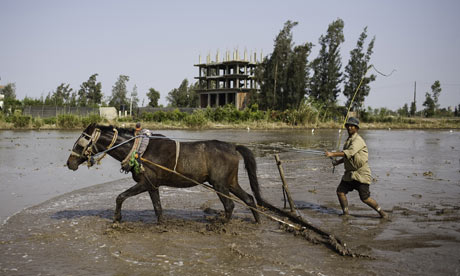
    A farmer ploughs his rice paddy in the Delta

    A farmer ploughs his rice paddy in the Delta. Photograph: Jason Larkin


    Maged Shamdy’s ancestors arrived on the shores of Lake Burrulus in the mid-19th century. In the dusty heat of Cairo at the time, French industrialists were rounding up forced labour squads to help build the Suez Canal, back-breaking labour from which thousands did not return. Like countless other Egyptians, the Shamdys abandoned their family home and fled north into the Nile Delta, where they could hide within the marshy swamplands that fanned out from the great river’s edge.


    As the years passed, colonial rulers came and went. But the Shamdys stayed, carving out a new life as farmers and fishermen on one of the most fertile tracts of land in the world. A century and a half later, Maged is still farming his family’s fields. In between taking up the rice harvest and dredging his irrigation canals, however, he must contemplate a new threat to his family and livelihood, one that may well prove more deadly than any of Egypt‘s previous invaders. “We are going underwater,” the 34-year-old says simply. “It’s like an occupation: the rising sea will conquer our lands.”


    Maged understands better than most the menace of coastal erosion, which is steadily ingesting the edge of Egypt in some places at an astonishing rate of almost 100m a year. Just a few miles from his home lies Lake Burrulus itself, where Nile flower spreads all the way out to trees on the horizon. Those trunks used to be on land; now they stand knee-deep in water.


    Maged’s imperial imagery may sound overblown, but travel around Egypt’s vast, overcrowded Delta region and you hear the same terms used time and again to describe the impact climate change is having on these ancient lands. Egypt’s breadbasket is littered with the remnants of old colonisers, from the Romans to the Germans, and today its 50 million inhabitants jostle for space among the crumbling forts and cemeteries of those who sought to subjugate them in the past.


    On the Delta’s eastern border, in Port Said, an empty stone plinth is all that remains of a statue of Ferdinand de Lesseps, the man who built the Suez Canal; somewhere along the Delta’s westernmost reaches, the long-lost tomb of Cleopatra lies buried. With such a rich history of foreign rule, it’s only natural that the latest hostile force knocking at the gates should be couched in the language of occupation.


    “Egypt is a graveyard for occupiers,” observes Ramadan el-Atr, a fruit farmer near the antiquated town of Rosetta, where authorities have contracted a Chinese company to build a huge wall of concrete blocks in the ocean to try to save any more land from melting away. “Just like the others, the sea will come and go – but we will always survive.”


    Scientists aren’t so sure. Two years ago, the Intergovernmental Panel on Climate Change declared Egypt’s Nile Delta to be among the top three areas on the planet most vulnerable to a rise in sea levels, and even the most optimistic predictions of global temperature increase will still displace millions of Egyptians from one of the most densely populated regions on earth.


    The Delta spills out from the northern stretches of the capital into 10,000 square miles of farmland fed by the Nile’s branches. It is home to two-thirds of the country’s rapidly growing population, and responsible for more than 60% of its food supply: Egypt relies unconditionally on it for survival. But with its 270km of coastline lying at a dangerously low elevation (large parts are between zero and 1m above sea level, with some areas lying below it), any melting of the polar ice caps could see its farmland and cities – including the historical port of Alexandria – transformed into an ocean floor. A 1m rise in the sea level, which many experts think likely within the next 100 years, will cause 20% of the Delta to go underwater. At the other extreme, the 14m rise that would result from the disappearance of Greenland and western Antarctica would leave the Mediterranean lapping at the northern suburbs of Cairo, with practically all of the Delta underwater.


    Already, a series of environmental crises are parking themselves on the banks of the Nile. Some are subtle, like the river’s quiet vanishing act in the Delta’s northern fields; others, like the dramatic collapse of coastal lands into the ocean, are more striking. Major flooding is yet to become a reality but, from industrial pollution to soil salinity, a whole new set of interconnected green concerns is now forcing its way into Egyptian public discourse for the first time.


    “The Delta is a kind of Bangladesh story,” says Dr Rick Tutwiler, director of the American University in Cairo’s Desert Development Centre. “You’ve got a massive population, overcrowding, a threat to all natural resources from the pressure of all the people, production, pollution, cars and agricultural chemicals. And on top of all that, there’s the rising sea. It’s the perfect storm.”


    Follow the Nile north out of Cairo on the old agricultural road, and you find it hard to pinpoint where the city ends and the lotus-shaped Delta begins. Carpeted with redbrick apartment blocks and spliced with streets in every direction, the lush greenery of the Nile’s splintered arteries is almost impossible to appreciate in isolation. This is where the urban and the rural get lost in each other, with livestock living in doorways and workers camping out in fields. In the past, literary giants venerated the Delta’s wild marshlands; today, any clear-cut divisions between the metropolis and the countryside have long faded away.


    Urban encroachment – the steady chipping away at arable land through unauthorised construction – haunts the Delta everywhere you look. Despite a web of legislation outlawing illegal building practices and theoretically “fencing off” agricultural land, in every direction the sweeping vista of wheat fields and rice paddies always ends abruptly in a cluster of half-built homes. There are more than 4,000 people per square mile in the Delta; it’s hard to think of any other place where humans and the environment around them are more closely intertwined. With Egypt’s present-day population of 83 million set to increase to more than 110 million in the next two decades, the seemingly unstoppable spread of bricks and mortar over the soil is both the most visible symptom of the country’s demographic time-bomb and an inevitable response to it.


    More people in the Delta means more cars, more pollution and less land to feed them all on, just at a time when increased crop production is needed most. Yet the desertification of land through human habitation is, worryingly, only the beginning of the problem. Although few in the Delta have noticed it yet, the freshwater of the Nile – which has enabled Egypt to survive as a unified state longer than any other territory on earth – is creaking under the strain of this population boom. The world’s most famous river has provided the backdrop to all manner of dramas throughout history, real and fictional. Now, around its northernmost branches where the minarets and pylons thin out and the landscape becomes more windswept, another is playing out to devastating effect.


    The villain is salinity. I visit one of the worst-affected regions, Kafr el-Sheikh, on a Friday morning when the fields have emptied out for the noon prayer. The streets are eerily silent; with its people gone, the area takes on the appearance of one of Italo Calvino’s fantastical string cities, chock-a-block with the shells of human habitation but no living souls remaining. The exception is Maged, who owns six feddan (about six acres) of land near the village of el-Hadadi.


    Maged is halfway down a hole when I approach his house. Clambering out apologetically, he explains that German experts visited this area last year and declared that the fresh water being pumped to local villages “wasn’t fit for a dog to drink”. After months of phone calls to the national water company, none of which were answered, Maged decided to lay down a new set of pipes himself in the hope it would improve the quality of drinking water for his two young daughters. It’s hot, exhausting work, which he fits in between his farming duties and a new part-time job as an accountant in a local alfalfa plant. “We don’t have much time on our hands at the moment,” Maged says, dusting himself off and gulping down some fresh melon juice. “Nobody can make a living solely off the land any more.”


    On a tour of his fields, I see why. The rich brown soil has greyed out in recent years, leaving a barren salt-encrustation on the surface. The cause is underground saltwater intrusion from the nearby coast, which pushes up through the soil and kills off roots. Coastal farmland has always been threatened by saltwater, but salinity has traditionally been kept at bay by plentiful supplies of fresh water gushing over the soil and flushing out the salt. It used to happen naturally with the Nile’s seasonal floods; after the construction of Egypt’s High Dam in the 70s (one of the most ambitious engineering projects on earth), these seasonal floods came to an end, but a vast network of irrigation canals continued to bring gallons of fresh water to the people who worked the land, the fellahin, ensuring salinity levels remained low.


    Today, however, Nile water barely reaches this corner of the Delta. Population growth has sapped its energy upstream, and what “freshwater” does make it downriver is increasingly awash with toxins and other impurities. Farmers such as Maged now essentially rely on waste water – a mix of agricultural drainage and sewage – from the nearby town of Sidi Salim.


    The result is plummeting fertility; local farmers say that whereas their fathers spent just a handful of Egyptian pounds on chemicals to keep the harvests bountiful, they now have to put aside between 25 and 80% of their profits for fertilisers just to keep their crops alive.


    “We can see with our own eyes that the water is no good, it’s less and less pure,” Maged says. He points out huge swaths of neighbouring land that once glimmered with rice paddies; recently they have been dug up and replaced by fish farms, the ground too barren for crop cultivation. Further out, in the village of Damru, the green fields of 10 years ago are cracked and brown, now put into service as informal football pitches and rubbish dumps.


    Experts believe the problem is only going to get worse. “We currently have a major water deficit in Egypt, with only 700 cubic metres of freshwater per person,” explains Professor Salah Soliman of Alexandria University. “That’s already short of the 1,000 cubic metres per person the UN believes is the minimum needed for water security. Now, with the population increase, it will drop to 450 cubic metres per person – and this is all before we take into account the impact of climate change.”


    That impact is likely to be a 70% drop in the amount of Nile water reaching the Delta over the next 50 years, due to increased evaporation and heavier demands on water use upstream. The consequences of all these ecological changes on food production are staggering: experts at Egypt’s Soils, Water and Environment Research Institute predict that wheat and maize yields could be down 40% and 50% respectively in the next 30 years, and that farmers who make a living off the land will lose around $1,000 per hectare for each degree rise in the average temperature.


    The farmers here feel abandoned by the state; there are regular dismissive references to the “New Age”, a euphemism for the much-hated regime of President Hosni Mubarak, whose neoliberal reform programmes and widespread corruption scandals have provoked a wave of popular discontent across the country. This disconnect between the state and its people has led to distrust of government scientists who think coastal erosion, rather than freshwater scarcity, is the main reason for the farmers’ problems. And, in a worrying twist for Egypt’s creaking economy, the erosion isn’t only affecting farmers. “Unfortunately, most of our industry and investment has been built on sites very close to the shore,” says Soliman. “There’s only so much water we can hold back.”


    Ras el-Bar is a small holiday resort at the mouth of the Nile’s Damietta branch. This was the summer paradise that Nobel prizewinning novelist Naguib Mahfouz’s well-heeled characters would escape to when the heat of the capital became unbearable; today its squat pink lighthouse and endless boulevards of deserted, low-rise holiday homes have the faded feel of a 50s Disneyland.


    Although still popular in July and August, Ras el-Bar has been overtaken as a seaside destination by the brash consumerism of a new generation of towns: Sharm el-Sheikh, Marina, Hurghada. In place of tourists, however, new factories have arrived here in abundance, including some that nearby residents believe are poisoning the air. The arrival of one industrial plant in Damietta, which coincided with the ministry of environment’s last-minute decision not to designate the area a protected nature reserve, is a familiar story of shady backdoor deals, public outrage and the studious disregard of local opinions. In this case, the locals managed to postpone the factory’s construction, but other plants remain. “In the morning here you can see nothing but smoke,” says Mohammed Fawzia, who is fishing in a canal down by the side of an industrial complex run by the state-owned Mopco company. “Take photos of it for us so we can show who is killing our children. We want the factories gone.”


    Many Cairo-based experts, however, insist that the task of coping with the dramatic ecological changes faced by the Delta is made harder by the ignorance of people such as Mohammed. They claim the fellahin are too uneducated to change their ways. But they are wrong: while farmers in the southern Delta, where Nile water is still relatively plentiful, have little knowledge of climate change, those in the north are painfully aware of the science behind the death of their land. However, they also have little time to listen to the harrying of a government which is widely seen to preach green rhetoric on the one hand but is only too willing to sell out the environment on the other, along with the local people.


    Money talks in Egypt, and sustainable development is forgotten when the interests of the rich and powerful – such as the industrial plants in Damietta or the influential Badrawi clan in Daqahliyah – are at stake. The repression and self-interest of Mubarak’s inner circle have left them bereft of any moral authority on environmental issues.


    And while scientists, academics and community organisers are making a concerted effort to educate Egyptians about the dangers of climate change, there is confusion over whether the focus of all these programmes should be on promoting ways to combat climate change, or on accepting climate change as inevitable and instead encouraging new forms of adaptation to the nation’s uncertain ecological future.


    Efforts are further hampered by a popular feeling that this is a crisis made by the west. “We’re not responsible for climate change,” says Soliman, pointing out that Egypt’s contribution to global carbon emissions is an underwhelming 0.5%, nine times less per capita than the US. “But unfortunately the consequence of climate change is no respecter of national borders.”


    The scale of the crisis – more people, less land, less water, less food – is overwhelming, and has infected discussion of climate change with a toxic combination of cynicism and fatalism at every level. There are senior environmental officials in top scientific jobs here who do not believe climate change is real; others are convinced the problem is so great that human intervention is useless. “It’s down to God,” one environmental officer for a major Delta town tells me. “If the Delta goes we’ll find new places to live. If Egypt was big enough for Mary and Joseph, then it will be big enough for all of us.”


    Of course, if sea levels do rise significantly, “then the debate is over,” says Dr Tutwiler. “The land will be underwater and crop production will be over.”


    As a result, many now believe that Egypt’s future lies far away from the Delta, in land newly reclaimed from the desert. Since the time of the pharaohs, when the Delta was first farmed, Egypt’s political leaders have rested their legitimacy on their ability to feed it by taming the Nile. Mohammed Ali, Lord Cromer and Gamal Abdel Nasser all launched major projects to control and harness the river’s seasonal floods; now Mubarak is following in their footsteps – not by saving the Delta, but by creating a bewildering array of canals and pumping stations that draw water out from the Nile into sandy valleys to the east and west, where the desert is slowly being turned green.


    You can see evidence of these new lands on the Delta’s fringes; mile upon mile of agri-business-owned fields peeking out behind the advertising billboards of the Cairo-Alexandria desert road. The billboards depict gated compounds and luxury second homes, escapist dreams for the Egyptian upper-middle class.


    The new lands behind them are another sort of escape, this time for the whole country. Their very water-intensive existence is, though, only hastening the demise of the Delta; once the glittering jewel of Egypt and bedrock of its survival, but now a region whose death warrant may already have been signed.


    Invasion of the Nile: The Delta’s troubled history


    • 4,000 – 3,000 BC approx – The Delta is populated by migrants from the Sahara and intensive farming begins in the region


    • 1,300 BC approx – According to the Bible, the Delta is home to the Israelites, and miraculously survives God’s plague of hail


    • 343 BC – The Persians kill Egypt’s last native pharaoh, ushering in more than 2,000 years of foreign rule over the Delta


    • 332 BC – Alexander the Great invades and founds Alexandria at the tip of the Delta


    • 30 BC – Cleopatra and Marc Anthony kill themselves


    • 639 AD – Muslim Arabs sweep into the Delta, forcing out the Byzantine rulers


    • 1517 AD – The Delta is absorbed into the Ottoman Empire and ruled from Turkey


    • 1798 AD – Napoleon Bonaparte begins a three-year French occupation


    • 1805 AD – The Albanian pasha Muhammad Ali seizes power but his dynasty falls under the control of the British Empire


    • 1952 AD – Gamal Abdel Nasser restores Egyptian rule for the first time in two millennia


    • 1970 AD – The Aswan Dam is completed, ending seasonal flooding in the Delta


    • 2007 AD – Delta declared among top three areas vulnerable to rising sea levels


    Alexandria: An ancient city under threat


    Alexandria has been through several reincarnations: as a small Pharaonic town in the 4th century BC, as the capital of Egypt for 1,000 years, and as a cosmopolitan melting-ground in the early 20th century. While most of its former glories are already lying on the seabed, scientists now fear the city’s outer fringes could be among the first victims of any rise in sea levels.


    A rise of only 1m will leave the city centre cut off from the mainland. If it does disappear, its literary chroniclers may provide some comfort. Lawrence Durrell called it “the capital of memory”, a city where recollections stay “clinging to the minds of old men like traces of perfume upon a sleeve”. The Greek poet Constantine Cavafy shared Durrell’s sense of being trapped by history. In what may prove a remarkable piece of foresight, he wrote in The City:


    You’ll find no new places, you won’t find other shores.


    The city will follow you. The streets in which you pace


    will be the same, you’ll haunt the same familiar places,


    and inside those same houses you’ll grow old.


    You’ll always end up in this city. Don’t bother to hope


    for a ship.