Category: News

Add your news
You can add news from your networks or groups through the website by becoming an author. Simply register as a member of the Generator, and then email Giovanni asking to become an author. He will then work with you to integrate your content into the site as effectively as possible.
Listen to the Generator News online

 
The Generator news service publishes articles on sustainable development, agriculture and energy as well as observations on current affairs. The news service is used on the weekly radio show, The Generator, as well as by a number of monthly and quarterly magazines. A podcast of the Generator news is also available.
As well as Giovanni’s articles it picks up the most pertinent articles from a range of other news services. You can publish the news feed on your website using RSS, free of charge.
 

  • Gunns says market remains difficult

    Gunns says market remains difficult

    Monday August 31, 2009, 6:47 pm


    Woodchipper Gunns Ltd has booked a virtually flat annual net profit and says the market for forest products remains difficult.


    Gunns also says it is still negotiating the financing of its $2.2 billion pulp mill project at Bell Bay in Tasmania.


    As it released its annual results on Monday, Gunns also announced it will acquire the ITC timber processing division, ITC Timber Pty Ltd, from rural services company Elders Ltd, financed through a $145 million capital raising.


    The ITC forestry and managed funds divisions have not been sold.


    Gunns booked an annual net profit for the 2008/09 financial year of $56.24 million, down one per cent on the prior year.


    Gunns chairman John Gay said the outlook for Gunns’ forest products business remained difficult.


    “Wood fibre sales are largely dependent on the Japanese market, and economic conditions are expected to remain weak through at least the course of the first quarter of the 2010 financial year, with the strengthening Australian dollar adversely impacting our competitive position,” Mr Gay said in a statement.


    Gunns said it was acquiring the timber processing division of ITC for an enterprise value of $100 million.


    The acquisition will be funded with a $145 million fully underwritten one-for-four non-renounceable pro-rata entitlement offer at 90 cents per share.


    Gunns shares closed at $1.145 on Thursday, before entering a trading halt ahead of the capital raising.


    Gunns said the balance of the funds to be raised would give it flexibility to pursue other acquisitions or to reduce debt.


    The ITC timber business includes two manufacturing sites in Victoria and two in Tasmania.


    It also includes a 50 per cent stake in Smartfibre, a joint venture with Forest Enterprises Australia Ltd, which exports hardwood chips.


    “This acquisition creates a business with significant scale and a distribution footprint across Australia and southeast Asia and the ability for the group to strengthen its presence in the most viable wood baskets in Australia,” Mr Gay said.


    The transaction is expected to deliver annualised earnings before interest and tax (EBIT) of about $20 million.


    In June, Gunns announced it had selected a preferred joint-venture partner for its pulp mill project at Bell Bay in Tasmania.


    “Negotiations are continuing positively,” Gunns said on Monday.


    “In parallel with the joint-venture process, Gunns has continued to progress negotiations with project finance banks.”


    Mr Gay said that, during 2009, export and domestic construction demand for forest products weakened, particularly in the third quarter.


    But they stabilised in the last quarter and were expected to improve through the 2010 financial year.


    Gunns’ main business, forest products, experienced a six per cent fall in annual revenue and a 13 per cent decline in earnings before interest and tax (EBIT) in 2008/09.


    Mr Gay said disruption to the managed investment scheme (MIS) sector caused by the collapse of Timbercorp and Great Southern had significantly affected sales in Gunns’ MIS business.


    Gunns said it was working on a possible role in the ongoing operation of assets presently managed by Timbercorp and Great Southern Plantations.


    The restructure of the MIS sector was generating significant opportunities for the expansion of Gunns’ forestry interests.


    Revenue for the year ended June 30, 2009, fell 10.7 per cent to $769.34 million.


    The company declared a final dividend of two cents per share, compared to four cents in the prior year.


    Gunns’ total dividend for the year was four cents per share compared to 10 cents in the previous year.

  • Vale Geoff Moxham

    Advocater
    for biochar and inventor, Geoff Moxham, died in a freak forest
    accident on Thursday 27
    th
    August.

    It is believed that Moxham was killed while cutting rafters for a new
    biochar facility when a tree entangled by vines with another tree
    that he felled was pulled onto him.

    A long term proponent of the
    efficacy of charcoal in improving soil fertility, Moxham was a
    tireless advocate for low-cost domestic biochar appliances. He was
    involved in a consortium that recently won a grant from UK-based
    Artists for Planet Earth to develop a robust stove for domestic use.
    In the same week, UK based public company Carbon Gold announced a
    carbon offset scheme based on biochar produced in their Sussex
    labroratory.

    View Geoff’s recent interview on the Generator


    For more information about Geoff’s work visit his website at Bodger’s Hovel


  • Water trial part of Roxby expansion plan

    Water trial part of Roxby expansion plan


    ABC August 28, 2009, 12:56 pm


    Olympic Dam mining: water pipeline trial

    ABC News © Enlarge photo


      BHP Billiton plans to run a trial of drawing water from a hypersaline aquifer below its proposed open pit expansion of the Olympic Dam mine in outback South Australia.


      A 25-kilometre pipe has been installed north of Roxby Downs to remove water from below the mine site and inject it into a nearby aquifer, instead of letting it run onto the ground.


      If the mine expansion is approved, the saline water would be extracted and used for tasks including suppression of dust.


      Anita Poddar, for BHP Billiton, says without access to the aquifer, the company would have to look for other water sources, such as more desalination or water from the Great Artesian Basin.


      “It’s good that we don’t have to use that water and obviously it’s a better environmental alternative,” she said.


      The proposed trial has government backing and has been discussed with the Arid Lands Natural Resources Management Board and the Pastoral Board.

    • Turning charcoal into carbon gold

      Turning charcoal into Carbon Gold


      A chocolate maker and music promoter aim to create a £1bn biochar industry, in a controversial effort to fight climate change


      In a patch of woodland on the outskirts of Hastings, on the English south coast, a group of men huddle around a brick laboratory as smoke curls from its two chimneys. The men are trying, with some chemical trickery, to bring a lucrative piece of South America to Sussex, to spark what they believe could be a £1bn industry in Britain.


      The business is controversial. Some maintain it should be outlawed, and others say that only full-scale legalisation would control the risks. Until the fuss dies down, the men have decided to bury the powder they make in a nearby field.


      Craig Sams, a millionaire chocolate maker, and Dan Morrell, a former music promoter and entrepreneur, are producing charcoal, and their aim is to get rich by selling it to tackle global warming.


      Together Sams and Morrell make Carbon Gold, a company they have set up to exploit the growing interest in green solutions to climate change. The brick laboratory is, they claim, Britain’s first dedicated facility to produce biochar, which is what you call charcoal when you are selling it as a solution to global warming.


      Their idea is a low-tech take on the futuristic concept of carbon capture and storage. Carbon, in the form of wood from trees and agricultural waste, can be turned to charcoal and buried in the ground, so storing it away from the atmosphere. If enough carbon can be buried in this way, then it could bolster so-far feeble global attempts to address climate change through cuts greenhouse gas emissions.


      Making and burying biochar to help reduce carbon levels in the atmosphere has some heavy green backing, including scientist and author James Lovelock and Jim Hansen of Nasa. The journal Nature Reports Climate Change said that biochar “could be the closest contender yet for a silver-bullet solution to climate change“.


      But it also has some high profile critics. Writing in this newspaper in March, George Monbiot said: “The idea that biochar is a universal solution that can be safely deployed on a vast scale is as misguided as Mao Zedong’s Great Leap Backwards.” He added: “According to the magical thinkers who promote it, the new miracle stops climate breakdown, replaces gas and petroleum, improves the fertility of the soil, reduces deforestation, cuts labour, creates employment, prevents respiratory disease and ensures that when you drop your toast it always lands butter side up.”


      Good idea or bad, if Sams and Morrell have their way, green consumers who want to offset the damaging emissions from their flights or cars will soon be able to pay Carbon Gold to make biochar on their behalf. Within weeks, the company expects to be approved by the offset industry’s unofficial watchdog. Bigger markets could follow: the firm is among those lobbying for biochar credits to be included in the UN’s clean development mechanism – a global carbon trading scheme used by countries such as Britain to meet ambitious carbon targets. A decision could be made as soon as December, at key climate talks in Copenhagen.


      Morrell, who founded Future Forests, which later became the Carbon Neutral Company, said: “Biochar is the only technology that enables us to take invisible carbon dioxide out of the atmosphere, transform it into black lumps of pure carbon and, by ploughing it into the soil, prevent it from going back into the atmosphere.”


      He added: “We don’t want to clear-cut woodland and turn it to dust. That’s slightly alarmist. We’re not saying this is the answer to global warming, but I don’t see why it can’t be one of a suite of solutions.”


      The duo’s biochar facility runs on wood from surrounding trees, part of a woodland owned by Sams. By lighting a fire in a chamber beneath and fiddling with the way air flows through the device, the team says it can convert about a third of the carbon locked in the wood to charcoal in 24 hours. The wood part burns and is part baked, in a process called pyrolysis.


      Biochar is not emissions free – the rest of the carbon from the wood goes up in smoke, but Morrell says it is better for the climate than burning or leaving it to rot, which can produce methane. He says their primary targets are large agricultural sites such as vineyards and olive producers, which have large amounts of waste cuttings.


      Under Carbon Gold’s business model, the firm would supply the technology to farmers and others, and take a cut of the valuable carbon credits generated by each tonne of carbon they store. It is already working on a similar project in Belize.


      “It’s almost like a franchise,” says Sams, a founder of Green and Black’s chocolate and former chair of the Soil Association. “It’s the same principle as McDonalds,” he adds, then wishes he hadn’t.


      Morrell’s answer to the critics of biochar is a rule book produced by the company that is currently being considered by the Voluntary Carbon Standard, which regulates carbon offsets. Morrell says it includes safeguards to make sure wood and other feedstocks used are sustainable, as well as to preserve biodiversity and to give work to local people. “Of course it will be easier to just clear cut forest, but we think we can set the bar high enough to keep those people out.”


      There could be other benefits too, he says. Biochar could help make more soil productive, because it offers a surface for bugs to thrive. Charcoal mixed into the ground by Indian tribes centuries ago is often credited for the acclaimed rich and dark terra preta soils of the Amazon basin. If benefits can be proven, and Carbon Gold says local soil scientists are investigating, then biochar could perhaps claim extra carbon credits based on reduced fertiliser use. Sams is already experimenting with charcoal sprayed and ploughed onto a field next to the Sussex woodland.


      Mike Childs, climate campaigner with Friends of the Earth, said: “The problems with biochar are largely the same as biofuel. If you manage it properly then making limited amounts is OK, sensible and useful. But there is massive pressure on forests for land and protecting ecosystems, and the potential to produce lots [of biochar] comes up against those pressures. In the short term it is not the answer to climate change.”

    • Bottled water bumps up parliament’s carbon footprint

      Bottled water bumps up parliament’s carbon footprint


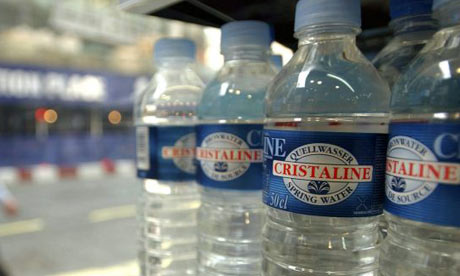
      A report commissioned by Commons authorities into the Houses of Parliament’s use of bottled water found that it uses over 21,000 bottles of water each year, resulting in a carbon footprint of 12 tonnes. From BusinessGreen.com, part of the Guardian Environment Network


      Bottled water

      Parliament uses 21,000 bottles of water each year, resulting in a carbon footprint of 12 tonnes. Photograph: Bruno Vincent/Getty Images


      A report commissioned by Commons authorities into the Houses of Parliament’s use of bottled water found that it uses over 21,000 bottles of water each year, resulting in a carbon footprint of 12 tonnes.


      The study, carried out by environmental consultants Best Foot Forward, was not published but was leaked to the Evening Standard.


      It revealed that each year 10,000 bottles of sparkling and 11,400 bottles of still water are used in Parliament, while the associated delivery lorries have clocked up more than 70,000 miles over five years.


      A blog posting by Best Foot Forward confirmed the findings of the report.


      “The study, which quantifies the life cycle emissions of several different options, found that bottled water performed the worst – and that savings of 11tCO2 per year were possible through a switch to tap water,” it said.


      However, the Commons Administration Committee controversially decided last year that it would offer only bottled water in meetings.


      The revelations will be especially damaging to MPs, some of whom have campaigned against bottled water.


      Last year, government minister Phil Woolas told the BBC that consumers should switch from bottled to tap water whereever possible. “It borders on morally being unacceptable to spend hundreds of millions of pounds on bottled water when we have pure drinking water, when at the same time one of the crises that is facing the world is the supply of water,” he said.


      US studies have found the total energy required for bottled water production was as much as 2,000 times the energy cost of producing tap water.


      • This article was shared by our content partner BusinessGreen.com, part of the Guardian Environment Network

    • Langlee Wave Power And Unmaksan To Build 24-MW System

      August 27, 2009

      Langlee Wave Power And Unmaksan To Build 24-MW System


      Oslo, Norway [Hydro Review]

      Turkish energy company Unmaksan and Norwegian energy company Langlee Wave Power have signed a deal to build a 24-MW wave power system off the coast of Turkey. The exact location has not been determined.


      The first phase of the project calls for a 120 KW pilot facility, which will eventually be developed into a 24-MW system comprised of 200 wave energy converters designed by Langlee.

      “Unmaksan has analyzed more than 70 different wave power concepts, and we believe Langlee has the most robust technology and cost-effective solution,” Unmaksan Managing Director Serhat Kan said in a news release.


      The US$169 million project will be built close to the shoreline in shallow waters near existing distribution systems, the companies said. Unmaksan will build the project and Langlee owns the licensing rights to the technology. Langlee said it expects to receive US$14.7 million in licensing fees from the project.

      Earlier this year, the World Bank approved US$600 million in financing for Turkey’s Private Sector Renewable Energy and Energy Efficiency Project. (HydroWorld 7/10/09) Contractors, consultants, and project sponsors have been encouraged to participate in the development of renewable energy projects, including hydropower