Category: Uncategorized

  • Climate change makes super typhoons worse, says UN meteorological agency

    Climate change makes super typhoons worse, says UN meteorological agency

    By Europe correspondent Mary Gearin

    Updated 4 minutes ago

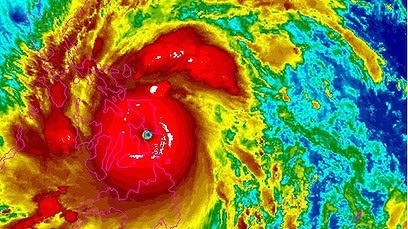
    The United Nations meteorological agency has found the effects of climate change are making the impact of severe storms like Typhoon Haiyan worse.

    The World Meteorological Organisation’s Michel Jarraud says Australia’s record-breaking summer helped push average global temperatures higher this year, and rising sea levels worsened the situation in the Philippines.

    “The impact of this cyclone was definitely significantly more than what it would have been 100 years ago because of the simple mechanical fact that the sea level is higher,” Mr Jarraud said.

    “Storm surges have a much more devastating effect than they would have had decades ago.

    “The same typhoon 50 years ago would have had less impact because the sea level was lower,” he said.

    The agency released an early analysis of this year’s global weather, so that scientists could discuss the data at the UN climate change conference in Poland.


    Australia received special mention, top-scoring with the world’s biggest increase in average temperatures last summer.

    Mr Jarraud says 2013 is likely to be one of the top 10 warmest years since records began.

    “Interestingly, what we call cold years in this last 10 years would have been seen as record warm years even 16, 17 years ago.”

    But when asked why, Mr Jarraud was careful not to get burnt by the political heat surrounding climate change.

    “The fact that the trend of higher and higher is compatible with what we expect from climate change. But the attribution, you know scientists are very careful people,” he said.

    The agency says the frequency of heat waves and extreme rain is rising.

    They are also warning that tropical cyclones will become more intense.

    Once in a lifetime typhoons are now happening once a year: UN

    Jerry Velasquez from the UN’s office for disaster risk reduction is on his way to the Philippines and he says when it comes to the weather, we need to re-think what is normal.

    “What we’re seeing is that the hazards, the typhoons, are getting stronger,” Mr Velasquez said.

    Storm surges have a much more devastating effect than they would have had decades ago.

    World Meteorological Organisation’s Michel Jarraud


    “The once-in-a-lifetime typhoons are now happening once a year. So the question for us, is this the new normal for us? And if this is then what should we do to prepare?”

    Countries worldwide are now trying to figure out what to do when faced with such questions.

    “There’s a lot that could be done. I think what this typhoon could really do is to allow us to rethink how we do disaster risk management, not only in this region but globally,” Mr Velasquez said.

    Mr Velasquez says attention also needs to turn to preventing the enormous economic cost of such disasters, especially in already poor regions.

    “For the last three years, for the first time in history, we’re seeing catastrophic disasters that have been more than $2 billion in losses,” Mr Velasquez said.

  • Vegetation clearing rules to be eased in fire-prone parts of NSW

    Vegetation clearing rules to be eased in fire-prone parts of NSW

    The aftermath of the fires on Yellow Rock Rd, Yellow Rock where many homes were destroyed in the Blue Mountains.Yellow Rock in the Blue Mountains was hard hit in last month’s fires. Photo: Dallas Kilponen

    The NSW government plans to loosen planning rules to give residents in bushfire-prone regions more freedom to clear vegetation around their homes without a permit.

    The new rules, to be introduced next year in the next session of Parliament, would allow homeowners in designated areas to fell trees within 10 metres of their homes and clear shrubs and other vegetation out to 50 metres on their own land without requiring planning permission.

    The proposal comes weeks after early-season bushfires in the Blue Mountains and elsewhere destroyed more than 200 homes and damaged 120 more.

    RFS volunteers assist in a hazard-reduction burn in Scheyville National Park in Sydney's north west.RFS volunteers at a hazard-reduction burn in Scheyville National Park in Sydney’s north west. Photo: Nick Moir

    “Residents in designated bushfire prone areas will not need to seek permission to sensibly clear vegetation from around their property that is posing a fire risk,” Premier Barry O’Farrell said in a statement.

    Advertisement

    “This will need to be done in an environmentally responsible manner.”

    Homeowners will be encouraged to “responsibly manage fire risks on their own properties”, Mr O’Farrell said.

    “Our changes will ensure the rules regarding hazard reduction are based on protecting lives and property – and not satisfying a narrow Green agenda that seeks to put trees before people.”

    While the clearing rules won’t go before the Parliament this year, the government will this week introduce laws giving the Rural Fire Service Commissioner the power to carry out hazard reduction burning on private land without consent of the owner if “reasonable attempts to contact the landowner have failed”, the statement said.

    The RFS Commissioner will also have the power to direct a Bush Fire Management Committee to amend its Bush Fire Risk Management Plan if it is considered to be inadequate, the statement said.

    “We need to ensure the community is as prepared as it possibly can be for future bushfires and that authorities have the powers they need to conduct essential hazard reduction work,” Mr O’Farrell said.

    Not broken?

    Pepe Clarke, chief executive of the Nature Conservation Council, environmental groups support hazard reduction efforts and cautioned against hasty changes to existing rules.

    ‘‘The current system works well and any changes need to be carefully considered,’’ Mr Clarke said. ‘‘Will the changes actually reduce risk to life and property and result in unnecessary environmental harm?’’

    He said the RFS is ‘‘embedded’’ in the present bushfire risk management of local districts, and to exclude their role in providing advice to households could be detrimental.

    ‘‘It means people don’t have direct access to the RFS and their advice on what measures will have the most impact in hazard reduction,’’ Mr Clarke said.

    Council view

    Jennifer Anderson, mayor of Ku-ring-gai council on Sydney’s northern fringe, welcomed the proposed changes.

    ‘‘I place a high priority on the safety of our residents, and if it’s going to be improved through these initiatives, then I think they’re very worthwhile,’’ Ms Anderson said.

    At present, tree preservation orders require residents to apply for tree removal, which can be a lengthy procees. ’’If there are a lot of requests then it can take several months,’’ she said. ‘‘If there’s an emergency imperative, that process can be too lengthy.’’

    ‘‘I’d certainly support (permission to clear land around houses) in an emergency situation.’’

    Care, though, must be taken where endangered species are involved, with state and federal laws protecting such areas, Ms Anderson said.

    Risks

    Research conducted for the previous Labor government by Risk Frontiers in 2010 found the distance of houses from the bushland boundary to be the most important factor in determining vulnerability to fire.

    Based on major blazes in the past, houses within 200 metres of at least half a hectare of bush are at-risk properties, the research found.

    By that gauge, about 37,893 addresses in the Blue Mountains local government area were vulnerable, the most exposed of any region in NSW, Risk Frontiers found.

    The research group, based at Macquarie University, found that, in significant blazes in the past, the probability of loss in the first 50 metres of the bush was about 60 per cent.

    In the 2009 Black Saturday fires in Victoria, “60 per cent of losses occurred within 10 metres of bushland”.

    Separate laws will also include two new offences for littering involving cigarettes and matches. Police and enforcement officers will be able to issue penalty notices for such littering on days when a total fire ban is in place.

    Fines will be $330 and $660 for an aggravated offence, the government said.

    Read more: http://www.smh.com.au/environment/conservation/vegetation-clearing-rules-to-be-eased-in-fireprone-parts-of-nsw-20131113-2xf7t.html#ixzz2kUdeKm43

  • How British and American aid subsidises Palestinian terrorism

    How British and American aid subsidises Palestinian terrorism

    US and UK taxpayers fund the Palestinian Authority, which in turn funds prisoners in Israeli jails. It’s dangerously dysfunctional
    Palestinian student from Bir Ziet university, throws a fire bomb during a clash with Israeli soldiers next to the Israeli military prison Ofer. The clashes occurred during a protest in support of Palestinian prisoners Jailed in Israeli prison.

    Palestinian student from Bir Zeit university during clashes over a protest in support of Palestinian prisoners jailed in Israeli prison, 2013. Photograph: Atef Safadi/EPA

    On both sides of the pond, in London and Washington, policymakers are struggling to weather their budget crises. Therefore, it may astound American and British taxpayers that the precious dollars and pounds they deploy in Israel and the Occupied Territories fungibly funds terrorism.

    The instrument of this funding is US and UK programs of aid paid to the Palestinian Authority. This astonishing financial dynamic is known to most Israeli leaders and western journalists in Israel. But it is still a shock to most in Congress and many in Britain’s Parliament, who are unaware that money going to the Palestinian Authority is regularly diverted to a program that systematically rewards convicted prisoners with generous salaries. These transactions in fact violate American and British laws that prohibit US funding from benefiting terrorists. More than that, they could be seen as incentivizing murder and terror against innocent civilians.

    Here’s how the system works. When a Palestinian is convicted of an act of terror against the Israeli government or innocent civilians, such as a bombing or a murder, that convicted terrorist automatically receives a generous salary from the Palestinian Authority. The salary is specified by the Palestinian “law of the prisoner” and administered by the PA’s Ministry of Prisoner Affairs. A Palestinian watchdog group, the Prisoners Club, ensures the PA’s compliance with the law and pushes for payments as a prioritized expenditure. This means that even during frequent budget shortfalls and financial crisis, the PA PA pays the prisoners’ salaries first and foremost – before other fiscal obligations.

    The law of the prisoner narrowly delineates just who is entitled to receive an official salary. In a recent interview, Ministry of Prisoners spokesman Amr Nasser read aloud that definition:

    A detainee is each and every person who is in an Occupation prison based on his or her participation in the resistance to Occupation.

    This means crimes against Israel or Israelis. Nasser was careful to explain:

    It does not include common-law thieves and burglars. They are not included and are not part of the mandate of the ministry.

    Under a sliding scale, carefully articulated in the law of the prisoner, the more serious the act of terrorism, the longer the prison sentence, and consequently, the higher the salary. Incarceration for up to three years fetches a salary of almost $400 per month. Prisoners behind bars for between three and five years will be paid about $560 monthly – a compensation level already higher than that for many ordinary West Bank jobs. Sentences of ten to 15 years fetch salaries of about $1,690 per month. Still worse acts of terrorism against civilians, punished with sentences between 15 and 20 years, earn almost $2,000 per month.

    These are the best salaries in the Palestinian territories. The Arabic word ratib, meaning “salary”, is the official term for this compensation. The law ensures the greatest financial reward for the most egregious acts of terrorism.

    In the Palestinian community, the salaries are no secret; they are publicly hailed in public speeches and special TV reports. The New York Times and the Times of Israel have both mentioned the mechanism in passing. Only British and American legislators seem to be uninformed about the payments.

    From time to time, the salaries are augmented with special additional financial incentives. For example, in 2009, a $150-per-prisoner bonus was approved to mark the religious holiday of Eid al-Adha. President Mahmoud Abbas also directed that an extra $190 “be added to the stipends given to Palestinians affiliated with PLO factions in Israeli prisons this month”. Reporting on the additional emolument, the Palestinian news service Ma’an explained:

    Each PLO-affiliated prisoner [already] receives [a special allocation of] $238 per month, plus an extra $71 if they are married, and an extra $12 for each child. The stipend is paid by the Palestine Liberation Organization (PLO) each month.

    About 6% of the Palestinian budget is diverted to prisoner salaries. All this money comes from so-called “donor countries” such as the United States, Great Britain, Norway, and Denmark. Palestinian officials have reacted with defiance to any foreign governmental effort to end the salaries. Deputy Minister of Prisoners Affairs Ziyad Abu Ein declared to satellite TV network Hona Al-Quds:

    If the financial assistance and support to the PA are stopped, the [payment of] salaries (Rawatib) and allowances (Mukhassasat) to Palestinian prisoners will not be stopped, whatever the cost may be. The prisoners are our joy. We will sacrifice everything for them and continue to provide for their families.

    Many believe foreign aid is an investment in peace between the warring parties in Israel and disputed lands. That investment might have a greater chance for success if terrorism did not pay as well as it does – with taxpayers footing the bill.

    • Comments on this article will be open for 24 hours and may be closed overnight

  • Typhoon Haiyan and climate change: connecting the dots Climate Code Red

    climate code red


    Typhoon Haiyan and climate change: connecting the dots

    Posted: 11 Nov 2013 04:15 PM PST

    Yeb Sano, head of Philippines  delegation to the UN climate talks:
    “What my country is going through as a result of this extreme climate event is madness… The climate crisis is madness. We can stop this madness. Right here in Warsaw. Typhoons such as Haiyan and its impacts represent a sobering reminder to the international community that we cannot afford to procrastinate on climate action… Science tells us that simply, climate change will mean more intense tropical storms. As the Earth warms up, that would include the oceans. The energy that is stored in the waters off the Philippines will increase the intensity of typhoons and the trend we now see is that more destructive storms will be the new norm.”
    http://www.theguardian.com/environment/2013/nov/11/typhoon-haiyan-philippines-climate-talks

    MunichRe statement 11 November 2013
    “Eastern Asia has been hard hit by weather-related loss events in the past three decades. Their number has increased by more than a factor of four, causing overall losses from weather-related events of some US$ 700bn during this period. The insured losses of US$ 76bn amounted to only around 10% of overall losses, with 62% of these attributable to Japan. Floods caused 56% of the overall losses in Eastern Asia, but only 30% of insured losses. The number of floods has increased strongly and is expected to increase further in the coming decades. With insured losses of US$ 16bn, the 2011 Thailand floods caused the biggest-ever weather-related insured loss in the region. After floods, it is typhoons that cause the greatest weather-related losses. New analyses indicate a clear cycle of activity for typhoons, and increased typhoon activity is expected over the coming years. .”
    http://www.munichre.com/en/media_relations/press_releases/2013/2013_11_11_press_release.aspx

    Download report summary

    Reinsurance giant, MunichRe:
    “Nowhere in the world are weather risks changing faster than in Eastern Asia”
    http://www.munichre.com/en/reinsurance/magazine/publications/knowledge-series/natural-hazards/severe-weather-asia.aspx
    “As a result of climate change… the intensity of typhoons will increase” in Eastern Asia
    http://www.munichre.com/app_pages/www/@res/pdf/downloads/severe-weather-in-eastern-asia-executive-summary-en.pdf

    Increasing frequency of extreme typhoons
    “Excluding super typhoon Haiyan, five of the 10 deadliest cyclones in the Philippines occurred in the past decade: Winnie in 2004, Durian in 2006, Fengshen in 2008, Washi in 2011 and Bopha in 2012.’
    “Six of the 10 costliest typhoons in the Philippines, typically in hundreds of millions of dollars, also occurred in the past decade (Fengshen/ 2008, Parma and Ketsana/ 2009, Megi/ 2010, Nesat/2011 and Bopha/2012). Notice the yearly succession.”
    http://thisiscomplicated.net/2013/11/09/haiyan-aftermath-feelings/

    Now is the time to implement the bold, deep
    and necessary emissions cuts our world so
    desperately needs to avoid further tragedies

    Nature journal: “Did climate change cause Typhoon Haiyan?
    “There is limited evidence that warming oceans could make superstorms more likely.”
    “Was Haiyan the strongest storm ever measured? Apparently, yes. With sustained wind speeds of more than 310 kilometres per hour, Haiyan was the most powerful tropical cyclone to make landfall in recorded history. The previous record was held by Hurricane Camille, which in 1969 hit the state of Mississippi with wind speeds of just over 300 km/h.”
    http://www.nature.com/news/did-climate-change-cause-typhoon-haiyan-1.14139 

    New research on  “Pacific Ocean Heat Content During the Past 10,000 Years”
    The recent oceanic warming is happening at a historically unprecedented rate: “rate of change in ocean heat content is 15 times greater now than it’s been in the last 7,000 or 8,000 years”
    http://www.sciencemag.org/content/342/6158/617.full
    http://grist.org/climate-energy/the-pacific-ocean-is-now-warming-15-times-faster/

    Philippines prepares climate change plans for worse to come
    Mary Ann Lucille Sering, head of the Philippine government’s climate change commission, warned earlier this year that her country faced a deepening crisis that it could ill afford financially and in human terms. Typhoon-related costs in 2009, the year the commission was created, amounted to 2.9% of GDP, she said, and have been rising each year since.
    “Extreme weather is becoming more frequent, you could even call it the new normal,” Sering said. “Last year one typhoon [Bopha] hurt us very much. If this continues we are looking at a big drain on resources.” Human activity-related “slow-onset impacts” included over-fishing, over-dependence on certain crops, over-extraction of ground water, and an expanding population (the Philippines has about 95 million people and a median age of 23).
    http://www.theguardian.com/world/2013/nov/11/typhoon-haiyan-philippines-climate-change-plan

    Typhoon Haiyan influenced by climate change, scientists say:
    “Once [cyclones] do form, they get most of their energy from the surface waters of the ocean,” Professor Steffen said. “We know sea-surface temperatures are warming pretty much around the planet, so that’s a pretty direct influence of climate change on the nature of the storm.”
    Data compiled from the US National Oceanic and Atmospheric Administration shows sea temperatures were about 0.5 to 1 degree above normal in the waters to the east of the Philippines as Haiyan began forming. The waters cooled in the storm’s wake, an indication of how the storm sucked up energy.
    http://www.smh.com.au/environment/climate-change/typhoon-haiyan-influenced-by-climate-change-scientists-say-20131111-2xb35.html

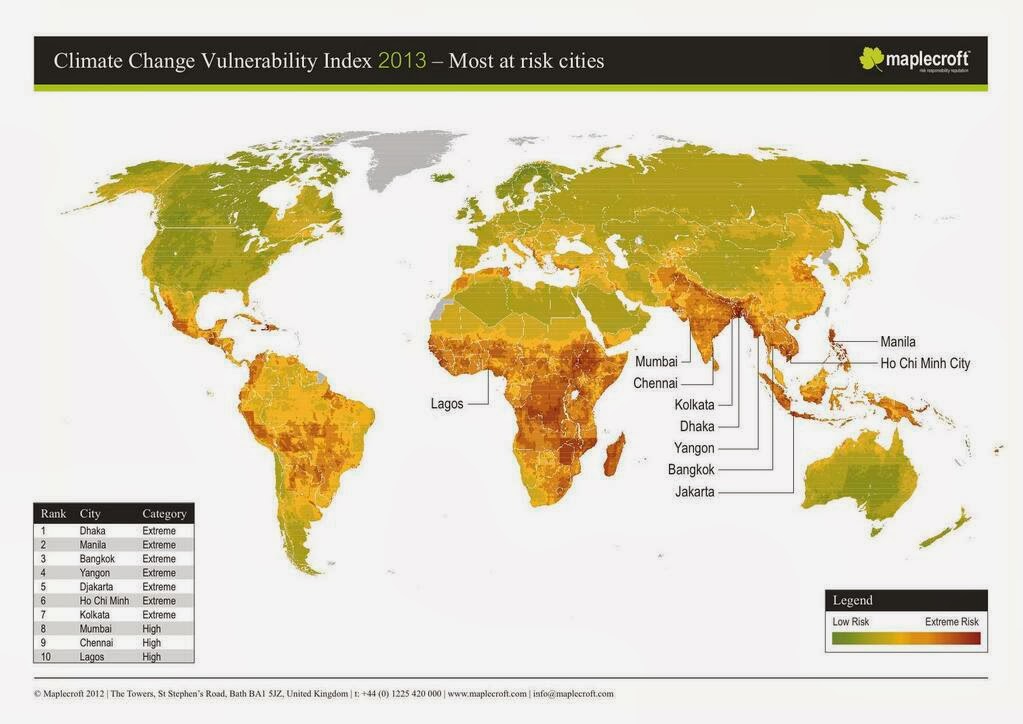
    Extreme risk
    Manila, Philippines, now 2nd most at risk city to climate change, in “extreme” category
    https://twitter.com/yebsano/status/314939005324124160/photo/1

    Research paper: Tropical cyclones and climate change:
    “future projections based on theory and high-resolution dynamical models consistently indicate that greenhouse warming will cause the globally averaged intensity of tropical cyclones to shift towards stronger storms, with intensity increases of 2–11% by 2100….  higher resolution modelling studies typically project substantial increases in the frequency of the most intense cyclones, and increases of the order of 20% in the precipitation rate within 100 km of the storm centre.
    http://www.nature.com/ngeo/journal/v3/n3/abs/ngeo779.html

    You are subscribed to email updates from Climate Code Red
    To stop receiving these emails, you may unsubscribe now.
    Email delivery powered by Google
    Google Inc., 20 West Kinzie, Chicago IL USA 60610
  • Why Politics Fails MONBIOT

    Why Politics Fails

    Posted: 11 Nov 2013 12:19 PM PST

    Nothing will change until we confront the real sources of power.


    By George Monbiot, published in the Guardian 12th November 2013

    It’s the reason for the collapse of democratic choice. It’s the source of our growing disillusionment with politics. It’s the great unmentionable. Corporate power. The media will scarcely whisper its name. It is howlingly absent from parliamentary debates. Until we name it and confront it, politics is a waste of time.

    The political role of corporations is generally interpreted as that of lobbyists, seeking to influence government policy. In reality they belong on the inside. They are part of the nexus of power that creates policy. They face no significant resistance, from either government or opposition, as their interests have now been woven into the fabric of all three main parties.

    Most of the scandals that leave people in despair about politics arise from this source. On Monday, for example, the Guardian revealed that the government’s subsidy system for gas-burning power stations is being designed by an executive from the company ESB, who has been seconded into the energy department(1). What does ESB do? Oh, it builds gas-burning power stations.

    On the same day we learnt that a government minister, Nick Boles, has privately assured the gambling company Ladbrokes that it needn’t worry about attempts by local authorities to stop the spread of betting shops(2). His new law will prevent councils from taking action.

    Last week we discovered that G4S’s contract to run immigration removal centres will be expanded, even though all further business with the state was supposed to be frozen while allegations of fraud are investigated(3). Every week we learn that systemic failures on the part of government contractors are no barrier to obtaining further work, that the promise of efficiency, improvements and value for money delivered by outsourcing and privatisation have failed to materialise(4,5,6). The monitoring which was meant to keep these companies honest is haphazard(7), the penalties almost non-existent(8), the rewards stupendous, dizzying, corrupting(9,10). Yet none of this deters the government. Since 2008, the outsourcing of public services has doubled, to £20bn. It is due to rise to £100bn by 2015(11).
    This policy becomes explicable only when you recognise where power really lies. The role of the self-hating state is to deliver itself to big business. In doing so it creates a tollbooth economy: a system of corporate turnpikes, operated by companies with effective monopolies.

    It’s hardly surprising that the lobbying bill – now stalled by the Lords – offered almost no checks on the power of corporate lobbyists, while hogtying the charities who criticise them. But it’s not just that ministers are not discouraged from hobnobbing with corporate executives: they are now obliged to do so.

    Thanks to an initiative by Lord Green, large companies have ministerial “buddies”, who have to meet them when the companies request it. There were 698 of these meetings during the first 18 months of the scheme, called by corporations these ministers are supposed be regulating(12). Lord Green, by the way, is currently a government trade minister. Before that he was chairman of HSBC, presiding over the bank while it laundered vast amounts of money stashed by Mexican drugs barons(13). Ministers, lobbyists – can you tell them apart?

    That the words corporate power seldom feature in the corporate press is not altogether surprising. It’s more disturbing to see those parts of the media that are not owned by Rupert Murdoch or Lord Rothermere acting as if they are.

    For example, for five days every week the BBC’s Today programme starts with a  business report in which only insiders are interviewed. They are treated with a deference otherwise reserved for God on Thought for the Day. There’s even a slot called Friday Boss, in which the programme’s usual rules of engagement are set aside and its reporters grovel before the corporate idol. Imagine the outcry if Today had a segment called Friday Trade Unionist or Friday Corporate Critic.

    This, in my view, is a much graver breach of BBC guidelines than giving unchallenged airtime to one political party but not others, as the bosses are the people who possess real power: those, in other words, whom the BBC has the greatest duty to accost. Research conducted by the Cardiff school of journalism shows that business representatives now receive 11% of airtime on the BBC’s 6 o’clock news (this has risen from 7% in 2007), while trade unionists receive 0.6% (which has fallen from 1.4%)(14). Balance? Impartiality? The BBC puts a match to its principles every day.

    And where, beyond the Green Party, Plaid Cymru, a few ageing Labour backbenchers, is the political resistance? After the article I wrote last week, about the grave threat the transatlantic trade and investment partnership presents to parliamentary sovereignty and democratic choice(15), several correspondents asked me what response there has been from the Labour party. It’s easy to answer: nothing.

    Blair and Brown purged the party of any residue of opposition to corporations and the people who run them. That’s what New Labour was all about. Now opposition MPs stare mutely as their powers are given away to a system of offshore arbitration panels run by corporate lawyers.

    Since Blair’s pogroms, parliament operates much as Congress in the United States does: the lefthand glove puppet argues with the righthand glove puppet, but neither side will turn around to face the corporate capital that controls almost all our politics. This is why the assertion that parliamentary democracy has been reduced to a self-important farce has resonated so widely over the past fortnight.

    So I don’t blame people for giving up on politics. I haven’t given up yet, but I find it ever harder to explain why. When a state-corporate nexus of power has bypassed democracy and made a mockery of the voting process, when an unreformed political funding system ensures that parties can be bought and sold, when politicians of the three main parties stand and watch as public services are divvied up by a grubby cabal of privateers, what is left of this system that inspires us to participate?

    www.monbiot.com

    References:

    1. http://www.theguardian.com/environment/2013/nov/10/gas-industry-employee-energy-policy

    2. http://www.theguardian.com/society/2013/nov/10/planning-law-changes-help-bookmakers-minister

    3. http://www.theguardian.com/business/2013/nov/08/g4s-expand-contract-freeze-government-work

    4. http://www.theguardian.com/commentisfree/2013/aug/05/privatisation-public-service-users-bill

    5. http://www.telegraph.co.uk/news/politics/9742685/Total-chaos-after-pet-dog-counted-on-translators-database.html

    6. http://www.theguardian.com/society/2013/jul/22/disabled-benefits-claimants-test-atos

    7. http://www.theguardian.com/society/2013/nov/07/government-outsourcing-problems-g4s-serco-a4e

    8. http://www.theguardian.com/public-leaders-network/2013/jul/17/ifg-government-outsourcing-privatisation-skills

    9. http://www.theguardian.com/commentisfree/2013/jan/09/financial-transparency-privatised-nhs

    10. http://www.theguardian.com/commentisfree/2013/nov/04/rail-privatisation-train-operators-profit

    11. http://www.theguardian.com/commentisfree/2013/feb/07/public-sector-outsourcing-shadow-state

    12. http://www.theguardian.com/politics/2013/jan/18/buddy-scheme-multinationals-access-ministers

    13. http://www.theguardian.com/business/2012/jul/24/lord-green-hsbc-scandal

    14. http://downloads.bbc.co.uk/bbctrust/assets/files/pdf/our_work/breadth_opinion/content_analysis.pdf

    15. http://www.theguardian.com/commentisfree/2013/nov/04/us-trade-deal-full-frontal-assault-on-democracy

    You are subscribed to email updates from George Monbiot
    To stop receiving these emails, you may unsubscribe now.
    Email delivery powered by Google
    Google Inc., 20 West Kinzie, Chicago IL USA 60610
  • What To Make Of All Those Sea-Level Rise Projections

    What To Make Of All Those Sea-Level Rise Projections

    Originally published on Mon November 11, 2013 12:05 pm

    Credit Credit NOAA
    3:45

    Climate scientists largely agree that sea level is rising. The extent of the change is a far more complicated matter.

    “Probably two feet. Three feet, possibly,” said David Enfield, a climatologist with the University of Miami and the National Oceanic Atmospheric Administration. “As an extreme — if for example we see an unexpected acceleration of the melting ice in Greenland and Antarctica, something else we’re not observing — we could be seeing six feet by the end of the century.”

    Compare that to the personal projection by Harold Wanless: “Six to 20 feet, somewhere in that range.”

    Wanless is a geologist at the University of Miami. He studies the evolution of coastal regions and believes past sea-level rise shows us that when ice sheets start to melt, they melt much faster than experts might think.

    “We don’t really know enough about how ice melts: big ice sheets, like the Greenland ice sheet or parts of the Antarctic ice sheet,” Wanless said. “Every year we’re learning new things and they’re all pointing towards a much more rapid rise [in melt] than is presently being projected.”

    Individual projections, even expert ones, are not typically the numbers you’ll see being cited regularly. Most of those projections come from groups of experts discussing which models are worthwhile, which published research to believe, and how to interpret the data. Even those meta-projections typically don’t agree with one another, though they generally fall within the eight-inch to six-and-a-half-foot range.

    “Everybody’s brother has been trying to predict the sea-level rise,” said Jayantha Obeysekera, chief modeler for the South Florida Water Management District.

    Obeysekera recently gave a presentation on that topic to the Florida Water and Climate Alliance. WLRN-Miami Herald News sat down with him afterwards to ask: What should the general public make of the array of sea-level rise projections?


    Copyright 2013 WLRN-FM. To see more, visit http://www.wlrn.org/.