Category: Uncategorized

  • Cindy Preszler, Mike Roberts explain climate change impact on local weather

    Cindy Preszler, Mike Roberts explain climate change impact on local weather

    10:15 PM, Sep 20, 2013   |   12  comments


    ST. LOUIS (KSDK) – A new voice is being heard in the discussion on climate change, as new evidence connecting it to extreme weather events begins to pile up.

    When the current Chief of the U.S. Navy’s Pacific Fleet, Admiral Samuel Locklear III, was asked what his biggest security concern is, he did not name North Korea or China. He did not mention a nation or military threat at all. He said; “climate change.”

    In NewsChannel 5’s half-hour special, “To the Extreme: Forecasting St. Louis’ Future,” the man the U.S. Navy assigned to be its first director of the Task Force on Climate Change, retired Rear Admiral David Titley talks about change. In 2009, he was asked to make a projection on how climate change would impact the Navy and its ability to keep the nation secure.

    Among Titley’s conclusions: seas will rise an average of 3′ to 3.5′; by 2025 to 2030 there will be places in the arctic with no sea ice; and decreased ice in the Bering Strait will open the arctic in many different and hard to predict ways.

    The military is moving forward on the assumption that climate change will cause a variety of problems.

    “There are more than 30 U.S. military installations in the world which project severe disruptions due to rising sea levels,” said retired U.S. Army Brigadier General John Adams. “There’s a real high sense of awareness in the Department of Defense about the risks of climate change and especially on coming up with plans to mitigate the risks.”

    Our special presents evidence released just this month by the American Meteorological Society, which concludes half of the extreme weather events examined from 2012 were impacted by human-induced climate change.

    In fact, the past few months have been something of a traffic jam for revelations in climate change understanding. Information came out in May showing that the earth’s atmosphere has now reached 400 parts per million (ppm) of carbon dioxide for the first time in three million years, based on observations taken at Mauna Loa Observatory in Hawaii. NewsChannel 5 meteorologist Chester Lampkin will have that story for us.

    In July the World Meteorological Society said “extreme weather events are the new face of climate change” and in August a report by a panel of international scientists connected “with near certainty” human activity to most of the increases in temperatures seen in recent decades. All of these findings factored into our report.

    There’s also a story of how a local community, faced with a daunting challenge to its water supply, met that challenge. Farrah Fazal introduced us to those folks.

    We have information based on a study by the E.P.A. on how the climate may change in the Midwest and finish with a panel discussion with Dr. Charles Graves from the Department of Earth and Atmospheric Sciences at St. Louis University; Anu Hittle, Director of Hawaiian Projects at Washington University and financial analyst Juli Niemann from Smith-Moore.

    There’s a lot more and we hope you can be with us to watch this evening at 7 p.m. for our special on climate change; “To the Extreme: Forecasting St. Louis’ Future.”

    You can watch the entire broadcast by clicking on the video players above and to the left of this story.

    Sources:
    U.S. Naval Task Force on Climate Change
    American Meteorological Society: Retired U.S. Navy Rear Admiral David Titley on climate change and national security
    Scientific American
    : U.S. Military forges ahead with plans to combat climate change
    New Security Beat
    U.S. Deputy Assistant Secretary of Defense for Strategy Daniel Chiu on energy concerns
    The Hill
    : Climate change causing Pentagon planning shift, says DOD strategist
    American Meteorological Society: Half of Extreme Weather Events in 2012 Tied to Climate Change
    NASA: Scientists react to 400 ppm carbon milestone
    United Nations: World Meteorological Organization
    IPCC 5th Assessment
    Centers for Disease Control: Climate change and state readiness
    EPA: Regional implications of climate change in the Midwest

    KSDK

  • “Al Gore, Climate Reality”

    John James
    12:02 PM (1 hour ago)

    to me

    —— Forwarded Message
    From: “Al Gore, Climate Reality” <info@climatereality.com>
    Reply-To: <info@climatereality.com>
    Date: Fri, 20 Sep 2013 16:46:13 -0400
    To: John James <jrhj99@gmail.com>
    Subject: EPA Announcement

    <http://forms.climaterealityproject.org/page/m/396e80fc/6fd7b4ab/1cd75bc5/19bc9daf/237696828/VEsH/>

    Dear John,Today’s announcement by EPA Administrator Gina McCarthy is an important step forward for our nation and our planet. From now on, future coal- and gas-fired power plants must take responsibility for their global warming pollution by reducing or capturing their overall emissions.This is a critical achievement for President Barack Obama and his administration. In the face of an intransigent and inactive Congress, the President has made halting the climate crisis a priority. The policies announced today, combined with the rest of the President’s Climate Action Plan, will put us on the path toward solving the climate crisis, but Congress must also soon face the reality of the situation.Three years ago, Congress failed to put a price on carbon and, in doing so, allowed global warming pollution to continue unabated. We have seen the disturbing consequences that the climate crisis has to offer — from a drought that covered 60% of our nation to Superstorm Sandy which wreaked havoc and cost the taxpayers billions, from wildfires spreading across large areas of the American West to severe flooding in cities all across our country — we have seen what happens when we fail to act. We need a price on carbon. We need it now.Thanks for all that you do,

    Al Gore
    Chairman, The Climate Reality ProjectP.S. This is a historic step in the right direction. Head to the EPA’s website for more information on the announcement <http://forms.climaterealityproject.org/page/m/396e80fc/6fd7b4ab/1cd75bc5/19bc9dae/237696828/VEsE/> .

    <http://forms.climaterealityproject.org/page/m/396e80fc/6fd7b4ab/1cd75bc5/19bc9dad/237696828/VEsF/>  <http://forms.climaterealityproject.org/page/m/396e80fc/6fd7b4ab/1cd75bc5/19bc9dac/237696828/VEsC/>

    Click here <http://forms.climaterealityproject.org/page/m/396e80fc/6fd7b4ab/1cd75bc5/19bc9dab/237696828/VEsD/p/eyJKU1ZGVFVGSlRDVWwiOiJqcmhqOTlAZ21haWwuY29tIn0=/>  to unsubscribe.
    ©2012 The Climate Reality Project.  All Rights Reserved.

    —— End of Forwarded Message

    Click here to Reply or Forward
  • The Problems with a Growing Population

    The Problems with a Growing Population

    By Kurt Cobb | Thu, 19 September 2013 22:28 | 0

    Benefit From the Latest Energy Trends and Investment Opportunities before the mainstream media and investing public are aware they even exist. The Free Oilprice.com Energy Intelligence Report gives you this and much more. Click here to find out more.

    Albert Bartlett might have been another obscure physics professor had he not put together a now famous lecture entitled “Arithmetic, Population and Energy” in 1969. The lecture, available broadly on the internet, begins with the line: “The greatest shortcoming of the human race is our inability to understand the exponential function.”

    The logic is surprisingly simple and irrefutable. Exponential growth, which is simply consistent growth at some percentage rate each year (or other time period), cannot proceed indefinitely within a finite system, for example, planet Earth. The fact that human populations continue to grow or that the extraction of energy and other natural resources continues to climb does not in any way refute this statement. It simply means that the absolute limits have not yet been reached.

    Select the reports you are interested in:

    NO-SPAM: Under no circumstances will we EVER rent, sell or give away your email

    Bartlett, who died this month at age 90, gave his lecture all over the world 1,742 times or on average once every 8.5 days for 36 years to audiences ranging from junior high students to seasoned professionals in many fields. His ability to stay on message for so long about something so important should make him the envy of every modern communications professional.

    His favorite shortcut is the doubling time, the time it takes to get to twice the original number at a constant rate of growth. The formula is 70 divided by the percentage rate of growth per year (or other period). Just a 2 percent growth rate doubles the rate of use of a resource or the size of world population in 35 years. Actual world population growth is about 1.2 percent per year today, which seems benign; but, it implies the next doubling within 58 years to 14 billion. (U.N. forecasts project world population will reach 10 billion by 2070–57 years from now–and continue to grow through 2100.)

    In his lecture Bartlett relates that in his hometown of Boulder, Colorado, city council members once stated publicly their preferences for population growth rates ranging from 1 percent to 5 percent per year. In the course of 70 years, roughly one lifetime, the 5 percent rate would make Boulder’s population (about 100,000) some 32 times larger or about 3.2 million, which would make it the third largest city in the country behind Los Angeles and in front of Chicago. A city that size could not possibly fit in the valley now home to Boulder, Bartlett explains. Attempting to do so would inevitably eliminate all open space, something highly prized by Boulder residents.

    Related article: Syria: As the World Backs Off, the Jihadists Attack

    Has Bartlett made a dent in our habitual ways of thinking about growth? Maybe. There were others back when Bartlett started giving his lecture who asked the same questions in a different form. One manifestation of that questioning was the groundbreaking study The Limits to Growth which, despite what its detractors have said, made no predictions. Rather the study models resource use over time given a large range of conditions including an endowment of resources that was twice what anyone imaged they might be at the time. The troubling conclusion of the study was that nearly all scenarios led to the crash of industrial civilization at some point.

    The key observation in that study aligns with Bartlett’s, namely that exponential growth in the consumption of finite resources is unsustainable. At some point growth in the rate of extraction will cease. And, given the dependence of the economy on continuous growth of resource inputs including energy, this leads to instability and finally decline.

    Let me help you envision what exponential growth means. If you receive 10 percent interest on $100, after one year, your $100 will turn into $110. In the second year, at the same interest rate, your money will turn into $121. At the end of year 50, the amount will be $11,739, a considerable sum. At the end of year 100, the amount will be $1,378,061. By year 200 your heirs will have almost $19 billion.

    If we dial down the rate to, say, just 2 percent, the corresponding figures are $269 for year 50, $724 for year 100 and $5,248 for year 200. Clearly, rate matters a lot! But, even so, if these numbers represented the rise in the rate of resource consumption, even at two percent after 50 years, we’d be consuming resources at 2.7 times the original rate. At 100 years it would be 7.2 times, and at 200 years, 52 times.

    Now money is a social invention which can be created by electronic keystrokes these days in any amount. Eons of geologic transformation and concentration are not required. But finite natural resources by definition have a limit. We cannot say with precision what that limit is, but we know it is there.

    The rejoinder to Bartlett and others like him is that technology will overcome any limits, and that we’ll use substitutes for resources that run low. It’s hard to imagine what might be a good substitute for uncontaminated, potable water; but, in the cornucopian’s mind anything is possible. It’s also hard to imagine a modern technical society without metals. But, we’ll think of something, right? However, please don’t say that that something is made out of materials derived from oil, natural gas or coal which are also finite.

    The problems posed by exponential growth mean we’ll have to think of “something” at increasingly short intervals given the ever rising rates of consumption and the broad range of finite materials we depend on–especially fossil fuels (oil, natural gas, coal) and much of the periodic table of elements including the usual suspects such as iron, copper, aluminum, zinc, silver, platinum, and uranium and the more exotic ones such as lithium, titanium, the so-called rare earth elements, and helium.

    Related article: $750 Billion in Food Wasted Every Year

    It’s not just one substitute we’ll have to find. And, we may be faced with having to find many all at once. The idea that technological innovation will always and everywhere stay ahead of an ever increasing rate of depletion may be true or not true. But we cannot know this ahead of time.

    In fact, if it were true, why hasn’t technological innovation brought oil prices down to where they were in the 1990s before the run-up of the last decade? There’s no commodity more central to the functioning of our economy; and, there’s been huge spending by the oil industry and deployment of revolutionary new techniques. Yet, the price remains stubbornly high. The glut that was promised year after year has failed to materialize. The problem is not that technological innovation has ceased; it’s that it may not be enough.

    And so, we are assuming huge risks by taking it on faith that all hurdles to the continuance of our technical civilization as it stands can be overcome in time and forever by technological advances. We are taking it on faith, essentially, that we will never screw up so badly that our highly-efficient, just-in-time economy will cease to grow and finally decline until it reaches a level that can be sustained by a much simpler and less technically advanced set of practices, probably for a much smaller population.

    It stands to reason that even the RATE of technological advancement must have a limit. Humans are not infinite in their powers of reason. Even with computers, we cannot innovate at infinite speeds.

    It is the rate issue that Albert Bartlett spent the last half of his life trying to bring to the fore in the minds of the public and policymakers. While many in the scientific community have now come to understand his message, the broader public and policymakers still seem largely in the dark. Rates, and particularly exponential growth, are clearly not easy to grasp; otherwise, so many more human beings would have grasped these concepts.

    But we have Albert Bartlett to thank for relentlessly reminding us that we should pay attention to the simple math that refutes our notions of endless growth. He asks in his lecture the following question:

    Can you think of any problem on any scale, from microscopic to global, whose long-term solution is in any demonstrable way aided, assisted or advanced by having larger populations at the local level, the state level, the national level, or globally?

    So far, I can’t think of any.

    By. Kurt Cobb

  • After the Storms, a Different Opinion On Climate Change

    After the Storms, a Different Opinion On Climate Change

    Sep. 19, 2013 — Extreme weather may lead people to think more seriously about climate change, according to new research. In the wake of Hurricanes Irene and Sandy, New Jersey residents were more likely to show support for a politician running on a “green” platform, and expressed a greater belief that climate change is caused by human activity.


    Share This:

    This research, published in Psychological Science, a journal of the Association for Psychological Science, suggests that traumatic weather events may have the power to shift people’s automatic attitudes — their first instincts — in favor of environmentally sustainable policies.

    Though scientists are in near-unilateral agreement that human activity contributes to climate change, the relationship isn’t as clear to many politicians and citizens. This translates into lackluster support for environmental policies, especially when the short-term consequences amount to higher taxes.

    “Americans tend to vote more from a self-interested perspective rather than demand that their government affect change,” says lead researcher Laurie Rudman of Rutgers University.

    In 2010, Rudman and her colleagues Meghan McLean and Martin Bunzl surveyed over 250 Rutgers undergraduate students, measuring their attitudes toward two politicians, one who favored and another who opposed environmental policies that involve tax increases. The researchers asked the students whether they believed that humans are causing climate change, and they also had the students complete a test intended to reveal their automatic, instinctual preferences toward the politicians.

    Though most students said they preferred the green politician, their automatic preferences suggested otherwise. The automatic-attitudes test indicated that the students tended to prefer the politician who did not want to raise taxes to fund environment-friendly policy initiatives.

    After Hurricanes Irene and Sandy devastated many areas on the Eastern Seaboard in 2012, Rudman and colleagues wondered whether they would see any differences in students’ attitudes toward environmental policies.

    “It seemed likely that what was needed was a change of ‘heart,’” Rudman explains. “Direct, emotional experiences are effective for that.”

    In contrast with the first group, students tested in 2012 showed a clear preference for the green politician, even on the automatic attitudes test. And those students who were particularly affected by Hurricane Sandy — experiencing power outages, school disruptions, even damaged or destroyed homes — showed the strongest preference for the green politician.

    “Not only was extreme weather persuasive at the automatic level, people were more likely to base their decisions on their gut-feelings in the aftermath of Sandy, compared to before the storm,” Rudman explains.

    While they don’t know whether the first group of students would have shown a shift in attitudes after the storms, the researchers believe their findings provide evidence that personal experience is one factor that can influence instinctive attitudes toward environmental policy. If storms do become more prevalent and violent as the climate changes, they argue, more people may demand substantive policy changes.

    Waiting for severe storms to shift the public’s opinions on policy changes might be a sobering reality, but Rudman and her colleagues are more optimistic.

    “Our hope is that researchers will design persuasion strategies that effectively change people’s implicit attitudes without them having to suffer through a disaster,” Rudman concludes.

    Share this story on Facebook, Twitter, and Google:
  • Antarctic Glacier Melting At Rapid Two Inches Per Day

    Antarctic Glacier Melting At Rapid Two Inches Per Day

    September 19, 2013
    5
    6
    0
    Image Caption: Bill Shaw attaches a thermistor string to measure ice temperatures. Credit: M. Truffer / University of Alaska Fairbanks

    Michael Harper for redOrbit.com – Your Universe Online

    When it comes to predicting the effects of global warming on our environment, scientists look to the world’s glaciers, exceptionally large masses of ice which are melting into the sea. Now researchers from the University of Alaska Fairbanks say they’ve completed a thorough examination of these melting glaciers to get a better picture of how climate change is affecting Earth.

    Specifically, the researchers examined the ice melt from below the Pine Island glacier in the West Antarctic Sea. They found that this particular chunk of ice is melting at a rapid 2-inches per day in some spots which could, in turn, spawn new icebergs such as the one which broke free of the glacier in July.

    Martin Truffer, a physics professor at the University of Alaska Fairbanks, and Tim Stanton, an oceanographer with the Naval Postgraduate School, completed the work which is now featured in the current issue of Science.

    “This particular site is crucial, because the bottom of the ice in that sector of Antarctica is grounded well below sea level and is particularly vulnerable to melt from the ocean and break up,” said Truffer in a statement.

    “I think it is fair to say that the largest potential sea level rise signal in the next century is going to come from this area.”

    Stanton and Truffer worked together with an international team of scientists to complete this study earlier this year.

    Glaciers are quite large and, as such, it’s no easy task to get to their literal bottom and measure how quickly they’re melting. For reference, the piece of ice which separated from the Pine Island Glacier in Antarctica a few months ago was measured to be about eight times the size of the island of Manhattan.

    The University of Alaska Fairbanks (UAF) team used a special drill to break through the ice in order to take measurements. Even getting the equipment to the location proved to be a chore, but Truffer said his team had the expertise to deploy these tools and gather accurate data from beneath the massive chunk of ice.

    “UAF’s part was to accomplish the drilling,” said Truffer. “We have a hot water drill that is modular enough to be deployed by relatively small airplanes and helicopters, and we have the expertise to carry this out.”

    With this data in hand, both Stanton and Truffer hope scientists from around the world will be able make accurate predictions about where the earth’s climate is headed and how to best prepare for it.

    Elsewhere in the world scientists are keeping a close eye on other glaciers and ice sheets with the same goal in mind.

    Recent research from the east side of Antarctica has shown the world’s largest ice sheet in the area to be more vulnerable than scientists had previously thought. After compiling declassified spy satellite imagery gathered for nearly 50 years, the team found that these glaciers may be more resilient than other glaciers in Greenland or West Antarctica, but the current climate trends could do more damage to these large ice sheets than previously thought.

    Dr. Chris Stokes from Durham’s Department of Geography conducted the research and noted: “If the climate is going to warm in the future, our study shows that large parts of the margins of the East Antarctic Ice Sheet are vulnerable to the kinds of changes that are worrying us in Greenland and West Antarctica – acceleration, thinning and retreat.”


    Source: Michael Harper for redOrbit.com – Your Universe Online


    0
    Inspiring
    0
    Innovative
    0
    LOL
    0
    Amazing
    0
    Geeky
    0
  • IPCC chairman dismisses climate report spoiler campaign

    IPCC chairman dismisses climate report spoiler campaign

    Rajendra K Pachauri says ‘rational people’ will be convinced by the science of the forthcoming blockbuster climate report

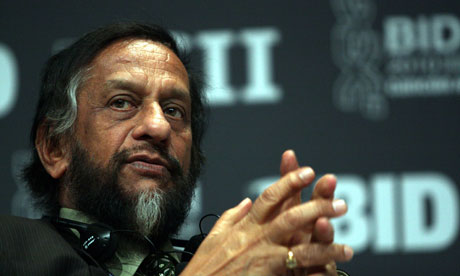
    Chairman of the IPCC Rajendra Pachauri attends general meetings of IADM in Cancun

    Chief of the Intergovernmental Panel on Climate Change, Rajendra Pachauri. Photograph: Elizabeth Ruiz/EPA

    The chairman of the United Nations‘ climate panel has dismissed a contrarian spoiler campaign targeting next week’s blockbuster report, saying “rational people” will be convinced by the science.

    In his first public comments on the organised effort to discredit the major climate change report ahead of its release on 27 September, Rajendra K Pachauri, the chairman of the Intergovernmental Panel on Climate Change (IPCC), said he was confident the high standards of the science in the report would make the case for climate action.

    “There will be enough information provided so that rational people across the globe will see that action is needed on climate change,” Pachauri told a conference call.

    “I really wouldn’t want to say anything about any perceived effort for a pushback,” he went on. “We are doing our job and we are reasonably confident that rational people in government and all over the world will see the merit of the work that has been done.”

    Pachauri spoke to a small group of reporters on a conference call organised by the Natural Resources Defence Council ahead of a visit to the US by India’s prime minister, Manmohan Singh.

    Organisations that dismiss the science behind climate change and oppose curbs on greenhouse gas pollution have made a big push to cloud the release of the IPCC report, the result of six years of work by hundreds of scientists.

    Those efforts this week extended to promoting the fiction of a recovery in the decline of Arctic sea ice.

    The IPCC assessments, produced every six or seven years, are seen as the definitive report on climate change, incorporating the key findings from some 9,000 articles published in scientific journals.

    But an error slipped into the 900-plus pages of the last such report in 2007 – the false claim the Himalayan glaciers could melt by 2035. That small mistake turned into a public relations disaster for the IPCC.

    Pachauri also came under a barrage of personal criticism for his handling of the mistake.

    The IPCC chairman suggested climate contrarians and those who oppose action on climate change deliberately exaggerated the significance of that error to try to damage the work of the IPCC – and so hurt the case for climate action.

    He pointed out that the single error “was buried somewhere in the middle” and had never made its way to the summary for policymakers – prepared to guide government officials preparing for future climate change – or other areas of the report.

    “It doesn’t in any way retract from the reality that glaciers in the Himalayas are melting. They are receding,” he said. “This is an error that should have been seen in a balanced way and should not have been made so much of.”

    Even so, the controversy over the last assessment, and the political polarisation in America and other countries around climate science and the need for climate action, have created an additional layer of scrutiny around next week’s report.

    Leaked drafts of the report suggest the teams of scientists, while re-affirming that humans are the drivers of climate change, may have couched some of their language.

    Some scientists involved in the IPCC effort have asked whether such huge undertakings are still relevant, now that the science is now so certain, and asked whether it might not be a better use of resources to focus on specific regions or extreme weather events.

    Pachauri said the IPCC would discuss those suggestions at a meeting in Batumi, Georgia, next month. But he said the final decision on the IPCC’s mission, and the future of the blockbuster climate reports, would rest with governments.

    “We are an intergovernmental body and we do what the governments of the world want us to do,” he said. “If the governments decide we should do things differently and come up with a vastly different set of products we would be at their beck and call.”

    For this assessment, however, in the wake of the 2007 backlash from
    climate doubters Pachauri said IPCC had taken additional measures
    throughout the long process of compiling the report, to ensure it was
    accurate and faithful to the science.

    “We have done everything humanly possible to ensure that every stage
    of drafting, every stage of comments and expert reviews carried out,
    that we look for any potential error or any source of information that
    might not carry the highest levels of credibility,” he said. “We have
    done everything possible but this is a human endeavour and we just
    hope for the best.”

    Green light

    close

    Sign up for the Green light email

    The most important environment stories each week including data, opinion pieces and guides.

    Sign up for the Green light email