Category: Uncategorized

  • Population Plus Climate: Why Coastal Cities Will Face Increased Risks From Floods

    Content

    Science & Space

    Population Plus Climate: Why Coastal Cities Will Face Increased Risks From Floods

    A new study names the global cities most at risk at coastal flooding—both today, and in a warmer future.

    155028577
    Aby Baker/Getty ImagesFlooding seen at the entrance to FDR Drive in New York City after Hurricane Sandy, on Oct. 30, 2012

    Living in New York, it’s easy to forget that the ocean is right on our doorsteps. This isn’t Miami with its beaches or Venice with its canals or New Orleans with its history of storms and floods. New York has always been a supremely self-involved city—this famous magazine cover pretty much sums it up—and though Manhattan is an island, it’s one that has its eyes turned inward, not out toward the water that rings it.

    Hurricane Sandy ended that illusion last year. The storm surge flooded tunnels, subway lines and apartment buildings; swamped power lines and transformers caused a blackout over much of Manhattan that lasted for days. Altogether Sandy cost the city of New York some $19 billion in public and private losses, nearly all of it due to the water. Sandy wasn’t even that powerful a storm, its winds barely ranking as a category 1 when it made landfall along the East Coast last October. What it had was something any New Yorker who’s hunted for apartments could appreciate—location, location, location—hitting the biggest city in America and flooding it with all that forgotten coastal water.

    For coastal cities like New York, Hurricane Sandy was a coming attraction for what is likely to be a very wet and destructive future. According to leaked drafts of the forthcoming new report from the Intergovernmental Panel on Climate Change (IPCC), scientists believe that sea level could rise by more than three feet by the end of the century is carbon emissions keep growing at a runaway pace. And a new study published in the journal Nature Climate Change laid out the enormous flood losses that major coastal cities could face in the future. Average global flood losses could rise from approximately $6 billion per year in 2005 to $60 to $63 billion per year by 2050, thanks to population and economic growth along the coasts and the multiplying effect of climate change-driven sea level rise. As Robert Nicholls, a professor of coastal engineering at the University of Southampton in Britain and a co-author of the study, put it in a statement: “There is a pressing need to start planning how to manage flood risk now.”

    The Nature Climate Change study looked at both present and projected future flood losses in the 136 largest coastal cities in the world, looking at their financial risks both in absolute terms—taking into account protections like sea walls and dikes—and as a percentage of the city’s GDP. The cities ranked as most at risk today range from Guangzhou in southern China to Mumbai in India to, yes, New York City. What those cities tend to have in common is high wealth and population levels and relatively little flooding protection. (By contrast, Dutch cities like Amsterdam or Rotterdam—which are extremely flood-prone geographically—aren’t found on the list because the Netherlands government has invested heavily in coastal protection.) Three American cities—Miami, New York and New Orleans—are responsible for 31% of the total losses across the 136 cities surveyed in 2005. When it comes to losses as a percentage of total city GDP—which gives the very richest cities like New York an advantage—Guangzhou, New Orleans and Guayaquil in Ecuador are most at risk.

    The situation changes a bit in 2050. The study assumed that climate change will lead sea levels to rise 0.65 to 1.3 ft. by 2050, with some cities facing additional sea level rise because of local subsidence—literally, the earth sinking. Developing cities like Guangzhou, Mumbai and Shenzhen face the biggest risks, though Miami and New York rank highest among cities in developed nations. If no improvements are made in flood defenses, the study estimates that the world could be facing as much as $1 trillion or more per year in losses. Now, that number is the worst of the worst case, assuming that cities do absolutely nothing to protect themselves from sea level rise, suffer major floods and then pay to immediately rebuild everything they lost. But even assuming improvements in coastal defenses, potential losses will increase significantly, thanks to the risk of bigger floods and more immediately, a huge increase in the number of people and the value of property along the coasts.

    That second bit is important. It’s vital for governments to gain a better understanding of flooding risks from global warming—and sea level rises of the sort apparently projected by the IPCC will endanger major world cities. But the most immediate threat is the sheer increase in people—and their property—put in harm’s way in coastal cities. In the U.S. 87 million people now live along the coast, up from 47 million people in 1960, and globally six of the world’s 10 largest cities are on the coast. Of the $60 to $63 billion in flood risk the Nature Climate Change study estimates the world’s cities will face by 2050, $52 billion is due to economic and population growth—the rest is due to sea level rise and land use change.

    That doesn’t mean that climate change-amplified floods and storms don’t present a danger to coastal cities—or that we don’t need to worry about reducing carbon emissions. But the numbers don’t lie—the single biggest increase in the risk from flooding comes from putting people and property in places where floods have always been likely to happen. As Sandy showed, coastal cities are at risk from major flooding right now if a storm should hit at the wrong place at the wrong time. It’s location, location, location—which is why it’s so important to spend money now to improve coastal

  • Grassroots Campaign Focuses on Tackling Sea Level Rise Awareness

    Published: 21 August 2013

    Including Study on Perceptions and Opinions

    Point Pleasant Beach, NJ- Today, environmental advocates gathered at Jenkinson’s Boardwalk in Point Pleasant Beach to wrap up this year’s C.O.A.S.T. (Clean Ocean Action Shore Tips) Campaign, highlighting the launch of a sea-level rise survey, tip-card for citizens, and a new national initiative called US Strong.

    C.O.A.S.T. is an annual summer outreach campaign that raises awareness among beachgoers and coastal citizens about current ocean pollution and industrialization issues.  The C.O.A.S.T. campaign organizes volunteers to set up and staff information and action tables at beach locations in Monmouth and Ocean Counties on weekend in July and August. This summer, additional tables were set up at festivals as several beaches could not accommodate the campaign due to complications from Superstorm Sandy. Despite the setbacks from the storm, the volunteers were able to reach hundreds of citizens at dozens of locations. Volunteers also sold campaign merchandise to raise funds for Clean Ocean Action’s efforts to stop ocean pollution.

    It has been nearly ten months since Superstorm Sandy devastated the Jersey Shore. What Sandy destroyed in 36 hours will take years to restore. This summer’s C.O.A.S.T. campaign focused on educating the public about the imminent threat of sea level rise in an effort to prevent the same kind of destruction from occurring again. At each table a new card from Clean Ocean Action’s “10 Tips” series were given out that outlines what steps the public can take to protect themselves from such devastation in the future.

    “Until recently, many New Jerseyans were unaware of what climate change meant to them; it was a vague term that had no face,” said Cindy Zipf, executive director of Clean Ocean Action. “Superstorm Sandy gave us a harsh devastating glimpse of the threats and realities of sea level rise, but we now have a window of opportunity to help inform citizens about what is at stake and how they can prepare and respond to keep them safe from future storms,” Zipf added.

    Yesterday, Governor Christie and Housing and Urban Development Secretary Shaun Donovan called for creating more resilient communities through long term planning. This year’s C.O.A.S.T. campaign got to the grassroots of that endeavor. The campaign provided coastal citizens with the tools to become more aware of the pressing issues related to sea level rise.

    “Clean Ocean Action’s work to educate the public about the threat and reality of sea level rise is vital,” said Lauren Townsend, New Jersey Director of US Strong. “Between sea level rise and extreme weather events like Superstorm Sandy, we need real protections and disaster relief to protect our communities. Establishing a federal extreme weather relief and protection fund will help vulnerable communities respond to sea level rise and extreme weather events that are becoming common place across the nation.  Acting now will save money and, more importantly, save lives.”

    The C.O.A.S.T. campaign also launched Clean Ocean Action’s new citizen’s survey on sea level rise. The survey will gauge public perception on what should be done to prevent sea level-related devastation, and whose responsibility it is.

    “The Jersey Shore bounced back from the storm with the kind of resilience and determination that you would expect from New Jerseyans” said Macailagh McCue, Clean Ocean Action’s C.O.A.S.T. Intern, “however there is a great deal of rebuilding and planning that still needs to be done. The citizen’s survey will help Clean Ocean Action to determine what the best actions are moving forward, and who should be responsible for protecting our homes and communities from this kind of catastrophe in the future”.

    To participate in the survey, and voice your opinion on this important issue, visit www.cleanoceanaction.org or call Clean Ocean Action at (732) 872-0111 for more information.

    Comments (2)

    • bill wolfe 13 hours ago
      Where was COA and COAST when it mattered?

      Where have they been as Gov. Christie has ignored climate change and sea level rise dismantled existing protections, such as: 1) DEP deregulation of infrastructure reconstruction; 2) DEP exemption of redevelopment from coastal permit requirements; 3) DEP emergency Orders that roll back existing coastal protections; 4) attack on FEMA flood maps; 5) DEP failure to update flood maps for inlands rivers; and most importantly 6) Gov. Christie’s appointment of a non-transparent, non-democratic unaccountable “Rebuild Czar” who oversaw NJ’s Rebuild plans for securing federal Sandy recovery funds?

      COAST and COA are ineffective diversions – while the policy, regulatory, and financial horses gallup out of the barn and repeat the mistakes of the past.

      0
    • bill wolfe 13 hours ago
      If the public is interested in shaping real solutions, here are the policy tools you need to look at critically and use:

      www.wolfenotes.com/2013/08/gov-christies…orm-hazard-planning/

      0
  • 5 Terrifying Statements in the Leaked Climate Report

    5 Terrifying Statements in the Leaked Climate Report

    Is the Intergovernmental Panel on Climate Change getting blunt about how bad global warming is going to be?

    —By

    | Tue Aug. 20, 2013 7:02 AM PDT
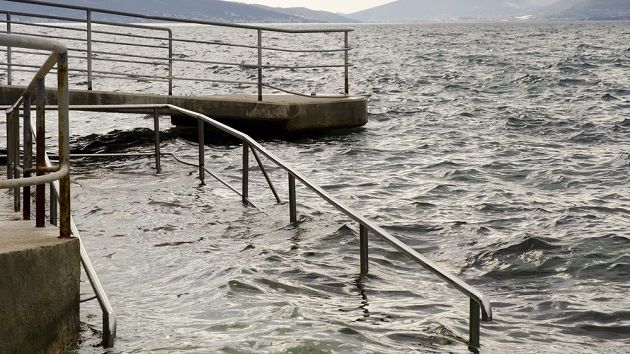
    Image of a submerged pier.In the long run, global sea level rise could easily exceed 5 meters. Brendan Howard/Shutterstock

    Climate Desk has obtained a leaked copy of the draft Intergovernmental Panel on Climate Change’s 2013 Summary for Policymakers report, which other media outlets are also reporting on. The document is dated June 7, 2013. We recognize, as we’ve previously reported, that this document is not final, and is in fact certain to change.

    Most media outlets are focusing on the document’s conclusion that it is now “extremely likely”—or, 95 percent certain—that humans are behind much of the global warming seen over the last six decades. But there is much more of note about the document—for instance, the way it doesn’t hold back. It says, very bluntly, just how bad global warming is going to be. It gives a sense of irreversibility, of scale…and, of direness.

    In particular, here are five “holy crap” statements from the new draft report:

    We’re on course to change the planet in a way “unprecedented in hundreds to thousands of years.” This is a general statement in the draft report about the consequences of continued greenhouse gas emissions “at or above current rates.” Unprecedented changes will sweep across planetary systems, ranging from sea level to the acidification of the ocean.

    Ocean acidification is “virtually certain” to increase. Under all report scenarios, the acidification of the world’s oceans will increase—the draft report calls this outcome “virtually certain.” As we have previously reported, more acidity “threatens the survival of entire ecosystems from phytoplankton to coral reefs, and from Antarctic systems reliant on sea urchins to many human food webs dependent on everything from oysters to salmon.”

    Long-term, sea level rise could be 5 to 10 meters. Journalists are already citing the draft report’s prediction that by the year 2100, we could see as much as three feet of sea level rise. But there is also a more long-range sea level scenario alluded to in the draft report, and it’s far more dramatic and alarming.

    Taking a look at the planet’s distant past, the document ascribes “very high confidence” to the idea that sea levels were “at least 5 [meters] higher” during the last interglacial period, some 129,000 to 116,000 years ago. It also adds that sea level during this period probably did not exceed 10 meters higher than present levels. Finally, the draft report says, with “medium confidence,” that temperatures at that time weren’t more than 2 degrees Celsius warmer than “pre-industrial” levels.

    Add it all up, and what that means is that if we exceed 2 degrees of warming beyond pre-industrial levels, then we could be looking at radically higher oceans, and submerged coastal cities, in the long run. And just how close are we to exceeding 2 degrees Celsius? Several scenarios used for the draft report project “high confidence” that we’ll get there by the end of the century. At that point, seas would continue to rise well beyond the year 2100, and by much more than three feet.

    This also implies a substantial melting of the Greenland ice sheet. The draft report adds that during the last interglacial period, the melting of Greenland “very likely” contributed between 1.4 and 4.3 meters of global sea level rise, with additional contributions coming from the melting of Antarctica. If Greenland were to melt entirely, it is estimated that sea level would rise by about seven meters.

    Thus, a substantial Greenland melting could also be set in motion by the end of this century, which would eventually result in dramatic sea level increases. To be sure, most of this wouldn’t occur during the current century—it would play out on a much longer time scale. But over 1,000 years or more, the draft report says, Greenland could melt almost entirely, and much of the change might be “irreversible.” (Granted, the report expresses low confidence about the precise temperature threshold required to bring about a full melting of Greenland.)

    Much of the carbon we’ve emitted will stay in the atmosphere for a millennium…even after we’ve stopped emitting it. The draft report says that 20 percent of the carbon dioxide currently in the atmosphere will stay there for an almost unimaginably long time—more than 1,000 years. Even if we were to completely cease all greenhouse gas emissions, the draft report adds, warming would continue for “many centuries.” “A large fraction of climate change,” the document intones, “is thus irreversible on a human time scale.” The only way out would be if our emission levels were “strongly negative for a

  • VIDEO: Are we kidding? Yes and no GET-UP

    Why this ad?
    Award Winning Mobile Planamaysim.com.au/Promo_Code_50UNL – No Lock-In Contracts Or Plans. BYO Mobile & Number. 50% Off-Ends Soon

    VIDEO: Are we kidding? Yes and no

    Inbox
    x
    GetUp!
    6:01 PM (26 minutes ago)

    to me
    NEVILLE,

    An hour ago, Immigration Minister Tony Burke went on TV to release the Government’s new “online video” spruiking their Papua New Guinea detention “solution”. We thought the Minister’s video was, well, shameless – and the production value sucks!

    We thought we’d help the Government out by making them a better video. After all, if you want to show off a renovation, there’s no better way than TV’s Grand Designs.

    Check it out and share far and wide:

    Bad Designs Video

    www.getup.org.au/manus-facts

    – the GetUp team

    PS. Tony Abbott recently announced refugee policies that go far lower than the Government’s plans – lower even than John Howard’s government ever dared. Stay tuned for more actions in our ongoing campaign to hold the parties accountable for their asylum seeker policies. If you haven’t already, let us know what you’d like to see the GetUp movement do next on this campaign by clicking here: http://www.getup.org.au/quick-survey


    GetUp is an independent, not-for-profit community campaigning group. We use new technology to empower Australians to have their say on important national issues. We receive no political party or government funding, and every campaign we run is entirely supported by voluntary donations. If you’d like to contribute to help fund GetUp’s work, please donate now! If you have trouble with any links in this email, please go directly to www.getup.org.au. To unsubscribe from GetUp, please click here. Authorised by Sam

  • Australia unveils most powerful computer

    Science Minister Kim Carr has unveiled Raijin, the most powerful supercomputer in Australia that will help scientists better predict extreme weather events.
    Source

    AAP

    Albert Einstein once said it would be impossible to forecast the weather more than a few days in advance.

    Then again, the genius scientist didn’t have access to Raijin, one of the world’s most powerful supercomputers now occupying an entire floor at the Australian National University.

    The machine – named after the Japanese god of thunder and storms – can perform as many calculations in an hour as the entire earth’s population could achieve using calculators for 20 years.

    This extraordinary power will be a game changer for Australia’s meteorologists, who need to crunch vast amounts of complex data faster than ever to improve weather forecasting in a changing climate.

    “You could say that we in the climate science community have a need for speed,” the Bureau of Meteorology’s head Rob Vertessy said at the launch of the supercomputer on Wednesday.

    “The simple fact is that supercomputer capacity is a major determinant of our success in this field, but it’s always been a struggle to secure access to it.”

    Now, through a $50 million grant from the federal government and collaborative funding from CSIRO, ANU, BoM and Geoscience Australia, researchers have Raijin.

    It’s the largest in Australia, housed within long, glittering rows in the ANU’s purpose-built National Computational Infrastructure (NCI) facility.

    With the power of 30,000 ordinary laptops working together, Raijin performs quadrillions of tasks per second and lets scientists store millions of terabytes of data in a vast, digital cloud.

    This means climate scientists can run weather models more frequently and at finer resolutions, and pinpoint severe weather warnings such as heatwaves and cyclones better.

    The Centre of Excellence for Climate System Science’s Professor Andy Pitman said predicting extreme weather in the 21st century required millions of lines of codes and complex data to be analysed in an instant.

    “You cannot do that on your home computer, you need a seriously large system in order to do that kind of processing,” he said.

    “And fortunately we now have one of those.”

    Science Minister Kim Carr said Raijin would help researchers from many disciples remain at the cutting edge of

  • Renewables future no more costly than fossil fuels

    Renewables future no more costly than fossil fuels

    By on 21 August 2013
    Print Friendly

    The Australian government appears to have made a remarkable concession following the release of the 100% renewables report by the country’s energy market operator – a renewables future will be no more costly than the largely fossil fuel alternative.

    As we reported earlier this month, after the release of the Australian Energy Market Operator’s 100% renewables scenario, the estimated wholesale cost of electricity from a system based largely around wind, solar, geothermal and biomass would cost around $110/MWh and $130/MWh between 2030 and 2050 – depending on the speed of that transition.

    A “community summary” posted on the Department of Climate Change website, highlights the fact that the various scenarios painted by Treasury, the CSIRO, the UNSW, and now the AEMO modeling suggests that wholesale prices – whatever the scenario – will fall in a generally narrow range of around $100/MWh to $130/MWh in 2030, and $110/MWh to $150/MWh in 2050.

    Here is the relevant piece from the document:

    A number of other studies have looked at generation and wholesale electricity prices in 2030 and 2050: the Treasury’s Strong Growth Low Pollution (SGLP) modelling from September 2011, the CSIRO’s eFuture modelling tool, and the University of New South Wales’ least cost 100 per cent renewable electricity scenarios in the Australian NEM study.

    Importantly, each model has a specific purpose and each has significantly different assumptions, methodologies and cost inputs. Furthermore, each model emphasises different aspects of the electricity system and simplifies others according to purpose. For example, the study’s cost numbers are based on a total revenue requirement (average costs) while others (such as CSRIO) are marginal costs. Average costs are likely to be lower than marginal costs.

    As a result, differences in the models, the exclusion of some costs and the framework which does not build the system incrementally means that is it not possible to accurately predict the quantum of additional costs that would result from any new policies to achieve 100 per cent renewable energy.

    Nonetheless, despite the differences between the modelling exercises, indicative wholesale electricity prices generally fall within a reasonably narrow range of around 100 – 130 dollars per MWh in 2030 and around 110 – 150 dollars per MWh in 2050.

    So it seems that Canberra bureaucrats, if not the politicians, are conceding that there is little difference in costs between the relatively modest climate and clean energy goals proposed by the current government, and the more ambitious targets proposed by The Greens, and environmental groups.

    This should not be a surprise to anyone who has properly considered the costs of new generation – as ACT minister Simon Corbell has – and their likely progress in coming years. Wind, and then solar, clearly offer the cheapest options.

    New coal and gas plants will be priced out of the market, an important consideration when taking into account that most current generation needs to be replaced in coming decades. (Some pro-nuclear web-sites and commentators like to say that nuclear energy will be within the same cost bracket, but that is only if the cost of capital is ignored.)

    The consideration of future costs is a crucial point in the current federal political debate, where policies such as high emission reduction targets and high renewables scenarios – as proposed by The Greens – are seen as reckless, dangerous, marginal or fringe policies.

    The frustration is that while such targets form part of the mainstream policy discussion in most other countries, each of the big parties in Australia are as keen as the other to put as much distance between themselves and the Greens. So while most other countries debate how quickly they should be moving to decarbonise the economy, the overall theme in Australia is how slowly it should be done.

    The common reason for this is cited as cost to the consumer, but the reality is that the cost to consumer is no greater in these ambitious scenarios than it is under the more modest transitions modeled by Treasury. And if other environmental costs are included, such as the health impacts of fossil fuels, then the numbers change again.

    As Corbell (he’s from the Labor Party) noted in his interview with RenewEconomy this week, a 90 per cent renewables target would cost no more to consumers if tied in with energy efficiency and other measures. It’s a shame that no other politician from a mainstream party is talking in those terms on a national scale.

    As Corbell noted, the real push back comes from incumbent generators and vested interests, because it is they who face lower revenues and profits – which is why their industrial lobby groups are calling for a dilution of Australia’s relatively modest 20 per cent renewable energy target by 2020 (in the case of the generators), or for climate policy to be completely re-evaluated (in the case of the Business Council of Australia).

    Both strategies are focused on creating further delay in the inevitable transition to a low-carbon economy. Unions and environmental groups operating under The Southern Cross Climate Coalition today released a policy platform that stressed that environmental policies can be directly linked to employment growth and economic expansion.

    It says that low-carbon and energy productive technologies and practices are essential for maintaining and growing jobs, and this applies as much to traditional industries as it does to innovate industries of the future.

    Despite efforts by some media to bring climate change to the forefront – as witnessed by the SMH editorial today – such pleas are likely to fall on deaf ears in the current campaign.

    Neither Treasurer Chris Bowen nor Opposition spokesman Joe Hockey mentioned climate change or a clean energy transition in their hour-long debate on Monday, focusing instead on an absurd argument about revenue