Category: Uncategorized

  • Federal approval for second mine in Tasmania’s Tarkine region

    Federal approval for second mine in Tasmania’s Tarkine region

    ABCAugust 5, 2013, 9:11 am

    Federal approval has been given for another iron ore mine in Tasmania’s Tarkine region.

    Venture Minerals’ Riley Creek mine gained state approval in May and now has been given the go ahead by Federal Environment Minister Mark Butler.

    The west coast mine will operate for two years.

    Venture wants to build it to help finance the company’s flagship Mount Lindsay tin and tungsten project nearby.

    Mining has been a key focus in the Braddon electorate in recent months as workers deal with a downturn in the forestry sector and high unemployment rates.

    Shree Minerals’ open cut iron more mine gained a second federal approval last week after the first one was successfully challenged by environmentalists.

    That action was brought by the Tarkine National Coalition which is also challenging Venture’s Riley Creek mine in the state planning appeals tribunal.

    The group is arguing the Environmental Protection Authority did not fully consider the mine’s impact on rare plants and the endangered Tasmanian devil.

  • Historical sea level changes

    Figures marked “CSIRO”, are copyright CSIRO, but please feel free to use them, conditional on the figures not being altered, and their source being acknowledged, and with a link to this site where possible.

    All other figures are copyright. Please do not copy without the owner’s permission.


    Historical sea level changes

    Last two decades

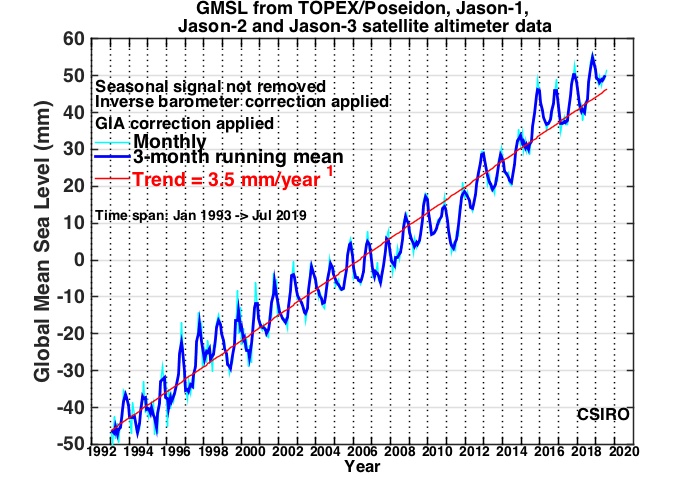
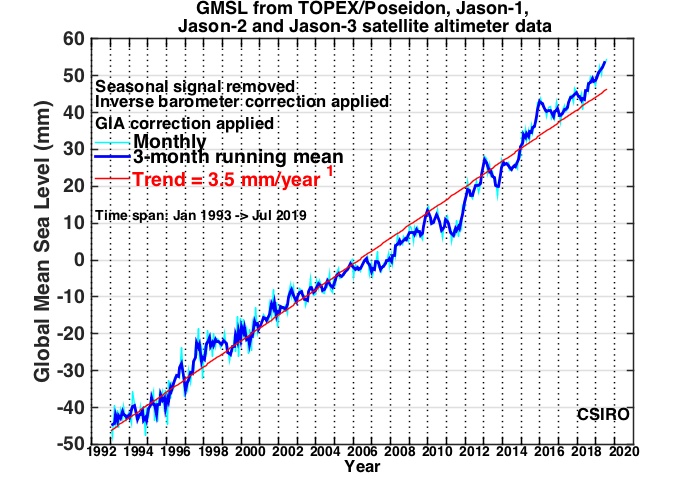
    High quality measurements of (near)-global sea level have been made since late 1992 by satellite altimeters, in particular, TOPEX/Poseidon (launched August, 1992), Jason-1 (launched December, 2001) and Jason-2 (launched June, 2008). This data has shown a more-or-less steady increase in Global Mean Sea Level (GMSL) of around 3.2 ± 0.4 mm/year over that period. This is more than 50% larger than the average value over the 20th century. Whether or not this represents a further increase in the rate of sea level rise is not yet certain.

    The two plots below show the GMSL measured from TOPEX/Poseidon, Jason-1 and Jason-2.

    This one shows it with the seasonal signal removed:

    Plot of global sea level from 1993 to 2012

    And this shows it with the seasonal signal left in:


    Sea level and El Niño

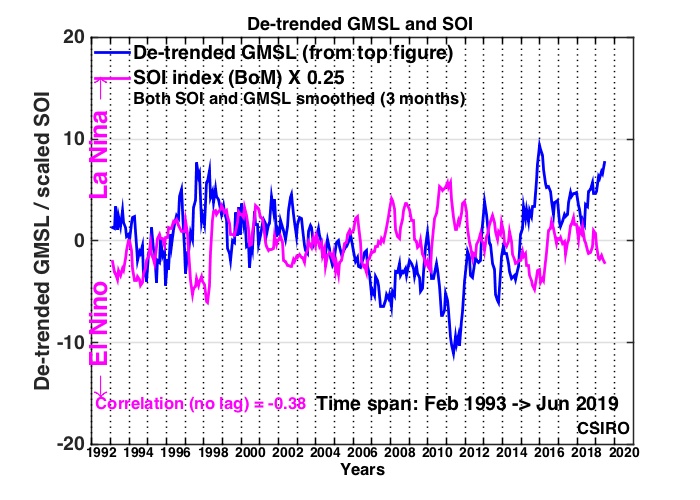
    Plot of global sea level vs the SOI index from 1993 to 2012

    There are a number of changes of slope over short periods in the GMSL record. This variability is at least partly related to El Niño and La Niña (sea level rises during El Niño and falls during La Niña) and associated changes in the hydrological cycle.

    The above graph shows detrended GMSL (from the top graph) versus the Southern Oscillation (SOI) index, which is one of the common indexes of the El Niño/La Niña cycle.

    Clearly (see, e.g. 1997/1998) sea level is higher during an El Niño event (SOI -ve) and lower (see, e.g. 1999/2000 and 2010/2011) during La Niña (SOI +ve).

    SOI data is from the Australian Bureau of Meteorology and data and graphs can be downloaded and seen at the Bureau of Meterology’s web site.


    Regional trends

    Sea level does not rise (or fall) uniformly over the oceans. This is illustrated by the map (below) showing sea-level trends from 1993 to 2012. There is a clear pattern of sea-level change that is also reflected in patterns of ocean heat storage.

    Plot of sea level trends from 1993 to 2009

    This pattern reflects interannual climate variability associated with the El Niño/La Niña cycle and the Indian Ocean Dipole, but also longer term changes such as the increase in sea levels in the Western Tropical Pacific due to changes in the Trade Winds. During El Niño years sea level rises in the eastern Pacific and falls in the western Pacific, whereas in La Niña years the opposite is true.

    Plot of sea level trends from 1993 to 2001 and 2001 to 2009


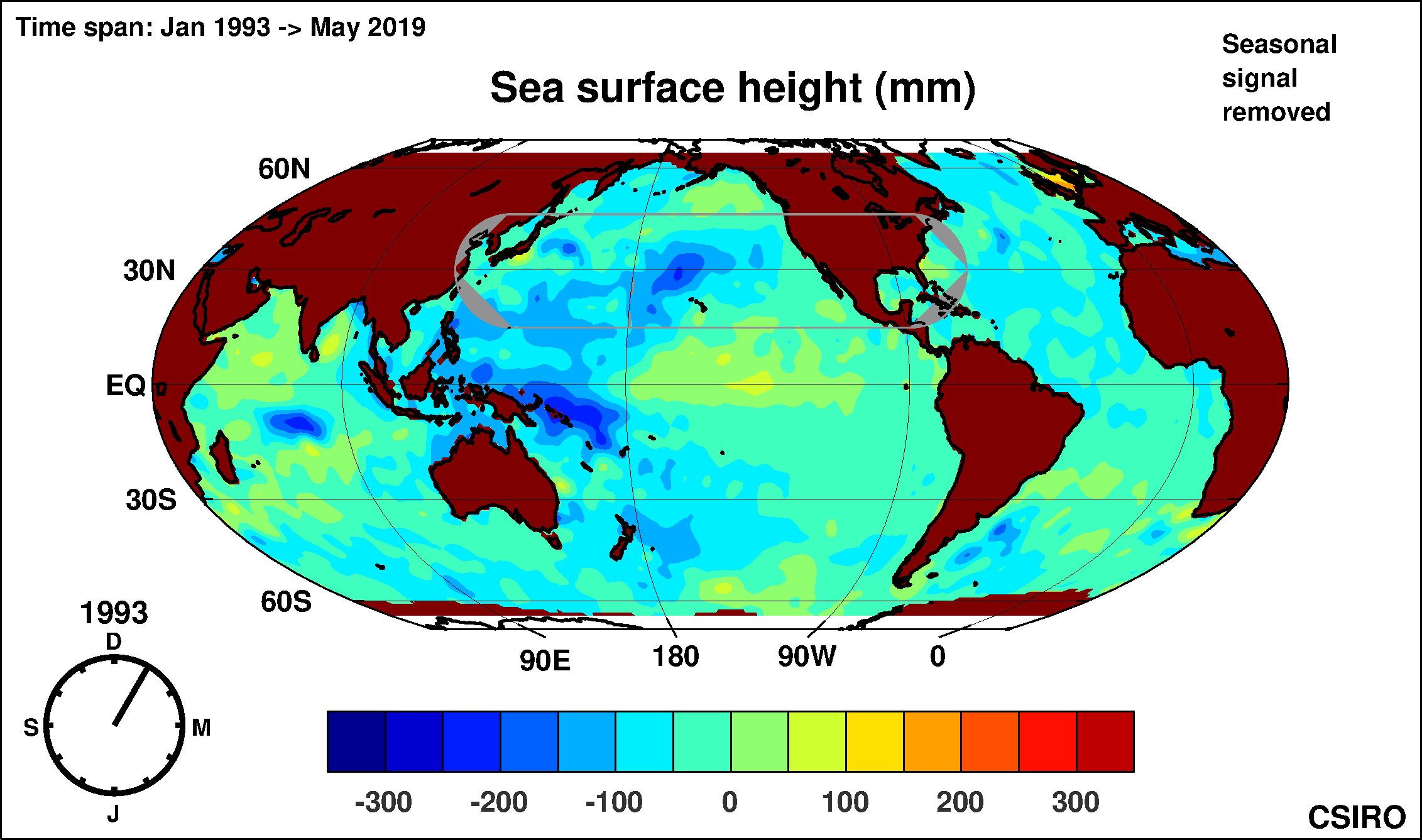
    Movie of sea-level changes (2.8MB animated gif) over the last 20 years – this version has had the seasonal (annual+semi-annual) signal removed at each point. This is comparable to the top figure (above).

    Click on the map below to see a movie of monthly-mean sea-surface height from January 1993 to April 2013 with the seasonal signal removed. The plot at the top of the page shows the time series of the means of these fields.

    The data that is displayed here can be downloaded from the “Sea level data>Data downloads” page on this site.

    Note the 1997/98 El Niño event!

    Sea surface height 1993-2010


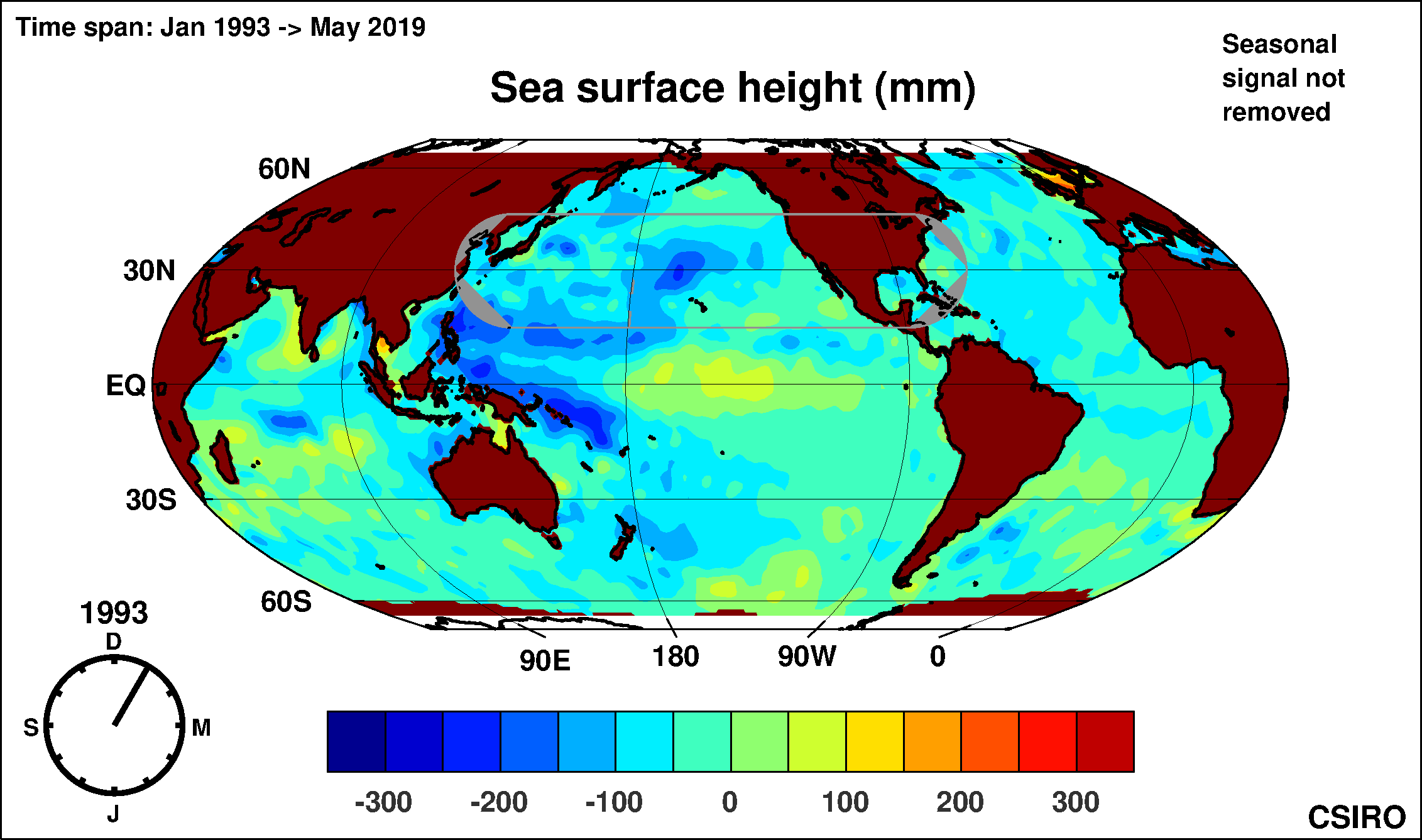
    Another movie of sea-level changes (2.9MB animated gif) over the last 20 years

    Click on the map below to see a movie of monthly-mean sea-surface height from January 1993 to April 2013. The seasonal signal has not been removed from this, so you should see the pumping as the water in each hemisphere warms and expands in Spring and Summer and cools and shrinks in Autumn and Winter. The second plot (above) shows the time series of the means of these fields.

    The data that is displayed here can be downloaded from the “Sea level data>Data downloads” page on this site.

    Note especially the 1997/98 El Niño event!

  • Newly discovered flux in the Earth may solve missing-mantle mystery

    Newly discovered flux in the Earth may solve missing-mantle mystery

    Research points to large reservoirs of material deep in the mantle that may help to explain Earth’s origins.
    Jennifer Chu, MIT News Office

    today’s news

    A woman in rural Afghanistan answers questions about the effects of the country’s National Solidarity Program. Photo: Fotini Christia

    Empowering women in Afghanistan

    By placing some women in local leadership positions, an innovative development aid program integrates women into civic life, and may have economic benefits.

    Research points toward better colonoscopy

    July 31, 2013

    The brains behind research on the brain

    July 31, 2013
    Newly discovered flux in the Earth may solve missing-mantle mystery

    This artist’s rendering shows a solar system that is a much younger version of our own. Dusty disks, like the one shown here circling the star, are thought to be the breeding grounds of planets, including rocky ones like Earth.
    Image: NASA/JPL-Caltech
    It’s widely thought that the Earth arose from violent origins: Some 4.5 billion years ago, a maelstrom of gas and dust circled in a massive disc around the sun, gathering in rocky clumps to form asteroids. These asteroids, gaining momentum, whirled around a fledgling solar system, repeatedly smashing into each other to create larger bodies of rubble — the largest of which eventually cooled to form the planets.

    Countless theories, simulations and geologic observations support such a scenario. But there remains one lingering mystery: If the Earth arose from the collision of asteroids, its composition should resemble that of meteoroids, the small particles that break off from asteroids.

    But to date, scientists have found that, quite literally, something doesn’t add up: Namely, the Earth’s mantle — the layer between the planet’s crust and core — is missing an amount of lead found in meteorites whose composition has been analyzed following impact with the Earth.

    Much of the Earth is composed of rocks with a high ratio of uranium to lead (uranium naturally decays to lead over time). However, according to standard theories of planetary evolution, the Earth should harbor a reservoir of mantle somewhere in its interior that has a low ratio of uranium to lead, to match the composition of meteorites. But such a reservoir has yet to be discovered — a detail that leaves Earth’s origins hazy.

    Now researchers in MIT’s Department of Earth, Atmospheric and Planetary Sciences have identified a “hidden flux” of material in the Earth’s mantle that would make the planet’s overall composition much more similar to that of meteorites. This reservoir likely takes the form of extremely dense, lead-laden rocks that crystallize beneath island arcs, strings of volcanoes that rise up at the boundary of tectonic plates.

    As two massive plates push against each other, one plate subducts, or slides, under the other, pushing material from the crust down into the mantle. At the same time, molten material from the mantle rises up to the crust, and is ejected via volcanoes onto the Earth’s surface.

    According to the MIT researchers’ observations and calculations, however, up to 70 percent of this rising magma crystallizes into dense rock — dropping, leadlike, back into the mantle, where it remains relatively undisturbed. The lead-heavy flux, they say, puts the composition of the Earth’s mantle on a par with that of meteorites.

    “Now that we know the composition of this flux, we can calculate that there’s tons of this stuff dropping down from the base of the crust into the mantle, so it is likely an important reservoir,” says Oliver Jagoutz, an assistant professor of geology at MIT. “This has a lot of implications for understanding how the Earth evolved through history.”

    Jagoutz and his colleague Max Schmidt, of the Swiss Federal Institute of Technology in Zurich, have detailed their results in a paper published in Earth and Planetary Science Letters.

    A mantle exposed

    Measuring the composition of material that has dropped into the mantle is a nearly impossible task. Jagoutz estimates that such dense rocks would form at a depth of 40 to 50 kilometers below the surface, beyond the reach of conventional sampling techniques.

    There is, however, one place on earth where such a depth of the crust and mantle is exposed: a region of northern Pakistan called the Kohistan arc. Forty million years ago, this island arc was crushed between India and Asia as the two plates collided.

    “When India came in, it slammed into the arc, and the arc extended and rotated itself,” Jagoutz says. “Because of that, we now have a cross-section of the mantle-to-crust transition. This is the only place on Earth where this exists.”

    On various trips from 2000 to 2007, Jagoutz trekked through the Kohistan arc region, collecting rocks from various parts of the arc’s crust and mantle. Bringing them back to the lab, he analyzed the rocks’ density and composition, discovering that some were “density-unstable” — much denser than the mantle. These denser rocks could potentially sink into the mantle, creating a hidden reservoir.

    Adding up to an asteroid origin

    The researchers measured the rocks’ composition, and found that the denser rocks contained much more lead than uranium — exactly the ratio predicted for the missing reservoir of material. Jagoutz then performed a mass balance (a simple conservation-of-mass calculation) to determine how much dense rock drops into the mantle, based on the composition of the region’s crust, rocks and mantle: Essentially, the mass of the Kohistan arc, minus whatever material drops into the mantle, should equal the material that comes out of the mantle.

    Jagoutz and Schmidt solved the equation for 10 common elements. From their calculations, they found that 70 percent of the magma that rises from the mantle must ultimately drop back down, relatively heavy with lead. Applying this statistic to other island arcs in the world — such as the Andean volcanic belt and the Cascade Range — they found that the amount of material dropped into the mantle globally equals the composition and quantity of the so-called missing reservoir — a finding that suggests that Earth did indeed form from the collision of meteorites.

    Bruce Buffett, a professor of earth and planetary science at the University of California at Berkeley, says a hidden reservoir in the mantle made of dense rocks is “interesting and plausible,” though he points out that there are other competing theories. For example, the subduction of oceanic crust into the mantle may contribute unknown material. Likewise, material may form from the cooling and solidifying of a large magma ocean.

    “There are a large variety of options on the table to explain the complex structure we detect seismically at the bottom of the mantle,” says Buffett, who was not involved in the study. “The attractive aspect of [Jagoutz’s] idea is that it has testable consequences. This is how progress is made.”

    “If we are right, one of the questions we have is: Why is the Earth capable of hiding something from us? Why is there never a volcano that brings up these rocks?” Jagoutz adds. “You’d think it’d come back up, but it doesn’t. It’s actually interesting.”

  • Fast Rising Magma Triggered Some Volcano Eruptions

    Fast Rising Magma Triggered Some Volcano Eruptions
    Submitted by Manjinder Singh on Sat, 08/03/2013 – 13:03

    VolcanoScientists have figured out that magma triggered the eruption of the Irazu volcano in the 1960s. Magma rose 22 miles in just two months.

    The 1963 Eruption of Costa Rica’s Irazu volcano has been re-examined by scientists. They have found something surprising and bit unsettling.

    Their findings suggested that some eruptions may happen in a much shorter time than previously thought. Scientists used to think that the rise of magma from the earth’s surface takes thousands of years.

    But they are surprised with what they have found now. Some volcanoes have the ability to recharge their magma supply in a manner of months to blow their tops relatively quickly. The findings were published in the journal Nature on Wednesday.

    The short fuse of the 10,000-foot-tall, 200-square mile-wide Costa Rican volcano Irazu has been described in the paper by a pair of researchers from Columbia University’s Lamont-Doherty Earth Observatory.

    “There’s definitely already evidence for fast-rising magmas in smaller volcanoes, but our new observation was that even `full-grown’ large volcanoes can also operate very fast”, lead author Philipp Ruprecht said in a phone interview.

    Icelandic volcanoes are directly connected to the earth’s mantle because of the location’s geology. Volcano in Costa Rica, according to the research, may have a direct connection to the mantle too, despite the fact of lying on a much thicker part.

  • Sept 7 in doubt as Rudd has things to do

    Sept 7 in doubt as Rudd has things to do

    By Adam Bennett, AAPUpdated August 3, 2013, 5:50 pm

    Kevin Rudd says he has “made no determination whatsoever” on when the federal election will be held, throwing doubt on the likelihood of a September 7 election.

    The prime minister also told reporters on Saturday he wanted to attend a G20 summit just days before what had been considered the favoured poll date, raising the prospect the election could be pushed out to at least September 21.

    Speculation had been building that Mr Rudd was planning to visit the governor-general on Sunday or Monday to seek approval for a September 7 election.

    But Mr Rudd said the government had yet to conclude negotiations with Victoria over schools funding, with Western Australia on disability care, and with NSW over new environmental assessment procedures.

    “We have a few things to attend to yet,” he said after signing a new asylum-seeker resettlement agreement with Nauru on Saturday.

    “So therefore on your question (about September 7), I’ve made no determination whatsoever in terms of the date of an election.”

    Whether Mr Rudd would attend the upcoming G20 leaders summit had also been a source of constant speculation, as the St Petersburg meeting is being held on September 5 and 6.

    Mr Rudd confirmed it was “my intention to be in St Petersburg”.

    “But I’m very mindful also of the challenges that lie ahead of us as well,” he told reporters in Brisbane.

    “I place enormous priority to the G20 and its agenda.

    “At the same time I will always balance that against other considerations before us as well.”

    If Mr Rudd does still decide on a September 7 election, it will need to be called by Monday to cover the minimum 33-day campaign period.

    With September 14 all but ruled out because it had been chosen by his predecessor Julia Gillard, a September 21 election would be the next possible date.

    Opposition Leader Tony Abbott declared his team ready for the campaign.

    “We’ve been ready for a long time,” Mr Abbott told reporters in Melbourne, when asked about a September 7 election.

    “I think the Australian people are eager to seize the chance to control the government once more.

    “This election is a choice between strength and stability under the coalition, or more chaos, division and dysfunction under the Labor party.”

    Speculation over the election date came a day after the government’s economic update, which predicted weaker economic growth, growing unemployment and more government debt, as well as a $33.3 billion writedown in revenues.

    Shadow treasurer Joe Hockey said he expected the prime minister to “run to the polls in the next two days”.

    “Because the boats keep coming, the debt is blowing out by $3 billion a week and unemployment continues to rise, heading towards 800,000,” he told reporters in Sydney.

    “If I were Kevin Rudd I would be going to the polls as soon as possible.”

    But foreshadowing how central the economy will again be during the campaign, Finance Minister Penny Wong released government analysis which, she said, uncovered a $70 billion hole in the coalition’s fiscal credentials.

    “The government has laid out our plans and our budget,” Senator Wong told reporters in Melbourne.

    “It’s time Tony Abbott did, because what this document shows against what Tony Abbott has said is that he would have to make $70 billion worth of cuts.”

  • Ageing population a ticking timebomb for EU

    Ageing population a ticking timebomb for EU

    Saturday, August 03, 2013

    Slowly but unsurely Europe is facing up to population trends that will sap long-run economic growth and force nations to choose between cutting pensions and welfare benefits or paying higher taxes to maintain them.

    By Alan Wheatley

    Some countries are getting an early taste of difficulties that await Europe as baby boomers retire and, because of flagging fertility rates, the average age of those left in the labour force rises.

    In France, trade unions are planning protests against modest plans to rein in the country’s pension funding gap of €14bn and rising.

    Spain, pressed by the European Commission, is drawing up reforms to tackle underfunding in its pension system that forced the government to dip into the social security reserve fund last year.

    “There’s a recognition that something needs to be done, and it’s just a question of the pace at which they move,” said Edward Hugh, an economist and demographer in Barcelona.

    Spain’s pension plight is partly cyclical: more than 3m workers have lost their jobs since the onset of recession and have stopped paying into the pensions system.

    Emigration is making the funding crunch worse. More than half a million foreign workers — lured to Spain during the boom years — have left since the start of 2010, while young Spaniards are moving abroad in droves in search of jobs.

    Spain, Portugal and Ireland all lost about 2% of their working-age adults between 2010 and the first quarter of 2013, said Marchel Alexandrovich, an economist with London investment bank Jefferies.

    In the medium term, he said, this raises the question of who pays for pensions and age-related health care costs in countries that are educating their youngsters only to see many of them emigrate and pay taxes elsewhere.

    Spain is also paying the price of a low fertility rate for the past 25 years

    The risk is that low fertility, high emigration and a rapidly ageing labour force form a vicious economic circle.

    With fewer workers having to pay for more retirees, Spaniards who are braced for lower pensions will tend to save rather than spend, holding back the recovery and thus further eroding the tax base, Hugh fears.

    Bulgaria’s population has shrunk by 582,000 people in the past 10 years to 7.3m. The Baltic states have also witnessed extensive emigration.

    Many countries fall well short of the total fertility rate (of 2.1 children that women need to bear to hold the population constant in the absence of net migration.

    The total fertility rate in Hungary, Poland, Romania and Slovakia fell more than 30% between 1990 and 2011. Hungary had a rate of just 1.2 live births per woman in 2011, with Poland and Romania at 1.3 — considered by demographers to be the danger level.

    Germany has the smallest proportion of people in the 0-14 age bracket, the joint-highest proportion of pensioners (with Italy) and the highest median age, according to the European Commission.

    Germany’s labour force fell by 70,000 in the past year. Immigration is coming to the rescue for now but the country’s growth prospects are darkening.

    The Organisation for Economic Co-operation and Development reckons Germany’s potential growth will fall to less than 1% a year after 2020, from an already low 1.5% today, due to population ageing.

    By 2050 France and Britain, with much more favourable demographic profiles, are projected to have bigger economies than Germany, whose population is set to shrink to just over 70m from nearly 82m now.

    The Commission’s central projection is that EU employment will fall by 5m, or 2.5%, between 2010 and 2030. Not everyone is confident that Europe will rise to the challenge and make its welfare states affordable.

    “Age-related spending plus slow-to-negative growth in labour forces will keep driving most developed nations toward bankruptcy until they reform their governments and financial sectors,” wrote Leigh Skene with Lombard Street Research, a London consultancy.

    — Reuters

    © Irish Examiner Ltd. All rights reserved