Category: Uncategorized

  • It’s climate scientists, not concern trolls who champion the scientific method

    It’s climate scientists, not concern trolls who champion the scientific method

    Warren Pearce has mistaken concern trolling for caring about the scientific method

    TROLLS - 1992

    Concern trolls can be mistaken for climate skeptics. Photograph: Andrew Dunsmore/Rex Features

    The Guardian Political Science section recently published an article written by social science researcher Warren Pearce from the University of Nottingham. In that piece, Pearce asked if climate “sceptics” (or “skeptics” in my preferred American English) are “the real champions of the scientific method.”

    This reminded me of a recent guest post on Pearce’s blog that focused on the exchanges between Ed Davey, Andrew Neil, and myself (to which Pearce gave me the opportunity to respond). The author of that post completely ignored the many scientific errors made by Neil and his refusal to consider all available evidence, concluding,

    “Andrew Neil, in just one show, has done more to promote an active understanding of climate science and its controversies than has been done by the Carbon Brief blog, academics at the Reuters Institute for the Study of Journalism and elsewhere, Bad Science warriors, and a legion of Tweeters who claim to speak for science have done in their entire existences. Along the way, it is possible that Neil made some inconsequential technical mistakes.”

    To be clear, Neil’s comments were not “inconsequential technical mistakes.” They were glaring errors, including ignoring 98 percent of the relevant global warming data and repeating long-debunked climate myths. That is not how to “promote an active understanding of climate science”.

    On this basis, it seems rather bizarre to ask whether these “sceptics” are “the real champions of the scientific method.” In any case, this is a misuse of the term “sceptic.” If one goes around repeating long-debunked myths as though they were reality, there are various adjectives that might apply, but “skeptic” is not one of them.

    Climate scientists, by contrast, are by their nature and profession skeptics. They subject their work and ideas to the peer-reviewed process, which acts as a filter to ensure that research is conducted carefully and objectively, consistent with the scientific method. That is real scientific skepticism, as opposed to uncritically repeating a bunch of stuff posted somewhere on an internet blog.

    Pearce’s primary example of a ‘sceptic champion of the scientific method’ is blogger Anthony Watts, and his reason is that Watts accepts that the greenhouse effect exists, and did an experiment to prove it. Personally I think that’s setting a rather low bar. Kudos to Anthony Watts for not denying basic physics that was established by Joseph Fourier in 1824, and for conducting a simple experiment to demonstrate it, as John Tyndall did in 1859.

    However, aside from accepting the 150-year-old science behind the greenhouse effect, Watts with latch onto any argument so long as it suggests that the human role in global warming is minimal – an attitude also known as ABC (Anything But Carbon). Coincidentally, that includes publishing guest blog posts from people who deny that the greenhouse effect exists. So much for that intense concern about the scientific method.

    For example, I once documented a 6-month period in which Watts argued on his blog that the current global warming could be blamed on the sun, ocean cycles, the sun again, chlorofluorocarbons, and then other ocean cycles. In fact, the only characteristic that arguments from Pearce’s “sceptics” share is that they contradict each other.

    Hence I prefer the term “contrarian” for people who will latch on to any argument as long as it is contrary to the human-caused global warming theory. This includes engaging in smear campaigns against climate scientists like Michael Mann and James Hansen, and even climate bloggers like myself who dare suggest that human-caused climate change is a problem that we must solve.

    Like Andrew Neil, Watts also consistently gets the science wrong. In fact, there are at least four separate climate blogs primarily devoted to correcting Watts’ constant scientific mistakes. After reading Pearce’s article, one of those bloggers wrote,

    “The main motivation behind me starting this blog was because I was tired of reading things on Anthony’s blog that were clearly scientifically incorrect. I thought I may write a post every now and again that tried to address something said on Anthony’s blog. I started in April and am now on post 153.”

    Constantly getting the science wrong, ignoring inconvenient evidence, smearing climate scientists and bloggers – that’s not skepticism. Pearce’s question is like asking whether moon landing conspiracy theorists are the real champions of the scientific method because they don’t believe the moon is made of cheese.

    There seems to be a growing opinion amongst some social scientists that we must listen to these climate contrarians and be careful not to offend or further polarize them. I can’t say I understand the logic, perhaps because I’ve had extensive dealing with contrarians over the past seven years and have yet to see more than one or two display any sort of real skepticism. Anthony Watts’ behavior is typical of contrarians, constantly flip-flopping between contradictory ABC arguments.

    Contrarians aren’t “champions of the scientific method,” as Pearce posits. They might more accurately be described as ‘concern trolls‘, feigning concern at every little climate uncertainty or issue they can use to manufacture doubt and delay the action necessary to solve the climate problem.

    In another guest article in our Political Science section, Tamsin Edwards commented that “sceptics” have told her the public trust in climate scientists has eroded because scientists have supposedly engaged in too much advocacy. It sounds to me like she’s been concern trolled. Climate scientists rarely if ever engage in specific policy advocacy. They’re also the most trusted sources of global warming information. And we have decades of evidence that ABC contrarians aren’t going to suddenly start trusting the climate scientists who tell them exactly what they refuse to believe – that climate change is a threat we need to address.

    There are certainly open climate questions that require further research. Will clouds accelerate or dampen global warming? How much global warming are aerosol pollutants offsetting by reflecting sunlight? Precisely how sensitive is the climate to the increased greenhouse effect? These are all questions being actively investigated by climate scientists, because they are open-minded, curious skeptics who want to know the answers and do care about and follow the scientific method. These questions are worthy of further investigation and discussion, but exploiting them to delay climate action is not skepticism, nor does concern trolling about them champion the scientific method.

    Our top priority should be implementing climate policies that are sufficient to avoid the most damaging and potentially catastrophic climate change. That’s a tall order. Right now we’re on a path for dangerous climate change even in the best-case scenario, let alone the most likely and worst case scenarios. We need major policy changes to reduce greenhouse gas emissions if we want to avoid some nasty climate consequences.

    Pandering to ABC climate contrarians is not going to help us solve the problem in the least. Using Yale’s ‘Six Americas’ categories, contrarians mainly fall into the category of ‘dismissive’ of global warming (8 percent of the population), with some overlap into ‘doubtful’ (13 percent). They are a small minority of the population.

    Concern trolling, constantly getting the science wrong, and ignoring the inconvenient data all stem from the same root cause – ideological opposition to climate solutions. No matter how much effort you put into pleasing contrarians, they are not going to be part of the solution; certainly not soon enough to help us avoid high-risk climate change. But they’re also a small fringe minority. We don’t need everyone to be on board, just enough to create the necessary support behind climate solutions. Pandering to ABC concern troll contrarians is wasted time that would be better spent communicating climate change risks to truly open minded skeptical people. Elevating contrarians with false praise for accepting that the moon isn’t made of cheese certainly isn’t going to help solve the problem.

    The above article has been corrected for a misspelling of Tamsin Edwards’ name, and to reflect that Warren Pearce is not a professor.
  • End this love for dirty fuels

    End this love for dirty fuels

    The future belongs to clean energy, but the UK is embracing shale gas and fracking instead of renewables – appalling policy

    Fracking for shale gas :  Natural Gas Hydraulic Drilling in Eastern Pennsylvania

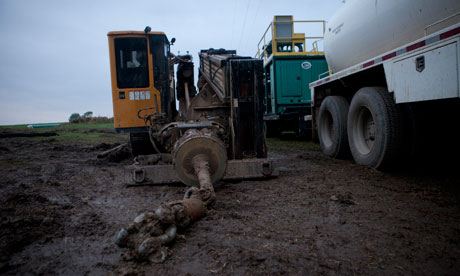
    Fracking equipment: shale gas is an inefficient fuel to exploit, and its extraction will accelerate climate change. Photograph: Amy Sussman/Corbis

    That blaring noise you can hear could be the sound of the UK missing the boat. A succession of crises over more than a decade revealed the UK’s dependence on fossil fuels, increasingly imported, to be both perilous and expensive. The fuel protests of 2000 showed the interconnected vulnerability of our food and fuel systems, while the oil price spike of 2008 revealed the economy as hostage to volatile market.

    You’d think then, that if only as an exercise in prudent government – forget about climate change for a moment – aggressive energy diversification into abundant, domestic renewable sources would be a good idea.

    Yet, if anything, flip-flopping on feed-in tariffs and scaldingly negative remarks from the chancellor, George Osborne, and others have, wilfully or not, undermined a whole UK industrial sector just as it could be growing, creating jobs and being a world leader.

    Renewables are, according to the International Energy Agency, now the fastest growing global energy sector, set to beat gas and generate double the supply from nuclear power by 2016.

    You might think that any government would look at a market like that, which can only get bigger (while oil, for example, by definition can only do the opposite), and want a big slice.

    Why, then, would the Treasury go out of its way to remain in ignorance of both the problem and the opportunity represented by climate change and the challenge of resource depletion? In March it was revealed that the most powerful department in government had its head shoved firmly in the sand.

    A group of senior economists from across Whitehall wanted to review how resource scarcity and climate change would interact with the economy and effect growth. The interests of both industry and environmental groups were to be explored and both sectors were supportive of the study. But the proposal was apparently killed by the Treasury’s chief economist as ‘too speculative’ in its reach.

    Less speculative unfortunately, is the recent trajectory of the UK’s greenhouse gas emissions and reliance on imported fossil fuels.

    Even discounting the UK’s ‘hidden emissions’ embedded in the goods we import and consume, carbon emissions rose by 4% in 2012, driven by a surge in the use of coal to generate electricity. In comparison, to reach a fair and climate-safe level, emissions need to fall by something of the order of 10% per year for the foreseeable future.

    Figures from the Department of Energy and Climate Change also revealed that energy imports rose by 7% meaning that we are now dependent on imports for nearly half (43%) of our energy use.

    More positively, in spite of the instability introduced to the green energy sector by government policy, in line with the global upswing, electricity generated from renewables went up by about one fifth in 2012 compared to the previous year.

    Yet, from the apparently ‘desolate’ north, to the Tory front line of the home counties, political priority is given to the development of shale gas, a difficult, dirty and inefficient fuel to exploit, whose extraction will accelerate climate change.

    Last month I wrote about how the American petro-state of Louisiana exhibited the characteristics of a developing country suffering the ‘resource curse.’ It had the paradox of huge revenues from exploiting natural resources leading not to human flourishing, but instead dependency, corruption, environmental damage and appalling social indicators.

    Since then, Louisiana appears to be having second thoughts. It seems, in effect, to be suing itself for decades of damage resulting from dependence on fossil fuel earnings.

    Officials from the state body responsible for flood protection are suing a host of energy companies including BP and Exxon Mobil for damage to vulnerable coastal wetlands that are vital to protecting the land from extreme weather, such as the impact of worsening hurricanes. A ‘buffer’ that took 6,000 years to form, they say has ‘been brought to the brink of destruction over the course of a single human lifetime.’ It has set experts against politicians, with the Republican state governor accusing his officials of overstepping their authority.

    Today there is generally a much higher level of awareness about the impact of the fossil fuel industry, both locally and globally. In spite of perverse political backing, its future is less than bright. There are the hard-won lessons of places like Louisiana. Middle class militancy is breaking out on the fracking front line of Balcombe, West Sussex before even a pilot drill has gone down, and former oil engineers turned renewable entrepreneurs like Jeremy Leggett predicting that not a single commercial well will open.

    Suddenly the renewables boat seems to offer a much smoother and less stressful journey. Time to climb aboard.

    Onehundredmonths.org

  • Economic update, policy changes clear deck for possible September 7 election

    Economic update, policy changes clear deck for possible September 7 election

    By political correspondent Louise Yaxley, staff, ABCUpdated August 3, 2013, 8:12 am

    A five-week official election campaign is expected to begin within days, culminating in voters going to the polls on September 7.

    The Federal Government’s mini-budget and recent policy changes have cleared the way for Prime Minister Kevin Rudd to visit the Governor-General to ask for an election.

    The Opposition has been demanding Mr Rudd announce the polling day, arguing business confidence has suffered because of the wait.

    Mr Rudd made it clear when he returned to the Labor leadership in June that he was not committed to sticking to the September 14 poll date set by former prime minister Julia Gillard.

    On the trail: Prime Minister Kevin Rudd visits the Royal Prince Alfred hospital in Sydney. Photo: AAP

    A federal election on September 7 would mean a referendum on recognising local government in the constitution on the same day.

    The Government has been preparing for an election campaign with recent policy changes on immigration, carbon pricing and .

    The updated budget sets the scene for a frugal election campaign ahead.

    The update revealed massive revenue write-downs since the May budget, deeper budget deficits for the next three years and $17.4 billion worth of cuts and savings measures.

    The Government says a substantial decrease in nominal GDP has had a major impact on expected tax receipts, leaving a $33.3 billion revenue black hole across the four years of the forward estimates.

    Opposition Leader Tony Abbott visits St. Andrews Christian College in Melbourne as his party announces a Coalition government would match Labor on school funding. Photo: AAP

    It also revealed that $879 million would be cut over four years from the aid budget.

    Australia will boost its aid contribution to Papua New Guinea by $420 million in return for support of Labor’s plans to resettle refugees in PNG.

    Aid agencies Oxfam and UNICEF have condemned the Government’s decision to slash foreign aid to pay for its so-called PNG solution.

  • Congress Passes First Significant Energy Legislation Since 2009

    Congress Passes First Significant Energy Legislation Since 2009

    By MATTHEW L. WALD

    Congress is heading home for its August recess having passed the first significant energy legislation, aside from some tax changes, since 2009, after the Senate approved two bills on Thursday that clear the way for faster licensing of hydroelectric projects.

    “I wouldn’t call it major,” a Senate aide acknowledged. But apart from the stimulus in 2009 and various tax credits, including one for wind energy last December, Congress has not reached agreement on any energy legislation in four years.

    The Senate unanimously approved two bills that had been passed by the House in February. They are hardly radical; they streamline the procedure for licensing small hydroelectric projects.

    Senator Lisa Murkowski, Republican of Alaska and the ranking minority member of the Senate Energy Committee, pointed out that only 3 percent of the 80,000 dams in the United States are set up to generate electricity. “Hydropower is our greatest untapped potential for generating cost-effective, carbon-free energy,” she said in a statement.

    Senator Ron Wyden, Democrat of Oregon, the chairman of the committee, added, “Capitalizing on the power potential of existing dams, pipes and conduits is the kind of practical thinking our country needs to generate more renewable energy and cut our carbon footprint.”

    Some questions that are far more contentious remain on the legislative docket. Mr. Wyden and Ms. Murkowski are two of the main sponsors of a bill to restart the search for a nuclear waste burial site. It is sure to face tough sledding, partly because Republicans in the House are still hoping to revive the Yucca Mountain project near Las Vegas, which was killed by President Obama, partly at the urging of Senator Harry Reid of Nevada, the Democratic leader.

    And a bill promoting energy efficiency, sponsored by Senators Jeanne Shaheen, Democrat of New Hampshire, and Rob Portman, Republican of Ohio, was approved by a Senate committee but has not been taken up by the full Senate.

    Other issues have not even made it that far, including legislation regarding a carbon tax to address climate change and a restructuring of the electric grid, which is not set up to meet modern environmental goals.

    • Save
    • E-mail
    • Share
    • Print
  • Will climate change trigger endless war?

    Will climate change trigger endless war?

    If we don’t change prevailing business-as-usual political economies, probably – but we can still say ‘no’ and mean it

    British soldiers

    British soldiers might be deployed more frequently to respond to new climate-induced disasters in remote regions. Photograph: David Cheskin/PA

    A new study published in the journal Science finds that climate change is strongly linked to human violence around the world. Based on more data than ever studied before – and looking at all major regions of the world from the United States to Somalia – the study unearthed a pattern of conflict linked to even minor climatic changes, including increased droughts or higher than average temperatures.

    The study covered all major types of conflict, from the standard “Intergroup violence and political instability, like civil wars, riots, ethnic violence, and land invasions” to the less studied categories of “Personal violence and crime such as murder, assault, rape, and domestic violence” – and even covered: “Institutional breakdowns, such as abrupt and major changes in governing institutions or the collapse of entire civilizations.”

    All three types of conflict exhibit “systematic and large responses to changes in climate, with the effect on intergroup conflict being the most pronounced”. In particular, the study found a positive relationship between high temperatures and greater violence.

    With a business-as-usual scenario of CO2 emissions heading for a minimum 3-4 Celsius (C) rise in global average temperatures by as early as mid-century, the study’s findings suggest that violent conflict will get more pronounced for the foreseeable future if we don’t do something to mitigate climate change – in the study’s own words:

    “… amplified rates of human conflict could represent a large and critical impact of anthropogenic climate change.”

    But the big mystery is why?

    “We can show that climatic events cause conflict, but we can’t yet exactly say why,” said lead author Dr Solomon Hsiang, an assistant professor at UC Berkeley’s Goldman School of Public Policy.

    “Currently, there are several hypotheses explaining why the climate might influence conflict. For example, we know that changes in climate shape prevailing economic conditions, particularly in agrarian economies, and studies suggest that people are more likely to take up arms when the economy deteriorates, perhaps in part to maintain their livelihoods.”

    Yet how firm are the study’s conclusions? A 2010 study in Proceedings of the National Academy of Sciences (PNAS), for instance, contradicted previous studies claiming that conflict in Africa was driven by climate change. The main driver of conflict, rather, has been poverty, economic inequalities, socio-political tensions, and ‘identity politics’ mobilising around ethnicity.

    At the time, PNAS author Dr Halvard Buhaug from Oslo’s Peace Research Institute said:

    “Even if you found that conflict, defined in a particular way, appeared to be associated with climate, if you applied a number of complementary measures – which you should do in order to determine the robustness of the apparent connection – then you would find, in almost all cases, the two were actually unrelated.”

    Dr Buhaug is deeply sceptical of the latest comprehensive study – which focuses entirely on quantitative analysis that excludes other complex social factors:

    “I disagree with the sweeping conclusion (the authors) draw and believe that their strong statement about a general causal link between climate and conflict is unwarranted by the empirical analysis that they provide. I was surprised to see not a single reference to a real-world conflict that plausibly would not have occurred in the absence of observed climatic extremes. If the authors wish to claim a strong causal link, providing some form of case validation is critical.”

    In reality, both approaches are flawed. While the new Science study focuses on correlations between climate change and different forms of violence without exploring the role of other social factors, the 2010 PNAS study dismissed too easily the role of climate change as a potential amplifier of such factors.

    By demonstrating strong correlations between climate change and incidents of violence, the Science study makes a compelling case for a link between the two. But the elephant in the room is the authors’ inability to coherently explain why the two should be linked at all, beyond vague references to ‘the economy’ or ‘physiology’.

    Missing from the analysis is the reality that climate change is always refracted through the complex socio-political, economic and cultural relations of different societies. It is precisely the way in which climate change might impact on those relations, and the way that those societies then choose to respond to those impacts, that determines the trajectory toward violence.

    The PNAS study of conflict in Africa provides an important antidote to assuming that climate change in itself guarantees a rise in violence, by highlighting the political, economic and ideological complexity of African societies.

    A fundamental issue is the new economy of war in which the impact of neoliberal capitalism and IMF-World Bank structural adjustment has devastated societies, ramping up infant mortality rates, widening inequalities, and entrenching regional states with unsustainable debt.

    The result in many cases has been a rise in ‘identity politics’ – where the unravelling of communities in the face of mounting crises is exploited by political groups who project the cause of this unravelling against what is most easy and visible to oppose – ‘the Other’, whether defined by ethnicity, tribe, political affiliation, or simply location. In this way, economic and social dislocation can become refracted into war. Thus, by focusing only on climate change, the Science study obscures the entrenched national and global power disparities that play a central role in converting environmental-induced resources stressors into a propensity for violence.

    Where the PNAS study falls short, however, is in recognising that climate change impacts play a key role in exacerbating the socio-political factors that might speed up this process of communal unravelling – whether by generating new resource challenges affecting food, water and energy that existing systems are ill-equipped to deal with, or by escalating natural disasters that destroy such systems altogether.

    But in themselves such processes do not ‘necessitate’ conflict. The fact that they might end up resulting in violence more often than not, is a question of the nature of the political and economic systems at stake, and the choices that political and economic actors make in pursuit of narrow vested interests.

    So will climate change trigger endless war? On a business as usual trajectory, quite probably. But not necessarily – we can say ‘no’.

    Dr Nafeez Ahmed is executive director of the Institute for Policy Research & Development and author of A User’s Guide to the Crisis of Civilisation: And How to Save It among other books. Follow him on Twitter @nafeezahmed

  • Australia faces increased risk of disease from climate change, reports find

    Australia faces increased risk of disease from climate change, reports find

    A number of recent studies have shown a clear connection between a warming planet and increased health risks

    Climate Change And Pollution  At Copenhagen : coal fueled Fiddlers Ferry power station, Warrington

    Australia faces significant challenges in responding to the effects of climate change, a number of reports have found. Photograph: Christopher Furlong/Getty Images

    Australia has been warned of the rising threat of dengue fever and heat stroke deaths in the wake of a study that found climate change is aiding the spread of infectious diseases around the world.

    The report, part-funded by the US National Science Foundation and published in Science, found that climate change is already abetting diseases in wildlife and agriculture, with humans at heightened risk from dengue fever, malaria and cholera.

    Wealthy countries will do much better at predicting and tackling new disease threats than poorer ones, according to the study.

    “Moving forward, we need models that are sensitive to both direct and indirect effects of climate change on infectious disease,” said Richard Ostfeld, co-author of the report.

    “We need to transcend simple arguments about which is more important – climate change or socioeconomics – and ask just how much harder will it be to control diseases as the climate warms? Will it be possible at all in developing countries?”

    While Australia, as a wealthy nation, possesses the resources to respond to the health impacts of climate change, studies have shown the country still faces significant challenges.

    Last month, the World Health Organisation said there was a clear connection between climate change and eight new health threats that have emerged in the Pacific region over the past decade.

    “This year alone we had dengue from Papua New Guinea, Fiji, New Caledonia, Solomons, French Polynesia and even northern Queensland,” said Dr Colin Tukuitonga, the director of the public health division in the Secretariat of the Pacific Community.

    “With the changes that come about with the result of climate change we’re concerned dengue will continue to spread.”

    A report published by Australia’s Climate Commission in 2011 warned that rising temperatures and changes in climate variability could trigger an extra 205,000 cases of gastroenteritis a year.

    More worryingly, the report stated that deaths from heatstroke, strokes and accidents could soar, while diseases such as dengue could move southwards.

    Lesley Hughes, co-author of the report and ecologist in the department of biological sciences at Macquarie University , told Guardian Australia that there needed to be greater awareness of the health implications of climate change.

    “I think there’s an under-appreciation that climate change is a human issue. People seem to think of it as just an environmental issue that doesn’t impact them,” she said.

    “Incidents of dengue fever are already changing, as are incidents of things like salmonella. Human adaptions are a big driver as well as climate – people put in water tanks to deal with drought but these are ideal breeding grounds for mosquitos.”

    “This year we’ve had the hottest ever summer, hottest ever month and hottest ever day on record. We take notice when people die in bushfires, but there’s not much awareness of the numbers of people who die from heatwaves, especially the elderly, isolated people and those from poor socio-economic backgrounds who can’t afford air conditioning.”