Category: Uncategorized

  • ABB to build world’s largest nationwide network of EV fast-charging stations in the Netherlands

    ABB to build world’s largest nationwide network of EV fast-charging stations in the Netherlands

    ABB wins contract for nationwide electric vehicle fast-charging infrastructure in the Netherlands bringing a charging station within 50 kilometers of all 16.7 million inhabitants

    Zurich, Switzerland, July 8, 2013 – ABB, the leading power and automation technology group, announced today that it has been selected by Fastned to supply chargers to more than 200 electric vehicle fast-charging stations in the Netherlands, bringing an EV fast charger within 50 kilometers of all of the country’s 16.7 million inhabitants.

    Each of the more than 200 Fastned stations along Dutch highways will be equipped with several multi-standards fast chargers, such as the 50 kilowatt (kW) Terra 52 and Terra 53 models, capable of charging electric vehicles in 15-30 minutes. The first ABB Terra fast chargers are due to be delivered in September 2013. Construction of the Fastned stations, which will have solar canopies, is expected to be completed by 2015.

    To date, the Netherlands is the most populous country to roll out a nationwide fast-charging network. Fast-chargers will be located a maximum of 50 kilometers apart along all highways, and because of ABB’s multi-standard design, the network will be capable of serving EVs offered by all major car brands from Europe, Asia and the USA. ABB’s open standards-based cloud connectivity solution allows Fastned to create a user-friendly payment and access service for all drivers.

    “Fastned chose ABB for its proven expertise in deploying and managing nationwide EV charging networks,” said Ulrich Spiesshofer, Executive Committee Member responsible for Discrete Automation and Motion. “ABB provides the chargers and industry-leading software solutions for remote servicing as well as connectivity to subscriber management and payment systems.”


    EV fast charging Netherlands infographic

    Each web-connected ABB fast charger has a wide range of connectivity features, including remote assistance, management and servicing and smart software upgrades.

    ABB’s multi-standard design supports all fast-charging standards and protocols such as CCS and CHAdeMO. This is critical to maintain compatibility between rapidly evolving cars and chargers in the years to come, and will allow Fastned to maintain a reliable service and to upgrade its network as the technology evolves.

    “This countrywide network of locations will lay the basis for the commercially viable development of e-mobility,” said Bart Lubbers, one of Fastned’s founders. “I foresee a race towards faster charging and larger batteries throughout the car industry.”

    The plan to deploy EV fast-charging stations along Dutch highways started in 2011 when Fastned asked the Ministry of Infrastructure for permission to implement an EV-charging network. In December 2011, the government announced a public-tender process to facilitate the deployment of charging facilities at the 245 service stations along the Dutch highways. Fastned gained concessions for 201 locations.


    ABB (www.abb.com) is a leader in power and automation technologies that enable utility and industry customers to improve their performance while lowering environmental impact. The ABB Group of companies operates in around 100 countries and employs about 145,000 people.


    Fastned (www.fastned.nl) is a Dutch start-up founded in 2011 by Bart Lubbers and Michiel Langezaal to realize a nationwide charging infrastructure. The business rationale is based on the concept that the first market entrant will be able to pick the best locations for fast chargers in a country, justifying an early stage investment.

    Stay in the loop:

  • Climate change is making private heat islands for people of color

    Climate change is making private heat islands for people of color

    By Susie Cagle

    Hotcity
    Shutterstock

    As if climate change weren’t enough of a huge jerk, now we find out that it’s racist, too — or at least it’s following America’s lead.

    A new study published in the journal Environmental Health Perspectives digs deep under the sidewalks and streets that are soaking up all this new heat in our cities — and finds that not all neighborhoods and racial groups are faring equally. According to the research, blacks, Asians, and Latinos are all significantly more likely to live in high-risk heat-island conditions than white people.

    At first glance, this seems to make some sense: Due to a long history of racist policies and lending practices, people of color are more likely than whites to live in poor neighborhoods. Neighborhood infrastructure in poor areas is mostly made of concrete and asphalt (with some soil here and there, often tinged with heavy metals). Those “impervious surfaces” conduct heat like crazy, and turn these areas into “heat islands” surrounded by their richer, greener neighbors.

    Dense tree cover in urban areas can improve local health factors and has even been associated with a decrease in crime in some cities. But cities don’t tend to invest in trees for poor neighborhoods, where residents without their own private green space aren’t in a position to invest for themselves.

    But this study found something entirely new: The heat-island effect and lack of neighborhood trees is more closely correlated with race than it is with class.


    Join Grist as we explore the wild landscape of our cities.
    Susie Cagle
    Join Grist as we explore the wild landscape of our cities.

    The authors, a team of researchers from UC Berkeley that includes Grist board member Rachel Morello-Frosch, say this is the first study of its kind. They compared Census population data with the 2001 National Land Cover Dataset, mediating for factors such as income, home ownership, and density. Richer folks of color who own their homes are less likely to live in a heat island than the poor, but still significantly more likely than whites. The study doesn’t point to causality, but does mention past and present lending practices which have concentrated people of color in dense, urban neighborhoods that may or may not receive the same level of civic investment as other areas.

    Translation: This study highlights the persistent racial segregation of urban areas more than it does a lack of trees. All told, this is just yet another amenity that people of color are losing out on. (Yes, trees are a luxury item!) “[S]egregation is crucial to understanding social drivers of environmental health disparities and, more directly, the potentially disproportionate health burdens of climate change on communities of color,” the study reads.

    It’s not just a potential discomfort, but a serious health risk, when extreme heat is a factor in about one in five deaths resulting from natural hazards. The authors ultimately recommend that “urban planning to mitigate future extreme heat should proactively incorporate an environmental justice perspective and address racial/ethnic disparities in land cover characteristics.”

    So yeah, cool, more trees! But these neighborhoods don’t just need a few new saplings on the block — they need a more direct challenge to the residual effects of modern residential redlining. Ultimately any significant change for these private urban heat islands will require a combination of environmental justice and social justice.

    And probably some clean soil for those new root systems.

    Susie Cagle writes and draws news for Grist. She also writes and draws tweets for Twitter.
    Find this article interesting? Donate now to support our work.
    Read more: Cities, Climate & Energy
  • ‘Direct Action’ could reward polluters rather than discourage

    03 June 2011

    ‘Direct Action’ could reward polluters rather than discourage

    First published in Crikey, 3 June 2011

    Without any mechanism to discourage additional carbon emissions, the Coalition’s “direct action” climate plan may perversely reward them.

    The Coalition plan proposes cash rewards for actions to “support 140 million tonnes of abatement per annum by 2020 to meet our 5% target”, at a cost to taxpayers said to be $3.2 billion over the first four years. (The government now assesses that abatement task at 160 metric tonnes, for the meagre 5% goal of both major parties — which stands in sharp contrast to the carbon budget approach advocated in the recent Climate Commission report.)

    The Coalition plan does not discourage additional pollution, whether from new industrial investment or increased energy use accompanying population growth and increased household consumption. At $25 a tonne, the plan’s budget for 2012-13 would buy 20 million tonnes of abatement. Economic growth of 4% would be enough to nullify most of that.
    And the plan is predicated on a 2011-12 start, but the earliest the Coalition is likely to get near a federal budget is 2014-2015. With less time, and a higher abatement target than specified, the plan’s year-by-year costings are not credible.

    “We are committed to incentives rather than penalties,” says the Coalition, but proposes businesses that “undertake activity with an emissions level above their ‘business as usual’ levels will incur a financial penalty”.

    A “financial penalty”? In plain language, a carbon tax. So, carbon pollution for new activity above a company’s “business-as-usual” emission baseline at the start of the scheme would be taxed after all? No, says the Coalition: “Provision will be made to ensure penalties will not apply to new entrants or business expansion at ‘best practice’.”

    So long as a new coal-fired power station or mine can be considered, by that most indefinite of terms, “best practice”, additional emissions face no penalty.

    And here the devil is in the detail: for a party that espouses minimising the role of government, it is ironic that every business investment which involves substantial emissions will need to be scrutinised in minute detail by government. Is it a routine plant upgrade? Or a new and genuine abatement project eligible for a Direct Action Plan handout? Is it world’s “best practice”, or not, and so subject to “financial penalty”? If Hazelwood power station patches up an out-of-order generator, can it receive a handout by turning it off again, and claim abatement? Or not repair it, and claim abatement cash for keeping it offline? Take an old, polluting plant out of mothballs, and put your hand out?

    These problems of “additionality” and genuine abatement have plagued and undermined the world’s first experiment in “direct action” — the Kyoto Protocol’s Clean Development Mechanism. In one spectacular instance, a US$5 million incinerator in China that was built to destroy hydrofluorocarbon gases earned European investors $500 million.

    The Coalition has no mechanism to discourage new emissions. Some emissions may be poured out of the pollution bucket by their plan, but there will be a tap pouring in new emissions driven by the mining boom, by population and economic growth, and perverse incentives.

    When you pay people to fill in holes, don’t be surprised if they try to make a living digging new ones.

  • Malcolm King: population growth in Penrith

    Malcolm King: population growth in Penrith

    July 9, 2013, 8:53 a.m.

    STABLE Population Party (SPP) candidate for Lindsay Geoff Brown is wrong (July 8).

    It is bizarre that the SPP continue to argue against population growth as if Sydney was a burgeoning African nation.

    Like Pauline Hanson in a koala suit, the SPP talk green but have no environmental record.

    The party wants to create a one in/one out immigration system, stop building houses for first home buyers, stop the Kiwis arriving, reduce child support payments and especially parental leave, stop 457 visas and slash our international student numbers.

    It aims to fulfill its ‘‘no growth’’ mantra by winding back capitalism to a level Pol Pot would have been proud of.

    Not only is growth in Penrith sustainable but it is a key factor in providing jobs and services to the area.

    I have researched population and generational change for 15 years and the antipopulationist claims are disingenuous and dangerous.

    In some parts of Sydney, there is a groundswell of people who say ‘‘no more people – we’re full’’.

    If they built a suburb and didn’t build the public transport, roads and shops, you’re asking for trouble.

    That’s a planning problem, not a people problem.

    The SPP’s policies are social engineering gone mad and evidence of a rising fundamental environmentalism.

    Malcolm King

    Director, Republic Generational Workforce Change

    Penrith

  • Tony Abbott’s climate policy is a deniers’ figleaf

    climate code red


    Tony Abbott’s climate policy is a deniers’ figleaf

    Posted: 08 Jul 2013 04:53 PM PDT

    Abbott’s direct inaction policy would condemn Australia to even worse heatwaves, extreme floods and bushfires 

    by Alexander White

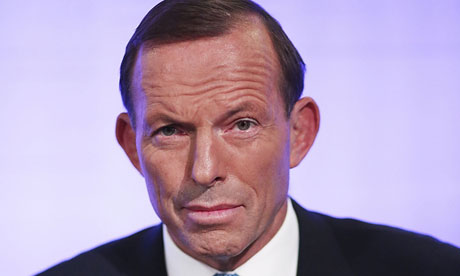
    Australia's opposition leader Tony Abbott
    Tony Abbott. Photograph: Stefan Postles/Getty Images

    Tony Abbott is the alternative prime minister of Australia, and later this year he will face an election presenting a climate change policy that is frankly insulting and potentially dangerous.

    The Coalition’s climate change policy amounts to a bullet point in a pamphlet – the “Real Solutions for Australians” plan – number 10 of 12 such bullet points. It reads:

    “We will take direct action to reduce carbon emissions inside Australia, not overseas – and also establish a 15,000-strong Green Army to clean up the environment.”

    Digging down, the direct action “policy” comprises of:

    • An “Emissions Reduction Fund” of $3bn to fund projects that would reduce carbon emissions, based on a tender process.
    • Support for projects such as “soil carbon technologies and abatement”.
    • A commitment to reducing carbon emissions by 5% by 2020.

    Not directly part of any climate policy, but related to the environment, the Coalition would implement the discredited Howard Murray Darling Basin plan, “reduce reliance” on desalination plants, build more dams, “streamline” (read: weaken) environmental approval processes, and support the industrial fishing industry in marine protected areas. Lenore Taylor reports on Guardian Australia that some in the Coalition are calling for the renewable energy target to be reviewed or scrapped.To understand this “voluntary approach” to climate change policy, you need to understand where Abbott and the Coalition are coming from: a position of denial that climate change is real and driven by human activity. In addition to saying “climate change is crap“, in a more considered interview with the ABC’s Four Corners, Abbott said:

    “I have pointed out in the past that there was that high year a few years ago and the warming, if you believe various measuring organisations, hasn’t increased … the point is not the science, the point is how should government respond, and we have a credible response.”

    If you don’t believe that global warming is real, then the “direct action” policy could be considered “credible”.

    An increasing number of Coalition members are climate denialists.

    Senator Cory Bernardi, in between comparing same-sex marriage to bestiality, has declared climate change science to be “increasingly discredited”. Kevin Andrews has expressed doubts about the human factor in climate change. Almost all Tasmanian Liberal senators have expressed the same doubts – Stephen Parry, Guy Barnett, Eric Abetz and David Bushby. The ABC reported that former Liberal senator and Abbott mentor Nick Minchin said “a majority [of Coalition MPs] don’t accept” that human activity is causing climate change.

    It seems that Abbott has taken as his main scientific adviser on climate change the discredited denialist Ian Plimer – a geologist by training. Abbott has ignored the advice of the CSIRO and the Bureau of Meteorology – two leading climate research institutes – as well as the Australian Academy of Science’s report on the science of climate change.
    Even if you only read the summary of the AAS’s report, the findings are pretty clear:

    “The global average surface temperature has increased over the last century and many other associated changes have been observed. The available evidence implies that greenhouse gas emissions from human activities are the main cause. It is expected that, if greenhouse gas emissions continue at business-as-usual rates, global temperatures will further increase significantly over the coming century and beyond.”

    The Coalition climate policy is dangerous, because it creates the impression that unproven soil carbon storage and $3bn in funding of emissions reduction projects could possibly reduce Australia’s carbon emissions by any amount, let alone by 5%.

    The CSIRO’s review into soil carbon storage highlights the uncertainties involved long-term with such a policy.

    A review by Monash University research officer Tim Lubcke into the sequestration side of the Coalition’s policy – the Green Army planting trees – estimated that:

    “to achieve pledged return of an annual 85 million tonnes of CO2 captured would require equivalent to a plantation within a minimum size more than twice the size of Melbourne and to increase wood production by more than an additional 300%. As this analysis relied upon the most optimistic assumptions, real world limits to tree plantation ignored and optimal yield was used. With this in mind, the scale of DAP would be much larger physically, in management and in cost with real world conditions.”

    The effect of the Coalition’s “direct action” policy is direct inaction on climate change. The architects of this inaction policy, as reported by Guardian blogger and Desmogblog regular columnist Graham Readfearn, is extremist conservative thinktank the Institute of Public Affairs:

    “The Institute of Public Affairs, a leading promoter of climate science denial and misrepresentation, has revealed its recommendations for the next government in a document outlining budget cuts. The plan was written by Alan Moran, director of the thinktank’s deregulation unit.
    The document made the pages of The Australian newspaper but the report did not mention the document’s detailed plans to obliterate all climate change functions in the country’s public sector. In one section the document outlines the thinktank’s recommendations for public sector departments. In dealing with the future of the “Climate Change and Energy Efficiency” department, Moran writes simply: “Abolish”.
    Pretty much every other federal government function to administer climate change policy, research global warming, ensure sustainable development or support renewable energy gets chopped under Moran’s plan. Many publicly-funded research programs and agencies are either chopped entirely or cut to the bone.”

    The deep connections between the secretive IPA and the Liberal Party are documented by the Climate Action Network in a 2010 report entitled “Doubting Australia: the roots of Australia’s climate denial“:

    “The IPA’s extensive connections to the Liberal party go back decades. Today this includes its executive director, John Roskam, a Liberal party powerbroker, and former Howard government staffer, who has run for election on several occasions. Its board chair is former Senator in the Howard Government, Rod Kemp. On its board are former Victoria Liberal party president Michael Kroeger, and former Rio Tinto and liberal party PR adviser Tim Duncan, who now works for Hintons PR.”

    This network is not unsurprising. The Guardian’s Suzanne Goldenberg in February reported that anonymous billionaires are funding climate denialist networks to the tune of $120m:

    “The funds, doled out between 2002 and 2010, helped build a vast network of thinktanks and activist groups working to a single purpose: to redefine climate change from neutral scientific fact to a highly polarising ‘wedge issue’ for hardcore conservatives.
    The millions were routed through two trusts, Donors Trust and the Donors Capital Fund, operating out of a generic town house in the northern Virginia suburbs of Washington DC. Donors Capital caters to those making donations of $1m or more.”

    Because the IPA does not disclose its funding sources, we don’t know if any of this dark money has been used to fund thinktanks in Australia. However, key Abbott supporter Senator Cory Bernardi has controversially been sponsored by the Heartland Institute to travel to the US to speak at a conference. The Heartland Institute famously linked belief in climate change to the Unabomber last year in a series of offensive billboards.

    The most honest assessment of the Coalition’s climate policy, ironically, comes from the man who once led the Liberal party itself: Malcolm Turnbull.

    Having been defeated by Abbott for the leadership of the Liberal party by one vote in 2009, then-backbencher Turnbull wrote that the policy was “a farce”. Amid several “home truths”, Turnbull underlines the problem with Abbott and the direct inaction policy:

    “…the fact is that Tony and the people who put him in his job do not want to do anything about climate change. They do not believe in human caused global warming. As Tony observed on one occasion ‘climate change is crap’ or if you consider his mentor, Senator Minchin, the world is not warming, it’s cooling and the climate change issue is part of a vast left wing conspiracy to deindustrialise the world.
    Now politics is about conviction and a commitment to carry out those convictions. The Liberal Party is currently led by people whose conviction on climate change is that it is ‘crap’ and you don’t need to do anything about it. Any policy that is announced will simply be a con, an environmental figleaf to cover a determination to do nothing. After all, as Nick Minchin observed, in his view the majority of the Party Room do not believe in human caused global warming at all. I disagree with that assessment, but many people in the community will be excused for thinking the leadership ballot proved him right.
    Remember Nick Minchin’s defense of the Howard government’s ETS was that the Government was panicked by the polls and therefore didn’t really mean it.”

    Turnbull may now have returned to the fold as shadow communications minister – this opinion piece is conspicuously absent from his website – but the lack of a credible policy remains.

    Barack Obama declared last week in his landmark climate speech that he doesn’t have “much patience for anyone who denies that this challenge is real. We don’t have time for a meeting of the flat earth society.”

    Abbott’s climate change direct inaction policy is dangerous because it would lock in a “flat earth society” future for Australia where super-storms, heatwaves, droughts, extreme floods, rising sea levels, ocean acidification and bushfires are allowed to run rampant.

    Australia “registered the warmest September–March on record, the hottest summer on record, the hottest month on record and the hottest day on record” in the 2012-13 summer, according to the Bureau of Meteorology. The changing climate will continue to have a serious impact on Australia in future years. Australians thinking about who to vote for in 2013 should know what Abbott’s true intentions are on climate policy.

    Given this, it is past time that Abbott faced more substantial scrutiny on his climate policy.

    Note: I am a member of The Wilderness Society (Victoria) committee of management, and a director of Greenpeace Australia Pacific. The views here are mine alone

  • Risk maps for Antarctic krill under projected Southern Ocean acidification

    Risk maps for Antarctic krill under projected Southern Ocean acidification

    Published 9 July 2013 Science Leave a Comment
    Tags: , , , ,

    Marine ecosystems of the Southern Ocean are particularly vulnerable to ocean acidification1. Antarctic krill (Euphausia superba; hereafter krill) is the key pelagic species of the region and its largest fishery resource2. There is therefore concern about the combined effects of climate change, ocean acidification and an expanding fishery on krill and ultimately, their dependent predators—whales, seals and penguins3, 4. However, little is known about the sensitivity of krill to ocean acidification. Juvenile and adult krill are already exposed to variable seawater carbonate chemistry because they occupy a range of habitats and migrate both vertically and horizontally on a daily and seasonal basis5. Moreover, krill eggs sink from the surface to hatch at 700–1,000 m (ref. 6), where the carbon dioxide partial pressure (pCO2) in sea water is already greater than it is in the atmosphere7. Krill eggs sink passively and so cannot avoid these conditions. Here we describe the sensitivity of krill egg hatch rates to increased CO2, and present a circumpolar risk map of krill hatching success under projected pCO2 levels. We find that important krill habitats of the Weddell Sea and the Haakon VII Sea to the east are likely to become high-risk areas for krill recruitment within a century. Furthermore, unless CO2 emissions are mitigated, the Southern Ocean krill population could collapse by 2300 with dire consequences for the entire ecosystem.


    Kawaguchi S., Ishida A., King R., Raymond B., Waller N., Constable A., Nicol S., Wakita M. & Ishimatsu A., in press. Risk maps for Antarctic krill under projected Southern Ocean acidification. Nature Climate Change. Article (subscription required).

    Rate this:

    Rate This

    Share this post!

    0 Responses to “Risk maps for Antarctic krill under projected Southern Ocean acidification”

    1. Leave a Comment

    Leave a Reply

    Subscribe to the RSS feed

    Powered by FeedBurner

    Follow AnneMarin on Twitter

    Pages

    Blog Stats

    • 649,868 hits

    OUP book

    Categories

    Art Blogroll Courses and