Category: Uncategorized

  • CBA Planning scandal ( Mike Carlton )

    *******************************************************************************

    What a night of nights it must have been last May: the music, the champagne, the chatter and laughter, the bursts of applause. See the merry throng of gentlemen elegant in best black tie, the ladies soignee in satins and silks, a soft light sparkling on silver and pearls, on diamonds and gold.

    We are at Ivy on George Street – ”a sophisticated urban playground for grown-ups” – and it’s the 23rd annual Australian Banking & Finance Awards, 2013. The Oscars, the Grammys, the Logies for the banking business. How thrilling. And the winner of the hotly contested, highly coveted award for Australian Financial Institution of the Year (Major Banks)? Come on down, the Commonwealth Bank of Australia! Lord knows who chooses these things, or what the criteria might be. It seems unlikely, though, that anyone consulted the 725 and more clients of the CBA who lost hundreds of millions of dollars as a result of dodgy practices of financial planners at the bank over the years since 2007.

    This is – or should be – one of the great banking scandals of our time. In a nutshell, at least seven CBA advisers shoved their customers into disastrously high-risk investments without their knowledge or understanding. All the while, of course, charging humungous fees for doing so.

    Many of those dudded were elderly or infirm. Mervyn Blanch, aged 81, saw the value of his life savings with the CBA nosedive from $260,000 to just $92,000. He and his wife were forced onto the cold charity of Centrelink. Mrs Patricia Babbage, a widow and the mother-in-law of the federal shadow treasurer, Joe Hockey, lost more than half her investment of $200,000 even as she was dealing with the trauma of bowel cancer. There are hundreds of similar stories.

    The kingpin in this outrage was a planner named Don Nguyen, a CBA hotshot who has since been banned from the industry for seven years. Another was a spiv named Ricky Gillespie, who forged clients’ signatures and is now out for life, although he denies any wrongdoing and is appealing. Nobody, though, has been to jail.

    We know much of this from a handful of brave whistleblowers at the bank who, aghast at what was happening, went first to the finance industry watchdog ASIC, the Australian Securities and Investment Commission, and then to their bosses. Gradually, the truth began to emerge. So all’s well that ends well, you might think.

    But no. It’s just the start. The Commonwealth Bank writhed and wriggled, pulling every trick in the book to get out from under its responsibilities. Distressed clients were fobbed off with evasions and, at times, outright lies. Eventually, derisory amounts of compensation were offered. ASIC – famously about as useful as a fish on a bicycle – dithered and sat on its hands from October 2008 until March 2010, despite having been given chapter and verse by the whistleblowers.

    The Fairfax Media business writer Adele Ferguson has been reporting this scandal for months, with admirable clarity and resolve. On Thursday there was a result. The Senate agreed to run an inquiry into the fraud and forgery at the CBA and the hand-wringing indolence at ASIC.

    Already, of course, the arse-covering has started. The CBA wrote to the Herald claiming that ”everything we do is focused on securing and enhancing our customers’ financial wellbeing”. Bollocks. And ASIC’s deputy chairman, Peter Kell, stoutly maintains that his outfit ”took serious enforcement action”. Codswallop.

    This affair has a long way to run. For the moment, the Commonwealth Bank might like to hand back its glittering prize.

    ***********************************************************************************


  • Singapore haze hits record high from Indonesia fires

    2013 Last updated at 19:38 GMT

    Singapore haze hits record high from Indonesia fires

    The BBC’s David Shukman explains the impact and cause of the haze

    Pollution levels soared for a third day in a row in Singapore, as smoky haze from fires in Indonesia shrouded the city state.

    The Pollutant Standards Index (PSI) hit 401 at 12:00 on Friday (04:00 GMT) – the highest in Singapore’s history.

    The index also reached 400 in one part of Indonesia, which is readying helicopters and cloud-seeding equipment in an effort to tackle the fires.

    Indonesia has said it is unfair to blame it solely for the forest fires.

    A senior official in the Indonesian president’s office said fires had been spotted on land owned by 32 companies in the region, some of them based in Malaysia and Singapore.

    Schools in parts of Malaysia and Indonesia have closed temporarily.

    Singaporean Prime Minister Lee Hsieng Loong warned on Thursday that the haze could remain in place for weeks.

    “We can’t tell how this problem is going to develop because it depends on the burning, it depends on the weather, it depends on the wind,” he said.

    “It can easily last for several weeks and quite possibly it could last longer until the dry season ends in Sumatra which may be September or October.”

    ‘Life threatening’

    Continue reading the main story

    Analysis

    Karishma Vaswani BBC News, Jakarta

    Indonesia is struggling to contain the raging forest fires that are causing the thick smog which is enveloping Singapore, parts of Malaysia and some Indonesian cities.

    On Friday, the government despatched helicopters to the worst affected areas, in a bid to create artificial rain. The plan is to seed the clouds once the temperature is a bit cooler to induce rain over the burning forestland.

    It is a big challenge. Fire-fighters on the ground have been working around the clock to put out the blazes, but they have spread to peatlands and are proving to be very difficult to extinguish. Officials have complained about a lack of resources and say they desperately need some rain to help.

    Indonesia’s weather agency says rainfall is not likely until 29 June. Singapore and Malaysia have both urged Indonesia to do more to solve this crisis. Singapore has offered aircraft to help with the cloud-seeding operation, but there needs to be clouds in the sky for it to work. This time of year is typically the hottest and driest on the island of Sumatra.

    A PSI reading above 300 is defined as “hazardous”, while Singapore government guidelines say a PSI reading of above 400 sustained for 24 hours “may be life-threatening to ill and elderly persons”.

    “Healthy people [may also] experience adverse symptoms that affect normal activity,” the government says.

    The PSI dropped down to 143 at 17:00 (09:00 GMT), although this is still classed as “unhealthy”.

    Before this week’s episode, the previous air pollution record was from September 1997 during the 1997-1998 South East Asian Haze, when the PSI peaked at 226.

    Singapore resident Nicole Wu told the BBC that she had stayed indoors for the past two days.

    “It’s terrible. In my flat the windows are all closed with the air conditioning on,” she said. “My mother has to wear a mask to go shopping.”

    “I can’t even see what’s happening outside my house due to the smog. You can’t see birds [or] moving objects,” she added.

    Philip Koh, a doctor, told AFP news agency that the number of medical consultations he had had in the past week had increased by 20%.

    Continue reading the main story

    Office workers wearing masks wait to cross a road in Singapore on 21 June 2013 Singaporeans have donned face masks as the haze engulfing the city hit hazardous levels.

    Continue reading the main story

    1/5

    “My patients are telling me they are worried about how long this is going to last and how much higher this is going to go,” he said.

    In Indonesia’s Riau province, where the fires are concentrated, the PSI reached 400 on Friday, the head of the local health office told the BBC.

    Schools there are to remain closed until the air quality improves.

    The chief of the health department Zainal Arifin said there was an “increasing number of asthma, lung, eye and skin problems due to higher CO2 levels”.

    “I call for residents to stay at home and reduce outdoor activities,” he said.

    Diplomatic strain

    Continue reading the main story

    “Start Quote

    The face masks which are in high demand in Singapore can protect against the worst of the smog… [but] are unlikely to provide total protection”

    Singapore’s National Environment Agency has started providing hourly PSI updates on its website, in addition to the three-hourly updates it previously provided.

    Around 300 schools in southern Malaysia have now been closed as a result of the smog. Schools in Singapore are currently closed for the holidays.

    There are also reports of flight delays affecting both Singapore’s Changi airport and Riau province in Indonesia.

    The fires are caused by illegal slash-and-burn land clearance in Sumatra, to the west of Singapore.

    Chart

    The smog has strained diplomatic relations between Singapore and Indonesia – two countries that usually share good relations, the BBC’s Karishma Vaswani in Jakarta reports.

    Continue reading the main story

    Slash-and-burn clearances

    • Slash-and-burn farming is a technique that involves cutting down vegetation and burning to clear land for cultivation
    • It is cheaper than using excavators and bulldozers
    • The illegal burning of forests to clear land for palm oil plantations has long been a problem in Indonesia – particularly during the dry season in the summer
    • Indonesia’s Environment Minister Balthazar Kambuaya has said the government is investigating several palm oil companies in this respect
    • Some producers have already denied their companies use slash and burn land clearance

    Mr Lee said Singapore had provided satellite date to Indonesia to help it identify companies involved and said that if any Singapore firms were involved, that would be addressed.

    Indonesia’s National Disaster Management Agency said it would deploy two helicopters to conduct “water-bombing” operations, as well as planes with cloud seeding equipment.

    One of the Malaysian companies named by the Indonesian presidential official denied that it was burning forest to clear land, but said some small farmers operating on its property were doing so.

    Palm oil giant Sime Darby said in a statement that it was strictly following its zero-burning policy throughout its operations, but that it could not control the activities of local growers farming on its concession area.

    More than 100 Indonesian firefighters are attempting to put out the fires in Sumatra.

    Selina Latiff, from Novena, Singapore, filmed this footage of the smog from a 29th floor balcony

    However, an official in Riau province said they were “overwhelmed and in a state of emergency”.

    “We have been fighting fires 24 hours a day for two weeks,” Ahmad Saerozi, the head of the natural resources conservation agency in Riau, told AFP news agency.

    He added that the fires were in peat around three or four metres below the ground, making it particularly hard to fight them.

    “It is still burning under the surface so we have to stick a hose into the peat to douse the fire,” he said.

    “We take one to two hours to clear a hectare, and by then another fire has started elsewhere.”

    Indonesian President Susilo Bambang Yudhoyono said “all the country’s

  • With regret, Gillard must go, for nation’s sake ( Mike Carlton )

    nt Mike Carlton Article

    Search smh:

    Search in:

    With regret, Gillard must go, for nation’s sake

    Date
    June 22, 2013
    Category
    Opinion
    • 467 reading now
    Time for Prime Minister Julia Gillard to wave goodbye to office.Time for Prime Minister Julia Gillard to wave goodbye to office.

    Prime Minister, it’s time. Time for you to quit. As this Parliament draws to its close, it’s time for you to recognise that, for all your achievements, you are leading your government and your party to an electoral defeat of unprecedented disaster.

    As painful as it must be, it’s time for you to stand aside for the good of your colleagues, for Labor people everywhere, and for the nation itself. The plain fact is that Australians are no longer listening to you.

    Prime Minister … you are leading your government and your party to an electoral defeat of unprecedented disaster.

    Kevin Rudd is the most popular politician in the country, far and away better liked and respected than Tony Abbott. For all his many faults, he alone has a fighting chance of keeping Abbott out of The Lodge. Every opinion poll shows that you do not. Better to go now, with dignity, at your own chosen speed, than to be flung aside by your party and the people.

    It will not be easy. Not for you, not for anyone. Rudd Redux will need the saintly forbearance of Nelson Mandela returning from Robben Island, which means no payback, no vendetta. Half the cabinet will have to swallow its pride and loathing. And the Liberals will no doubt feast on the result.

    Advertisement

    But there is no choice. It gives me no pleasure to write this, Prime Minister. The decision is yours.

    ***********************************************************************************


  • Canadian floods prompt evacuation of entire downtown Calgary area

    Canadian floods prompt evacuation of entire downtown Calgary area

    Twenty-five neighborhoods in the city, with an estimated population of 75,000, have already been evacuated due to floods

    Residents evacuate Calgary

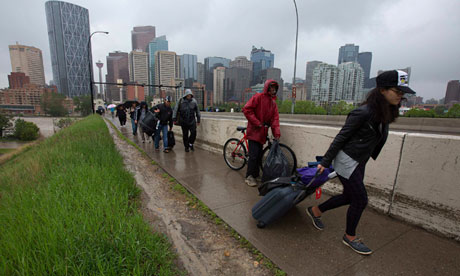
    Residents leave the flooding downtown core as new orders evacuating all of downtown were issued in Calgary, Alberta. Photograph: Todd Korol/Reuters

    Flooding forced the western Canadian city of Calgary to order the evacuation of the entire downtown area on Friday, as the waters reached the 10th row of the city’s hockey arena.

    About 230,000 people work downtown on a typical day. However, officials said very few people need to be moved out, since many heeded warnings and did not go to work on Friday.

    Twenty-five neighborhoods in the city, with an estimated population of 75,000, have already been evacuated due to floodwaters in Calgary, a city of more than a million people that hosted the 1988 Winter Olympics and is the center of Canada‘s oil industry.

    No deaths were reported since torrential rains hit the region Wednesday night, although one woman swept away with a mobile home was still missing.

    In the downtown, water was inundating homes and businesses in the shadow of skyscrapers. Water has swamped cars and train tracks.

    The city said the home rink of the National Hockey League Calgary Flames has flooded and the water inside is 10 rows deep. The 19,000-seat Saddledome is one of the feature buildings on the famed Calgary Stampede grounds, which is largely under water.

    Officials said there was little that can be done to pump the water out of the building because there is simply too much.

    About 1,500 have gone to emergency shelters while the rest have found shelter with family or friends, Mayor Naheed Nenshi said.

    Nenshi said he’s never seen the rivers that high or that fast, but said the flooding situation is as under control as it can be. Nenshi said the Elbow River, one of two rivers that flow through the southern Alberta city, has peaked. And if things don’t change, officials expect that the flow on the Bow River – which, in in the mayor’s words early Friday, looks like “an ocean at the moment” – will remain steady for the next 12 hours.

    Police urged people to stay away from downtown and not go to work.

    The flood was forcing emergency plans at the Calgary zoo, which is situated on an island near where the Elbow and Bow rivers meet. Lions and tigers were being prepared for transfer, if necessary, to prisoner holding cells at the courthouse.

    Schools and court trials were cancelled Friday and residents urged to avoid downtown. Transit service in the core was shut down.

    Alberta Premier Alison Redford promised the province will help flood victims put their lives back together and provide financial aid to communities that need to rebuild The premier said at a briefing that she has spoken to Prime Minister Stephen Harper, who is heading to Calgary and has promised disaster relief. She urged people to heed evacuation orders, so authorities could do their jobs. She called the flooding that has hit most of southern Alberta an “absolutely tragic situation.

    The premier warned that communities downstream of Calgary have not yet felt the full force of the floodwaters.

    It had been a rainy week throughout much of Alberta, but on Thursday the Bow River Basin was battered with up to 100 millimeters (four inches) of rain. Environment Canada’s forecast calls for more rain in the area, but in much smaller amounts.

    Calgary is not alone in its weather-related woes. There have been flashpoints of chaos from Banff and Canmore and Crowsnest Pass in the Rockies and south to Lethbridge.

    More than a dozen towns have declared states of emergency. Entire communities, including High River and Bragg Creek, near Calgary are under mandatory evacuation orders.

    Some of the worst flooding hit High River, where it’s estimated half of the people in the town have experienced flooding in their homes.

    Military helicopters plucked about 30 people off rooftops in the area. Others were rescued by boat or in buckets of heavy machinery. Some even swam for their lives from stranded cars.

    A spokesperson for Defense Minister Peter MacKay said 354 soldiers are being deployed to the entire flood zone.

    Further west, in the shadow of the Rocky Mountains, pictures from the mountain town of Canmore depicted a raging river ripping at house foundations.

  • dian minister attacks weather office as monsoon death toll nears 600

    Indian minister attacks weather office as monsoon death toll nears 600

    Updated 4 hours 51 minutes ago

    Rescuers recovered scores of bodies from the Ganges river in northern India Friday, as the death toll from flash floods and landslides neared 600, with thousands of mainly pilgrims and tourists still stranded or missing.

    Dozens of helicopters and thousands of soldiers have been deployed to rescue more than 35,000 trapped people, the home ministry said, almost one week after floods and landslides from torrential monsoon rains struck the Himalayan state of Uttarakhand.

    Raging rivers have swept away houses, buildings and entire villages, and destroyed bridges and narrow roads leading to pilgrimage towns in the mountainous state, which is known as the “Land of the Gods” for its revered Hindu shrines.

    “556 bodies have been noticed by the army… either floating or buried in slush,” Vijay Bahuguna, state chief minister told local TV channel CNN-IBN on Friday evening.

    Scores of bodies were recovered from the Ganges river earlier Friday, with the death toll expected to rise further as flood waters recede to reveal the extent of the devastation, and rescue workers reach more isolated areas.

    “This kind of disaster has never happened in Himalayan history,” Mr Bahuguna said.

    He attacked the India Meteorological Department for not issuing adequate warning ahead of the heavy rains, which struck earlier than expected, saying the local government was unable to prepare for the deluge and evacuate people on time.

    The IMD warning was not clear enough,” he said, adding that it would take another 15 days to evacuate all the tourists.

    Monsoon rains came weeks early

    Torrential rains four and a half times heavier than usual have hit Uttarakhand – known as the “Land of the Gods” – where Hindu shrines and temples built high in the mountains attract many pilgrims.

    “There are some 3,000 of us stuck in Gangotri [a pilgrimage site] for the past few days and there is no food, no drinking water or assurances from the government,” pilgrim Parwinder Singh said.

    The military operation was focused on the worst-hit Kedarnath temple area, as families of the missing faced an anxious wait in Uttarakhand capital’s Dehradun.

    Ganesh Godiyal, a chairman of a trust in charge of several shrines in Kednarth, says bodies are “scattered all around”.

    “We estimate more than 1,000 people have died,” he said.

    Some of those rescued told of scrambling to higher ground to escape raging waters, only to watch helplessly as buildings, cars and even dead bodies were swept away before them.

    One of those stranded was Indian cricket star Harbhajan Singh, who was attempting to reach a Sikh pilgrimage site but had to take refuge in a police station.

    “Some people are saying that we’re stuck but I wouldn’t say that we’re stuck, I’d say we’ve been saved by God,” said the spin bowler, who was later flown out of the flood-hit area by military chopper.

    “With the kind of rainstorm we witnessed, anything could have happened. Many people lost their lives,” the cricketer said.

    Figures for the death toll have varied considerably, underscoring the difficulty of reaching isolated areas. An Uttarakhand state lawmaker, Shaila Rani Rawat, put the death toll at 2,000, but disaster management officials could not confirm this.

    Nearly 10,000 soldiers, along with 13 teams from the National Disaster Response Force, have been deployed for the rescue and relief effort, the government said.

    Indian paramilitary officers have been building rope and log bridges across raging rivers to try to reach those stranded.

    Relief camps have been set up to house evacuated residents and tourists, and 22 helicopters are ferrying many of those rescued to the camps.

    The air force and the government say 14 tonnes of food and relief aid has been dropped in remote areas.

    The monsoon, which covers the subcontinent from June to September, usually brings some flooding but the heavy rains arrived early this year, catching many by surprise and exposing the country’s lack of preparedness.

    AFP

    Topics: floods, weather, disasters-and-accidents, india, asia, nepal

  • Algae farmers spruik potential for WA biofuel boom

    Algae farmers spruik potential for WA biofuel boom

    By Sean Murphy

    Updated 2 hours 57 minutes ago

    A report by a Western Australian think tank says algae farming has the potential to generate $50 billion a year and create up to 50,000 new jobs across Australia.

    Future Directions International says the west coast is ideally suited to build a biofuel industry from algae because of its abundant sunshine, innovative farmers and the resource industry’s huge demand for fuel.

    At Karratha, the US company Aurora Algae is expanding its microalgae operations with a $300 million facility being built next year to produce omega oils, aqua-feed and biofuels.

    Marketing manager Paul Brunato says a $10 million pilot study over the last three years has proven the viability of production based on Nannochloropsis, an algae which the company breeds in California’s Silicon Valley and imports to Australia under strict quarantine conditions.

    “What we’ve learned is we can grow algae at tremendous rates here in the Pilbara,” he said.


    “The species of algae we’re working with … is able to double in volume on a daily basis.”

    While the company’s main profit driver is omega oil products for the health supplement market, it will subsidise ongoing biofuel production and hopes further research will realise the heroic predictions now being made for the industry.

    “We can sell biofuel for market price no matter what it is and be profitable based on the omega-3s,” he says.

    “What we see when we look out over the desert area here is potentially the next Saudi Arabia of biofuel production.”

    Algae expert says biofuel boom still a pipedream


    Professor Michael Borowitzka from Murdoch University’s Algae Research and Development Centre says the production of biofuels is not yet cost-effective.

    His centre has studied about 400 algal strains in the last 15 years.

    It was part of a recent biofuel pilot study at Karratha and is involved in a joint venture building a demonstration plant at Whyalla in South Australia.

    Professor Borowitzka says biofuel can be produced for between 50 cents and 80 cents a litre.

    “There’s great demand for renewable sustainable fuels, the challenge is to produce biofuel cost-effectively,” Professor Borowitzka said.

    “It’s still actually quite a long way away. We have to reduce the cost of production by at least a factor of 10.”

    Growing global demand for natural food colouring

    The real money in algae farming, for now, is in functional health products such as food colouring which can earn as much as $3,000 a kilogram.

    BASF operates the world’s oldest algae farm at Hutt Lagoon, north of Geraldton, producing natural food colouring for global food and beverage manufacturers.

    The farm harvests Dunaliella salina, a natural occurring algae, which turns pink when stressed, releasing a range of carotenoids, high in vitamins.

    Production manager Harry Haikalis says there is a growing global demand for its products because of their high levels of antioxidants.

    “We like to say it’s food colouring, but the colour comes for free,” he said.

    Sean Murphy’s report on the algae industry in WA will be on Landline on ABC 1 from midday on Sunday.

    Topics: biotechnology-industry, industry, business-economics-and-finance, alternative-energy, environment, sustainable-and-alternative-farming, rural, karratha-6714, geraldton-6530, wa, australia

    First posted 3 hours 16 minutes ago