Category: Uncategorized

  • World population to reach 8.1 billion in 2025, UN says

    World population to reach 8.1 billion in 2025, UN says

    India’s population is expected to surpass China’s around 2028

    The Associated Press

    Posted: Jun 13, 2013 3:29 PM ET

    Last Updated: Jun 13, 2013 3:39 PM ET

    A crowd swarms at a market area near a train station in Mumbai, India in July 2012. The UN says India's population is expected to surpass China's in 2028. A crowd swarms at a market area near a train station in Mumbai, India in July 2012. The UN says India’s population is expected to surpass China’s in 2028. (Rajanish Kakade/Associated Pres)
    Facebook
    23
    Twitter
    8
    Share
    31
    Email

    Related

    The United Nations forecast Thursday that the world’s population will increase from 7.2 billion today to 8.1 billion in 2025, with most growth in developing countries and more than half in Africa. By 2050, it will reach 9.6 billion.

    India’s population is expected to surpass China’s around 2028 when both countries will have populations of around 1.45 billion, the report on “World Population Prospects.” While India’s population is forecast to grow to around 1.6 billion and then slowly decline to 1.5 billion in 2100, China’s is expected to start decreasing after 2030, possibly falling to 1.1 billion in 2100.

    “By the end of the century, Nigeria could start to rival China as the second most populous country in the world,” the report said, forecasting Nigeria’s population at 913.8 million in 2100.

    John Wilmoth, director of the Population Division in the UN’s Department of Economic and Social Affairs, which prepared the report, cautioned that “there is a great deal of uncertainty about population trends.”

    “Trends and future population will be affected by the trajectories of its three major components — fertility, mortality and migration — but especially by the future course of fertility,” he said.

    Fallen fertility rates

    He said fertility has fallen rapidly, especially since the 1960s. The average number of children per woman has swiftly declined in several large countries, including China, India, Indonesia, Iran, Brazil and South Africa, leading to a reduction in population growth rates in much of the developing world.

    But Wilmoth said the UN’s projections of future population have been revised upward from those issued two years ago, based mainly on recently available data on fertility levels.

    In 15 high-fertility countries of sub-Saharan Africa, the estimated average number of children per woman has been adjusted upwards by more than five per cent, he said. These include Angola, Cameroon, Congo, Ethiopia, Mozambique, Niger and Nigeria.

    The report said population in developing regions is projected to increase from 5.9 billion in 2013 to 8.2 billion in 2050.

    During that same period, it said, the population of developed countries is expected to remain largely unchanged at around 1.3 billion people.

    In Africa, the report said, the population could increase from 1.1 billion today to 2.4 billion in 2050 and potentially 4.2 billion by 2100.

    Share Tools

  • Methane Adsorption by Shales

    Methane Adsorption by Shales

    A new study focusing on the validated measurement of methane adsorption by shale under practical geological conditions has just been published in the American Chemical Society (ACS) journal Energy & Fuels.

    A shale sample

    This is an important topic due to the recent emergence of shale gas as a significant unconventional gas resource.

    Professor Mark Thomas of Newcastle University in the UK, and co-workers at Durham University (UK) and Hiden Isochema, studied methane (CH4) adsorption in a dry, organic-rich Alum shale sample at pressures up to approximately 14 MPa, in the temperature range 300 – 473 K. The measurement of adsorption at these elevated pressures and temperatures is important, in order to assess the capacity of shales under practical conditions, since commercial gas shales are commonly located at a burial depth of 1 – 2 km, which corresponds to pressures in the range 10 – 20 MPa and temperatures between 40°C and 80°C (313 – 353 K).

    The high pressure, above-ambient temperature methane adsorption data were complemented by adsorption measurements performed using nitrogen (N2) at 77 K, carbon dioxide (CO2) at 273 and 195 K, and methane at 112 K.

    The high pressure excess methane adsorption data were measured on a Hiden Isochema Intelligent Manometric Instrument (IMI) at ten different temperatures, and thus allowed a detailed analysis of the adsorption behaviour as a function of both temperature and pressure. Additionally, carbon dioxide adsorption data up to 3 MPa were measured using the IMI, with the low pressure adsorption of nitrogen, carbon dioxide and methane determined using a Hiden Isochema Intelligent Gravimetric Analyzer (IGA).

    The measurement of subcritical methane adsorption at 112 K was particularly useful because the absolute adsorption at this temperature, calculated assuming the adsorbed phase has the same density as liquid methane, represents an upper limit for adsorption.

    At 273 K, the gravimetrically-determined carbon dioxide adsorption data, plotted as a function of relative pressure, agreed with the manometrically-determined carbon dioxide data in the overlapping regime, thus validating the data. This is important due to the low uptakes typically exhibited by shales, which make accurate sorption measurements more challenging than those performed on high surface area nanoporous materials, such as activated carbons, zeolites and metal-organic frameworks (MOFs).

    In addition, the subcritical methane, carbon dioxide and nitrogen adsorption isotherms, plotted as a normalized molar uptake against relative pressure, also show good agreement, indicating that the use of carbon dioxide and nitrogen adsorption to characterize the pore volume of this particular shale is valid.

    A number of models were then fitted to the high pressure methane adsorption data in order to parameterize the behaviour of the material. The fitting parameters from the best performing model, which used the Supercritical Dubinin-Radushkevich (SDR) equation, then allowed the prediction of the excess and absolute amounts of adsorbed methane for this particular shale as a function of geological depth.

    Find out more by downloading the full article now from the ACS Energy & Fuels website:

    Methane Adsorption on Shale under Simulated Geological Temperature and Pressure Conditions

    Thomas F. T. Rexer, Michael J. Benham, Andrew C. Aplin, and K. Mark Thomas, Energy & Fuels, 2013, Article ASAP (As Soon As Publishable)

    DOI: 10.1021/ef400381v

    The study was supported by the GASH (Gas Shales in Europe) project, which is funded by Bayerngas, ExxonMobil, GdFSuez, Marathon, Repsol, Schlumberger, Statoil, Total, Vermilion and Wintershall.

    If you would like to find out more about our instrumentation for the measurement of high pressure methane adsorption, please do not hesitate to get in touch.

    Posted on June 10th 2013 in Research
  • Warm Ocean, Not Icebergs, Causing Most of Antarctic Ice Shelves’ Mass Loss NASA

    J.D. Harrington
    Headquarters, Washington
    202-358-5241
    j.d.harrington@nasa.gov

    Maria-Jose Vinas Garcia
    Goddard Space Flight Center, Greenbelt, Md.
    301-614-5883
    maria-jose.vinasgarcia@nasa.gov

    Whitney Clavin
    Jet Propulsion Laboratory, Pasadena, Calif.
    818-354-4673
    whitney.clavin@jpl.nasa.gov

    June 13, 2013

    RELEASE : 13-183

    Warm Ocean, Not Icebergs, Causing Most of Antarctic Ice Shelves’ Mass Loss

    PASADENA, Calif. — Ocean waters melting the undersides of Antarctic ice shelves are responsible for most of the continent’s ice shelf mass loss, a new study by NASA and university researchers has found.

    Scientists have studied the rates of basal melt, or the melting of the ice shelves from underneath, of individual ice shelves, the floating extensions of glaciers that empty into the sea. But this is the first comprehensive survey of all Antarctic ice shelves. The study found basal melt accounted for 55 percent of all Antarctic ice shelf mass loss from 2003 to 2008, an amount much higher than previously thought.

    Antarctica holds about 60 percent of the planet’s fresh water locked into its massive ice sheet. Ice shelves buttress the glaciers behind them, modulating the speed at which these rivers of ice flow into the ocean. Determining how ice shelves melt will help scientists improve projections of how the Antarctic ice sheet will respond to a warming ocean and contribute to sea level rise. It also will improve global models of ocean circulation by providing a better estimate of the amount of fresh water ice shelf melting adds to Antarctic coastal waters.

    The study uses reconstructions of ice accumulation, satellite and aircraft readings of ice thickness, and changes in elevation and ice velocity to determine how fast ice shelves melt and compare the mass lost with the amount released by the calving, or splitting, of icebergs.

    “The traditional view on Antarctic mass loss is it is almost entirely controlled by iceberg calving,” said Eric Rignot of NASA’s Jet Propulsion Laboratory in Pasadena, Calif., and the University of California, Irvine. Rignot is lead author of the study to be published in the June 14 issue of the journal Science. “Our study shows melting from below by the ocean waters is larger, and this should change our perspective on the evolution of the ice sheet in a warming climate.”

    Ice shelves grow through a combination of land ice flowing to the sea and snow accumulating on their surface. To determine how much ice and snowfall enters a specific ice shelf and how much makes it to an iceberg, where it may split off, the research team used a regional climate model for snow accumulation and combined the results with ice velocity data from satellites, ice shelf thickness measurements from NASA’s Operation IceBridge — an continuing aerial survey of Earth’s poles — and a new map of Antarctica’s bedrock.
    Using this information, Rignot and colleagues were able to deduce whether the ice shelf was losing mass through basal melting or gaining it through the basal freezing of seawater.

    In some places, basal melt exceeds iceberg calving. In other places, the opposite is true. But in total, Antarctic ice shelves lost 2,921 trillion pounds (1,325 trillion kilograms) of ice per year in 2003-2008 through basal melt, while iceberg formation accounted for 2,400 trillion pounds (1,089 trillion kilograms) of mass loss each year.

    Basal melt can have a greater impact on ocean circulation than glacier calving. Icebergs slowly release melt water as they drift away from the continent. But strong melting near deep grounding lines, where glaciers lose their grip on the seafloor and start floating as ice shelves, discharges large quantities of fresher, lighter water near the Antarctic coast line. This lower-density water does not mix and sink as readily as colder, saltier water, and may be changing the rate of bottom water renewal.

    “Changes in basal melting are helping to change the properties of Antarctic bottom water, which is one component of the ocean’s overturning circulation,” said author Stan Jacobs, an oceanographer at Columbia University’s Lamont-Doherty Earth Observatory in Palisades, N.Y. “In some areas it also impacts ecosystems by driving coastal upwelling, which brings up micronutrients like iron that fuel persistent plankton blooms in the summer.”

    The study found basal melting is distributed unevenly around the continent. The three giant ice shelves of Ross, Filchner and Ronne, which make up two-thirds of the total Antarctic ice shelf area, accounted for only 15 percent of basal melting. Meanwhile, fewer than a dozen small ice shelves floating on “warm” waters (seawater only a few degrees above the freezing point) produced half of the total melt water during the same period. The scientists detected a similar high rate of basal melting under six small ice shelves along East Antarctica, a region not as well known because of a scarcity of measurements.

    The researchers also compared the rates at which the ice shelves are shedding ice to the speed at which the continent itself is losing mass and found that, on average, ice shelves lost mass twice as fast as the Antarctic ice sheet did during the study period.

    “Ice shelf melt doesn’t necessarily mean an ice shelf is decaying; it can be compensated by the ice flow from the continent,” Rignot said. “But in a number of places around Antarctica, ice shelves are melting too fast, and a consequence of that is glaciers and the entire continent are changing as well.”

    For images related to this release, please visit:

    http://go.nasa.gov/175OAkF


    – end –

  • Debate on Environment Grows as Drought Tests Texas Rivers

    Note the rust on the bridge
    The Texas Tribune

    Debate on Environment Grows as Drought Tests Texas Rivers

    Michael Stravato for The Texas Tribune

    Part of the Neches River, above, turned black in 2011, the driest year in Texas history.

    By
    Published: June 14, 2013
    • Facebook
    • Twitter
    • Google+
    • Save
    • E-mail
    • Share
    • Print
    • Reprints

    BEAUMONT — As the Neches River flows south toward a string of oil refineries and manufacturing plants in Southeast Texas, it winds through an area so ecologically diverse that the National Park Service runs a preserve called Big Thicket along its banks.

    The Texas TribuneExpanded coverage of Texas is produced by The Texas Tribune, a nonprofit news organization. To join the conversation about this article, go to texastribune.org.

    Michael Stravato for The Texas Tribune

    A survey map of vegetation at the Neches, near Beaumont.

    Despite recent spring rains, years of drought have caught up to the landscape. In 2011, the driest year in recorded Texas history, part of the river became so stagnant that it turned black.

    “You see all those dead trees?” said Kirk Winemiller, who runs an aquatic ecology laboratory at Texas A&M University, pointing from a boat toward bald cypress trees that rose like ghosts along the bank. “They weren’t dead when we came out in 2011.” (Texas A&M University is a corporate sponsor of The Texas Tribune.)

    Like the Neches, other rivers across Texas have been severely tested by the long-running drought, which still blankets most of the state and comes on top of increasing demands for water from a growing population and industrial base. Average stream-flow measurements are well below normal, especially in western regions, prompting worries about increased salinity and the health of fish and plants. The environmental group American Rivers recently listed the San Saba River in the Hill Country as the country’s third-most-endangered river, because of heavy pumping by farmers.

    Six years ago, the Texas government began an effort to manage the rivers’ health better. But environmental advocates fear that ecology still takes a back seat while the state frets about having enough water in the future for its growing cities. And climate change threatens further disruptions.

    The Texas water plan, a wish list of water-supply projects like reservoirs that lawmakers are willing to spend $2 billion to finance, includes no projects to help fish and wildlife, said Myron Hess, who manages the Texas Water Program for the National Wildlife Federation.

    “In my mind, it’s not acceptable to just say we’re not going to worry about what’s going to happen to the environment,” he said, noting that rivers offer economy-boosting activities like fishing, tourism and recreation.

    Merry Klonower, a spokeswoman for the Texas Water Development Board, said that the state water plan did take water for the environment into account, because the water supply available was reduced.

    Texas’ focus on the environmental health of its rivers increased in 2007, when state lawmakers passed a bill that created a process for studying and managing “environmental flows,” the amount of water needed to sustain the ecology of major river basins and bays.

    The bill “represents one of the most groundbreaking environmental compromises” between Texas water suppliers and environmental groups, said Mary Kelly, who runs Parula, an environmental consulting firm in Austin, and was involved in the negotiations.

    After a river basin is studied, scientists, farmers, citizens, water suppliers and other stakeholders make recommendations for its management. The input also takes future water needs of people and businesses into account. The Texas Commission on Environmental Quality, the state’s environmental agency, has the final say over how much water should flow down the river. Lawmakers provided $2 million in additional money for the process during the legislative session that concluded recently.

    On a practical level, environmental flow standards can translate to the release of more water from reservoirs. This spring, for example, the agency that manages Texas’ Colorado River released a large amount of water — roughly equivalent to 35,000 Texas households’ annual use — from its reservoirs to aid the blue sucker, a threatened fish species, during its spawning season.

    The agency has already issued flow standards for a number of rivers, including the Colorado, but it has more to cover, including the Rio Grande, the Brazos and the Nueces. Dr. Winemiller and Ms. Kelly (who serves on a science advisory committee in the flows process) say that the commission’s recommendations have often fallen short of scientific recommendations. So the ecological standards for rivers like the Neches, the Trinity and the Guadalupe are not as high as scientists (and even some stakeholders) think they should be.

    “T.C.E.Q.’s adopted environmental flow standards include many of the science team and stakeholder recommendations,” Terry Clawson, an agency spokesman, said in an e-mail.

    A big concern hangs over this river-management process: if the state cannot manage its own rivers, the federal government could step in to help, amid concerns about endangered species.

    A court case with potentially significant implications for Texas river management involves the whooping crane, an endangered bird that likes to spend winters on the Texas coast. In March, a federal district judge ruled that the environmental quality commission had failed to ensure that sufficient water to aid the whooping cranes was released down the Guadalupe and San Antonio Rivers. At least 23 cranes died as a result, the judge found.

    Texas has appealed, and a federal appeals court will hear oral arguments in the case in August.

    “Texas is very proud of their history of making largely autonomous water-permitting, water-use decisions,” said David Smith, a lawyer with the Austin firm Graves Dougherty Hearon & Moody. “You throw a couple of federal listed species in the mix, and all of a sudden you have those decisions being made with the specter of having federal oversight.” (Graves Dougherty Hearon & Moody is a corporate sponsor of The Tribune.)

    In the coming years, Texas may encounter further endangered-species questions involving its waterways. For example, the federal government is expected to consider whether to list various species of freshwater mussels found in Texas rivers.

    Meanwhile, human demands continue to put pressure on the rivers. The United States Army Corps of Engineers is seeking Congressional approval to deepen the Sabine-Neches Waterway, downstream from Big Thicket near the Gulf of Mexico, to allow larger ships to reach the ports.

    That could cause more saltwater to flow upriver, scientists say. The saltwater, which can harm swamp vegetation, is stopped by a barrier near Beaumont, which protects the city’s water supply.

    When the river turned black two years ago, saltwater was a key factor — some of it left over from Hurricane Ike in 2008, according to Scott Hall, general manager of the Lower Neches Valley Authority, which manages the river and sells its water.

    A paper mill has a permit to discharge an average of 65 million gallons of wastewater daily into the Neches not far below the barrier. Mr. Hall said in an e-mail, however, that he believed “the water color was much more influenced by the high salt concentration than the paper mill effluent.”

    This year, with the rains, the river system is “in pretty good shape,” he added.

    kgalbraith@texastribune.org

    A version of this article appeared in print on June 14, 2013, on page A21A of the National edition with the headline: Debate on Environment Grows as Drought Tests Texas Rivers.

    • Save
    • E-mail
    • Share
  • Keep our coal in the ground

    Keep our coal in the ground

    If coal extraction developments are to go ahead in Queensland, we are dooming ourselves to a world no one wants to see

    Queensland coal
    Coal waiting to be loaded onto ships at the Gladstone harbour. Photograph: Simon Copland 

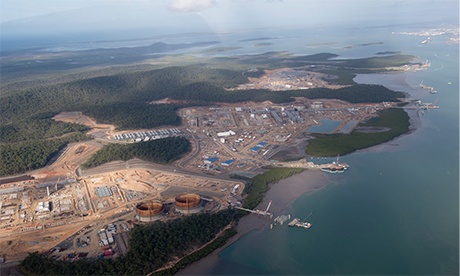
    I’m instantly stuck by the contrast. On one side, the landscape is beautiful. A river winds its way towards the ocean, until it hits a few islands sitting on the coast. Mangroves cling to the water edge. Beyond the initial line of trees, the landscape is bare – dark brown and red soils radiating in the sun.

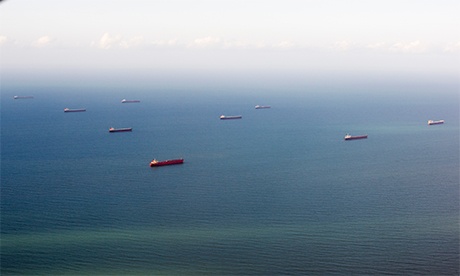
    The other side is very different. Amongst the beauty, humans have wreaked havoc. We can see factories, gas plants and piles of coal getting ready to be shipped out. On the ocean I can count around 20 ships, sitting, waiting to be loaded up with their cargo. The harbour is being dredged so more ships can enter its waters.

    I have traveled with US climate activist Bill McKibben and Greens senator Larissa Waters to the town of Gladstone to visit the frontline of Australia’s coal expansion. We took a charter plane to fly over the developments, and I interviewed McKibben and Waters as part of the trip. McKibben said that he was struck by what he saw: “I thought it was remarkable to see one of the relatively few spots in the world where the great carbon conveyor belt has its beginning.”

    Coal ships waiting off the coast of Gladstone
    Coal ships waiting off the coast of Gladstone. Photograph: Simon Copland 

    The Gladstone and Fitzroy Delta port area already comprises of two ports, with three more proposed/under construction (a fourth was recently dumped by Xstrata). The port area already handles approximately 50 million tonnes of coal each year. The new developments could increase that number by approximately 28.3 million tonnes. McKibben says that is simply too much for the climate to bear:

    “There’s just six or seven places around the world that have such great concentrations of carbon. This part of Australia, the tar sands of Canada, the Powder River basin of the US. Unless we can keep that carbon in the ground there is very little chance of arresting climate change.”

    The last year in climate science has been nothing short of terrifying. In Australia, we saw our “angry summer“. Records were smashed and floods and fires ravaged the country. But what has been worse has been the reports coming out from some of our more conservative institutions; ones like The World Bank and the International Energy Agency, saying that we are heading for a world of four degrees warming or more. Far too much for a safe climate.

    The maths – as highlighted by McKibben – has become clear. The science shows that we can only emit globally 565 gigatons more of CO2 to stay at or below two degrees of global warming – a target agreed by pretty much every government in the world. The known carbon reserves in Australia make up 30% of that number.

    Thinking about those numbers as I flew over Gladstone, one thing became obvious. Even though we have implemented a carbon price, Australia is not doing enough to halt climate change. Our leaders, and our fossil fuel companies, are addicted to coal, and in doing so are playing an oversized role in warming our planet. Waters agrees. She told me that we can’t let most of the proposed developments go ahead:

    “If the world is to stay below two degrees we only have a certain budget left, a carbon budget if you like. And if all of the proposed, enormous coal mines that are planned for the Galilee basin – if they were to go ahead, that one basin would comprise 6% of the world’s burnable carbon to stay below two degrees warming. That is a sheer amount that simply must stay in the ground.”

    Waters argued that despite agreeing to the target, the Australian government is not doing enough:

    “Under the current environment minister, and in fact all previous environment ministers, no coal mine has ever been rejected in Queensland and to my knowledge in Australia. Under our current environmental laws there has never been a refusal of a fossil fuel project in our history. And that’s saying an awful lot.”

    This is the reality we now must face up to. Global warming is here. If developments like Gladstone and the Galilee Basin go ahead, we are dooming ourselves to a world of four degrees of warming – a world no one wants to see.

    If we are serious about leaving a safe world for our future generations there is only one course of action – leave our coal in the ground.

  • Chief of Army David Morrison tells troops to respect women or ‘get out’

    This is long overdue.


    Chief of Army David Morrison tells troops to respect women or ‘get out’

    ABCUpdated June 14, 2013, 1:47 pm

    Army chief David Morrison has issued a stern warning to personnel after it was revealed that dozens of members were involved in the distribution of hundreds of explicit emails denigrating women.

    and the Director of Public Prosecutions is considering a brief of evidence against them from the New South Wales Police.

    In a message to members of the army recorded on Wednesday and uploaded to YouTube, Chief of Army General David Morrison said there is “no place” in the army for members who “exploit and demean” their colleagues.

    “[The] conduct, if proven, has not only brought the army into disrepute, but has let down every one of you and all of those whose past service has won the respect of our nation,” he said.

    “Evidence collected to date has identified a group within our ranks who have allegedly produced highly inappropriate material demeaning women, and distributed it across the internet and Defence’s email networks.

    “If this is true, then the actions of these members are in direct contravention of every value the Australian Army stands for.”

    General Morrison says there has been a systemic problem, and urged personnel to uphold defence force values.

    “I will be ruthless in ridding the army of people who cannot live up to its value, and I need everyone of you to support me in achieving this,” he said.

    “If we are a great national institution – if we care about the legacy left to us by those who have served before us, if we care about the legacy we leave to those who, in turn, will protect and secure Australia – then it is up to us to make a difference. If you’re not up to it, find something else to do with your life. There is no place for you amongst this band of brothers and sisters.”

    He also issued a warning to army personnel who bullied or humiliated their colleagues.

    “Those who think that it is okay to behave in a way that demeans or exploits their colleagues have no place in this army,” he said.

    “If that does not suit you, then get out. The same goes for those who think that toughness is built on humiliating others.

    “If you become aware of any individual degrading another, then show moral courage and take a stand against it.”

    Fairfax Media is reporting that a ring of soldiers calling themselves the Jedi Council swapped footage of their sexual encounters online without the women’s knowledge.

    General Morrison says the allegation is a “fair description” of what he had been told.

    “There are other offences to do with inappropriate use of defence computing systems and there are references in the many emails we have seen to possibly the use of illicit drugs and they are all matter for investigation,” he said in an interview this morning.

    The Defence investigation is continuing and is expected to last months.