Category: Uncategorized

  • ‘Everything at stake’ with NBN, says visionary

    ‘Everything at stake’ with NBN, says visionary

    Date
    June 13, 2013 – 11:49AM

    Matthew Hall

    Resisting change could be catastrophic, says the founder of a high-profile international think tank.

    Zoom in on this story. Explore all there is to know.

    All aboard? Broadband visionary likens the NBN to the railways.All aboard? Broadband visionary likens the NBN to the railways. Photo: Bob Finlayson

    The implementation of an effective national broadband network is critical to economic development and the federal opposition must not fear it, the founder of a high-profile “intelligent community” think tank has told IT Pro.

    It is not sustainable if we allow the trend to continue where people flee rural areas for economic purposes.

    Louis Zacharilla

    Louis Zacharilla of the New York-based Intelligent Community Forum warned that failure to make the most of implementing the NBN in Australia would be the equivalent of ignoring railways in the 19th century.

    “I get the fear and the resistance,” Zacharilla co-author of Broadband Economies: Creating the Community of the 21st Century, said.

    Advertisement

    “Governments are dealing with public money and dealing with significant change. I don’t declare bad intentions for the opposition [to the NBN]. I just declare them to be a bit fearful and a little bit too cautious.

    “That is natural. That is human nature. We resist change. But if you speak with anyone who has had to overcome that resistance they will say to you, this is the right way to go – we just disagree about how to get there.”

    Zacharilla, whose forum anointed Communications Minister Stephen Conroy Visionary of the Year in 2012, spoke to IT Pro ahead of his address at this week’s Digital Productivity Conference in Brisbane, hosted by the Department of Broadband, Communications and the Digital Economy.

    The Intelligent Community Forum releases an annual list of “intelligent communities” highlighting regions around the globe that use communications technology to effectively boost their local economies.

    No Australian community has made the ICF finalist list since 2004, when Victoria made the cut.

    “Australia does not lack aspiration,” Zacharilla said. “They know what is at stake. They know they should keep the talent at home, but they don’t have all the tools yet.”

    ICF’s work has received plaudits from New York City mayor Mike Bloomberg and government leaders in Taiwan, France, Finland, the Netherlands, South Korea and Afghanistan.

    Toronto (Canada), Oulo (Finland), and Tallin (Estonia), were among the list of this year’s top seven communities.

    In implementing broadband, Zacharilla drew comparison with the economic development of cities in the US that elected to use riverboats as their main form of industrial transportation against those that saw the benefits of railways.

    “Chicago, which was a backwater city, saw this thing called the railroad,” Zacharilla said. “Chicago invested in it and even today has 10 times the GDP of the state of Missouri.

    “Everything is at stake [with the NBN]. This is the new railroad. If your communities are not connected to it then it is difficult to put cargo on it.”

    A major focus for ICF is broadband development for rural areas. According to Zacharilla, efficient connectivity outside urban centres is a critical factor in determining wider environmental sustainability.

    “It is not sustainable if we allow the trend to continue where people flee rural areas for economic purposes,” he said.

    “The smaller communities will lose everything and the big cities will not be able to take the people that flood in, especially in a place like China. All hell will break loose.

    “If you can keep people where they want to be, embedded in their cultures, contributing to their towns and villages, looking after their elders and learning from their elders, raising their kids in the places where they want to but can connect them to a global society through internet and broadband, then it is a win-win.” 


    Read more: http://www.smh.com.au/it-pro/government-it/everything-at-stake-with-nbn-says-visionary-20130613-2o5g0.html#ixzz2W5O5qfYh

  • Why Greenland’s darkening ice has become a hot topic in climate science

    Why Greenland’s darkening ice has become a hot topic in climate science

    Darkening causes the snow to absorb more sunlight which in turn increases melting

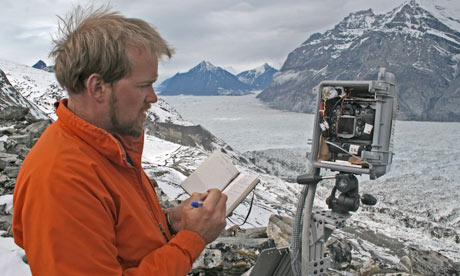
    Scientist Jason Box during an expedition in Greenland

    Climate scientist Jason Box during an expedition in Greenland in July 2008. Photograph: Byrd Polar Research Center

    Last July, a record melting occurred on the Greenland ice sheet. Even in some of the highest and coldest areas, field parties observed rainfall with air temperatures several degrees above the freezing point. A month before, it was as though Greenland expert Jason Box had a crystal ball; he predicted this complete surface melting in a scientific publication. Box’s research then got broader public visibility after climate activist and writer Bill McKibben covered it in Rolling Stone magazine.
    The basic premise of Box’s study was that observations reveal a progressive darkening of Greenland ice. Darkening causes the white snow surface to absorb more sunlight which in turn increases melting. Given that this process is likely to continue, the impact on Greenland melt, and subsequent sea level rise, will be profound.

    There are several mechanisms that are known to darken arctic ice, including desert dust, pollen, soot from natural forest fires, and human biomass burning for land clearing and domestic use. Industrial, shipping, and aircraft pollution also play a role. Some of these effects are increasing. As climate change accelerates, more areas are being burned by wildfire each year. Box wondered how much increasing wildfires with resulting soot landing on the northern ice might amplify what scientists call a “positive feedback” – a self-reinforcing cycle – increasing Greenland melting. The cycle starts with initial warming, leading to more fires, more soot, and in turn more warming and more melt. The feedback is important, particularly in polar regions where observed warming is twice the rate of more southerly locations around the globe. Box calculates this effect has doubled Greenland surface melting since year 2000.

    The topic has become hot among ice experts as new observations of ice melt continue to outstrip projections from just a few years ago. Arctic sea ice, another key measure of global heating, is now 60 years ahead of worst-case projections from the last report by the Intergovernmental Panel on Climate Change in 2007. Arctic snow cover on land has also been declining more rapidly than projected, even faster than sea ice. While mass loss of the enormous Greenland sheet is difficult to measure, satellite data indicate it has doubled in the last decade. If this acceleration continues, sea level rise could be even higher this century than the 1 or 2 meters that mainstream scientists now project – possibly much higher. Despite a recent study that projected Greenland outflow glaciers to slow, surface melting has increased faster than ice flow. The albedo feedback is a critical piece of physics that enables surface melting to continue dominating the loss.

    To test his hypothesis, Box has assembled a team of scientists and communicators to collect and analyze samples from key locations on the ice sheet, and report those results directly to the public. The plan is to arrive in Greenland in late June, just as the peak melting season and fire season coincide. Box will be joined by Bill McKibben, who will be covering the research for Rolling Stone, and videographer Peter Sinclair, whose series of climate change videos on YouTube has gained high praise from climate scientists.

    The scientific team includes Sara McKenzie Skiles, a researcher at UCLA and the NASA Jet Propulsion Laboratory, and Marek Stibal, a biogeochemist at the Geological Survey of Denmark and Greenland. Dr Stibal will be looking at yet another potential source of darkening, the activity of microorganisms that produce their own darkening pigments, which may be increasing due to atmospheric warming and fertilization by pollutants.

    While government funding contracted, Box decided to push forward with a new approach, financing the research as a “citizen science” initiative, funded by internet crowd sourcing. His project is aptly named DARK SNOW and financial support is being collected online.

    It is exciting to watch emerging science collide with novel scientific fundraising initiatives. It is possible that this emergence will grow in the coming years as scientific projects grow in cost and complexity, while more traditional funding sources diminish. The costs of funding projects like DARK SNOW are miniscule compared to the costs we endure from climate-change-related weather disasters. The penny-wise pound-foolish attitude we’ve taken toward science funding is a complicated issue that I’ll deal with in a future post.

  • Australian team competes in Airbus ideas competition with low-emission jet fuel

    Australian team competes in Airbus ideas competition with low-emission jet fuel

    Your Friends’ Activity

    NEW! Discover news with your friends. Give it a try.
    To get going, simply connect with your favourite social network:

    Facebook
    • twitter
    • linkedin
    • google

    This feature allows you to discover news with your friends on Our Network.

    This means stories that are read and watched will be shared with your friends, and they’ll share things with you too.

    To try out Discover news with friends simply login with your favourite social network. You can login with Facebook, Twitter, Linkedin or Google+

    Give it a try! You can turn it off at any time.

    unexpected problems crop

    BRIGHT IDEA: The new A350 Airbus long-haul carrier does a taxiing test at the aérodrome of Toulouse-Blagnac. AFP PHOTO / ERIC CABANIS Source: AFP

    FIVE Australian students have challenged European aviation giant Airbus to consider a quantum leap to a future featuring sustainable bio-methane fuelled airliners.

    Flown to France this week by Airbus for the finals of the company’s prestigious Fly Your Ideas aviation design competition aimed at university students, the Royal Melbourne Institute of Technology team yesterday made their final presentation to a panel of industry experts at Airbus’ Toulouse headquarters.

    59d34aa2-d3b5-11e2-b860-d5a4f7ec6372

    The Australian team in France for the Airbus Fly Your Ideas challenge.

    Source: Supplied

    Their proposition is for a combination of LNG and sustainable bio-methane, dubbed Bio-LNG, to replace JetA1 fuel, which has the potential to reduce emissions by up to 97 per cent, depending on the mix, and slash airlines’ operating costs.

    From the Homepage

    Army scandal ‘worse than Skype’

    Army hit with email scandal  THE Defence Force has been rocked by a new scandal it says is bigger than the recent Skype affair, with almost 100 Army personnel under investigation.

    Victorians warned to brace for floods

    Melbourne Weather ROLLING COVERAGE: WILD weather – from flash flooding to 100km/h winds – prompts warnings for several Victorian regions including the metro area.

    ‘I had no idea this would go viral’

    David Carter UPDATE: THE chef who released the offensive menu depicting Julia Gillard as a quail says Mal Brough has his “full sympathy”.

    The lowest paid jobs in Australia

    The lowest paid jobs in AustraliaIT may be a stereotype that low paid jobs require little skill, but that’s not always the case. These are the country’s 10 lowest paying jobs.

    Jellyfish halts world-record swim

    Chloe McCardel A JELLYFISH sting has ended a Melbourne marathon swimmer’s audacious attempt to swim the Straits of Florida from Cuba to the US.

    Mackay family told about new search

    Mackay POLICE kept Donald Mackay’s family in the loop before beginning their fresh search for the remains of anti-drug campaigner last night.

    Drugs fuelled Satanic sex shop spree

    Sexyland sign A MAN blames party drug ice for sending him on a “satanic” armed robbery spree on a string of Melbourne sex shops and restaurants.

    How rapists ‘fake’ it out of jail

    How rapists ?fake? it out of jailVIOLENT rapists such as Jill Meagher’s killer are faking their way through sex offender programs only to reoffend on release from prison, a sexual violence expert warns.

    The aerospace engineering students, led by 21-year-old Luke Spiteri, also produced modelling to support the modification of existing aircraft wing tanks and the addition of underwing fuel pods to accommodate the cryogenic fuel.

    “We’re very happy with how we went,” Spiteri said. “It’s now down to the judges.

    “But just to be here is so rewarding. This has been an unforgettable experience.”

    The group, also including Mark Spiteri, Katherine Gregoriou, Martin Burston – all 21 – and James Herringer, 24, now have to wait until Friday to see if they have beaten the four other groups from Brazil, India, Malaysia and Italy who made the finals of the competition with its 30,000 euro prizemoney.

    More than 8000 students making up 618 teams from 82 countries entered this year’s competition.

    Dr Graham Dorrington, the RMIT team’s academic supervisor, said if Airbus really wanted to hear about potentially “disruptive” technology – radical ideas which challenged the status quo – then he believed the RMIT students had provided it.

    “If Airbus takes notice the future (of aviation) is secure,”he said.

    “And what I really want is for companies back home like Woodside to take note. If we can get the industry mobilised in Australia we can be ahead of the game and there’s a lot of bloody good people working in LNG in Australia.”

    Spiteri said his parents, John and Margaret of Albany Creek, were excited the team had made it as far as they had.

    “They are thrilled,” he said. “They know how much work we’ve put in over the past seven months.”

    The winning team will be announced at a ceremony held on Friday at UNESCO in Paris.

  • This 29 year-old analyst just gave up his whole life –Bradley Manning (AVAAZ)

    Hi all,

    This 29-year-old just gave up his whole life to blow the whistle on the US’s insane PRISM program — which has hacked all our emails, Skype messages and Facebook posts for years. If millions of us act urgently and get behind him, we can help press the US to crack down on PRISM, not Edward. Let’s stand with him before it’s too late:

    Sign the petition

    This 29 year-old analyst just gave up his whole life — his girlfriend, his job, and his home — to blow the whistle on the US government’s shocking PRISM program — which has been reading and recording our emails, Skype messages, Facebook posts and phone calls for years.

    When Bradley Manning passed this kind of data to Wikileaks, the US threw him naked into solitary confinement in conditions that the UN called “cruel, inhumane and degrading”.

    The authorities and press are deciding right now how to handle this scandal. If millions of us stand with Edward in the next 48 hours, it will send a powerful statement that he should be treated like the brave whistleblower that he is, and it should be PRISM, and not Edward, that the US cracks down on:

    https://secure.avaaz.org/en/stop_prism_fb_c/?bBYMjdb&v=25811

    PRISM is profoundly disturbing: it gives the US government unlimited access to all of our personal email and social media accounts on Google, Youtube, Facebook, Skype, Hotmail, Yahoo! and much more. They’re recording billions of our messages every month and the CIA can now or in the future use the information to prosecute, persecute, or blackmail us, our friends or our families!

    Edward was horrified by this unprecedented violation of individual privacy. So he copied large amounts of files, sent them to the Guardian newspaper for publication and escaped to Hong Kong. His bravery not only exposed PRISM, but has started a domino effect around the world, shining a light on secret spy programs in Canada, the UK and Australia in just days! Now he’s trapped in Hong Kong, waiting to be arrested. A global outcry could save him from extradition to the US, and encourage other countries to grant him asylum.

    We can’t let the US do to Edward what they did to Bradley Manning. Let’s urgently stand with him, and against PRISM:

    https://secure.avaaz.org/en/stop_prism_fb_c/?bBYMjdb&v=25811

    Sometimes the things our governments do are simply breathtaking. When heroic individuals like Edward have risked their own freedoms to bring scandals of this scale into light, the Avaaz community has come together to demand fair treatment — and won. When half a million of us joined with other organizations and activists calling on the US government to stop its cruel treatment of Bradley Manning, he was relocated to a medium-security prison and taken out of solitary confinement. If we act quickly, we might do better for Edward, and help him win the fight he’s bravely taken on, for all our sakes.

    With hope and determination,

    Ricken, Emma, Oli, Mia, Allison, Ari, Dalia, Laura and the whole Avaaz team

    PS – Many Avaaz campaigns are started by members of our community! Start yours now and win on any issue – local, national or global: http://www.avaaz.org/en/petition/start_a_petition/?bgMYedb&v=25795

    MORE INFORMATION:

    Edward Snowden: the whistleblower behind the NSA surveillance revelations (The Guardian)
    http://www.guardian.co.uk/world/2013/jun/09/edward-snowden-nsa-whistleblower-surveillance

    Edward Snowden Contact Glenn Greenwald Should Be ‘Disappeared’, Security Officials ‘Overheard Saying’ (Huffington Post)
    http://www.huffingtonpost.co.uk/2013/06/10/nsa-leaker-and-journalist-should-be-disappeared-overheard_n_3414346.html?utm_hp_ref=canada&ir=Canada

    NSA PRISM program taps in to user data of Apple, Google and others (The Guardian)
    http://www.guardian.co.uk/world/2013/jun/06/us-tech-giants-nsa-data

    Prism scandal: Government program secretly probes Internet servers (Chicago Tribune)
    http://www.chicagotribune.com/news/chi-nsa-prism-scandal-20130607,0,301166.story

    PRISM by the Numbers: A Guide to the Government’s Secret Internet Data-Mining Program (TIME)
    http://newsfeed.time.com/2013/06/06/prism-by-the-numbers-a-guide-to-the-governments-secret-internet-data-mining-program/

    Anger swells after NSA phone records court order revelations (The Guardian)
    http://www.guardian.co.uk/world/2013/jun/06/obama-administration-nsa-verizon-records

    Data-collection program got green light from MacKay in 2011 (Globe and Mail)
    http://www.theglobeandmail.com/news/national/data-collection-program-got-green-light-from-mackay-in-2011/article12444909/

    Greens unveil plan to require warrant to access phone and internet records (The Guardian)
    http://www.guardian.co.uk/world/2013/jun/11/greens-warrant-phone-internet-records

    Support the Avaaz Community!
    We’re entirely funded by donations and receive no money from governments or corporations. Our dedicated team ensures even the smallest contributions go a long way. Donate to Avaaz


    Avaaz.org is a 22-million-person global campaign network
    that works to ensure that the views and values of the world’s people shape global decision-making. (“Avaaz” means “voice” or “song” in many languages.) Avaaz members live in every nation of the world; our team is spread across 18 countries on 6 continents and operates in 17 languages. Learn about some of Avaaz’s biggest campaigns here, or follow us on Facebook or Twitter.

    You are getting this message because you signed “Join Avaaz!” on 2012-06-22 using the email address ngarthurslea@yahoo.com.au.
    To ensure that Avaaz messages reach your inbox, please add avaaz@avaaz.org to your address book. To change your email address, language settings, or other personal information, contact us, or simply go here to unsubscribe.

    To contact Avaaz, please do not reply to this email. Instead, write to us at www.avaaz.org/en/contact or call us at +1-888-922-8229 (US).

  • What Goes Into A Tesla Model S Battery–And What It May Cost

    What Goes Into A Tesla Model S Battery–And What It May Cost

    2,838 views Jun 11, 2013
    Tesla Motors - Model S lithium-ion battery packTesla Motors – Model S lithium-ion battery pack

    Related Photo Galleries

    See more photos »

    In his recent interview with Barron’s, Tesla Motors CEO Elon Musk hung up on the reporter who was interviewing him.

    He said he had “no interest in an article that debates what we consider to be an obvious point — which is that there is a dramatic reduction in battery costs,” then went on to tell the reporter, “You clearly do not understand the business,” before apologizing and ending the interview.

    The resulting Barron’s story argued that Tesla’s stock price was overvalued, because the lithium-ion cells used to power Tesla’s vehicles cost a great deal.

    Reading the story, it becomes clear that the author believes Tesla has to spend $400 per kilowatt-hour to build the battery pack for its Model S electric luxury sport sedan.

    The figure is widely cited by journalists who write about Tesla–The New York Times last year, for instance.

    This “price” may come from the $10,000 price difference between the 60-kWh and 85-kWh versions of the Model S, since $10,000 divided by 25 kWh produces a per-kWh figure of $400.

    Quick market test

    To test that notion, I contacted one wholesaler and offered to purchase a small number of the ‘18650’ lithium-ion cells Tesla uses in its packs.

    That company offered to sell them to me at a price of roughly $350 per kWh, including the attached circuit boards used to group battery cells into larger assemblies, which can retail for almost $4 each.

    Considering the small number of cells, and the free offer of attached (or unattached, my choice) circuit boards, it seems clear Tesla’s price in great volume could be much lower.

    Nevertheless, the $400-per-kWh “price” seems to have been widely accepted without further inquiry–perhaps because it is still much less than what competing automakers appear to be paying.

    2013 Tesla Model S2013 Tesla Model S

    Tesla: thousands of cells

    In contrast to every other automaker, which use specialized large format Li-Ion cells, Tesla’s battery pack is made up of thousands of inexpensive commodity cells similar to those found in laptops.

    Unlike automotive cells, these cells are produced in the billions, subject to the fierce competitive pressures that are a signature characteristic of the computer and consumer electronics industries.

    Even including the overhead of the pack enclosure, connections between cells in modules (and modules in the pack), sensors, and circuitry, Tesla likely has lower pack costs than any other maker of plug-in electric cars.

    Simplifying a cheap cell

    But for the Model S, Tesla  redesigned what was already a relatively simple cell to be much less complex, and to have a much lower manufacturing cost–largely by removing expensive safety systems built into each individual cell.

    When used as a laptop battery, each cells requires a safety mechanisms to prevent fires. But in a large, electronically-controlled, liquid-cooled battery pack like the one used in the Tesla Model S, having certain safety features on each cell would be redundant.

    2012 Tesla Model S body-in-white2012 Tesla Model S body-in-white

    In this case, the company’s cell design eliminates the relatively complicated battery cap of the commercial cell, and replaces it with a simple aluminum disk.

    Intumescent goo

    Having radically simplified the cells, Tesla then designed simple and inexpensive fireproofing systems into its battery pack.  Among many innovations, Tesla appears to have incorporated a form of intumescent goo that it sprays onto the interior of the pack to aid in fireproofing.

    When exposed to heat, a chemical reaction occurs in the goo that helps cool the heat source, while simultaneously forming a fireproof barrier to protect the rest of the pack.

    In testing by Tesla, this material often cooled cells experiencing a runaway reaction–to the point that many failed to ignite at all–and provided a fireproof barrier surrounding those that ignited.

    The potential safety advantages of Tesla’s small-cell approach were highlighted during the Boeing Dreamliner battery-fire fracas.

    'Revenge of the Electric Car' premiere: Tesla Motors CEO Elon Musk on red carpet‘Revenge of the Electric Car’ premiere: Tesla Motors CEO Elon Musk on red carpet
    As Elon Musk pointed out, it can be quite difficult to cool large-format cells efficiently, and even harder to contain them once they do ignite.

    Thus far, Tesla has never experienced a battery fire in a production pack.

    Tesla’s price advantage

    But even without the simplified design Tesla created, the standard Panasonic NCR18650A 3100mAh cells that Tesla uses probably don’t come close to costing it $400 per kWh.

    Panasonic is an investor in Tesla Motors, so there could be an incentive to work hard on lowering the price for specially-developed cells to a company it partially owns.

    And for years now, people associated with Tesla have said its battery packs would cost under $200 per kWh–it’s a figure that’s hardly news.

    Yet that’s the price that prestigious consulting firm McKinsey suggests will be reached in 2020 by the industry at large.

    Page 1 of 2

    1. 1
    2. 2
  • Peak soil: industrial civilisation is on the verge of eating itself

    Peak soil: industrial civilisation is on the verge of eating itself

    New research on land, oil, bees and climate change points to imminent global food crisis without urgent action

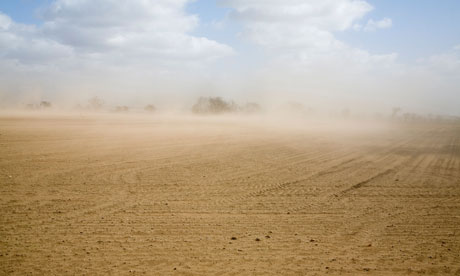
    Nafeez Blog on Peak soil : Wind causing soil erosion in fields, Suffolk Sandlings

    Wind causing soil erosion in agricultural fields, Suffolk, on 18 April 2013. Photograph: Alamy

    A new report says that the world will need to more than double food production over the next 40 years to feed an expanding global population. But as the world’s food needs are rapidly increasing, the planet’s capacity to produce food confronts increasing constraints from overlapping crises that, if left unchecked, could lead to billions facing hunger.

    The UN projects that global population will grow from today’s 7 billion to 9.3 billion by mid-century. According to the report released last week by the World Resources Institute (WRI), “available worldwide food calories will need to increase by about 60 percent from 2006 levels” to ensure an adequate diet for this larger population. At current rates of food loss and waste, by 2050 the gap between average daily dietary requirements and available food would approximate “more than 900 calories (kcal) per person per day.”

    The report identifies a complex, interconnected web of environmental factors at the root of this challenge – many of them generated by industrial agriculture itself. About 24% of greenhouse gas emissions come from agriculture, encompassing methane from livestock, nitrous oxide from fertilisers, carbon dioxide from onsite machinery and fertiliser production, and land use change.

    Industrial agriculture, the report finds, is a major contributor to climate change which, in turn is triggering more intense “heat waves, flooding and shifting precipitation patterns”, with “adverse consequences for global crop yields.”

    Indeed, global agriculture is heavily water intensive, accounting for 70 per cent of all freshwater use. The nutrient run off from farm fields can create “dead zones” and “degrade coastal waters around the world”, and as climate change contributes to increased water stress in crop-growing regions, food production will suffer further.

    Other related factors will also kick in, warns the report: deforestation from regional drying and warming, the effect of rising sea levels on cropland productivity in coastal regions, and growing water demand from larger populations.

    Yet the report points out that a fundamental problem is the impact of human activities on the land itself, estimating that:

    “… land degradation affects approximately 20% of the world’s cultivated areas”.

    Over the past 40 years, about 2 billion hectares of soil – equivalent to 15% of the Earth’s land area (an area larger than the United States and Mexico combined) – have been degraded through human activities, and about 30% of the world’s cropland have become unproductive. But it takes on average a whole century just to generate a single millimetre of topsoil lost to erosion.

    Soil is therefore, effectively, a non-renewable but rapidly depleting resource.

    We are running out of time. Within just 12 years, the report says, conservative estimates suggest that high water stress will afflict all the main food basket regions in North and South America, west and east Africa, central Europe and Russia, as well as the Middle East, south and south-east Asia.

    Unfortunately, though, the report overlooks another critical factor – the inextricable link between oil and food. Over the last decade, food and fuel prices have been heavily correlated. This is no accident.

    Last week, a new World Bank report examining five different food commodities – corn, wheat, rice, soybean, and palm oil – confirmed that oil prices are the biggest contributor to rising food prices. The report, based on a logarithm designed to determine the impact of any given factor through regression analysis, concluded that oil prices were even more significant than the ratio of available world food stocks relative to consumption levels, or commodity speculation. The Bank thus recommends controlling oil price movements as a key to tempering food price inflation.

    The oil-food price link comes as no surprise. A University of Michigan study points out that every major point in the industrial food system – chemical fertilisers, pesticides, farm machinery, food processing, packaging and transportation – is dependent on high oil and gas inputs. Indeed, 19% of the fossil fuels that prop up the American economy go to the food system, second only to cars.

    Back in 1940, for every calorie of fossil fuel energy used, 2.3 calories of food energy were produced. Now, the situation has reversed: it takes 10 calories of fossil fuel energy to produce just one calorie of food energy. As food writer and campaigner Michael Pollan remarked in the New York Times:

    “Put another way, when we eat from the industrial-food system, we are eating oil and spewing greenhouse gases.”

    But high oil prices are here to stay – and according to a UK Ministry of Defence assessment this year, could rise as high as $500 per barrel over the next 30 years.

    All this points to a rapidly approaching convergence point between an increasingly self-defeating industrial food system, and an inexorably expanding global population.

    But the point of convergence could come far sooner due to the wild card that is the catastrophic decline in honeybees.

    Over the last 10 years, US and European beekeepers have reported annual hive losses of 30% or higher. Last winter, however, saw many US beekeepers experiencing losses of 40 to 50% more – with some reporting losses as high as 80 to 90%. Given that a third of food eaten worldwide depends on pollinators, particularly bees, the impact on global agriculture could be catastrophic. Studies have blamed factors integral to industrial methods – pesticides, parasitic mites, disease, nutrition, intensive farming, and urban development.

    But the evidence specifically fingering widely used pesticides has long been overwhelming. The European Food Safety Authority (EFSA), for instance, has highlighted the role of neonicotinoids – much to the British government’s chagrin – justifying the EU’s partial ban of three common pesticides.

    Now in its latest scientific warning put out last week, the EFSA highlights how another pesticide, fipronil, poses a “high acute risk” for honeybees. The study also noted large information gaps in scientific studies preventing a comprehensive assessment of risks to pollinators.

    In short, the global food predicament faces a perfect storm of intimately related crises that are already hitting us now, and will worsen over coming years without urgent action.

    It is not that we lack answers. Last year, the Commission on Sustainable Agriculture and Climate Change chaired by former chief government scientist Prof Sir John Beddington – who previously warned of a perfect storm of food, water and energy shortages within 17 years – set out seven concrete, evidence-based recommendations to generate a shift toward more sustainable agriculture.

    So far, however, governments have largely ignored such warnings even as new evidence has emerged that Beddington’s timeline is too optimistic. A recent University of Leeds-led study found that severe climate-driven droughts in Asia – especially in China, India, Pakistan and Turkey – within the next 10 years would dramatically undermine maize and wheat production, triggering a global food crisis.

    When we factor into this picture soil erosion, land degradation, oil prices, bee colony collapse, and population growth, the implications are stark: industrial civilisation is on the verge of eating itself – if we don’t change course, this decade will go down in history as the beginning of the global food apocalypse.

    Dr Nafeez Ahmed is executive director of the Institute for Policy Research & Development and author of A User’s Guide to the Crisis of Civilisation: And How to Save It among other books. Follow him on Twitter @nafeezahmed