Author: admin

  • Nile Delta: ‘We are going underwater. The sea will conquer our lands’

    Nile Delta: ‘We are going underwater. The sea will conquer our lands’


    The Nile Delta is under threat from rising sea levels. Without the food it produces, Egypt faces catastrophe


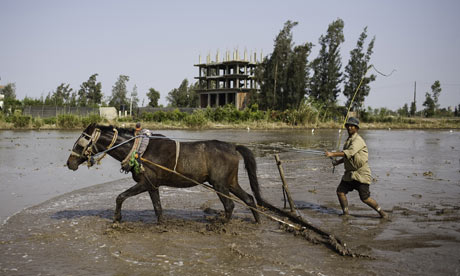
    A farmer ploughs his rice paddy in the Delta

    A farmer ploughs his rice paddy in the Delta. Photograph: Jason Larkin


    Maged Shamdy’s ancestors arrived on the shores of Lake Burrulus in the mid-19th century. In the dusty heat of Cairo at the time, French industrialists were rounding up forced labour squads to help build the Suez Canal, back-breaking labour from which thousands did not return. Like countless other Egyptians, the Shamdys abandoned their family home and fled north into the Nile Delta, where they could hide within the marshy swamplands that fanned out from the great river’s edge.


    As the years passed, colonial rulers came and went. But the Shamdys stayed, carving out a new life as farmers and fishermen on one of the most fertile tracts of land in the world. A century and a half later, Maged is still farming his family’s fields. In between taking up the rice harvest and dredging his irrigation canals, however, he must contemplate a new threat to his family and livelihood, one that may well prove more deadly than any of Egypt‘s previous invaders. “We are going underwater,” the 34-year-old says simply. “It’s like an occupation: the rising sea will conquer our lands.”


    Maged understands better than most the menace of coastal erosion, which is steadily ingesting the edge of Egypt in some places at an astonishing rate of almost 100m a year. Just a few miles from his home lies Lake Burrulus itself, where Nile flower spreads all the way out to trees on the horizon. Those trunks used to be on land; now they stand knee-deep in water.


    Maged’s imperial imagery may sound overblown, but travel around Egypt’s vast, overcrowded Delta region and you hear the same terms used time and again to describe the impact climate change is having on these ancient lands. Egypt’s breadbasket is littered with the remnants of old colonisers, from the Romans to the Germans, and today its 50 million inhabitants jostle for space among the crumbling forts and cemeteries of those who sought to subjugate them in the past.


    On the Delta’s eastern border, in Port Said, an empty stone plinth is all that remains of a statue of Ferdinand de Lesseps, the man who built the Suez Canal; somewhere along the Delta’s westernmost reaches, the long-lost tomb of Cleopatra lies buried. With such a rich history of foreign rule, it’s only natural that the latest hostile force knocking at the gates should be couched in the language of occupation.


    “Egypt is a graveyard for occupiers,” observes Ramadan el-Atr, a fruit farmer near the antiquated town of Rosetta, where authorities have contracted a Chinese company to build a huge wall of concrete blocks in the ocean to try to save any more land from melting away. “Just like the others, the sea will come and go – but we will always survive.”


    Scientists aren’t so sure. Two years ago, the Intergovernmental Panel on Climate Change declared Egypt’s Nile Delta to be among the top three areas on the planet most vulnerable to a rise in sea levels, and even the most optimistic predictions of global temperature increase will still displace millions of Egyptians from one of the most densely populated regions on earth.


    The Delta spills out from the northern stretches of the capital into 10,000 square miles of farmland fed by the Nile’s branches. It is home to two-thirds of the country’s rapidly growing population, and responsible for more than 60% of its food supply: Egypt relies unconditionally on it for survival. But with its 270km of coastline lying at a dangerously low elevation (large parts are between zero and 1m above sea level, with some areas lying below it), any melting of the polar ice caps could see its farmland and cities – including the historical port of Alexandria – transformed into an ocean floor. A 1m rise in the sea level, which many experts think likely within the next 100 years, will cause 20% of the Delta to go underwater. At the other extreme, the 14m rise that would result from the disappearance of Greenland and western Antarctica would leave the Mediterranean lapping at the northern suburbs of Cairo, with practically all of the Delta underwater.


    Already, a series of environmental crises are parking themselves on the banks of the Nile. Some are subtle, like the river’s quiet vanishing act in the Delta’s northern fields; others, like the dramatic collapse of coastal lands into the ocean, are more striking. Major flooding is yet to become a reality but, from industrial pollution to soil salinity, a whole new set of interconnected green concerns is now forcing its way into Egyptian public discourse for the first time.


    “The Delta is a kind of Bangladesh story,” says Dr Rick Tutwiler, director of the American University in Cairo’s Desert Development Centre. “You’ve got a massive population, overcrowding, a threat to all natural resources from the pressure of all the people, production, pollution, cars and agricultural chemicals. And on top of all that, there’s the rising sea. It’s the perfect storm.”


    Follow the Nile north out of Cairo on the old agricultural road, and you find it hard to pinpoint where the city ends and the lotus-shaped Delta begins. Carpeted with redbrick apartment blocks and spliced with streets in every direction, the lush greenery of the Nile’s splintered arteries is almost impossible to appreciate in isolation. This is where the urban and the rural get lost in each other, with livestock living in doorways and workers camping out in fields. In the past, literary giants venerated the Delta’s wild marshlands; today, any clear-cut divisions between the metropolis and the countryside have long faded away.


    Urban encroachment – the steady chipping away at arable land through unauthorised construction – haunts the Delta everywhere you look. Despite a web of legislation outlawing illegal building practices and theoretically “fencing off” agricultural land, in every direction the sweeping vista of wheat fields and rice paddies always ends abruptly in a cluster of half-built homes. There are more than 4,000 people per square mile in the Delta; it’s hard to think of any other place where humans and the environment around them are more closely intertwined. With Egypt’s present-day population of 83 million set to increase to more than 110 million in the next two decades, the seemingly unstoppable spread of bricks and mortar over the soil is both the most visible symptom of the country’s demographic time-bomb and an inevitable response to it.


    More people in the Delta means more cars, more pollution and less land to feed them all on, just at a time when increased crop production is needed most. Yet the desertification of land through human habitation is, worryingly, only the beginning of the problem. Although few in the Delta have noticed it yet, the freshwater of the Nile – which has enabled Egypt to survive as a unified state longer than any other territory on earth – is creaking under the strain of this population boom. The world’s most famous river has provided the backdrop to all manner of dramas throughout history, real and fictional. Now, around its northernmost branches where the minarets and pylons thin out and the landscape becomes more windswept, another is playing out to devastating effect.


    The villain is salinity. I visit one of the worst-affected regions, Kafr el-Sheikh, on a Friday morning when the fields have emptied out for the noon prayer. The streets are eerily silent; with its people gone, the area takes on the appearance of one of Italo Calvino’s fantastical string cities, chock-a-block with the shells of human habitation but no living souls remaining. The exception is Maged, who owns six feddan (about six acres) of land near the village of el-Hadadi.


    Maged is halfway down a hole when I approach his house. Clambering out apologetically, he explains that German experts visited this area last year and declared that the fresh water being pumped to local villages “wasn’t fit for a dog to drink”. After months of phone calls to the national water company, none of which were answered, Maged decided to lay down a new set of pipes himself in the hope it would improve the quality of drinking water for his two young daughters. It’s hot, exhausting work, which he fits in between his farming duties and a new part-time job as an accountant in a local alfalfa plant. “We don’t have much time on our hands at the moment,” Maged says, dusting himself off and gulping down some fresh melon juice. “Nobody can make a living solely off the land any more.”


    On a tour of his fields, I see why. The rich brown soil has greyed out in recent years, leaving a barren salt-encrustation on the surface. The cause is underground saltwater intrusion from the nearby coast, which pushes up through the soil and kills off roots. Coastal farmland has always been threatened by saltwater, but salinity has traditionally been kept at bay by plentiful supplies of fresh water gushing over the soil and flushing out the salt. It used to happen naturally with the Nile’s seasonal floods; after the construction of Egypt’s High Dam in the 70s (one of the most ambitious engineering projects on earth), these seasonal floods came to an end, but a vast network of irrigation canals continued to bring gallons of fresh water to the people who worked the land, the fellahin, ensuring salinity levels remained low.


    Today, however, Nile water barely reaches this corner of the Delta. Population growth has sapped its energy upstream, and what “freshwater” does make it downriver is increasingly awash with toxins and other impurities. Farmers such as Maged now essentially rely on waste water – a mix of agricultural drainage and sewage – from the nearby town of Sidi Salim.


    The result is plummeting fertility; local farmers say that whereas their fathers spent just a handful of Egyptian pounds on chemicals to keep the harvests bountiful, they now have to put aside between 25 and 80% of their profits for fertilisers just to keep their crops alive.


    “We can see with our own eyes that the water is no good, it’s less and less pure,” Maged says. He points out huge swaths of neighbouring land that once glimmered with rice paddies; recently they have been dug up and replaced by fish farms, the ground too barren for crop cultivation. Further out, in the village of Damru, the green fields of 10 years ago are cracked and brown, now put into service as informal football pitches and rubbish dumps.


    Experts believe the problem is only going to get worse. “We currently have a major water deficit in Egypt, with only 700 cubic metres of freshwater per person,” explains Professor Salah Soliman of Alexandria University. “That’s already short of the 1,000 cubic metres per person the UN believes is the minimum needed for water security. Now, with the population increase, it will drop to 450 cubic metres per person – and this is all before we take into account the impact of climate change.”


    That impact is likely to be a 70% drop in the amount of Nile water reaching the Delta over the next 50 years, due to increased evaporation and heavier demands on water use upstream. The consequences of all these ecological changes on food production are staggering: experts at Egypt’s Soils, Water and Environment Research Institute predict that wheat and maize yields could be down 40% and 50% respectively in the next 30 years, and that farmers who make a living off the land will lose around $1,000 per hectare for each degree rise in the average temperature.


    The farmers here feel abandoned by the state; there are regular dismissive references to the “New Age”, a euphemism for the much-hated regime of President Hosni Mubarak, whose neoliberal reform programmes and widespread corruption scandals have provoked a wave of popular discontent across the country. This disconnect between the state and its people has led to distrust of government scientists who think coastal erosion, rather than freshwater scarcity, is the main reason for the farmers’ problems. And, in a worrying twist for Egypt’s creaking economy, the erosion isn’t only affecting farmers. “Unfortunately, most of our industry and investment has been built on sites very close to the shore,” says Soliman. “There’s only so much water we can hold back.”


    Ras el-Bar is a small holiday resort at the mouth of the Nile’s Damietta branch. This was the summer paradise that Nobel prizewinning novelist Naguib Mahfouz’s well-heeled characters would escape to when the heat of the capital became unbearable; today its squat pink lighthouse and endless boulevards of deserted, low-rise holiday homes have the faded feel of a 50s Disneyland.


    Although still popular in July and August, Ras el-Bar has been overtaken as a seaside destination by the brash consumerism of a new generation of towns: Sharm el-Sheikh, Marina, Hurghada. In place of tourists, however, new factories have arrived here in abundance, including some that nearby residents believe are poisoning the air. The arrival of one industrial plant in Damietta, which coincided with the ministry of environment’s last-minute decision not to designate the area a protected nature reserve, is a familiar story of shady backdoor deals, public outrage and the studious disregard of local opinions. In this case, the locals managed to postpone the factory’s construction, but other plants remain. “In the morning here you can see nothing but smoke,” says Mohammed Fawzia, who is fishing in a canal down by the side of an industrial complex run by the state-owned Mopco company. “Take photos of it for us so we can show who is killing our children. We want the factories gone.”


    Many Cairo-based experts, however, insist that the task of coping with the dramatic ecological changes faced by the Delta is made harder by the ignorance of people such as Mohammed. They claim the fellahin are too uneducated to change their ways. But they are wrong: while farmers in the southern Delta, where Nile water is still relatively plentiful, have little knowledge of climate change, those in the north are painfully aware of the science behind the death of their land. However, they also have little time to listen to the harrying of a government which is widely seen to preach green rhetoric on the one hand but is only too willing to sell out the environment on the other, along with the local people.


    Money talks in Egypt, and sustainable development is forgotten when the interests of the rich and powerful – such as the industrial plants in Damietta or the influential Badrawi clan in Daqahliyah – are at stake. The repression and self-interest of Mubarak’s inner circle have left them bereft of any moral authority on environmental issues.


    And while scientists, academics and community organisers are making a concerted effort to educate Egyptians about the dangers of climate change, there is confusion over whether the focus of all these programmes should be on promoting ways to combat climate change, or on accepting climate change as inevitable and instead encouraging new forms of adaptation to the nation’s uncertain ecological future.


    Efforts are further hampered by a popular feeling that this is a crisis made by the west. “We’re not responsible for climate change,” says Soliman, pointing out that Egypt’s contribution to global carbon emissions is an underwhelming 0.5%, nine times less per capita than the US. “But unfortunately the consequence of climate change is no respecter of national borders.”


    The scale of the crisis – more people, less land, less water, less food – is overwhelming, and has infected discussion of climate change with a toxic combination of cynicism and fatalism at every level. There are senior environmental officials in top scientific jobs here who do not believe climate change is real; others are convinced the problem is so great that human intervention is useless. “It’s down to God,” one environmental officer for a major Delta town tells me. “If the Delta goes we’ll find new places to live. If Egypt was big enough for Mary and Joseph, then it will be big enough for all of us.”


    Of course, if sea levels do rise significantly, “then the debate is over,” says Dr Tutwiler. “The land will be underwater and crop production will be over.”


    As a result, many now believe that Egypt’s future lies far away from the Delta, in land newly reclaimed from the desert. Since the time of the pharaohs, when the Delta was first farmed, Egypt’s political leaders have rested their legitimacy on their ability to feed it by taming the Nile. Mohammed Ali, Lord Cromer and Gamal Abdel Nasser all launched major projects to control and harness the river’s seasonal floods; now Mubarak is following in their footsteps – not by saving the Delta, but by creating a bewildering array of canals and pumping stations that draw water out from the Nile into sandy valleys to the east and west, where the desert is slowly being turned green.


    You can see evidence of these new lands on the Delta’s fringes; mile upon mile of agri-business-owned fields peeking out behind the advertising billboards of the Cairo-Alexandria desert road. The billboards depict gated compounds and luxury second homes, escapist dreams for the Egyptian upper-middle class.


    The new lands behind them are another sort of escape, this time for the whole country. Their very water-intensive existence is, though, only hastening the demise of the Delta; once the glittering jewel of Egypt and bedrock of its survival, but now a region whose death warrant may already have been signed.


    Invasion of the Nile: The Delta’s troubled history


    • 4,000 – 3,000 BC approx – The Delta is populated by migrants from the Sahara and intensive farming begins in the region


    • 1,300 BC approx – According to the Bible, the Delta is home to the Israelites, and miraculously survives God’s plague of hail


    • 343 BC – The Persians kill Egypt’s last native pharaoh, ushering in more than 2,000 years of foreign rule over the Delta


    • 332 BC – Alexander the Great invades and founds Alexandria at the tip of the Delta


    • 30 BC – Cleopatra and Marc Anthony kill themselves


    • 639 AD – Muslim Arabs sweep into the Delta, forcing out the Byzantine rulers


    • 1517 AD – The Delta is absorbed into the Ottoman Empire and ruled from Turkey


    • 1798 AD – Napoleon Bonaparte begins a three-year French occupation


    • 1805 AD – The Albanian pasha Muhammad Ali seizes power but his dynasty falls under the control of the British Empire


    • 1952 AD – Gamal Abdel Nasser restores Egyptian rule for the first time in two millennia


    • 1970 AD – The Aswan Dam is completed, ending seasonal flooding in the Delta


    • 2007 AD – Delta declared among top three areas vulnerable to rising sea levels


    Alexandria: An ancient city under threat


    Alexandria has been through several reincarnations: as a small Pharaonic town in the 4th century BC, as the capital of Egypt for 1,000 years, and as a cosmopolitan melting-ground in the early 20th century. While most of its former glories are already lying on the seabed, scientists now fear the city’s outer fringes could be among the first victims of any rise in sea levels.


    A rise of only 1m will leave the city centre cut off from the mainland. If it does disappear, its literary chroniclers may provide some comfort. Lawrence Durrell called it “the capital of memory”, a city where recollections stay “clinging to the minds of old men like traces of perfume upon a sleeve”. The Greek poet Constantine Cavafy shared Durrell’s sense of being trapped by history. In what may prove a remarkable piece of foresight, he wrote in The City:


    You’ll find no new places, you won’t find other shores.


    The city will follow you. The streets in which you pace


    will be the same, you’ll haunt the same familiar places,


    and inside those same houses you’ll grow old.


    You’ll always end up in this city. Don’t bother to hope


    for a ship.

  • ‘Simple changes’ fight climate change


    ‘Simple changes’ fight climate change


    Updated: 14:07, Friday August 21, 2009


    'Simple changes' fight climate change


    Australians need to join the fight against climate change by making simple changes in how they live, the federal government says.


    A day after finalising a significant commitment to renewable energy, the government has set its sights on ordinary households, saying they can do more to assist the climate change challenge.


    Solar panel rebates of up to $7,000 were passed on Thursday as part of the drive to lower emissions of greenhouse gases.


    Environment Minister Peter Garrett on Friday launched initiatives to offer practical tips on how to live a ‘greener’ lifestyle.


    The new livinggreener.gov.au website provides a range of information on sustainable living, including composting, how to buy an environmentally friendly oven and the installation of rainwater tanks.


    ‘Almost 10 per cent of Australia’s greenhouse gas emissions come from households,’ Mr Garrett said in a statement.


    ‘But every Australian can make a big difference to the environment and their wallets through simple, cost-effective, everyday actions.’


    For a first-hand look at how it can be done, some 170 homes across the country will open their doors as part of Sustainable House Day on September 13.


    Environmentally aware householders have been welcoming visitors since 2001, giving them a first-hand look at how homes can be modified, Mr Garrett said.


    But the event will be fully sponsored for the first time since 2001, so admission will be free.


    Agriculture Minister Tony Burke believes the sugarcane industry will also play a part in achieving the 20 per cent renewable energies target by 2020.


    He’s called for greater investment in sugarcane-powered energy, which currently accounts for five per cent of electricity generation in Queensland.


    Up to 180,000 homes in the sunshine state and northern NSW could benefit, he said.

  • Is there any point in fighting to stave off industrial apocalypse?

    Is there any point in fighting to stave off industrial apocalypse?


    The collapse of civilisation will bring us a saner world, says Paul Kingsnorth. No, counters George Monbiot – we can’t let billions perish


    Dear George


    On the desk in front of me is a set of graphs. The horizontal axis of each represents the years 1750 to 2000. The graphs show, variously, population levels, CO2 concentration in the atmosphere, exploitation of fisheries, destruction of tropical forests, paper consumption, number of motor vehicles, water use, the rate of species extinction and the totality of the human economy’s gross domestic product.


    What grips me about these graphs (and graphs don’t usually grip me) is that though they all show very different things, they have an almost identical shape. A line begins on the left of the page, rising gradually as it moves to the right. Then, in the last inch or so – around 1950 – it veers steeply upwards, like a pilot banking after a cliff has suddenly appeared from what he thought was an empty bank of cloud.


    The root cause of all these trends is the same: a rapacious human economy bringing the world swiftly to the brink of chaos. We know this; some of us even attempt to stop it happening. Yet all of these trends continue to get rapidly worse, and there is no sign of that changing soon. What these graphs make clear better than anything else is the cold reality: there is a serious crash on the way.


    Yet very few of us are prepared to look honestly at the message this reality is screaming at us: that the civilisation we are a part of is hitting the buffers at full speed, and it is too late to stop it. Instead, most of us – and I include in this generalisation much of the mainstream environmental movement – are still wedded to a vision of the future as an upgraded version of the present. We still believe in “progress”, as lazily defined by western liberalism. We still believe that we will be able to continue living more or less the same comfortable lives (albeit with more windfarms and better lightbulbs) if we can only embrace “sustainable development” rapidly enough; and that we can then extend it to the extra 3 billion people who will shortly join us on this already gasping planet.


    I think this is simply denial. The writing is on the wall for industrial society, and no amount of ethical shopping or determined protesting is going to change that now. Take a civilisation built on the myth of human exceptionalism and a deeply embedded cultural attitude to “nature”; add a blind belief in technological and material progress; then fuel the whole thing with a power source that is discovered to be disastrously destructive only after we have used it to inflate our numbers and appetites beyond the point of no return. What do you get? We are starting to find out.


    We need to get real. Climate change is teetering on the point of no return while our leaders bang the drum for more growth. The economic system we rely upon cannot be tamed without collapsing, for it relies upon that growth to function. And who wants it tamed anyway? Most people in the rich world won’t be giving up their cars or holidays without a fight.


    Some people – perhaps you – believe that these things should not be said, even if true, because saying them will deprive people of “hope”, and without hope there will be no chance of “saving the planet”. But false hope is worse than no hope at all. As for saving the planet – what we are really trying to save, as we scrabble around planting turbines on mountains and shouting at ministers, is not the planet but our attachment to the western material culture, which we cannot imagine living without.


    The challenge is not how to shore up a crumbling empire with wave machines and global summits, but to start thinking about how we are going to live through its fall, and what we can learn from its collapse.


    All the best, Paul


    Dear Paul


    Like you I have become ever gloomier about our chances of avoiding the crash you predict. For the past few years I have been almost professionally optimistic, exhorting people to keep fighting, knowing that to say there is no hope is to make it so. I still have some faith in our ability to make rational decisions based on evidence. But it is waning.


    If it has taken governments this long even to start discussing reform of the common fisheries policy – if they refuse even to make contingency plans for peak oil – what hope is there of working towards a steady-state economy, let alone the voluntary economic contraction ultimately required to avoid either the climate crash or the depletion of crucial resources?


    The interesting question, and the one that probably divides us, is this: to what extent should we welcome the likely collapse of industrial civilisation? Or more precisely: to what extent do we believe that some good may come of it?


    I detect in your writings, and in the conversations we have had, an attraction towards – almost a yearning for – this apocalypse, a sense that you see it as a cleansing fire that will rid the world of a diseased society. If this is your view, I do not share it. I’m sure we can agree that the immediate consequences of collapse would be hideous: the breakdown of the systems that keep most of us alive; mass starvation; war. These alone surely give us sufficient reason to fight on, however faint our chances appear. But even if we were somehow able to put this out of our minds, I believe that what is likely to come out on the other side will be worse than our current settlement.


    Here are three observations: 1 Our species (unlike most of its members) is tough and resilient; 2 When civilisations collapse, psychopaths take over; 3 We seldom learn from others’ mistakes.


    From the first observation, this follows: even if you are hardened to the fate of humans, you can surely see that our species will not become extinct without causing the extinction of almost all others. However hard we fall, we will recover sufficiently to land another hammer blow on the biosphere. We will continue to do so until there is so little left that even Homo sapiens can no longer survive. This is the ecological destiny of a species possessed of outstanding intelligence, opposable thumbs and an ability to interpret and exploit almost every possible resource – in the absence of political restraint.


    From the second and third observations, this follows: instead of gathering as free collectives of happy householders, survivors of this collapse will be subject to the will of people seeking to monopolise remaining resources. This will is likely to be imposed through violence. Political accountability will be a distant memory. The chances of conserving any resource in these circumstances are approximately zero. The human and ecological consequences of the first global collapse are likely to persist for many generations, perhaps for our species’ remaining time on earth. To imagine that good could come of the involuntary failure of industrial civilisation is also to succumb to denial. The answer to your question – what will we learn from this collapse? – is nothing.


    This is why, despite everything, I fight on. I am not fighting to sustain economic growth. I am fighting to prevent both initial collapse and the repeated catastrophe that follows. However faint the hopes of engineering a soft landing – an ordered and structured downsizing of the global economy – might be, we must keep this possibility alive. Perhaps we are both in denial: I, because I think the fight is still worth having; you, because you think it isn’t.


    With my best wishes, George


    Dear George


    You say that you detect in my writing a yearning for apocalypse. I detect in yours a paralysing fear.


    You have convinced yourself that there are only two possible futures available to humanity. One we might call Liberal Capitalist Democracy 2.0. Clearly your preferred option, this is much like the world we live in now, only with fossil fuels replaced by solar panels; governments and corporations held to account by active citizens; and growth somehow cast aside in favour of a “steady state economy”.


    The other we might call McCarthy world, from Cormac McCarthy’s novel The Road – which is set in an impossibly hideous post-apocalyptic world, where everything is dead but humans, who are reduced to eating children. Not long ago you suggested in a column that such a future could await us if we didn’t continue “the fight”.


    Your letter continues mining this Hobbesian vein. We have to “fight on” because without modern industrial civilisation the psychopaths will take over, and there will be “mass starvation and war”. Leaving aside the fact that psychopaths seem to be running the show already, and millions are suffering today from starvation and war, I think this is a false choice. We both come from a western, Christian culture with a deep apocalyptic tradition. You seem to find it hard to see beyond it. But I am not “yearning” for some archetypal End of Days, because that’s not what we face.


    We face what John Michael Greer, in his book of the same name, calls a “long descent”: a series of ongoing crises brought about by the factors I talked of in my first letter that will bring an end to the all-consuming culture we have imposed upon the Earth. I’m sure “some good will come” from this, for that culture is a weapon of planetary mass destruction.


    Our civilisation will not survive in anything like its present form, but we can at least aim for a managed retreat to a saner world. Your alternative – to hold on to nurse for fear of finding something worse – is in any case a century too late. When empires begin to fall, they build their own momentum. But what comes next doesn’t have to be McCarthyworld. Fear is a poor guide to the future.


    All the best, Paul


    Dear Paul


    If I have understood you correctly, you are proposing to do nothing to prevent the likely collapse of industrial civilisation. You believe that instead of trying to replace fossil fuels with other energy sources, we should let the system slide. You go on to say that we should not fear this outcome.


    How many people do you believe the world could support without either fossil fuels or an equivalent investment in alternative energy? How many would survive without modern industrial civilisation? Two billion? One billion? Under your vision several billion perish. And you tell me we have nothing to fear.


    I find it hard to understand how you could be unaffected by this prospect. I accused you of denial before; this looks more like disavowal. I hear a perverse echo in your writing of the philosophies that most offend you: your macho assertion that we have nothing to fear from collapse mirrors the macho assertion that we have nothing to fear from endless growth. Both positions betray a refusal to engage with physical reality.


    Your disavowal is informed by a misunderstanding. You maintain that modern industrial civilisation “is a weapon of planetary mass destruction”. Anyone apprised of the palaeolithic massacre of the African and Eurasian megafauna, or the extermination of the great beasts of the Americas, or the massive carbon pulse produced by deforestation in the Neolithic must be able to see that the weapon of planetary mass destruction is not the current culture, but humankind.


    You would purge the planet of industrial civilisation, at the cost of billions of lives, only to discover that you have not invoked “a saner world” but just another phase of destruction.


    Strange as it seems, a de-fanged, steady-state version of the current settlement might offer the best prospect humankind has ever had of avoiding collapse. For the first time in our history we are well-informed about the extent and causes of our ecological crises, know what should be done to avert them, and have the global means – if only the political will were present – of preventing them. Faced with your alternative – sit back and watch billions die – Liberal Democracy 2.0 looks like a pretty good option.


    With my best wishes, George


    Dear George


    Macho, moi? You’ve been using the word “fight” at a Dick Cheney-like rate. Now my lack of fighting spirit sees me accused of complicity in mass death. This seems a fairly macho accusation.


    Perhaps the heart of our disagreement can be found in a single sentence in your last letter: “You are proposing to do nothing to prevent the likely collapse of industrial civilisation.” This invites a question: what do you think I could do? What do you think you can do?


    You’ve suggested several times that the hideous death of billions is the only alternative to a retooled status quo. Even if I accepted this loaded claim, which seems designed to make me look like a heartless fascist, it would get us nowhere because a retooled status quo is a fantasy and even you are close to admitting it. Rather than “do nothing” in response, I’d suggest we get some perspective on the root cause of this crisis – not human beings but the cultures within which they operate.


    Civilisations live and die by their founding myths. Our myths tell us that humanity is separate from something called “nature”, which is a “resource” for our use. They tell us there are no limits to human abilities, and that technology, science and our ineffable wisdom can fix everything. Above all, they tell us that we are in control. This craving for control underpins your approach. If we can just persaude the politicians to do A, B and C swiftly enough, then we will be saved. But what climate change shows us is that we are not in control, either of the biosphere or of the machine which is destroying it. Accepting that fact is our biggest challenge.


    I think our task is to negotiate the coming descent as best we can, while creating new myths that put humanity in its proper place. Recently I co-founded a new initiative, the Dark Mountain Project, which aims to help do that. It won’t save the world, but it might help us think about how to live through a hard century. You’d be welcome to join us.


    Very best, Paul


    Dear Paul


    Yes, the words I use are fierce, but yours are strangely neutral. I note that you have failed to answer my question about how many people the world could support without modern forms of energy and the systems they sustain, but 2 billion is surely the optimistic extreme. You describe this mass cull as “a long descent” or a “retreat to a saner world”. Have you ever considered a job in the Ministry of Defence press office?


    I draw the trifling issue of a few billion fatalities to your attention not to make you look like a heartless fascist but because it’s a reality with which you refuse to engage. You don’t see it because to do so would be to accept the need for action. But of course you aren’t doing nothing. You propose to stiffen the sinews, summon up the blood, and, er … “get some perspective on the root cause of this crisis”. Fine: we could all do with some perspective. But without action – informed, focused and immediate – the crisis will happen. I agree that the chances of success are small. But they are non-existent if we give up before we have started. You mock this impulse as a “craving for control”. I see it as an attempt at survival.


    What could you do? You know the answer as well as I do. Join up, protest, propose, create. It’s messy, endless and uncertain of success. Perhaps you see yourself as above this futility, but it’s all we’ve got and all we’ve ever had. And sometimes it works.


    The curious outcome of this debate is that while I began as the optimist and you the pessimist, our roles have reversed. You appear to believe that though it is impossible to tame the global economy, it is possible to change our founding myths, some of which predate industrial civilisation by several thousand years. You also believe that good can come of a collapse that deprives most of the population of its means of survival. This strikes me as something more than optimism: a millenarian fantasy, perhaps, of Redemption after the Fall. Perhaps it is the perfect foil to my apocalyptic vision.


    With my best wishes, George


  • Is it time to start worrying about Copenhagen?

    Is it time to start worrying about Copenhagen?


    The gap between rich nations and emerging economies over carbon emissions targets is beginning to look unbridgable. From BusinessGreen.com, part of the Guardian Environment Networ


    I am starting to get very worried.


    This week, another round of the UN’s climate change talks gets underway in Bonn, Germany and once again all the key factions look as far from reaching a meaningful agreement on carbon emissions targets as they ever were.


    It is far too early to give up hope on a deal being reached, particularly given that any exercise in international diplomacy is always characterised by the kind of posturing and brinkmanship we can expect to see again over the next five days. But with just 117 days to go until the start of the Copenhagen conference, major breakthroughs are needed soon if we are to have anything to celebrate this Christmas.


    The problem is that all of the key negotiating teams are beginning to sound like broken records as they demand that others move first to deliver targets before they make any commitment.


    China, India and the other emerging economies are not unreasonably demanding that rich nations follow the dictats of the latest climate science and agree to cut emissions 40 per cent by 2020 on 1990 levels. But even assuming this is an opening gambit and they might accept the EU’s conditional offer of a 30 per cent cut, they are still asking for reductions that are an order of magnitude larger than the four per cent cut on 1990 levels proffered by the Obama administration as part of its climate change bill – which, by the way, has not yet been passed.


    So will the US budge and increase the cuts it is willing to offer? Not a chance.


    We can discuss the vagaries of the US electoral system, the malign influence of fossil fuel industry lobbyists and the collective psychosis of parts of the American Right another time, but the facts as they stand are that the Obama administration will count itself very lucky indeed to get the four per cent cut included in the Waxman-Markey bill passed into law.


    The US negotiators could have an attack of conscience in Copenhagen and sign up to deeper cuts in order to get India and China on board, but any more demanding targets would soon be shot down in Congress, leaving us exactly where we started.


    That puts the ball back in the court of the emerging nations. Will they accept that the Obama administration is offering all it can in the short term and is serious about delivering much deeper cuts of 80 per cent by 2050, leaving them free to sign up to more modest targets for themselves? Again, the answer is not a chance.


    You can make a strong case that they are making a rod for their own back, given that the developing world will be on the front line against the impacts of climate change. Just as you can easily dismiss the argument that emerging economies should be allowed to develop using the same carbon-intensive technologies that underpinned growth in the West. As Gaia Vince asked rhetorically in an article for the Guardian today: “The rich south of the USA got to develop its economy with the assistance of slaves. Would it be acceptable for India to use slaves now?”


    But it is all but impossible to argue with India and China’s stated position that under any definition of social justice the rich world has a historical debt to pay and must pick up the vast majority of the bill for tackling climate change – and that means agreeing to far more ambitious targets and helping the developing world to decarbonise its growing economies.


    As Indian ambassador Chandrashekhar Dasgupta, the senior Indian negotiator, neatly explained to the BBC: “[India] is a country where half the rural population does not have a light bulb in its home, or a gas ring. So to describe this country as a large emitter is absurd – there’s no other word for it.”


    Or to quote the somewhat more robust John Prescott in the Guardian: “The fact is that the West has poisoned the world and left continents such as Africa in poverty. The West will have up to stump up the cash for clean technology.”


    The way to square this circle is for negotiators to agree to some form of equitable per capita emissions target, and it is this so-called contraction and convergence model that is winning growing support among some of the negotiating teams. But it seems far too late in the day for per capita targets to be included in the Copenhagen process, and even if they were they too would run into the brick wall of a US political system that will not countenance targets that would in effect require deeper emission cuts in the US than anywhere else.


    So where does the process go to break this deadlock? I’m not sure it can, at least not on the issue of binding emission targets. It looks increasingly likely that we will see an almighty fudge on the issue of targets built around what is already on the table: namely, largely inadequate targets from rich nations, mirrored by vague aspirational goals to curb emission growth from emerging economies.


    However, while a treaty without targets may end up resembling a football match without goal posts, it would not necessarily make the exercise a complete waste of time.


    Progress does appear to be being made on the development of a global carbon market, reforestry schemes and clean tech funding for developing nations. Negotiators from the rich world may not be able to see the competitive advantage in signing up to emissions targets that will not be matched by emerging rivals, but they can certainly see the benefits attached to the creation of a major new commodity class in the form of carbon and the strengthening of trade relations with the likes of China and India.


    There is a consensus building that clean tech financing pumped into the developing world will help to create new markets for the emerging clean tech hubs of the US and Europe, creating an economic win-win for all involved. Make the grants and financing deals attractive enough and it might even be possible to get emerging economies to budge a little on the issue of targets.


    It is likely to be a bit of a mess and it is unlikely to deliver what the scientists demand, but the final Copenhagen deal might just inadvertently deliver what is required. A legislative, financing and carbon pricing framework that makes it both possible and attractive for businesses to develop clean technologies that are better and more cost effective than the carbon intensive rivals they hope to replace. Deliver that and market forces will ensure the decarbonisation of the global economy looks after itself – with or without targets.


    • This article was shared by our content partner BusinessGreen.com, part of the Guardian Environment Network

  • New cheaper SolarTechnology


    There are warnings that a delay in passing the renewable energy targets would put green jobs at risk. (File photo)

    ABC News © Enlarge photo


      Scientists from Canberra’s Australian National University (ANU) and Tianjin University in China have teamed up to develop new cheaper solar technology.


      The two year project will pioneer the use of solar cells immersed in cooling fluid to make them more efficient and less expensive than current solar panels.


      ANU Professor Andrew Blakers says the new solar systems will be able to simultaneously heat households, water and generate electricity.


      “This combines the two functions into a single lightweight, low profile concentrator system,” he said.


      “And because you’re utilising the same infrastructure for both electricity and heat collection you can aim to have a substantially reduced cost.”


      Mr Blakers says it has the potential to make buildings carbon neutral.


      “Inside that receiver immersed in mineral oil is a solar cell that absorbs about 20 per cent of the reflected sunlight to make electricity,” he said.


      “The other 80 per cent becomes heat and can be used to make solar hot water and to heat houses in winter and to drive solar cooling in the summer.”

    • Senate approves renewable energy target

      Senate approves renewable energy target


      Posted 2 hours 14 minutes ago


      The Senate has passed the Federal Government’s renewable energy target legislation.


      The Government split the legislation from its emissions trading scheme and negotiated more industry compensation with the Coalition to secure support for the bill.


      Under the new target, 20 per cent of Australia’s electricity will have to be generated from renewable energy sources by 2020.


      The Nationals were unsuccessful in their bid to get compensation for food-processing industries and the Greens’ effort to have the target raised to 30 per cent also failed.


      Greens Senator Bob Brown says the legislation could have been better.


      “It ought to have had better opportunities for regional and rural Australia,” he said.


      “It ought not have been a further big handout to the big polluters but it will be.”


      Meanwhile, Greens deputy leader Christine Milne says the bill’s passing is a clear sign the Government will be willing to weaken its emissions trading scheme to get it through the Senate.


      “Go to the minister with amendments that brown down the scheme, that shore up the Labor vote in their coal electorates, and they go ‘yes’,” she said.


      “Take amendments to the minister that actually drive the expansion of renewable energy and the zero-carbon future and it’s all too hard and it can’t be done.”


      Assistant Climate Change Minister Greg Combet says the Coalition must now pass the emissions trading scheme.


      “It is critical to have the CPRS legislation passed through this Parliament and it is critical for the Coalition to stand up in the national interest,” he said.


      Tags: business-economics-and-finance, electricity-energy-and-utilities, alternative-energy, climate-change, federal-government, australia, canberra-2600