Author: admin

  • Men- not the only greens


    Men – not the only greens


    When it comes to climate change talks, women are an endangered species. But our input is crucial


    I am always amazed when I walk into meetings with the prime minister and groups campaigning on climate change to find that I suddenly appear to be an endangered species. As a woman involved in climate change campaigning on a national and international level, I am often left stunned to think that over half the world’s population is being represented in meetings across the world by a tiny number of female voices.


    From Britain’s environment ministers, past and present, to prominent campaigners such as Jonathan Porritt or George Monbiot, global converts such as Al Gore, and the panoply of climate change negotiators from Kyoto to Copenhagen, men are dominating this debate.


    What is it about the issue of climate change that means women do not get involved? Undoubtedly, in the realm of decision-making, it is a failure of politics to catch up with 21st-century equality. In terms of campaigning, environmental journalism and grassroots activism, I suspect the reasons may be more complex, and stem from women themselves feeling shut out from a lot of very male-dominated debates.


    I am privileged to represent more than 205,000 women across England and Wales, many of whom have spent the last few years raising awareness about the threat of climate change in their communities. Building on this, the National Federation of Women’s Institutes recently launched a national campaign to get the government to recognise the unique role that women can play. Our members are sending postcards to urge Ed Miliband, the climate change secretary, to do more than pay lip service and to recognise the role of women in agreements at the December climate conference in Copenhagen.


    Women remain particularly influential consumers of domestic products and utilities, and could choose greener energy suppliers and appliances. Britain’s women control over £400m more expenditure every week than men do. The consequences of even a tiny proportion of that total being spent with the environment in mind would be huge, and would create demand for more sustainable goods. Think of that the next time you’re standing in the cleaning product aisle in the supermarket.


    Women are also still the primary educators of the next generation and so have huge power to change the way children think about their coexistence with the planet. In developing countries, women are the guardians of natural resources – collecting food, water and fuel for their families. They also make up over 70% of the world’s poorest citizens, and because of this they will be hit the hardest when the impacts of climate change are felt, as their position in society in many countries makes them less well equipped to deal with emergencies.


    Projects and examples from all around the world have demonstrated that women can be powerful agents of change when they are provided with the right tools, helping to make a better life for themselves, their families and their communities. Individual women can make a difference to the future of our planet. Our members have demonstrated this by building eco-homes, reducing their car use, switching to green suppliers or reducing the energy they use in their homes.


    If we want our children and grandchildren to have a world worth enjoying, now is the time for women to stand up and be counted. Forget being indifferent to climate change – make some noise, be an environmental consumer, find out more about the issues, get interested, get involved. Rise up and make your voices known. The status quo is not good enough: women have a powerful and important place in tackling climate change, and know more than anyone the direct impact on families and communities across the world.
  • Blocked rivers threaten livelihood of Brazilian tribes

    Blocked rivers threaten livelihood of Brazilian tribes


    Plans to build more than 200 hydroelectric dams bring prospect of cheap electricity but destruction of Amazon habitats


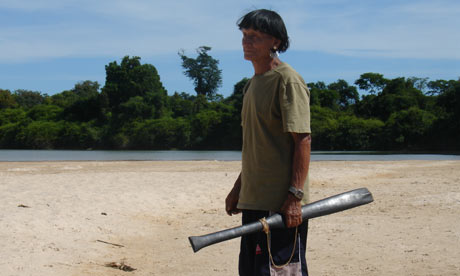
    Melobo, shaman, standing on Xingu river

    Activists say government plans for up to 16 new hydroelectric plants pose an unprecedented threat to the 14 tribes that live in the park. Photograph: Tom Phillips


    Once they were threatened by wildcat gold-miners and a measles epidemic that slashed their population to just 56. But now the Ikpeng, a proud tribe of Amazon warriors, say a new catastrophe looms over their future: the damming of the rivers they depend upon for food.


    Across Brazil alarm bells are ringing over plans to build at least 229 small hydroelectric dams, known as PCHs, which the government hopes will generate electricity and drive economic development.


    Opponents say they will damage the environment and destroy the livelihoods of thousands of Brazilian tribespeople.


    There are 346 PCHs in Brazil, with another 70 under construction and 159 awaiting licences. If the construction of dams continues, “the fish will run out and the waters will start to go down,” warned Komuru Txicao, a local tribesman. “Here in the forest we don’t need electricity. We need fish, water and land.”


    Other hydroelectric projects planned by the government are huge — the $4bn Belo Monte dam further north along the Xingu river from Pavuru would be the third biggest plant of its kind on earth, producing over 11,000 megawatts of electricity. While Belo Monte has been described by the government as a “gift from God”, critics say it will destroy lives, homes and traditions.For Komuru and his neighbours, the immediate concern is the construction of a network of PCHs around the Xingu national park in Mato Grosso state. Komuru fears the dams will block the tributaries of the Xingu, itself the largest tributary of the Amazon.


    According to the National Electric Energy Agency (Aneel), four PCHs – the Paranatinga II, Culuene, ARS and Ronuru – operate near the reserve; another, Paranatinga I, is waiting for its licence. Aneel says 13 PCHs are being built in Mato Grosso state, while another 19 projects are awaiting licences. The government says such dams will help power the agricultural revolution that is sweeping Brazil’s mid-west and bring electricity to small towns.


    Recent years have seen the Ikpeng, a proud tribe of Amazon warriors, embrace many of the comforts and distractions of the outside world.


    Three months ago wireless internet was installed here in Pavuru, one of over 30 villages located in the Park — a vast, 2.8 million hectare indigenous reserve home to some 5,000 Indians from 14 different ethnic groups. Today Ikpeng teenagers spend their afternoons downloading tracks by artists such as Enrique Iglesias and the US rapper 50 Cents while many of the tribe’s hunters use shot-guns rather than the traditional bow and arrow to hunt spider monkeys and wild-boar in the surrounding forests.


    “Things are changing,” admitted Karane Txicao, 28, sat behind an HP laptop in the village’s concrete internet cafe. “Now people never leave the front of the computer screen.”


    Several of the traditional huts – or owros – also shelter large television sets, powered by a diesel generation which is switched on at 9am each day and turned off at 9pm.


    But unlike the telenovelas and MP3s, government plans for PCHs around the Xingu Park have met with a furious reception.


    “It is very worrying,” said Kumare, a resident who is the local head of Funai, Brazil’s indigenous agency. “This will directly affect us. They are damming all of the rivers.” Kumare said the dams would make it impossible for the fish to migrate upstream thus decimating the main source of food for the reserve’s Indians.


    Last March the conflict escalated when eight staff from the electricity company responsible for one PCH spent five days held “hostage” near Pavuru. They were released only after the president of Brazil’s indigenous agency, Funai, personally intervened. “We didn’t kill them, we ‘arrested’ them,” recalled Komuru.


    Similar battles are raging across the Amazon region, where plans to build roads, hydroelectric dams and other major infrastructure projects have triggered a conflict between those who want to protect the world’s largest tropical rainforest and its indigenous tribes and those wishing to drive development and relieve poverty. A dispute over the Belo Monte dam turned violent in May when an engineer from the Brazilian power company Eletrobras was attacked during a presentation about the plant. President Luiz Inácio Lula da Silva has sought to allay fears over the dam, vowing that it “would not be shoved down anyone’s throat”.


    But concerns grew in July when a federal court lifted an embargo on the Belo Monte licensing process, clearing the way for a bidding round later this year.


    Having witnessed the Ikpeng’s plight in the 1960s, Melobo, an Ikpeng shaman, who says he is around 60 years old and wears 15 shell ear-rings in each ear, fears history may be repeating itself. “The farmers ruin the Indian’s things,” Melobo said, in heavily accented Portuguese, standing on the banks of the Xingu river. “They ruin the Indian’s water. They ruin the Indian’s land.””We don’t want to negotiate,” added Komuru. “We don’t want money. We don’t want things that are worth nothing. We want our land.”

  • AGL to develop renewable energy projects.


    AGL to develop renewable energy projects


    Updated: 14:52, Sunday August 23, 2009


    AGL to develop renewable energy projects


    AGL Energy says it will develop $6 billion to $7 billion in renewable energy projects over the next decade.


    AGL Energy chief executive Michael Fraser said the recent passage of renewable energy target (RET) legislation through parliament was ‘very significant’ for AGL.


    The passage of the RET means that from January there will be a target requiring 20 per cent of electricity to be generated from renewable energy sources by 2020.


    ‘We are the largest developer of renewable assets in the country, and this really means that we are going to be able to accelerate our development program,’ Mr Fraser told the ABC’s Inside Business program on Sunday.


    Mr Fraser said that in total, about $25 billion to $30 billion of renewable projects would have to be built over the next decade to meet the RET target.


    ‘We intend to develop a pipeline of our projects so when we look over the next decade that’s probably six to seven billion dollars worth of projects on our own,’ he said.


    ‘We’ve already got over two billion dollars worth of projects on our books, so over the longer term, it’s a very significant value-creation opportunity for the company.’


    Mr Fraser said that under the RET, about 4,500 wind turbines would have to be built to supply about 9,000 megawatts of power.


    He agreed that the RET legislation would ‘crowd out’ gas-fired power generation.


    ‘Yes, that is definitely what will happen,’ Mr Fraser said.


    He said renewable power-generation technologies were dominated by wind power.


    Mr Fraser rejected a suggestion that AGL, which also has interests in the gas and brown coal sectors, would be happy about delays in the passage through federal parliament of the government’s emissions trading scheme (ETS).


    ‘Around the ETS, we want that in place. We think that’s a very important component,’ Mr Fraser said.


    He said the ETS would result in additional costs to the energy industry and to the economy.


    ‘(But) what we really want is that legislation in place. We want certainty about what the business environment is going forward.’


    Mr Fraser said companies would find it hard to make investment decisions unless there was certainty.


    He said that, ultimately, sensible legislation would be put in place around a Carbon Pollution Reduction Scheme (CPRS), but it would require transition arrangements to ‘make sure that the lights stay on’.


    Mr Fraser acknowledged that under the legislation coal-fired power stations using brown coal would eventually have to shut down unless they become cleaner.


    ‘When we look forward, ultimately, if there are no advances in carbon capture and storage, then ultimately, yes, the objective of the legislation is that those generators will be shut down and other generation will take its place,’ he said.

  • Coalition vows to fight emissions scheme.

    Coalition vows to fight emissions scheme


    NB (Could lead to a Double Dissolution)


    Posted 42 minutes ago


    The Coalition says if it wins the next election, it would consider changing the Federal Government’s emissions trading scheme, should it be passed by Parliament.


    The Government is hoping its emissions trading scheme will pass the Senate the second time around by negotiating changes with the Coalition.


    Even if they reach an agreement that would see the scheme passed into law, Opposition Leader Malcolm Turnbull says he would consider changing it if the Coalition is returned to Government.


    “We may well go to the election wth proposals to amend it or change it,” he said.


    Nationals Senate leader Barnaby Joyce goes much further, saying the Nationals will not accept the emissions trading scheme at all.


    “That system has to be dismantled, you can’t go forward with a system that sends you broke,” he said.


    The second Senate vote is expected to be in November.


    At their annual conference on Saturday, the Nationals vowed to vote against the Government’s emissions trading scheme regardless of what the Liberals decide.


    Tags: federal-government, federal-parliament, labor-party, liberal-party, nationals, australia

  • China’s spiralling consumption is fuelling waste and pollution

    China’s spiralling consumption is fuelling waste and pollution


    China’s government and the domestic market are calling for greater spending. Economic growth may be maintained, writes Huo Weiya, but US-style living may mean we need another two Earths. From ChinaDialogue, part of the Guardian Environment Network


    To maintain an 8% economic-growth target through the current global financial crisis, the Chinese government has launched an investment stimulus package worth four trillion yuan (US$585 billion) and eased bank-lending restrictions. But another important measure is the increasing of individual consumption.


    In 2008, the Chinese government launched “village appliance” schemes nationwide, with subsidies used to increase sales of televisions, refrigerators, washing machines and mobile phones in rural areas. Another two billion yuan (nearly US$300 million) was invested in 2009 in a “new-for-old” policy that will see individuals and businesses sell old appliances back to the state and receive a 10% subsidy on new purchases. Besides this, the automobile market is benefiting from subsidies and tax breaks, and many cities have handed out shopping vouchers to local people.


    The export-oriented economy has been hard-hit by the economic turmoil, increasing the government’s determination to make the domestic market the engine of growth. “Increase domestic demand, maintain growth” is seen as the secret to guiding the economy through hard times. But there are dangers hidden in this strategy, and there will be considerable environmental consequences if a long-term approach is not taken.


    First, there is the issue of reusing resources. In China, it is not just rubbish that gets buried in landfill; many materials that could be reused also end up there. And once products have been used, they are treated as rubbish and thrown away. Any recycling that takes place is often the result of scrap collectors sifting through rubbish for the more valuable items; the rest goes to scrap or compost.


    Increasing amounts of rubbish mean that many cities – including Beijing – are at risk of being surrounded by landfill sites and are turning to power-generating incinerator plants. This is controversial, with environmental bodies saying China should be sorting and recycling its rubbish. But China does not have a system for sorting rubbish.


    When explaining the “new-for-old” policy, a National Development and Reform Commission (NDRC) spokesperson said that it would see five million appliances replaced, while 90 million of the types of appliances mentioned above would be discarded annually. But the pervasive presence of scrap collectors throughout China’s cities demonstrates that standardised collection and disassembly companies are not yet common. The sector is dominated by small, informal traders, and the environmental consequences of this already have already been covered in our earlier article “Low-carbon living begins at work”.


    The authorities released guidance alongside the “village appliances” and “new-for-old” policies, but with the recycling sector just getting started, it is unclear if the measures will be effective and if they will reach out into the rural areas.


    In February, the State Council issued Regulations on Recovery Processing of Waste Electrical and Electronic Products, setting out the direction for the sector. But this only comes into effect in 2011. Until then, those small scrap merchants will be the main channel for recycling. They will purchase discarded appliances and then sell them on to companies unable to process them properly or to small, unregistered workshops.


    The inadequate processing of waste doesn’t just create pollution; it’s also the cause of significant waste. According to the same State Council spokesperson, the new-for-old policy would see 2.3 million tonnes of resources collected for reuse. But without systems in place, much of that will be treated as garbage.


    Another risk is the inflation of consumer expectations. A special feature on a well-known Chinese website, 21cn.com, recently described white-collar workers as the killers of the environment. The white-collar lifestyle involves high levels of consumption, and consumption is the natural enemy of the environment. In a poll on the website, the vast majority of those surveyed said that it is everyone’s duty to protect the environment.


    But despite these views, what actually happens is different. From July 1, hotels in the city of Changsha were no longer supplying items such as disposable toothbrushes and single-use tubes of toothpaste for free; they will be charged for. A survey on People.com.cn found 77% of respondents opposed the move, complaining of inconvenience.


    These two surveys demonstrate the clash between ideas of consumption and environmental protection. Environmental awareness was non-existent three decades ago. Today, the environment is often the focus of public debate. But the Chinese seem to be becoming ever more like the Americans they so often point fingers at – happy to protect the environment, as long as they don’t need to change their lifestyles.


    The “3R” principles of waste-management strategy are “reduce” (to minimise energy and resource use), “reuse” (to use an item more than once), and “recycle” (to process used items into new products). Reduction and recycling have been put into political and economic practice, but reuse — the concept at the heart of the circular economy – has been given the cold shoulder. Most consumers seem to have left environmental matters to environmental groups. As long as they can afford to, they’ll consume as much as possible that is new.


    China is placing more emphasis on its domestic market, with a range of methods applied to increase consumption and boost the economy, thereby making consumption seem ever more natural. With both the government and the market calling for greater spending, will China’s potential consumption be realised?


    The Chinese did not use to be heavy consumers, either because they did not have the funds or the lack of a welfare system meant they saved their money for a rainy day. But 30 years of economic growth have given us ample material desires – a lifestyle of keeping up with the rich, keeping up with the Americans, has taken root. As soon as we are able to consume, we do so – no less than the citizens of developed nations do. Economic growth may be maintained, but as the environmentalists warn, we may need another two Earths to meet the new US-style consumption of the Chinese nation.


    • Huo Weiya is operations and development manager for chinadialogue in Beijing and former editor-in-chief of Environmental Culture Newsletter.


    • This article was shared by our content partner ChinaDialogue, part of the Guardian Environment Network

  • Food supplies at risk from price speculation, warns expert

    Food supplies at risk from price speculation, warns expert


    Global food markets must be regulated to avoid speculators creating panic with artificial prices rises, says the head of the International Food Policy Research Institute


    The world food market is still “seriously exposed” to speculators artificially driving up prices and worsening the risks of malnutrition, according to one of the world’s leading agricultural researchers.


    Linking the recent food and financial crises, Joachim von Braun, the head of the International Food Policy Research Institute (IFPRI), warned that the world was at risk of a new panic over grain unless commodity markets were more tightly regulated and production expanded.


    “The banking sector is in the process of being re-regulated worldwide, but the food market remains seriously exposed to short-term flows of indexed funds into commodity exchanges. That vulnerability needs to be addressed,” he said in an interview with the Guardian.


    Von Braun was one of the first to predict the sharp rise in food prices that peaked last year, when 13 nations halted cross-border trade amid fears of shortages.


    The crisis, which escalated over four years, hit poor people hardest and saw pasta protests in Italy, tortilla rallies in Mexico and onion demonstrations in India.


    During that period, the UN’s Food and Agriculture Organisation estimates the number of hungry people in the world rose from about 800 million to more than 1 billion.


    At the time, most of the blame for the price spike centred on growing populations, climate change, biofuels, rising oil prices and increased demand from fast-growing economies like China and India that were running down food stocks.


    But von Braum said recent research highlighted the role of commodity speculators: “What we didn’t foresee two years ago is how speculation exacerbated the real market issues. It was not a primary cause but a second-round amplifier, which added seriously to the problem.”


    Daily trading volumes on the Chicago commodities exchange surged at the peak of the crisis between December 2007 and March 2008, boosted by the entry of non-commercial investors entering the market to speculate.


    “When food supply is at risk, speculators are attracted, especially when trade barriers are put in place,” he warned.


    Exchanges in India and China were closed down to prevent similar speculative attacks.


    The global credit crunch also hamstrung government efforts to boost food production by reducing the money available for investment in new technology and better irrigation.


    With climate change expected to reduce yields by 15% by 2050 even as demand grows from a rising world population, von Braum said it was important for nations and international institutions to respond with more funds for agriculture.


    China, Japan, South Korea and several Middle Eastern nations have begun buying up farmland in Africa and South America as a hedge against food shortage risks.


    Global prices are down from their peak thanks partly to effective measures by the Chinese government to rebuild grain stocks, increased agricultural investment in India and a great focus on food production in the aid programmes of the UK and other donor nations.


    But von Braun said prices remain high in many African countries because of trade constraints and foreign exchange rates, while an unusually dry Indian monsoon could affect harvests in Asia. A UN report published earlier this week warned that Asia faces dire food shortages unless hundreds of billions of dollars are invested in better irrigation systems to grow crops for its growing population.


    “Fundamentally, the crisis of high food prices in the majority of poor countries is not over at all,” said von Braun.