Author: Neville

  • The UN Climate Summit, Streaming Live All Day (VIDEO)

    The UN Climate Summit, Streaming Live All Day (VIDEO)

    September 23rd, 2014 by

    Years ago, countries of the world committed to lock in a new international climate agreement at the 2015 U.N. Climate Change conference in Paris, informally called COP 21. It’s coming up fast, considering that for the past 50 years, scientists have been expressing their sense of an impending showdown between the people of earth and its climate. (See “The Unchained Goddess” video following this article.) Ordinary people as well as almost all scientists and nations have come to anticipate climate change, and today’s UN Climate Summit, with the other events of Climate Week, should prime the world to prepare for it.

    United Nations in New York, site of the UN Climate Change Summit, September 2014 (p.d.)

    But right now, the world is only on track to make less than half the carbon pollution reductions we need by 2020 to prevent massive global changes. We do have the technologies and policies available to turn the corner on the possible Sixth Extinction—but lack of political will and intercountry squabbles could prevent us from achieving achieving this goal and moving forward into an era of low or zero-carbon economic growth.

    For these reasons, U.N. Secretary-General Ban Ki-moon has convened a UN Climate Summit for world leaders in New York City today. As well as bringing the world’s political leaders to the table, the meeting will draw together captains of industry, world and regional financial institutions, policy regulators, and ordinary citizens. Ban has invited them to share and cross-fertilize ideas for reducing emissions and reaching an effective global climate agreement in Paris next December.

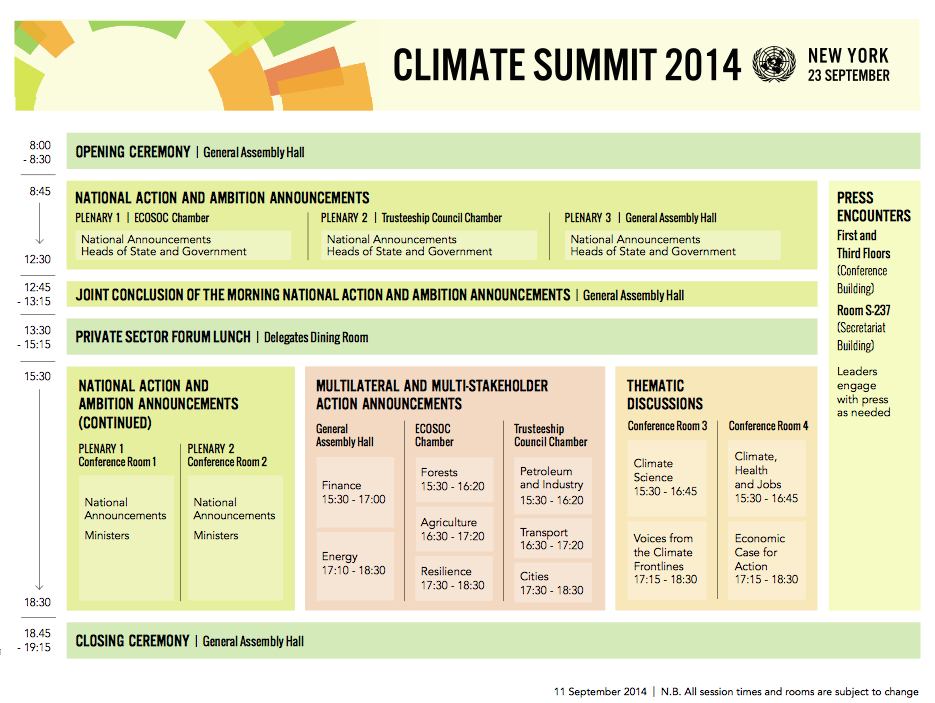
    We recently addressed “What Is Climate Change” on PlanetSave here, for anyone who would like a quick refresher on the subject. And below is the final version of today’s UN program. (As The Guardian‘s team pointed out yesterday, it lacks a separate discussion section for the topic of Oceans, which comprise 60% of earth’s surface and play a crucial role in determining climate.)
    UN Climate Summit 2014 final schedule (UN.org)

    You can follow the events from the UN Climate Summit live all day at the UN Web TV Channel and probably other venues as well. The UN Climate Change Newsroom on the web has dozens of reports on all the issues. Networks and independents will provide coverage as well.

    Important Media will be reporting from UN Headquarters and the streets of New York and from other correspondents about the People’s Climate March, UN Summit, and Climate Week programming and events. Follow the climate stories throughout the week here on Planetsave and on our fellow site, Cleantechnica. You can also access our past climate coverage at these links: Planetsave archives and Cleantechnica archives.

    Keep up to date with all the most interesting green news on the planet by subscribing to our (free) Planetsave newsletter.

    The UN Climate Summit, Streaming Live All Day (VIDEO)

    September 23rd, 2014 by

    Years ago, countries of the world committed to lock in a new international climate agreement at the 2015 U.N. Climate Change conference in Paris, informally called COP 21. It’s coming up fast, considering that for the past 50 years, scientists have been expressing their sense of an impending showdown between the people of earth and its climate. (See “The Unchained Goddess” video following this article.) Ordinary people as well as almost all scientists and nations have come to anticipate climate change, and today’s UN Climate Summit, with the other events of Climate Week, should prime the world to prepare for it.

    United Nations in New York, site of the UN Climate Change Summit, September 2014 (p.d.)

    But right now, the world is only on track to make less than half the carbon pollution reductions we need by 2020 to prevent massive global changes. We do have the technologies and policies available to turn the corner on the possible Sixth Extinction—but lack of political will and intercountry squabbles could prevent us from achieving achieving this goal and moving forward into an era of low or zero-carbon economic growth.

    For these reasons, U.N. Secretary-General Ban Ki-moon has convened a UN Climate Summit for world leaders in New York City today. As well as bringing the world’s political leaders to the table, the meeting will draw together captains of industry, world and regional financial institutions, policy regulators, and ordinary citizens. Ban has invited them to share and cross-fertilize ideas for reducing emissions and reaching an effective global climate agreement in Paris next December.

    We recently addressed “What Is Climate Change” on PlanetSave here, for anyone who would like a quick refresher on the subject. And below is the final version of today’s UN program. (As The Guardian‘s team pointed out yesterday, it lacks a separate discussion section for the topic of Oceans, which comprise 60% of earth’s surface and play a crucial role in determining climate.)

    UN Climate Summit 2014 final schedule (UN.org)

    You can follow the events from the UN Climate Summit live all day at the UN Web TV Channel and probably other venues as well. The UN Climate Change Newsroom on the web has dozens of reports on all the issues. Networks and independents will provide coverage as well.

    Important Media will be reporting from UN Headquarters and the streets of New York and from other correspondents about the People’s Climate March, UN Summit, and Climate Week programming and events. Follow the climate stories throughout the week here on Planetsave and on our fellow site, Cleantechnica. You can also access our past climate coverage at these links: Planetsave archives and Cleantechnica archives.

    Keep up to date with all the most interesting green news on the planet by subscribing to our (free) Planetsave newsletter.

    The UN Climate Summit, Streaming Live All Day (VIDEO)

    September 23rd, 2014 by

    Years ago, countries of the world committed to lock in a new international climate agreement at the 2015 U.N. Climate Change conference in Paris, informally called COP 21. It’s coming up fast, considering that for the past 50 years, scientists have been expressing their sense of an impending showdown between the people of earth and its climate. (See “The Unchained Goddess” video following this article.) Ordinary people as well as almost all scientists and nations have come to anticipate climate change, and today’s UN Climate Summit, with the other events of Climate Week, should prime the world to prepare for it.

    United Nations in New York, site of the UN Climate Change Summit, September 2014 (p.d.)

    But right now, the world is only on track to make less than half the carbon pollution reductions we need by 2020 to prevent massive global changes. We do have the technologies and policies available to turn the corner on the possible Sixth Extinction—but lack of political will and intercountry squabbles could prevent us from achieving achieving this goal and moving forward into an era of low or zero-carbon economic growth.

    For these reasons, U.N. Secretary-General Ban Ki-moon has convened a UN Climate Summit for world leaders in New York City today. As well as bringing the world’s political leaders to the table, the meeting will draw together captains of industry, world and regional financial institutions, policy regulators, and ordinary citizens. Ban has invited them to share and cross-fertilize ideas for reducing emissions and reaching an effective global climate agreement in Paris next December.

    We recently addressed “What Is Climate Change” on PlanetSave here, for anyone who would like a quick refresher on the subject. And below is the final version of today’s UN program. (As The Guardian‘s team pointed out yesterday, it lacks a separate discussion section for the topic of Oceans, which comprise 60% of earth’s surface and play a crucial role in determining climate.)

    UN Climate Summit 2014 final schedule (UN.org)

    You can follow the events from the UN Climate Summit live all day at the UN Web TV Channel and probably other venues as well. The UN Climate Change Newsroom on the web has dozens of reports on all the issues. Networks and independents will provide coverage as well.

    Important Media will be reporting from UN Headquarters and the streets of New York and from other correspondents about the People’s Climate March, UN Summit, and Climate Week programming and events. Follow the climate stories throughout the week here on Planetsave and on our fellow site, Cleantechnica. You can also access our past climate coverage at these links: Planetsave archives and Cleantechnica archives.

    Keep up to date with all the most interesting green news on the planet by subscribing to our (free) Planetsave newsletter.

    The UN Climate Summit, Streaming Live All Day (VIDEO)

    September 23rd, 2014 by

    Years ago, countries of the world committed to lock in a new international climate agreement at the 2015 U.N. Climate Change conference in Paris, informally called COP 21. It’s coming up fast, considering that for the past 50 years, scientists have been expressing their sense of an impending showdown between the people of earth and its climate. (See “The Unchained Goddess” video following this article.) Ordinary people as well as almost all scientists and nations have come to anticipate climate change, and today’s UN Climate Summit, with the other events of Climate Week, should prime the world to prepare for it.

    United Nations in New York, site of the UN Climate Change Summit, September 2014 (p.d.)

    But right now, the world is only on track to make less than half the carbon pollution reductions we need by 2020 to prevent massive global changes. We do have the technologies and policies available to turn the corner on the possible Sixth Extinction—but lack of political will and intercountry squabbles could prevent us from achieving achieving this goal and moving forward into an era of low or zero-carbon economic growth.

    For these reasons, U.N. Secretary-General Ban Ki-moon has convened a UN Climate Summit for world leaders in New York City today. As well as bringing the world’s political leaders to the table, the meeting will draw together captains of industry, world and regional financial institutions, policy regulators, and ordinary citizens. Ban has invited them to share and cross-fertilize ideas for reducing emissions and reaching an effective global climate agreement in Paris next December.

    We recently addressed “What Is Climate Change” on PlanetSave here, for anyone who would like a quick refresher on the subject. And below is the final version of today’s UN program. (As The Guardian‘s team pointed out yesterday, it lacks a separate discussion section for the topic of Oceans, which comprise 60% of earth’s surface and play a crucial role in determining climate.)

    UN Climate Summit 2014 final schedule (UN.org)

    You can follow the events from the UN Climate Summit live all day at the UN Web TV Channel and probably other venues as well. The UN Climate Change Newsroom on the web has dozens of reports on all the issues. Networks and independents will provide coverage as well.

    Important Media will be reporting from UN Headquarters and the streets of New York and from other correspondents about the People’s Climate March, UN Summit, and Climate Week programming and events. Follow the climate stories throughout the week here on Planetsave and on our fellow site, Cleantechnica. You can also access our past climate coverage at these links: Planetsave archives and Cleantechnica archives.

    Keep up to date with all the most interesting green news on the planet by subscribing to our (free) Planetsave newsletter.

    The UN Climate Summit, Streaming Live All Day (VIDEO)

    September 23rd, 2014 by

    Years ago, countries of the world committed to lock in a new international climate agreement at the 2015 U.N. Climate Change conference in Paris, informally called COP 21. It’s coming up fast, considering that for the past 50 years, scientists have been expressing their sense of an impending showdown between the people of earth and its climate. (See “The Unchained Goddess” video following this article.) Ordinary people as well as almost all scientists and nations have come to anticipate climate change, and today’s UN Climate Summit, with the other events of Climate Week, should prime the world to prepare for it.

    United Nations in New York, site of the UN Climate Change Summit, September 2014 (p.d.)

    But right now, the world is only on track to make less than half the carbon pollution reductions we need by 2020 to prevent massive global changes. We do have the technologies and policies available to turn the corner on the possible Sixth Extinction—but lack of political will and intercountry squabbles could prevent us from achieving achieving this goal and moving forward into an era of low or zero-carbon economic growth.

    For these reasons, U.N. Secretary-General Ban Ki-moon has convened a UN Climate Summit for world leaders in New York City today. As well as bringing the world’s political leaders to the table, the meeting will draw together captains of industry, world and regional financial institutions, policy regulators, and ordinary citizens. Ban has invited them to share and cross-fertilize ideas for reducing emissions and reaching an effective global climate agreement in Paris next December.

    We recently addressed “What Is Climate Change” on PlanetSave here, for anyone who would like a quick refresher on the subject. And below is the final version of today’s UN program. (As The Guardian‘s team pointed out yesterday, it lacks a separate discussion section for the topic of Oceans, which comprise 60% of earth’s surface and play a crucial role in determining climate.)

    UN Climate Summit 2014 final schedule (UN.org)

    You can follow the events from the UN Climate Summit live all day at the UN Web TV Channel and probably other venues as well. The UN Climate Change Newsroom on the web has dozens of reports on all the issues. Networks and independents will provide coverage as well.

    Important Media will be reporting from UN Headquarters and the streets of New York and from other correspondents about the People’s Climate March, UN Summit, and Climate Week programming and events. Follow the climate stories throughout the week here on Planetsave and on our fellow site, Cleantechnica. You can also access our past climate coverage at these links: Planetsave archives and Cleantechnica archives.

    Keep up to date with all the most interesting green news on the planet by subscribing to our (free) Planetsave newsletter.

  • The politics of Piketty’s reception on the Left

    The politics of Piketty’s reception on the Left

    by · September 24, 2014

    sub-piketty

    This is a version of my paper from the Historical Materialism Australasia conference in Sydney earlier this month, which was part of a panel on Thomas Piketty’s Capital In The Twenty-First Century. I’d like to thank my fellow panelists Anitra Nelson and Mike Beggs.

    It an unlikely bestseller: Thomas Piketty has written a thick book packed with data and the detailed description thereof. Is this the economics version of Stephen Hawking’s A Brief History of Time, to be bought in large numbers but rarely read all the way through, let alone understood?

    The book has been lauded especially on the Left, from its liberal and social democratic end, to the large parts of the far Left which, while more critical, have welcomed the overlap between Piketty’s concerns and those of Marxists.

    But it is not the first major foray into the issue of inequality that has caught imaginations. Think of the impact of the work of Rawls. Think of the UN Human Development Reports that showed massive wealth disparities. Think of Wilkinson & Pickett’s The Spirit Level.

    Noberto Bobbio famously argued that “the criterion most frequently used to distinguish between the left and the right is the attitude of real people in society to the ideal of equality”. Bobbio’s words were first published in Italian in 1994. Have we made any advance since then?

    Piketty’s book tells us that in fact in most rich countries inequality has worsened, and in a handful of societies (of which Australia is one) the richest 1 percent has not just pulled away from the rest but pulled away rapidly. The great strength of the book is that it makes the case for growing inequality since the early 1980s clear with a mountain of data. You can almost forgive Piketty’s naïve acceptance of a whole range of vulgar economic theory or superficial dismissals of those theorists he rejects (Marx being just one) — because the numbers, graphs and meticulous description are very interesting.

    But stand back a minute and there is something quite weird going on here.

    In many ways Piketty’s book is an implicit critique of the social effects of what is known as the “neoliberal” era. That era culminated in the biggest global economic crisis since the Great Depression. Recovery from the crisis has in most places been halting and weak. It has thrown several European states into regime crisis, and political instability seems to have accelerated in most places.

    The traditional Left — in its more mainstream and radical versions — has gotten very little out of the crisis despite having spent a long time leading up to the crisis arguing for alternatives to “market fundamentalism”.

    It’s my view that the renewed interest in inequality is based not just in the fact that capitalism produces terrible social inequality, which it has been doing for a long time, but because of the failure of the Left to deal with the much more immediately destructive effects of the global crisis itself. The Left has essentially come to the conclusion it can do little to control such forces and so battling “inequality” becomes a substitute for that project.

    Furthermore, the “anti-neoliberal” program of the Left — nationalisation, state intervention, regulation, etc. — was actually implemented by governments of all shades after 2008. In Kevin Rudd’s words:

    In the United States, the rescue of Citigroup and the Bank of America amounts to a de facto nationalisation. This followed the placing into conservatorship of Fannie Mae and Freddie Mac, and the effective nationalisation of AIG, the world’s largest insurance company. Once again, the social-democratic state, not the unfettered forces of the market, was called to the rescue.

    Remember: This was the “social-democratic state” run by George W. Bush!

    The result has been that in many rich countries most of the anti-market project of the Left was implemented, but in the interests of the capitalist system and not in the interests of the people it was supposed to help. Rudd again: “Not for the first time in history, the international challenge for social democrats is to save capitalism from itself”.

    Piketty’s book is in one sense no more than a diversion from the abject failure of the Left with respect to the crisis. Of course this isn’t Piketty’s fault — he’s been researching this stuff for ages. But his superstar status suggests that his argument resonates with something that is going on.

    It’s my view that the fight against inequality represents the last sigh of social democratic and more radical Left political projects that have reached their point of exhaustion. They failed to have much effect in the crisis, but they stagger on, zombie-like, trying to find some relevance. The grand dreams of “managing the economy” or “planning” or “overcoming crisis” don’t really figure in Piketty’s book, or in most modern Left discourse, except as a fantasy projection.

    The reception of Piketty’s book raises another issue for me. Most Left commentators have noted how hesitant he is in pushing his wealth tax and other arguments around redistribution. It is a far cry from British Labour’s Shadow Chancellor Denis Healey stating he would “tax the rich until the pips squeak” before his party’s 1974 general election victory. Piketty’s pessimism is understandable given the direction of such policies over the last three decades.

    I think most of the Left falls into the trap of seeing this as a matter of “political will” (or its lack). Piketty is insistent that, “The history of the distribution of wealth has always been deeply political, and it cannot be reduced to purely economic mechanisms”. Yet he also suggests that there is an economic driver of inequality: “Specifically, it is important to note that the fundamental r > g inequality, the main force of divergence in my theory, has nothing to do with any market imperfection.”

    This reflects the same dilemma expressed in politics — that society moves by its own “natural” laws but simultaneously that politics can correct these social problems. This paradox has always been at the heart of Left politics. It is now more acute than ever because the state intervened massively in the crisis and the result was no real circumvention of these trends to inequality, as well as a weakening and destabilization of the political system. On the Left PASOK had its “PASOK moment” but now others are falling prey: PSOE, the SPD, the ALP, etc.

    Marx, by way of contrast, argued that social problems cannot be legislated away, merely administered differently by the state. This is because the state rests on the maintenance of a society that produces the social problems in the first place. He used an example similar to the current concern about inequality — how nations dealt with the issue of poverty:

    From a political point of view, the state and the organization of society are not two different things. The state is the organization of society. In so far as the state acknowledges the existence of social grievances, it locates their origins either in the laws of nature over which no human agency has control, or in private life, which is independent of the state, or else in malfunctions of the administration which is dependent on it.

    Piketty’s argument is a perfect example of the “political point of view” Marx criticizes.

    The rapturous reception for someone who offers only the mildest corrective to deep inequality in his policy proposals reflects the Left’s exhaustion. It also provides a convenient explanation for the apparent failure of the Left to overturn neoliberalism. If indeed the relative economic strength of the 1 percent is so great, then maybe — in the words of recent Piketty convert, Greens leader Christine Milne —  “You get to the point as I have now come to believe, that we no longer do live in a democracy, but a plutocracy – a country governed by the wealthy for the wealthy.” Or Wayne Swan’s rants against the subversion of democracy by the super-rich.

    Clearer admissions of political ineffectuality it would be hard to find.

    We would also do well to remind ourselves that Marx was much less interested in equality than his modern followers. By Bobbio’s definition, then, Marx is not part of the Left.

    karl-marx-thomas-piketty

    Marx identified two main types of equality, both indissolubly linked to bourgeois society.

    The first was equality as a political concept that came to prominence with the rise of capitalist social relations and the bourgeois revolutions. He was sharply critical of the limits of this kind of equality, arguing that political emancipation (equality before the state) was no substitute for social emancipation (which was human liberation).

    The second was the exchange of equivalents in the capitalist market. In Capital Marx goes to great lengths to show that surplus value doesn’t emerge from unequal exchange or some other unfair process at the level of the market. Rather, underlying the equal exchange of values is a process of real abstraction of labour, of exploitation in the hidden abode of production, leaving behind the world of freedom, equality, property and Bentham.

    Again, actual equality conceals exploitative social relations.

    In Critique of the Gotha Programme, Marx argues that the point of communism is not “the narrow horizon of bourgeois right” but a situation of “from each according to their ability, to each according to their need”. That is, the alternative to the political and social inequality produced by capitalism is not a lessening of economic inequality but an entirely different way of organizing social relations. In such a society the real differences between individuals — which make true social equality impossible — and their collective existence are no longer estranged.

    The excitement over Piketty’s contribution suggests that such a social vision is not only beyond the Left’s abilities, the Left doesn’t even understand the terms of the problem Marx was trying to address. Worse, while wanting to save capitalism from itself with the demand for more equality, it no longer has any real confidence it can achieve this modest aim.

    Piketty, then, is truly the economist for today’s Left.

    – See more at: http://left-flank.org/2014/09/24/politics-pikettys-reception-left/#sthash.nHsUvG3W.dpuf

  • Breaking: Madigan is voting NO

    Click here to enable desktop notifications for Gmail.   Learn more  Hide
    More

    1 of 3
    AdRetiring overseas is easywww.escapologist.com.au – Three English speaking countries where you can live well for less

    Breaking: Madigan is voting NO

    Inbox
    x

    Ged Kearney <info@actu.org.au>

    6:15 PM (1 hour ago)

    to me
    Neville —

    Two pieces of great news:

    1. Independent Senator John Madigan has just announced that he will vote against Tony Abbott’s new workplace laws that take away your rights at work!
    2. Parliament has finished for the week and Tony Abbott and the Liberals haven’t been able to bring their horrible new workplace laws on for debate in the Senate yet.

    This is all due to your hard work. By making your voices heard, and calling out these anti-worker laws, making a difference.

    Senator Madigan has been committed to workers rights for a long time and today is another strong demonstration of that commitment. In his statement Senator Madigan said Abbott’s laws were an attack on workers and would “leave those with the least with even less”. He also is urging his fellow Senators to support our campaign and vote against the Bill.

    The government thought that passing these new laws would be simple. They thought they could push them through whilst no one was looking. You changed that.

    If Tony Abbott thought he had the numbers to pass the Bill he would have put it to the vote by now. He hasn’t, and it’s thanks to your hard work. You are helping the Senators understand the serious impacts of this bill.

    It’s not over yet. Here is where we think things are up to:

    • Our best information is that two Senators–Bob Day and David Leyonhjelm–will almost definitely support this Bill and vote yes. David Leyonhjelm is a classical Libertarian and much of this Bill fits with to his deeply held beliefs about removing government regulation. Bob Day has been a senior figure in the extremist HR Nicholls society–one of the groups that conceived the idea of WorkChoices–and believes that workers should be stripped of most of their workplace rights and protections.
    • The remaining Senators Muir, Xenophon, Lazarus, Wang and Lambie haven’t committed but seem to still have open minds on this Bill.

    The Senate is back in session next week and there is a chance that the Bill will be debated then – otherwise the next time it can be looked at will be three weeks later. I know it often seems like the sands are shifting – that the laws keeping coming up for a vote and then get delayed. It’s frustrating. We don’t get a say in when Tony Abbott and his crew bring these votes on. The delay gives us more time to convince Senators to stand with us and with working people.
    Across the country people have worked hard to make sure all of the Senators hear the call to stand with workers and not be a part of Tony Abbott’s attack on living standards. Victorian union members delivered Senators Madigan and Muir thousands of handwritten letters. In South Australia union members have protested outside Senator Day’s office. 
    The calls that you’ve made and the emails–well over 20,000 of them–that you have sent are having a big impact. As I said before – if Tony Abbott thought he had the numbers he would have passed the Bill. Instead all the Government could muster this week was a whining speech by Eric Abetz complaining about your campaign.
    That’s because of you, and thousands of people like you around the country.
    Thank for everything that you have been doing —

    Ged

  • Global warming has irreversibly damaged coral reefs, Arctic ice: Report

    Global warming has irreversibly damaged coral reefs, Arctic ice: Report

    UN International Panel on Climate Change group has agreed to state irreversible effects on natural systems have accelerated.

     A UN report coming out Monday contains a consensus statement that the melting of Arctic sea ice is one of the irreversible consequences of global warming.

    National Oceanic and Atmospheric Administration / The Associated Press

    A UN report coming out Monday contains a consensus statement that the melting of Arctic sea ice is one of the irreversible consequences of global warming.

    The international climate change panel currently meeting in Yokohama, Japan, has agreed to state in its upcoming report that global warming has inflicted irreversible damage coral reefs and Arctic sea ice.

    The agreement came at a plenary session of Working Group II of the UN International Panel on Climate Change (IPCC). The IPCC is meeting in Yokohama to assess the impact of ongoing warming of the planet.

    According to the IPCC, there will be serious effects on the natural environment when global average temperatures rise 1.6 C higher than average levels before the Industrial Revolution, and conditions will worsen further with a rise of 2.6 C.

    Related:

    Its agreed-upon report, which will be released Monday, will affect ongoing international negotiations over global warming countermeasures, the main aim of which is to keep temperature rises within 2 C.

    At the beginning of the agreement, the working group acknowledges that “observed impacts of climate change are widespread and substantial” and “in recent decades changes in climate have caused impacts on natural and human systems on all continents and across the oceans.”

    These acknowledgments are more serious than those in its 2007 report, which said: “Observational evidence from all countries and most oceans shows that many natural systems are being affected by regional climate changes, particularly temperature increases.”

    Later in the agreement, the working group touches on the effect that temperature increases have had on the environment. The current world average temperature has risen by 0.6 C since the start of the Industrial Revolution. It warns that an increase of 1.6 C from that time will have a wider impact on fragile natural systems that are not capable of adjusting to global warming.

    As examples of such fragile natural environments, the group lists Arctic sea ice and coral reefs.

    In the Arctic Ocean, sea ice has been melting for several years. Large swathes of coral reefs, including one south of Japan, have been turning white as a result of sea temperature increases.

    The IPCC specifically stresses that irreversible effects on natural systems have accelerated.

    Meanwhile, the working group forecasts that with a 1.6 C rise will increase the risk of death from heat stroke and heat exhaustion, mainly in metropolitan areas.

    With a 2.6 C increase, drought and unreliable rainfall will cause a decline in crop production and shortages of drinking and irrigation water, according to the group’s forecasts.

    The target to keep average temperatures within 2 C of the pre-Industrial Revolution level was set at a summit held five years ago. However, some have said it is hard to achieve this target and that the goal should be eased.

    The IPCC’s report will provide the basis for international negotiations on greenhouse gas mitigation to be held in 2020 and after.

  • Can energy utilities keep their customers, or will they flee the grid? Giles Parkinson

    1 of 1
    AdSolar Panel Installationwww.bradfordsolar.com.au – Solar Panel Installation Company Backed By CSR. Get Your Free Quote.

    Daily update: Can energy utilities keep their customers, or will they flee the grid?

    Inbox
    x

    RenewEconomy editor@reneweconomy.com.au via mail140.us4.mcsv.net Unsubscribe

    2:34 PM (10 minutes ago)

    to me
    Research says one-third of electricity customers will change suppliers or quit the grid – what will the utilities do? Plus: A heartfelt solar plea to Abbott; BHP’s climate concession; 1000s set to attend Friday rallies for RET; why the future energy giants will not be the usual suspects; federal MP’s rant against environmentalists taps into terror; UN climate summit special briefing; how gas is ruining it for renewables; the truth about the Arctic ice melt; and more big solar moves from SolarCity.
    Is this email not displaying correctly?
    View it in your browser.
    RenewEconomy Daily News
    The Parkinson Report
    Energy utilities have decided to take solar and storage seriously after all, as new research says one third of customers will take their energy supply elsewhere, or even leave the grid, as solar, batteries and electric vehicles provide new options.
    A 2MW solar plant Conergy Australia is building in New Caledonia will be heart-shaped: a message to the Abbott government to ‘start loving solar.’
    BHP Billiton says it is factoring climate into all its investments, unlike the Australian government. The statement comes as Ian Dunlop says he will run again for the board.
    Thousands of renewables workers and supporters set to picket government offices across Australia to demand support for the 41,000GWh by 2020 RET.
    Australia could be a big winner in global race towards an energy-efficient, renewable energy future. But it would mean cannibalising existing energy industries, a challenge ducked by Kodak.
    Federal MP George Christensen equates environmental activism with terrorism, says ‘gutless green germs’ are attacking Australian livelihoods.
    A summary of the major announcements on climate pledges, climate finance and forestry, and whether they are new.
    New study suggests  push toward natural gas is not only a distraction from “decarbonizing” the U.S., it could also make climate change worse.
    According to polar scientist Dr Dirk Notz, the question isn’t why is Arctic sea ice melting so fast, it’s how come we have any left at all?
    SolarCity strikes a deal with New York for solar manufacturing plant. The projected economic boost is good news today. Will it continue into the future?
  • This year’s Arctic sea ice minimum is sixth lowest on record

    Blog

    This year’s Arctic sea ice minimum is sixth lowest on record

    • 22 Sep 2014, 17:39
    • Robert McSweeney

    The eight lowest measurements of Arctic summer sea-ice extent occurred in the last eight years, scientists confirmed today.

    The findings were presented by Professor Julienne Stroeve from the National Snow & Ice Data Centre (NSIDC) at a Royal Society conference on Arctic sea ice reduction.

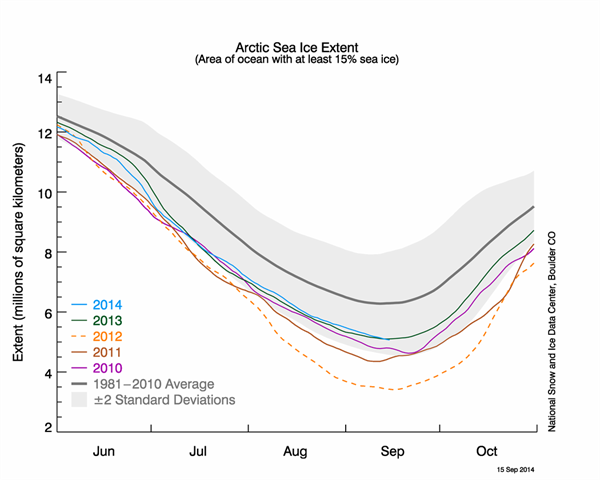
    On the 17th September satellites recorded the Arctic summer minimum extent at 5.01 million square kilometers (sq km). Stroeve confirmed that this year’s summer sea-ice extent is the sixth lowest on record, in a series of satellite measurments stretching back over thirty years.

    Sea-ice minimum

    Mid to late September marks the end of the Arctic summer, and the point when Arctic ice is at it’s smallest extent, before it freezes up again as temperatures fall in the autumn.

    Measurements of sea ice taken over the past decades suggest the rate of sea-ice loss is accelerating.

    Between 1979 and 1996 Arctic sea ice declined at around 36,000 sq km a year, on average. Since 1997, the rate of loss has accelerated to dramatically, to 130,000 sq km per year.

    The two trends are statistically different from each other, which means there is less than five per cent chance the change has happened by chance. “We can argue that in the last several years there is an accelerated rate of decline,” Stroeve says.

    She also says there’s a clear link to rising temperatures. While sea ice conditions vary a lot from one year to the next, the summers with the warmest summer temperatures have seen the lowest sea ice extents:

    “If you look at the last two minimum [Arctic sea-ice] low years – 2007 and 2012 – especially 2007 it was very warm… 2007 is the warmest summer we’ve had.”

    Arctic sea ice - conditions in context.

    Thick ice

    Scientists have also found that the amount of older, thicker ice is diminishing. Stroeve’s research finds a reduction in the amount of ice at least five years old.

    Usually around 90 per cent of old ice persists through the summer melt season and into the winter. In recent years this has dropped to around 70 percent, she says.

    This is important because old ice will be replaced by new, thinner ice as the sea refreezes in winter. Thin ice is more susceptible to being broken up by storms and will melt more easily the following year, say scientists. Only around 30 per cent of first-year ice survives the average summer.

    During the 1980s or 1990s, in an average year, around 54 to 58 per cent of ice in the Arctic would be first-year ice. Last year it was 77 per cent.

    Melt season

    Another important factor in monitoring changes in the Arctic is the length of the melt season. Ice melt is starting earlier and lasting longer, says Stroeve.

    In particular, scientists have found a delay in when the sea-ice starts to freeze again after the summer. For example, in some areas of the Beaufort Sea north of Canada and Alaska, the sea isn’t freezing again until almost two months later than usual.

    Stroeve points to warmer sea surface temperatures as the likely cause. While this might not come as a surprise, this could suggest a link between the sea surface temperature at an earlier point in the year and the length of the meltwater season.

    This could allow scientists to predict when the melt season is going to end and when the ice would start to freeze again.

    A later session at the conference examined the current state of Antarctic sea ice, that we’ll be covering tomorrow.