Author: Neville

  • Forecasts: Hopes and Fears About Climate Change

    Continue reading the main story Share This Page

    Two dozen scientists, authors, and world and national figures answered two questions: What is your greatest worry about climate change? What gives you hope? Here are some of their answers, condensed for space.

    JANE LUBCHENCO, Former administrator, National Oceanic and Atmospheric Administration

    I worry about oceans becoming more corrosive, decimating both fisheries and coral reefs. Oceans have already become 30 percent more acidic since the beginning of the Industrial Revolution; if business-as-usual carbon emissions continue, oceans are likely to be 150 percent more acidic by the end of this century. Yikes!

    I take heart in knowing that social change can happen very rapidly once a tipping point is reached, that young people are bringing new passion and creativity to the issue, and that climate change is being seen increasingly as the moral issue it is.

    TENZIN GYATSO, 14th Dalai Lama of Tibet

    The worst possible aspect of climate change is that it will be irreversible and irrevocable. Therefore, there is the urgency to do whatever we can to protect the environment while we can.

    When I was young, even I did not really think about the environment, nor did I hear much about it from others. Today, more and more people are trying to take action. We are beginning to look at this planet as our only home, and I am hopeful that this will lead to the generation of a genuine sense of universal responsibility. We can do this.

    MICHAEL R. BLOOMBERG, Former mayor of New York City and special United Nations envoy for cities and climate change

    Something like 90 percent of the world’s cities are on coasts, and in most places, the most vulnerable people in those cities will feel the worst impacts. We have a responsibility to do something about that. We can’t afford to sit back, cross our fingers and hope for the best.

    A tremendous amount of progress is being made by cities all around the world. Cities account for some 70 percent of the emissions that cause climate change, so together they can make a big difference. In New York City back in 2007, we set a goal of reducing our carbon footprint 30 percent by 2030, and we got to a 19 percent reduction in just six years.

    Mayors have powers they can use to address climate change immediately. They have control over many of the things that create emissions — like transportation and buildings — and they can invest in infrastructure. They’re not interested in turning the issue into a big political fight. They’re the ones most directly responsible for people’s safety and welfare — and they recognize the dangers of inaction.

    JEFFREY SACHS, Director, Earth Institute of Columbia University

    The oil industry has lobbied Washington to a state of paralysis, and as is so often true, greed is at the root of the crisis, with the politicians getting in line to feed at the oil trough. The climate deniers are not the real problem. Their transparent propaganda and misdirections are laughable; their scientific ignorance is impossible to miss. The real problem is the cowardice and greed of those who absolutely know better, both in government and industry.

    We are living in an age of technological breakthroughs that could transform the world economy to a low-carbon energy system by midcentury. Solar, wind, geothermal, carbon sequestration, safe nuclear energy, and energy efficiency are all part of the mix. The oil industry should cooperate, rather than faking it or dodging it as until now.

    BARBARA KINGSOLVER, Novelist; author of the memoir “Animal, Vegetable, Miracle

    My fear: Catastrophic extinction. We don’t get to make natural laws. Natural law made us, and it ultimately will unmake us. What makes me very sad is that we’re going to take so many species down with us.

    My hope: We in the United States finally seem to be coming to the table after decades of either denial or argument. It seems as if denial as a political strategy has run its course and that we are stepping up to our responsibilities. I hope that’s true.

    ALAN I. LESHNER, Chief executive, American Association for the Advancement of Science

    Ideology and intuition sometimes appear to be trumping science. So people deny the evidence even as it increases. I fear that the pace at which the public understands that the climate is changing, and puts pressure on the political system, will be too slow.

    We are seeing that communicating scientific knowledge has had an effect, and that makes me happy! The deniers have less and less credibility as the public understands the scientific consensus more and more.

    NEIL DeGRASSE TYSON, Director, Hayden Planetarium

    I find that to worry about things is to invest emotional energy in ways that do not lead to change. Always better to do something about a problem than to worry about it.

    What I expect will happen in the coming decades is that beachfront real estate, some of the most expensive in the housing marketplace, will become overrun by storm surges with enough frequency that it will force the wealthiest class (who might have previously been in denial of the phenomenon) to recognize the problem and take action, actions they can take since they are typically captains of industry and are in power and in control.

    JERRY BROWN, Governor of California

    A huge challenge of climate change lies in the fact that for its solution, countries all over the world must collaborate in ways that are entirely unprecedented.

    Each nation-state has to be fully engaged and take decisive steps outside the conventional economic comfort zone. And that requires more statesmanship that is currently in evidence in any of those countries. The mythology of the market and economistic view of life has to be transcended so people understand that a decent and sustainable quality of life requires a very different philosophy than the one that governs contemporary societies.

    Here in California, we’re leading the nation in the economic recovery and the creation of jobs, and we are pioneering climate change strategies across a broad front. We have a robust cap-and-trade system. We have a goal of one-third renewable energy in the electricity sector; we’re already at 22 percent. We have the strictest building standards in the world. We have a goal of over a million electric vehicles; we’ve got our first 100,000! We have a certain momentum in California. There are other states where this is also true.

    JAMES E. HANSEN, Climate scientist, emeritus director at NASA Goddard Institute for Space Studies

    The reason it’s a really dangerous situation is that the climate system does not respond quickly to the forces we apply to it. That means that we have not witnessed the impact of the gases we’ve already added to the atmosphere. We’re waiting for the public to see enough to demand effective government response.

    The public doesn’t see that much yet, but there’s more in the pipeline. We are pumping energy into the ocean at a rapid rate; that energy is accumulating, and its biggest impact is going to be on ice shelves. The sea level will go up many meters. That means all coastal cities will be doomed if we stay on fossil fuel business as usual.

    The upside is that the only policy that will work is making the price of fossil fuels match their cost. We have an organization determined to focus on exactly that issue: the Citizens Climate Lobby. It’s growing rapidly. Things are changing. But not fast enough.

    MARIO J. MOLINA, Co-recipient of the 1995 Nobel Prize for his research on the chemistry of the ozone layer

    What worries me most is the irrationality of certain interest groups preventing society from addressing the problem. Republicans in Congress are preventing action on an efficient solution such as a carbon tax.

    There is a solution at hand. It doesn’t cost as much as the deniers claim. The Montreal Protocol [on ozone depletion] showed that you could solve such global problems. It would have been much more expensive not to solve it.

    ELIZABETH KOLBERT, Author of “The Sixth Extinction: An Unnatural History

    For the last 10,000 years or so, the climate’s been relatively stable. But if you start imagining a world with a constantly changing climate, one where, say, rainfall patterns shift dramatically every few decades, then you begin to realize how dependent we all are on that stability. And the world we’re creating is that constantly changing one.

    So I worry about just about everything, starting with the basics. There are 7.2 billion people on the planet right now, and we all need to eat.

    Hopefulness or a lack of it is really not the issue here. We’ve already caused a lot of damage; there’s a lot of warming that’s in effect baked into the system. We’re capable of causing a great deal more damage, and we’re also capable of limiting that damage. That’s the choice at this point, and we need to face up to that.

    J. MARSHALL SHEPHERD, Former president, American Meteorological Society

    It bothers me that people think there’s a big debate in science when there isn’t. Being concerned about climate change is not some whim. When I go to the mall or to Walmart, people ask, “Do you really believe in climate change?” That’s like asking, “Do you believe in gravity?” I mean, the science is clear.

    What gives me optimism is that many of the people who question the science are of an older generation. The kids get it. When I go to my children’s Scout meetings or when I talk to students on campus, they get beyond the misinformation and politics.

    THE REV. MITCHELL C. HESCOX, President, Evangelical Environmental Network

    Climate change is the greatest moral challenge of our time because it impacts every single soul in the world. In the conservative Christian world in the United States, we’ve gotten caught up in political partisanship. I’d like to see climate change as a Christian issue and not a partisan issue.

    We are the stewards of God’s creation. We believe that the earth’s creation belongs to God and that we are charged to care for it.

    When we started this [network] five years ago, we had 15,000 people we regularly communicated with on this issue. Today it approaches 400,000. It means that we’re starting to overcome the partisan divide and the tide is slowly turning.

    DIANA H. WALL, Director, School of Global Environmental Sustainability, Colorado State University

    What keeps me up, the thing that really drives me nuts, is that the rate of change is so fast. I work in one of the most extreme ecosystems on Earth: the Antarctic Dry Valleys. It is the coldest, windiest, driest place on Earth. We’re seeing warming events and very sunny events there, and this is causing a change in the organisms I study. These species have adapted to the conditions there. We don’t know what the impact will be on them or us.

    My students give me hope.

    MARTIN REES, Astrophysicist, University of Cambridge

    I have a lot more fears than hopes. One aspect that particularly troubles me is that economists tend to underprioritize efforts at mitigation of atmospheric carbon, because the really serious downside of inaction won’t be experienced until the 22nd century and beyond. If action is delayed, it may then be too late to avoid irreversible runaway changes.

    We shouldn’t discriminate against our fellow humans on grounds of date of birth. The lifetime welfare of the newborn should rate as highly as that of the already middle-aged. Indeed, many philosophers would assign equal value to the rights of those not yet born.

    For them, foreclosing the potentialities of all future generations would be so catastrophic that we should strive to reduce even the tiniest probability that this could happen.

    CHRISTINE TODD WHITMAN, Former governor of New Jersey and former administrator, Environmental Protection Agency

    What keeps me up at night are people who talk in absolutes. It’s the people who say “humans cause it” or “people have no role in it,” full stop. Science is not exact and the truth is in between. By taking the extreme position, they give an opening to the other side, and then people stop listening.

    What gives me hope is that there are signs that the American people are beginning to relate some of the frequent weather extremes to climate.

    Since 1980 our economy has grown, our population has grown and our energy use has grown, and yet our overall pollution has gone down. We are perfectly capable of implementing environmental regulation without stopping economic growth.

    KATHARINE HAYHOE, Director, Climate Science Center, Texas Tech University

    What troubles me as a scientist is the potential for vicious feedbacks within the climate system. The warming that we cause through all the carbon we produce could cause a series of cascading impacts that could lead to a much greater warming. The more carbon we produce, the higher the likelihood of these unpredictable risks.

    What makes me hopeful are people. I’ve been working with cities, states and regional transportation councils, and none of them have to be convinced of the reality of this problem. I was sitting next to an assistant city manager for Dallas, a town not known for being green, and she blew me away with her list of amazing things Dallas has done to save energy. People are preparing for change.

    MARGARET ATWOOD, Poet and novelist, author of “The Year of the Flood

    The most worrisome thing is the potential death of the ocean. If it dies, we die.

    What gives me hope is that more and more people are aware of the dangers we face, and many smart people are at work on solutions. Our smart brains got us into this. Let’s see if they can get us out.

    FREEMAN J. DYSON, Theoretical physicist, Institute for Advanced Study

    What worries me is that many people, including scientists and politicians, believe a whole lot of dogmatic nonsense about climate change. The nonsense says that climate change is a terrible danger and that it is something we could do something about if we wanted to. The whole point is to scare people, and this has been done very successfully.

    Climate has always been changing, and climate has always been lousy. It has always been a background to existence that on the whole we’ve learned to cope with pretty well. What I feel happy about is that there are a lot of ordinary people with common sense who don’t believe the nonsense.

    MARLENE MOSES, Nauru’s ambassador to the United Nations, chairwoman of the Alliance of Small Island States

    When I go home and look at the deteriorating situation there — increased droughts, the ocean washing away the coast — I can’t help but be fearful for what the future may hold for Nauru’s children and grandchildren. How will they adapt? Will the international community be there for them? These are most distressing questions to which I don’t yet have answers.

    GLORIA STEINEM, Co-founder and former editor, Ms. Magazine

    Thinking about climate change used to give me images of the sun burning down and icebergs melting — horrific, but also impersonal and far away. Now I have intimate fears of storms and floods that drive us off this island of Manhattan, and fires that send thousands fleeing — in other words, just an acceleration of what we’re already seeing.

    Like millions of others in public opinion polls, I’m willing to lower my standard of living to help create a turning point. We’re waiting for a practical, coordinated, understandable set of instructions that counters the Kochs, the deniers, the profiteers. Meanwhile, we try to do whatever we can.

    Somehow, I find comfort in the idea that the earth is a living organism with a will of its own. The global women’s movement gives me hope because women are trying to take control of their own bodies and reproduction, which is even more basic than production. Everything we know says that when women can decide whether and when to have children, growth slows down to a little over replacement level. And that would be the single biggest long-term relief for the environment.

    MARY ROBINSON, Former president of Ireland, former United Nations High Commissioner for human rights

    I’m a grandmother with five grandchildren. What will they say about what we did or didn’t do?

  • Daily update: Abbott keep Australia on climate margins, Hunt attacks solar

    1 of 1
    AdDon’t buy CBA, BHP, WOWwww.moneymorning.com.au – Forget blue-chip stocks. Here’s where the big gains are in 2014

    Daily update: Abbott keep Australia on climate margins, Hunt attacks solar

    Inbox
    x

    RenewEconomy editor@reneweconomy.com.au via mail12.wdc01.mcdlv.net 

    3:01 PM (12 minutes ago)

    to me
    Abbott to keep Australia at margins of climate talks; Hunt slams “cross-subsidies” of rooftop solar; why coal is the biggest loser; Unsubsidised wind & solar competitive with coal; Hunt attacks solar “cross-subsidy” from neighbours”; Citigroup sees Aus solar market at 2.2GW in 2020; Global Co2 emissions could peak well before 2020; The move to peak coal in China by 2016; If carbon budget was a cake, we’d be running out of dessert; China heads for price on carbon; Will Abengoa tower be last CSP project in US?; and Richmonds Tigers turn to solar.
    Is this email not displaying correctly?
    View it in your browser.
    RenewEconomy Daily News
    The Parkinson Report
    An unheralded G20 report calls on nations to introduce carbon pricing; little wonder Australia doesn’t want climate change mentioned at the November summit. Meanwhile, Abbott determined to keep Australia at margins of global climate talks, and will not offer new targets.
    Environment Minister Greg Hunt attacking rooftop solar as a “cross subsidy” from one neighbour without solar to another with solar.
    Citigroup says annual solar installations will more than double in Australia by 2020, with global market set to jump to 51GW in 2015.
    Wind and solar power are set to be cost competitive with coal-fired stations, even without subsidies, says US investment bank Lazard.
    Yet another major analysis has painted a bleak outlook for the global thermal coal industry.
    Action by US and China opens up opportunity to achieve what many thought was a lost cause – a peak in global emissions well before 2020.
    China is rapidly transforming its electricity system, with a central outcome to diversify the system away from coal-fired power generation.
    If the planet’s carbon budget was a giant cake, then we’d all be running out of dessert — fast.
    Economic reforms such as a national carbon price could usher in dramatic changes on China’s energy landscape.
    Can concentrated solar thermal (with or without storage) ever compete with photovoltaics in terms of electrical generation?
    Richmond Tigers install 100kW rooftop solar at its training facilities at iconic Punt Road headquarters.
  • CONSUMPTION

    Main page
    CONSUMPTION
     

    by Valentino Piana (2001)


    Contents


    Significance

    Consumption is the value of goods and services bought by people. Individual buying acts are aggregated over time and space.

    Consumption is normally the largest GDP component. Many persons judge the economic performance of their country mainly in terms of consumption level and dynamics.

    Composition

    First, consumption may be divided according to the durability of the purchased objects. In this vein, a broad classification separates durable goods (as cars and television sets) from non-durable goods (as food) and from services (as restaurant expenditure). These three categories often show different paths of growth.

    Second, consumption is divided according to the needs it satisfies. A commonly used classification identifies ten chapters of expenditure:

    1. Food
    2. Clothing and foot wear
    3. Housing
    4. Heating and energy
    5. Health
    6. Transport
    7. House furniture and appliances
    8. Communication
    9. Culture and schooling
    10. Entertainment

    People in different position in respect to income have systematically different structures of consumption. The rich spend more for each chapter in absolute terms, but they spend a lower percentage in income for food and other basic needs. The percentage values of an aggregation over all the households in a country can thus be used for judging income distribution and the development level of the society.

    The rich have both higher levels of consumption and savings. In differentiated product markets, the rich can usually buy better goods than the poor. This happens also because they tend to use different decision making rules. In other words, consumption depends on social groups and their behaviours, as well as their proneness to advertising.

    Third, one should distinguish “consumption” as use of goods and services from “consumption expenditure” as buying acts. For durable goods this difference may be relevant, since they are used for long time periods.

    In this vein, the rich have a much wider cumulative bundle of durable goods purchased over time, so they enjoy a very significantly higher degree of need satisfaction, whereas the poor can suffer deficiencies even in the most basic goods.

    Conversely, purchased non-durable goods that are not consumed before the deadline are a typical waste (and squander).

    Fourth, only newly produced goods enter into the definition of consumption, wheareas the purchase of, say, an old house is not considered consumption in macroeconomics, since it was already counted in the GDP of the year in which it was built. Needless to say, for the consumer, both old and new goods provides some need satisfaction.

    In microeconomic terms, total consumption expenditure of one household is the sum, across all categories, of the value (i.e. price times quantity) of all varieties of goods and services purchased, where the quantity purchased depends on the consumption average dose times the number of consumption occasions (i.e. seized consumption opportunities). Macroeconomic consumption is the sum of the consumption of all households, keeping into account that households are not independent from each other but rather communicate and co-variate.

    Conversely, consumption is the value of domestic and foreign firms’ sales in the domestic market to households (thus excluding business investment and public expenditure).

    Determinants

    Current income level and dynamics is the most relevant determinant of consumption. Income comes from labour (employment and wages), capital (e.g. profits leading to dividends, rents, etc.), remittances from abroad. Income from consumer’s cumulative bundle (including dividends and interests on wealth) provides an additional flow to available income.

    Cumulated savings in the past can be squeezed in case of necessity and give rise to a jump in consumption, similarly with what happens with wealth increase, due for instance to stock exchange boom or house prices boom. Family debt can be boosted to fund consumption, while repayments brake its dynamics.

    Expectations on future income, especially if concerning short-term credible events, may also play an important role.

    At household level, there are many possible rules set to control monthly, weekly or even daily consumption expenditure, resulting from empirical and theoretical approaches to consumers. These routines relate not only to income but also to the following factors among others:

    1. general lifestyles, in particular attitudes toward savings or consumption and shopping as “values” in itself;
    2. a standard level of consumption the family tries to maintain over time;
    3. decisions regarding active saving strategies, like an investment scheme for pension aims;
    4. the relative success of past investment in shares or other financial instruments; in fact, a housing, a real estate or a stock-exchange boom are likely to promote an euphoria tide with growing consumption;
    5. opportunities of consumer credit, depending in turn by interest rates and marketing strategies by banks and special consumer credit institutions;
    6. past decisions on durables. For instance, a family having bought a car will reduce expenditure on public transport in favour e.g. of fuel;
    7. status symbols diffusion – “social musts” – that can be favoured by a pro-diffusion-of-innovation tax ;
    8. new employment perspectives, also as far as the corresponding investments in human and physical capital are concerned;
    9. innovative sale proposals in terms of both new products and new services, effectively advertised;

    10. temporary money (cash) excess;
    11. family debt management, with repayments tightening consumption;
    12. fiscal conditions, with particular tax and subsidies impacting the timing and the amount devoted to purchases; VAT expected increases, for instances, might lead to anticipation to purchases.

    According to age of the decision-maker, individual and household consumption varies, both in values and composition. Thus, aggregate consumption may be influenced by demographic factors, such as an older and older population, even though one should not rely too much on these relationships since demographic variables are extremely slow in changes, whereas consumption clearly reacts to economic climate.

    Other things equal, a higher price level (inflation) reduces the real current income, thus real consumption.

    Impact on other variables

    A GDP component as it is, consumption has an immediate impact on it. An increase of consumption raises GDP by the same amount, other things equal. Moreover, since current income (GDP) is an important determinant of consumption, the increase of income will be followed by a further rise in consumption: a positive feedback loop has been triggered between consumption and income.

    An autonomous increase of consumption, if at the same level of income, would reduce savings, but the positive loop just described (known as the “Keynesian multiplier”) will imply an increase of income level with a positive impact on future savings.

    If directed to goods and services produced abroad, an increase of consumption will immediately push up imports, while a similar indirect effect will result from consuming domestic products requiring foreign raw materials, energy, semi-manufactured goods.

    Since usually the States separately tax consumption (say with a VAT tax), an increase of consumption will also boost this type of State revenue, as well as import duties revenue in the case of imported goods. The growth mechanism of consumption-income will also provide State revenue through income taxes.

    To the extent firms decide to invest by forecasting future demand and by comparing it with present production capacity, an increase of consumption may induce new investment. In particular:

    1. soaring consumption raises the production capacity utilization, with positive effects on profits;
    2. it improves expectations on future demand;
    3. it improves the financial conditions for funding investment both through profits and loans.

    If exports are a second-best solution for domestic firm, an increase of domestic consumption might decrease export, since at the same level of production firms would prefer to sell inside the country. To verify this by yourself, try and play “You are an exporter“.

    Consumer dissatisfaction with current products can lead to faster adoption of new products, thus intertwining the whole new product development cycle.

    An increased total market demand may induce firms to increase prices, the more so when they operate at full production capacity or they operate on monopolized markets. Thus increased price level and accelerated inflation can be an effect of booming consumption.

    Consumption can lead to CO2 emissions in the atmosphere, thus contributing to climate change.

    Long-term trends

    In Western countries, consumption has always grown in the last 50 years, except in few deep recessions. Its growth is smoother than investment’s rise or net exports’ growth. In particular, services have always systematically grown at a fairly steady pace, non-durables have often mirrored the business cycle and durables have often over-shot the fluctuations in GDP.

    Sustainable lifestyles, based on satisfaction of basic needs, green consumer goods, dematerialisation, and carbon footprint off-setting, will be more and more relevant in the future.

    Business cycle behaviour

    As the main component of GDP, it is pro-cyclical almost by definition: any large fall in consumption would reduce GDP. Consumption has a smoother dynamics than GDP. During a recovery, it sustains and stabilises the trend. Durable goods, however, are strongly pro-cyclical and they may peak shortly before GDP.

    Particular tax reductions and subsidies can be directed to temporarily sustain sales in order to promote extraordinary purchases. If large enough, they may help in economic turn-around from recession to recovery. Cars and house-related large expenditures have been often targeted, with green goods possibly engendering further benefits to climate change mitigation.

    Data

    Consumption and the other GDP components (1946-2007) for 171 countries

    Consumption data from 136 countries: a long term time series
    Consumption expenditure by income classes

    93 Food products prices in 198 countries
    Data for all the variables in IS-LM model
    EU data for all the variables in IS-LM model (Germany, France, Italy, Spain, UK, Switzerland and other 13 European countries)
    Savings behaviors in the UK population (2000 and 2001)
    Coffee world prices (1982 – 2000)
    Consumer micro-decisions database

    Empirical analyses

    Experiment with real consumers about “sustainable coffee” price premium

    Fair Trade coffee hedonic price in Italy

    Changing patterns of households consumption in India (2004)

    A behavioral model of cyclical food dieting

    Durable goods during the 2010 business cycle

    Formal models

    Consumer choice in the neoclassical model for microeconomics

    Consumer decision rules for agent-based models

    An interactive map of how consumption is related to the rest of the economy according to a basic macroeconomic scheme: the IS-LM model

    Develop your own skills in demand forecasting of durable and non durable goods through a computer-aided simulation

    Consumers’ choice in front of differentiated products: a business model simulation

    Consumption in the economics of ex ante coordination

    Does job impacts on consumption habits?

    A behavioral model of consumption patterns: the effects of cognitive dissonance and conformity

  • Nuclear Power for Australia?

    Monday, June 16, 2014

    Nuclear Power for Australia?

    Should the electricity production in Australia go nuclear?

    In this entry we’ll calculate the number of reactors that would be required to produce 50% of the electricity in Australia.

    Before even starting, here we state two facts:

    1. Australia is the Saudi Arabia of Uranium reserves: they have 31% of the world total. The country in second place, Kazakhstan, has less than HALF Australia’s reserves.*

    2. Australia has the 4th largest global reserves of Thorium.**

    Other countries would certainly kill to own these amounts of fissile material.

    Now, let’s make the math.

    According to the IEA, Australia produced 228,152 GWh of electricity in 2013.  Let’s convert this to average power:

    228,152 GWh / 24 hours / 365 days = 26.045 GW.  For simplicity, let’s leave it at 26 GW.

    50% of the above power is 13 GW. So now let’s calculate how many 1 GWe nuclear power plants would be required to supply 13 GW of electrical power.

    To be conservative, let’s say that the capacity factor of these reactors is 85%. Thus:

    13 GW / 0.85 / 1GWe = 15.29 nuclear reactors.  Let’s round it up to 16.

    That’s it! 16 reactors is all that Australia needs to replace 50% of its electricity and thus dramatically reduce its carbon emissions (in 2013, 86.4% of Australia’s electricity was produced with combustible fuels).***

    With their current reserves, Australia essentially has enough U / Th to power a civilization “forever.”

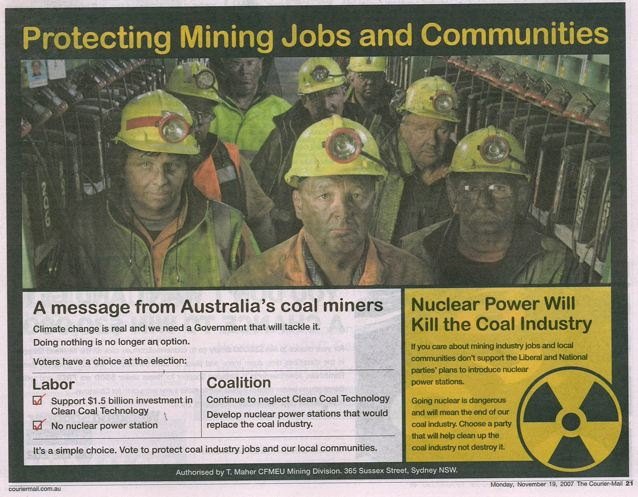
    Sure, the Australian coal industry would suffer greatly, but this is probably the price that has to be paid to reduce emissions Down Under.

    The growth in Australia’s electricity consumption is projected to amount to only 1.4% per year, so by 2035 they would need 22 reactors to supply 50% of its electricity. China today is building 28, so 22 should be a perfectly achievable objective for a developed country like Australia.

    Feel free to add to the conversation on Twitter: @luisbaram

    Thank you.

    *
    http://www.world-nuclear.org/info/Nuclear-Fuel-Cycle/Uranium-Resources/Supply-of-Uranium/

    **
    http://www.world-nuclear.org/info/current-and-future-generation/thorium/

    ***
    http://www.iea.org/statistics/relatedsurveys/monthlyelectricitysurvey/

    ****
    http://www.bree.gov.au/sites/default/files/files//publications/aep/australian-energy-projections-report.pdf

    Labels: , , , , , , ,

    2 Comments:

    At 6:20 PM, Anonymous actinideage said…
    I’m not claiming it’ll be simple, but it’s pretty straightforward, isn’t it Luis? We have your chinese example but also the french who built many more reactors then we would need even for 80 percent capacity like they have. The coal industry need not shut completely: coal is still a rich chemical feedstock but unfortunately there is much environmental impact related to its mining and when the concept of synfuel manufacturing and the like was raised with industry people by an acquaintance they showed no interest in such opportunities.

    The party which holds power here currently is historically friendly to at least the idea of nuclear energy but unfortunately they are very happy with coal and are unlikely to be swayed on this issue (or any issue for that matter). The most damaging aspect of this is the tall order of amending the specific legislation prohibiting fuel production and nuclear generation (unique within the OECD) which is the main target of my advocacy efforts.

    At 9:54 PM, Anonymous Ruth Sponsler said…
    As the saying goes, the Liberals and Abbott are killing nuclear with faint praise.

    It’s the same thing that Reagan and both Bushes did in the US.

    Mind you, I’m not discussing the overt anti-nuclearism of elements of Labour and the US Democrats.

    I’m talking about conservatives’ (Liberal in Australia) faint praise that amounts to lip service.

    I think a direct policy is needed akin to the Gaullism that got France where she is today.

    Post a Comment

    << Home

  • Speaking Truth to Power – and to Friends (Hansen)

    3 of 8
    AdNeed more clients?www.sidekicker.com.au – The easiest way to find local experienced marketing freelancers.

    Speaking Truth to Power – and to Friends

    Inbox
    x

    James Hansen via mail61.atl51.rsgsv.net 

    5:43 AM (3 hours ago)

    to me
    Email not displaying correctly? View it in your browser.
     Speaking Truth to Power – and to Friends
    Speaking Truth to Power – and to Friends is available here, from my web site, or on our blog.

    ~Jim
    20 September 2014

    Like my Facebook page
    Like https://www.facebook.com/jimehansen on Facebook
    Share on social media
    Facebook Twitter
    Visit our program webpage
    csas.ei.columbia.edu

  • Home » Feature »

    Australia warned of ‘staggering economic costs’ of climate change

    Australia’s Climate Council this week warned of significant loss of infrastructure, potentially costing the country billions.

    shutterstock_102751841

    The Climate Council’s report ‘Counting the Costs: Climate Change’ paints a grim picture for Australia, warning that the country faces losing billions in infrastructure.

    The report, released this week, estimated that within the next century  the Australian coast could lose as much as 40 – 100cm to rising sea levels.

    Lead author of the report, Professor Will Steffen said Australia can expect to lose anywhere between three tenths of a percent and 9 percent loss of gross domestic product per year unless the government takes action to counter the effects extreme weather events and rising sea levels are having on the Australian coast line.

    The report also stated that unless more is done by the Federal Government to counter the effects of climate change, Australia will lose billions to infrastructure within the next century. The report went further to state that the southeast corner of Queensland and Sydney would be hardest hit by rising sea levels.

    Professor Steffen pointed out that, “A wide area of infrastructure will be also at risk since 75 percent of Australians live near the coastline.”

    He added that these at-risk areas would see, “a one-in-100-year flood every few years toward the end of the century,” and suggested that infrastructures should be designed to withstand the effects of rising sea levels.

    Steffen added that while property developers and infrastructure planners continue to ignore the effects of rising sea levels, the impact of global flooding will, at the present rate, cost the world’s countries US$ 1 trillion a year by 2050.

    John Hunter, an oceanographer at the Antarctic Climate and Ecosystem Cooperative Research Centre, told the Sydney Morning Herald that Sydney is prone to storm surges and high tides.

    He agreed with Professor Steffen’s assessment that places like Hobart and Sydney are at risk of sea level rises if carbon emissions continue to heat up the planet at the current rate.

    Reports say that the world’s sea levels currently rise at a rate of 3.2 millimetres a year, and have continued to do so for the past 20 years.

    Scientists investigating the phenomenon of rising sea levels have found that about 45 percent of rising sea levels are directly contributed to by oceans expanding as heat from greenhouse gasses melt polar glaciers and polar caps.

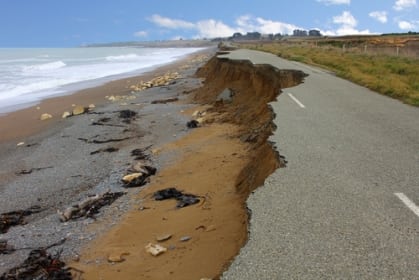
    The report by The Climate Council warned that rising sea levels could ultimately impact on home insurance rates as the world, and that the Australian coast line will become more eroded and less stable