Author: Neville

  • Torpedoed MONBIOT

    1 of 1
    Why this ad?
    TAFE Courses Onlinewww.opencolleges.edu.au – Study From Home At Your Own Pace Download A Course Guide Today.

    Monbiot.com

    Inbox
    x

    George Monbiot news@monbiot.com via google.com

    6:21 PM (1 minute ago)

    to me

    Monbiot.com


    Torpedoed

    Posted: 21 Feb 2014 09:03 AM PST

    The results of a crowd-sourcing appeal prove that Discovery Channel engaged in fakery.


    By George Monbiot, published on the Guardian’s website, 21st February 2014

    The suspicion that the Discovery Channel had abandoned its professed editorial standards was a powerful one. Its documentary claiming that the giant shark Carchardon megalodon still exists contained images which gave a strong impression of being faked; reports of incidents which don’t appear to have happened; and interviews with “marine biologists” no one has been able to trace.

    But allegations of fakery are very hard to prove. As you know, absence of evidence doesn’t mean evidence of absence. Just because no one has been able to trace the news reports the Megalodon show claims to have found, or any record of the deaths of four people in an attack by a giant shark off South Africa last year, or any trace of the suspiciously handsome experts it used to confirm its thesis doesn’t prove definitively that all of them are inventions, even though it’s hard to see how they could not be.

    And pointing out that a photograph the “documentary” used to make its case looks like a really bad CGI cobblers in which just about everything is wrong isn’t quite the same as being able to state categorically that it’s a fraud.

    The photo of a whale carcass which Discovery claims to have "found".The photo of a whale carcass which Discovery claims to have “found”.

    So to test my suspicions I offered a small reward – a signed copy of my latest book – to the first person who could find an original copy of another image Discovery used, which purported to show a Megalodon swimming past two U-boats off Capetown.
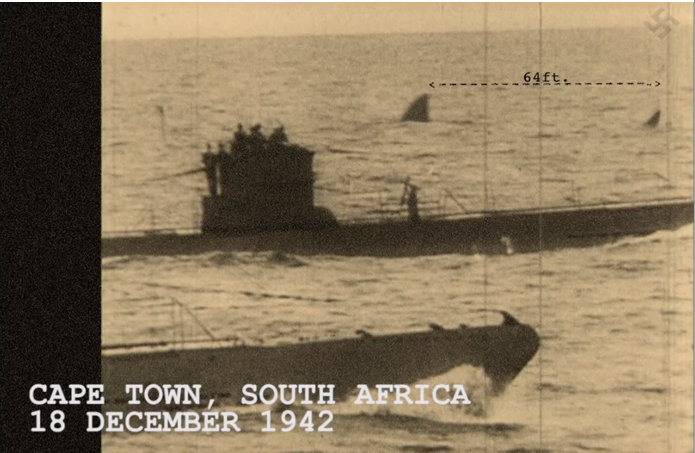
    U-boat and giant shark: a match made in heaven. U-boat and giant shark: a match made in heaven.

    It was the perfect cable channel conjunction: Nazi U-boats and a rediscovered extinct sea monster all in one frame. How clever they were to have found such an image, which, though utterly astounding, had remained unnoticed for 70 years!

    Apart from the minor quibbles that no U-boats of this class are known to have been close to South Africa on the given date, that everything about the shark fins looks wrong, that at 64 feet between the dorsal fin and the tail this monster was twice the size even of the actual creature (which every expert on earth, except the two mysterious “marine biologists” in the film, believe became extinct about 2 million years ago), and that the great beast mysteriously creates neither bow wave nor wake, there were other reasons to be a little suspicious.

    As one of my correspondents points out, “The swastika up the top is ludicrous so I won’t bother mentioning that. The photograph is toned sepia. This is ridiculous as it required a separate pigment in a process that was used to make the photograph look warmer and ‘nicer’ for family photographs. It required more effort that developing in black and white. Photographs coming as sepia as standard is simply another myth created for entertainment.”

    So there’s powerful evidence that this image had been doctored, but again it doesn’t quite amount to proof. Until now.

    Before I wrote the article I conducted an image search, and found nothing. Now I know why. It wasn’t a still picture. A sharp-eyed reader found the frame in some footage of U-boats on tarrif.net. The footage was shot in the Atlantic. Take a look at the film, 12 seconds in.

    It’s the same shot. But guess what? No shark. And no swastika. And not off Capetown. Or anywhere near.

    I wrote to the company handling media inquiries, putting it to them that the production company which made the film, Pilgrim Studios, doctored the image and misled the audience. I have not heard back from them.

    Here’s Discovery’s mission statement:

    Discovery's Mission Statement

    How many people now believe it’s living up to these ideals?

    www.monbiot.com


  • Intensity Of East Asian Tropical Cyclones Has Increased

    Site » News stories

    News

    Intensity Of East Asian Tropical Cyclones Has Increased

    16.01.2014

    16.01.2014 07:31 Age: 36 days

    A study published today highlights growing threat of intense tropical cyclones hitting East Asia. The intensity of such storms has increased over the last 30 years. This is consistent with what many climate scientists would expect to see as a result of climate change although, according to the researchers, this study only accounts for natural variations in sea surface temperature and the Walker circulation.


    The intensity of tropical cyclones hitting East Asia has significantly increased over the past 30 years, according to a new study published today (16 January 2014).


    The coastlines of China, Korea and Japan in particular have experienced increasingly stronger cyclones, which the researchers have attributed to increasing sea surface temperatures and a change in atmospheric circulation patterns over the coastal seas.


    According to the study, the changes in sea surface temperature and wind flows meant that cyclones were more likely to track along coastal seas from the South China Sea upwards, meaning that by the time the cyclones hit the north-east coast of Asia they had gathered more energy than usual and were at their maximum intensity.


    Five data sets

    The study, which has been published today, 16 January, in IOP Publishing’s journal Environmental Research Letters, involved an analysis of five separate data sets that documented the evolution of tropical cyclones across the north-west Pacific between 1977 and 2010.


    The researchers also found that in south-east Asia, in countries such as Taiwan and Vietnam, there was no substantial change in the intensity of tropical cyclones. Here, they found that tropical cyclones had started to generate too close to land in the South China Sea to gather enough energy to reach maximum intensity as they approached land.


    In addition to increasing sea surface temperatures in the western Pacific, which have notably warmed over the past 30 years, the researchers also attributed the changes to the strengthening of the Walker circulation—an ocean-based atmospheric circulation system that exists over the Pacific.


    According to the researchers, the Pacific Walker circulation strengthens as the difference in sea surface temperature between the warmer western Pacific and the colder central-eastern Pacific increases. The result is that the wind flows associated with the circulation pattern force the tropical cyclones towards the north-east coast of Asia, where they reach maximum intensity.


    Natural variations

    Although the study only accounts for natural variations in sea surface temperature and the Walker circulation retrospectively, over the past 30 years, the researchers do predict that the tropical cyclones hitting East Asia will only strengthen under human-induced climate change.


    Professor Chang-Hoi Ho, from Seoul National University, said: “Noticeable increases of greenhouse gases over the globe could influence rising sea surface temperature and change large-scale atmospheric circulation in the western North Pacific, which could enhance the intensity of tropical cyclones hitting land over East Asia.


    “If the past changes of large-scale environments are evidence or a result of global warming, it can be assumed that, in the future, more catastrophic tropical cyclones will strike East Asia than ever before.


    “The next stage of our research is to use climate models to predict future tropical cyclone landfall intensity in these regions.”


    Abstract

    The threat of intense tropical cyclones (TCs) to East Asia has increased in recent decades. Integrated analyses of five available TC data sets for the period 1977–2010 revealed that the growing threat of TCs primarily results from the significant shift that the spatial positions of the maximum intensity of TCs moved closer to East Asian coastlines from Vietnam to Japan. This shift incurs a robust increase in landfall intensity over east China, Korea and Japan. In contrast, an increase of TC genesis frequency over the northern part of the South China Sea leads to a reduction in the maximum TC intensity before landfall, because of their short lifetime; thus, there are no clear tendencies in the landfall intensity across Vietnam, south China and Taiwan. All changes are related to the strengthening of the Pacific Walker circulation, closely linked with the recent manifestation that the warming trend of sea surface temperature in the tropical western Pacific is much higher than that in the central to eastern Pacific.


    Citation

    Growing threat of intense tropical cyclones to East Asia over the period 1977–2010 by Doo-Sun R Park, Chang-Hoi Ho and Joo-Hong Kim and published in the open access journal Environmentaol Research Letters. Doo-Sun R Park et al 2014 Environ. Res. Lett. 9 014008
    doi:10.1088/1748-9326/9/1/014008

    Read the abstract ad get the open access paper here.


    Source

    This story based on a news release from the Institute of Physics and issued by the AAAS

  • Federal Reserve initially failed to grasp 2008 crisis

    21 February 2014 Last updated at 20:48

    Federal Reserve initially failed to grasp 2008 crisis

    Ben Bernanke The transcripts of the meetings show the Fed’s struggles to cope with the financial crisis under Mr Bernanke

    During the 2008 financial crisis, the US Federal Reserve struggled to grasp the scope of the problem and how to adequately respond, transcripts reveal.

    After a five-year wait, the central bank released the records of a total of 14 meetings from 2008.

    The transcripts offer the clearest insights yet into the central bank’s thinking during the crisis.

    “Frankly, I am decidedly confused and very muddled” said former chair Ben Bernanke during a September meeting.

    Overall, the documents paint a picture of the Fed that shows that it worried perhaps more than it should about inflation risks, and failed to grasp initially the full impact of the housing market crisis.

    However, once the extent of the problems were known, the central bank was largely in agreement about moving decisively to prevent the next Great Depression from occurring.

    Continue reading the main story

    “Start Quote

    It is becoming abundantly clear that we are in the midst of a serious global meltdown”

    Janet Yellen

    ‘I am very concerned’

    The hundreds of pages of transcripts underscore the difficulty of coping with the financial crisis and the Fed’s scramble to react to events like the collapse of Bear Sterns in March of 2008.

    Minutes from the 16 September 2008 meeting – which took place a day after the Fed had allowed Lehman Brothers to fail – show that Mr Bernanke and other Fed officials were grappling with the implications of bailing out some institutions and not others.

    Mr Bernanke worried about the “ad hoc” nature of deciding who to bail out, while noting “the real possibility in some cases that you might have very severe consequences for the financial system and, therefore, for the economy of not taking action.”

    However, overall the September transcripts indicate that most members of the Fed thought the crisis was contained.

    At another point, Mr Bernanke said: “I think that our policy is looking actually pretty good,” indicating he thought that a move by the central bank earlier in 2008 to trim interest rates had stemmed the tide of the crisis.

    After that meeting concluded with the bank keeping its benchmark interest rate at 2%, just two days later, Mr Bernanke and Treasury Secretary Henry Paulson were forced to speak to members of Congress, advising them to agree to a bailout of the banking system.

    ‘A witch’s brew’The transcripts also give an insight into current Fed chair Janet Yellen’s involvement with its decisions during the crisis.

    Although Ms Yellen went along with the decision to keep rates steady in September, she warned during the same meeting: “I am very concerned about downside risks to the real economy and think that inflation risk is diminished.”

    At an October meeting, Ms Yellen noted the dire events that had occurred that year, saying the Fed had received “witch’s brew of news”.

    “The downward trajectory of economic data,” Yellen went on, “has been hair-raising”.

    “It is becoming abundantly clear that we are in the midst of a serious global meltdown,” she said.

    More on This Story

    Related Stories

  • You Can’t Beat Climate Change With Weather Guns

    You Can’t Beat Climate Change With Weather Guns

    John Kerry gave a speech in Jakarta, Indonesia, last weekend where he referred to climate change as “perhaps the world’s most fearsome weapon of mass destruction.” Defense Secretary Chuck Hagel and Navy Admiral Samuel Locklear, the head of U.S. Pacific Command, have made similar statements. Yet the most recent research shows that the human output of carbon dioxide, a leading cause of climate change, is only getting worse, increasing the probability that mean global temperatures will rise by the end of this century, perhaps by as much as 4.5 degrees Celsius, which would be disastrous.

    Some researchers have proposed changing the weather deliberately, a strategy referred to as geoengineering. It’s sometimes considered the last-ditch effort to avert the worst possible effects of climate change and it’s controversial to say the least.

    One weather-shifting tactic that’s received a lot of attention from researchers involves enormous injections of sulfate into the atmosphere via boats or even balloons. The sulfate works like a volcanic ash cloud bouncing more of the sun’s light back into space and resulting in cooler global temperatures. The idea works, in theory, but a team of researchers from the University of Washington this week found that, if not properly maintained, any attempt to change the weather by continually pushing sulfate into the atmosphere will backfire.

    They describe their findings in this paper:

    Here’s the key point: “If such an enhanced stratospheric aerosol layer were produced, any interruption to its continual maintenance would cause a quick return to natural aerosol levels within 1–2 years…In turn, global temperature would increase rapidly as the climate adjusts to the full, unmasked GHG radiative forcing.”

    If the U.S. or some other government were to begin a program of solar radiation management with sulfate, and continue the program for decades, it would need to keep up the program, perhaps indefinitely. Without consistent injections, warming could get much worse very quickly, bringing about the dreaded  4°C rise in as little as a decade.

    In other words, our climate could get hooked on sulfate.

    The University of Washington researchers aren’t the first team to point out the potential dangers of geoengineering. But they are the first to find that the extreme variability in weather patterns that would result from abruptly ceasing sulfate blasts would be higher than researchers had previously anticipated.

    The GAO has recommended continued research into geoengineering before any anyone makes an attempt to purposely tamper with the climate. And the researchers say if solar radiation management is tied to aggressive and sustained efforts to actually curb greenhouse gases, the results will be better.

    In short, global warming may be the newest security threat, but that doesn’t mean we’ll defeat it by shooting at it.


  • Renewable Energy, Nuclear Power, and Galileo (HANSEN) (ACCESS TO WEBSITE)

    Renewable Energy, Nuclear Power, and Galileo

    Inbox
    x

    James Hansen via mail170.wdc02.mcdlv.net

    5:04 AM (4 hours ago)

    to me
    Email not displaying correctly? View it in your browser.
    Renewable Energy, Nuclear Power, and Galileo

    A draft opinion piece, Renewable Energy, Nuclear Power, and Galileo, is available here or on my web site. Criticisms are welcome.

    ~Jim
    21 February 2014

  • Crystallography: Atomic secrets

    Nature | News Feature

    Sharing

    Crystallography: Atomic secrets

    100 years of crystallography.

    29 January 2014

    Article tools

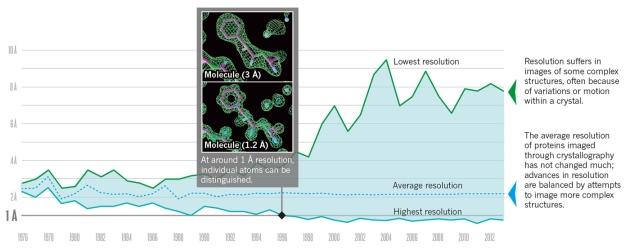
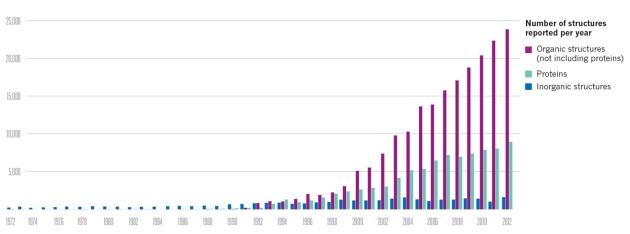
    In 1914, German scientist Max von Laue won the Nobel Prize in Physics for discovering how crystals can diffract X-rays: a phenomenon that led to the science of X-ray crystallography. Since then, researchers have used diffraction to work out the crystalline structures of increasingly complex molecules, from simple minerals to high-tech materials such as graphene and biological structures, including viruses. With improvements in technology, the pace of discovery has accelerated: tens of thousands of new structures are now imaged every year. The resolution of crystallographic images of proteins passed a critical threshold for discriminating single atoms in the 1990s, and newer X-ray sources promise images of challenging proteins that are hard or impossible to grow into large crystals.

    Birth of an idea

    SPL

    Von Laue hit on the idea that when X-rays passed through a crystal, they would scatter off the atoms in the sample and then interfere with each other like waves passing through a breach in a shore wall. In some places, the waves would add to each other; in others, cancel each other out. The resulting diffraction pattern could be used to back-calculate the location of the atoms that scattered the original X-rays. Von Laue and his colleagues proved his theory in 1912 with a sample of copper sulphate.

    Going up

    The Worldwide Protein Data Bank has been collecting resolved structures of proteins since 1971, and now holds nearly 100,000 entries. Other databanks, including the Crystallography Open Database (COD), include structures of everything from minerals to metals and small biological molecules. The COD is now adding instructions into its database for how to print three-dimensional models of some structures.

    Source: Worldwide Protein Data Bank/ Crystallography Open Database

    Getting clearer

    Better techniques for both imaging and interpreting data have allowed researchers see finer details in some structures and tackle ever more complicated molecules.

    Images: Bernhard Rupp/Garland Science/Taylor & Francis Graph: H. M. Berman Protein Sci. 21, 1587–1596 (2012), with updates from Worldwide Protein Data Bank

    100 years of crystallography

    1913: Diamond

    Diffraction image allowed researchers to confirm the tetrahedral structure of carbon atoms in this famous crystal.

    1923: Hexamethylenetetramine

    The first organic molecule to be imaged, chosen because of its simple cubic symmetry. It proved that molecules, not just atoms, can make up the repeating elements of a crystal.

    Am. Chem. Soc.

    Hexamethylenetetramine in 3D

    Courtesy: James Garnett and Jonathan Taylor

    1925: Quartz

    The determination of the structure of silicate minerals was fundamental to the field of mineraology.

    1952: DNA

    Rosalind Franklin’s X-ray image of DNA, known as photo 51, helped James Watson and Francis Crick to create their famous model of the double helix. An atomic-resolution image of the structure proposed in 1953 was not taken until 1980.

    King’s College London

    DNA in 3D

    Courtesy: James Garnett and Jonathan Taylor

    1958: Myoglobin

    The irregular folds seen in the structure of the first imaged protein were a huge surprise.

    Myoglobin in 3D

    Courtesy: James Garnett and Jonathan Taylor

    1965: Lysozyme

    The first enzyme to be imaged, sourced from hen egg whites.

    Lysozyme in 3D

    Courtesy: James Garnett and Jonathan Taylor

    1970: Synchrotron

    A study of insect muscle at the German Electron Synchrotron (DESY) in Hamburg was the first to use X-rays generated by a synchrotron. The use of these machines caused a boom in crystallography studies.

    1978: Tomato bushy stunt virus

    First atomic-scale image of a complete virus: in this case, a plant virus. It revealed structural rules that were found to hold true in human pathogens a few years later.

    Tomato bushy stunt virus in 3D

    Courtesy: James Garnett and Jonathan Taylor

    1984: Quasicrystals

    The first crystals were identified with atomic arrangements that do not repeat exactly, defying general wisdom about crystals.

    US Dept of Energy/AFP/Getty

    2000: Ribosome

    The molecular machine that assembles proteins from instructions encoded in DNA.

    V. Ramakrishnan & D. E. Brodersen/Medical Research Council

    Ribosome in 3D

    Courtesy: Said Sannuga and V. Ramakrishnan, MRC Laboratory of Molecular Biology

    2009: X-ray free-electron laser

    The Linac Coherent Light Source at the SLAC National Accelerator Laboratory in Menlo Park, California, went into operation, opening up a new world of imaging possibilities (see page 604).

    2013: HIV trimer

    An X-ray crystallographic image of the hook that HIV uses to bind to human cells helped to resolve a debate about what this important protein looks like.

    AAAS

    HIV trimer in 3D

    Courtesy: James Garnett and Jonathan Taylor

    The future

    The ‘most wanted’ list of proteins that remain to be imaged includes the massive spliceosome, which helps to organize and edit messenger RNA, and the even larger nuclear-pore complex, which serves as a nucleus’s gatekeeper.

    These structures can contain hundreds of proteins, making them hard to crystallize or keep still for an image.

    One strategy is to crystallize bits of these structures and piece them together like a jigsaw; the use of X-ray free-electron lasers should also help.

    Nature
    505,
    602–603
    (30 January 2014)
    doi:10.1038/505602a

    Author information

    For the best commenting experience, please login or register as a user and agree to our Community Guidelines. You will be re-directed back to this page where you will see comments updating in real-time and have the ability to recommend comments to other users.